Page 91 of 117
Points To Remember
NOTE:When the vehicle is stopped after a few miles/
kilometers of operation, you may observe vapor coming
from the front of the engine compartment. This is nor-
mally a result of moisture from rain, snow, or high
humidity accumulating on the radiator and being vapor-
ized when the thermostat opens, allowing hot engine
coolant (antifreeze) to enter the radiator.
If an examination of your engine compartment shows no
evidence of radiator or hose leaks, the vehicle may be
safely driven. The vapor will soon dissipate.
• Do not overfill the coolant expansion bottle.
• Check the coolant freeze point in the radiator and in
the coolant expansion bottle. If engine coolant (anti-
freeze) needs to be added, the contents of the coolant
expansion bottle must also be protected against freez-
ing. •
If frequent engine coolant (antifreeze) additions are
required, the cooling system should be pressure tested
for leaks.
•
Maintain engine coolant (antifreeze) concentration at a
minimum of 50% OAT coolant (conforming to
MS.90032) and distilled water for proper corrosion pro-
tection of your engine which contains aluminum com-
ponents.
• Make sure that the coolant expansion bottle overflow
hoses are not kinked or obstructed.
• Keep the front of the radiator clean. If your vehicle is
equipped with air conditioning, keep the front of the
condenser clean.
•
Do not change the thermostat for Summer or Winter
operation. If replacement is ever necessary, install ONLY
the correct type thermostat. Other designs may result in
unsatisfactory engine coolant (antifreeze) performance,
poor gas mileage, and increased emissions.
5
MAINTAINING YOUR VEHICLE 89
Page 92 of 117
Charge Air Cooler — Inter-Cooler
The charge air cooler is positioned in front of the radiator
and the air conditioner condenser. Air enters the engine
through the air cleaner and passes through the turbo-
charger, where it is pressurized. This pressurized air
rapidly reaches high temperature. The air is then directed
through a hose to the charge air cooler and through
another hose to the intake manifold of the engine. This
cooling process enables more efficient burning of fuel
resulting in fewer emissions.
To guarantee optimum performance of the system, keep
the surfaces of the charge air cooler, condenser and
radiator clean and free of debris. Periodically check the
hoses leading to and from the charge air cooler for cracks
or loose clamps resulting in loss of pressure and reduced
engine performance.
Brake System
Brake Master Cylinder — Brake Fluid Level Check
The fluid level of the master cylinder should be checked
when performing under the hood service, or immediately
if the “Brake System Warning Light” indicates system
failure.
The brake master cylinder has a translucent plastic
reservoir. On the outboard side of the reservoir, there is a
“MAX” mark and a “MIN” mark. The fluid level must be
kept within these two marks. Do not add fluid above the
full mark because leakage may occur at the cap.
With disc brakes, the fluid level can be expected to fall as
the brake linings wear. However, an unexpected drop in
fluid level may be caused by a leak and a system check
should be conducted.
90 MAINTAINING YOUR VEHICLE
Page 101 of 117
Engine Oil Filter Replacement
Residual oil in the housing may spill from the housing
when the new filter is installed if the residual oil is not
either removed from the housing or enough time has not
elapsed to allow the oil to drain back into the engine.
When servicing the oil filter on this engine, carefully
remove the filter and use a suction gun to remove any
residual oil left in the housing or wait about 30 minutes
for the oil to drain back into the engine.Once A Month Or Before A Long Trip:
•
Check engine oil level
• Check windshield washer fluid level
• Check the tire inflation pressures and look for unusual
wear or damage
• Check the fluid levels of the coolant reservoir, brake
master cylinder, power steering and transmission as
needed
• Check function of all interior and exterior lights
6
MAINTENANCE SCHEDULE 99
Page 110 of 117
Adding Engine Coolant (Antifreeze).............86
Adding Fuel ..............................62
Air Cleaner, Engine (Engine Air Cleaner Filter) .....74
Air Conditioning Filter ......................75
Antifreeze (Engine Coolant) ...................85
Capacities .............................92
Disposal ..............................88
Automatic Transmission Fluid Type .............................95
Axle Fluid ...............................95
Battery .................................83
Brake Fluid ..............................95
Brake System .............................90
Fluid Check ............................90
Master Cylinder .........................90
Capacities, Antifreeze (Engine Coolant) ...........92
Capacities, Fluid ...........................92 Caps, Filler
Oil (Engine) ............................73
Radiator (Coolant Pressure) .................88
Charge Air Cooler .........................90
Coolant Pressure Cap (Radiator Cap) ............88
Cooling System ...........................84
Adding Coolant (Antifreeze) ................86
Coolant Capacity ........................92
Coolant Level ...........................84
Disposal Of Used Coolant ..................88
Drain, Flush, And Refill ...................85
Points To Remember ......................89
Pressure Cap ...........................88
Radiator Cap ...........................88
Selection Of Coolant (Antifreeze) ..........85, 93
Diesel Fuel ...............................42
Diesel Fuel Requirements ....................42
Bulk Storage Of .........................65
108 INDEX
Page 111 of 117
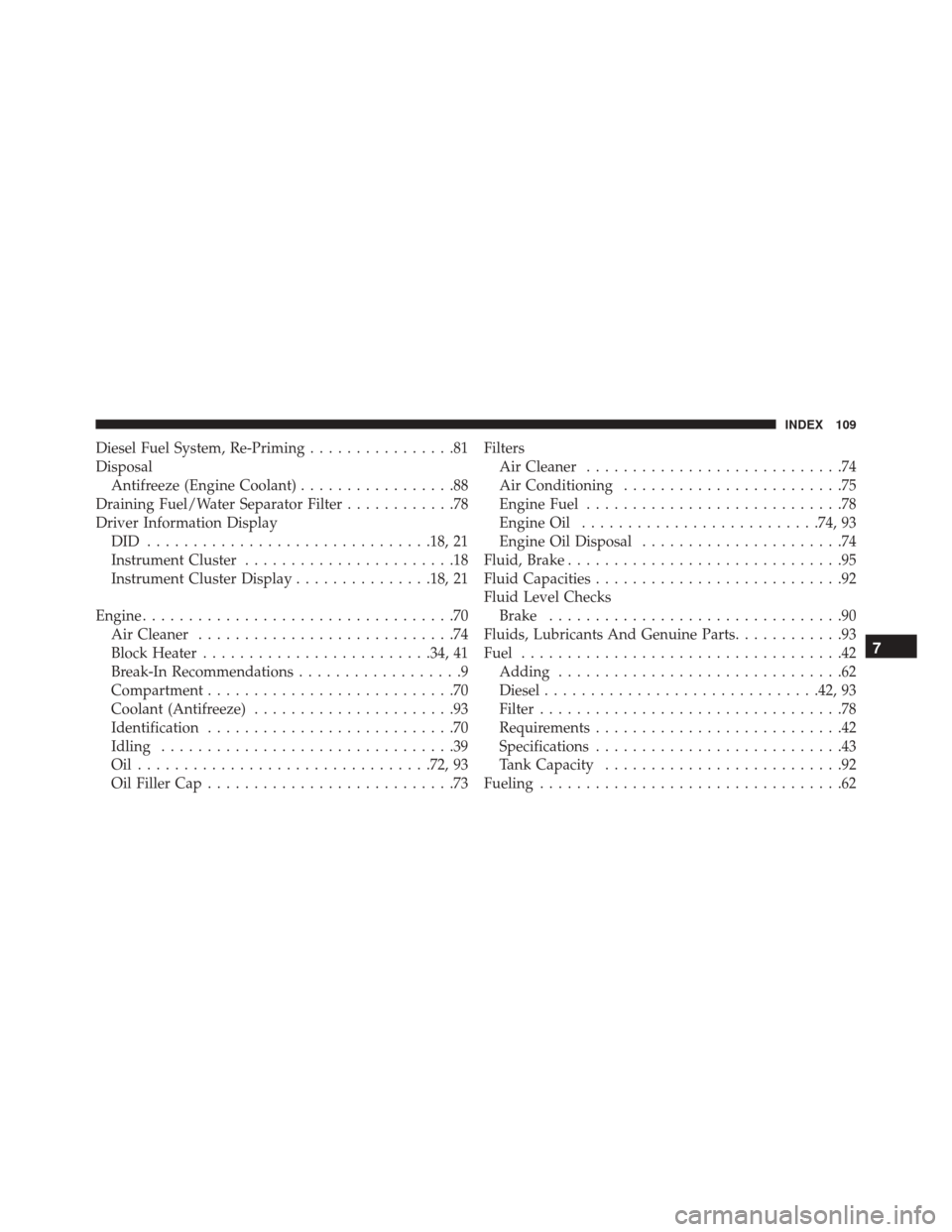
Diesel Fuel System, Re-Priming................81
Disposal Antifreeze (Engine Coolant) .................88
Draining Fuel/Water Separator Filter ............78
Driver Information Display DID .............................. .18, 21
Instrument Cluster .......................18
Instrument Cluster Display ...............18, 21
Engine ..................................70
Air Cleaner ............................74
Block Heater ........................ .34, 41
Break-In Recommendations ..................9
Compartment ...........................70
Coolant (Antifreeze) ......................93
Identification ...........................70
Idling ................................39
Oil............................... .72, 93
Oil Filler Cap ...........................73 Filters
Air Cleaner ............................74
Air Conditioning ........................75
Engine Fuel ............................78
Engine Oil ......................... .74, 93
Engine Oil Disposal ......................74
Fluid, Brake ..............................95
Fluid Capacities ...........................92
Fluid Level Checks Brake ................................90
Fluids, Lubricants And Genuine Parts ............93
Fuel ...................................42
Adding ...............................62
Diesel ............................. .42, 93
Filter .................................78
Requirements ...........................42
Specifications ...........................43
Tank Capacity ..........................92
Fueling .................................62
7
INDEX 109