Page 442 of 589

NOTE:The trailer tongue weight must be considered as
part of the combined weight of occupants and cargo, and
should never exceed the weight referenced on the Tire
and Loading Information placard. Refer to “Tire Safety
Information” in “Starting and Operating” for further
information.
Trailer And Tongue Weight
Always load a trailer with 60% to 65% of the weight in
the front of the trailer. This places 10% to 15% of the
Gross Trailer Weight (GTW) on the tow hitch of your
vehicle. Loads balanced over the wheels or heavier in the
rear can cause the trailer to sway severelyside to side
which will cause loss of control of the vehicle and trailer.
Failure to load trailers heavier in front is the cause of
many trailer collisions.
Never exceed the maximum tongue weight stamped on
your bumper or trailer hitch. Consider the following items when computing the
weight on the rear axle of the vehicle:
•
The tongue weight of the trailer.
• The weight of any other type of cargo or equipment
put in or on your vehicle.
• The weight of the driver and all passengers.
440 STARTING AND OPERATING
Page 444 of 589
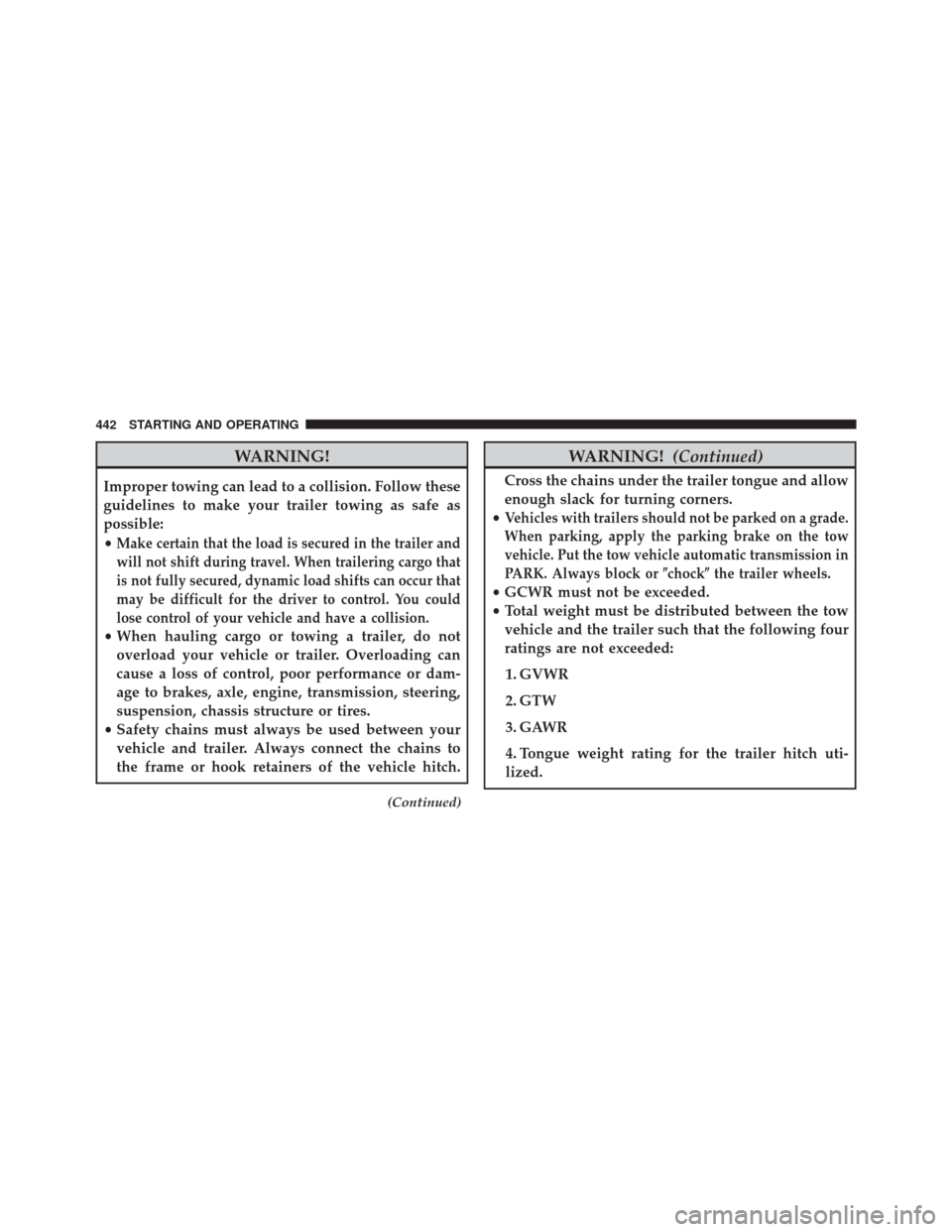
WARNING!
Improper towing can lead to a collision. Follow these
guidelines to make your trailer towing as safe as
possible:
•
Make certain that the load is secured in the trailer and
will not shift during travel. When trailering cargo that
is not fully secured, dynamic load shifts can occur that
may be difficult for the driver to control. You could
lose control of your vehicle and have a collision.
• When hauling cargo or towing a trailer, do not
overload your vehicle or trailer. Overloading can
cause a loss of control, poor performance or dam-
age to brakes, axle, engine, transmission, steering,
suspension, chassis structure or tires.
• Safety chains must always be used between your
vehicle and trailer. Always connect the chains to
the frame or hook retainers of the vehicle hitch.
(Continued)
WARNING! (Continued)
Cross the chains under the trailer tongue and allow
enough slack for turning corners.
•
Vehicles with trailers should not be parked on a grade.
When parking, apply the parking brake on the tow
vehicle. Put the tow vehicle automatic transmission in
PARK. Always block or �chock�the trailer wheels.
•GCWR must not be exceeded.
• Total weight must be distributed between the tow
vehicle and the trailer such that the following four
ratings are not exceeded:
1. GVWR
2. GTW
3. GAWR
4. Tongue weight rating for the trailer hitch uti-
lized.
442 STARTING AND OPERATING
Page 450 of 589
RECREATIONAL TOWING (BEHIND MOTORHOME, ETC.)
Towing This Vehicle Behind Another Vehicle
Towing Condition Wheels OFF the Ground Manual Transmission Automatic TransmissionFlat Tow None
•Transmission in NEU-
TRAL
• Key in ACC PositionNOT ALLOWED
Dolly Tow Front FWD Models ONLY FWD Models ONLY Rear NOT ALLOWED NOT ALLOWED
On Trailer AllOK OK
NOTE:
• When recreationally towing your vehicle, always fol-
low applicable state and provincial laws. Contact state
and provincial Highway Safety offices for additional
details. •
Vehicles equipped with manual transmissionsmay be
recreationally towed (flat towed) at any legal highway
speed, for any distance, if the manual transmissionis
in NEUTRAL and the ignition key is in the ACC
position.
448 STARTING AND OPERATING
Page 451 of 589
CAUTION!
•DO NOT flat tow any vehicle equipped with an
automatic transmission. Damage to the drivetrain
will result. If these vehicles require towing, make
sure all drive wheels are OFF the ground.
• DO NOT dolly tow any 4WD vehicle. Internal
damage to the transmission or transfer case will
occur if a dolly is used when recreational towing.
5
STARTING AND OPERATING 449
Page 453 of 589
WHAT TO DO IN EMERGENCIES
CONTENTS
�HAZARD WARNING FLASHERS ...........453
� IF YOUR ENGINE OVERHEATS ............453
� WHEEL AND TIRE TORQUE
SPECIFICATIONS ..................... .454
▫ Torque Specifications ..................454
� JACKING AND TIRE CHANGING ..........456
▫ Jack Location ....................... .457
▫ Spare Tire Stowage ....................457
▫ Preparations For Jacking ................457
▫ Jacking Instructions ...................458 ▫
Road Tire Installation ...................465
� TIRE SERVICE KIT — IF EQUIPPED .........467
▫ Tire Service Kit Storage .................467
▫ Tire Service Kit Components And Operation . .468
▫ Tire Service Kit Usage Precautions .........469
▫ Sealing A Tire With Tire Service Kit ........471
� JUMP-STARTING PROCEDURES ...........477
▫ Preparations For Jump-Start ..............478
▫ Jump-Starting Procedure ................480
� FREEING A STUCK VEHICLE .............482
6
Page 456 of 589

CAUTION!
Driving with a hot cooling system could damage
your vehicle. If the pointer rises to the H (red) mark,
the instrument cluster will sound a chime. When
safe, pull over and stop the vehicle with the engine at
idle. Turn off the air conditioning and wait until the
pointer drops back into the normal range. If the
pointer remains on the H (red) mark for more than a
minute, turn the engine off immediately and call for
service.
WARNING!
You or others can be badly burned by hot engine
coolant (antifreeze) or steam from your radiator. If
you see or hear steam coming from under the hood,
do not open the hood until the radiator has had time
(Continued)
WARNING!(Continued)
to cool. Never try to open a cooling system pressure
cap when the radiator or coolant bottle is hot.
WHEEL AND TIRE TORQUE SPECIFICATIONS
Proper lug nut/bolt torque is very important to ensure
that the wheel is properly mounted to the vehicle. Any
time a wheel has been removed and reinstalled on the
vehicle the lug nuts/bolts should be torqued using a
properly calibrated torque wrench.
Torque Specifications
Lug Nut/Bolt Torque **Lug Nut/
Bolt SizeLug Nut/
Bolt
Socket Size
100 Ft-Lbs (135 N·m) M12 x 1.5 19 mm
454 WHAT TO DO IN EMERGENCIES
Page 457 of 589
**Use only your Authorized Dealer recommended lug
nuts/bolts and clean or remove any dirt or oil before
tightening.
Inspect the wheel mounting surface prior to mounting
the tire and remove any corrosion or loose particles.Tighten the lug nuts/bolts in a star pattern until each
nut/bolt has been tightened twice.
After 25 miles (40 km) check the lug nut/bolt torque to be
sure that all the lug nuts/bolts are properly seated
against the wheel.
Wheel Mounting Surface
Torque Patterns
6
WHAT TO DO IN EMERGENCIES 455
Page 458 of 589

WARNING!
To avoid the risk of forcing the vehicle off the jack,
do not tighten the lug nuts fully until the vehicle has
been lowered. Failure to follow this warning may
result in personal injury.
JACKING AND TIRE CHANGING
WARNING!
•Do not attempt to change a tire on the side of the
vehicle close to moving traffic. Pull far enough off
the road to avoid the danger of being hit when
operating the jack or changing the wheel.
(Continued)
WARNING! (Continued)
•Being under a jacked-up vehicle is dangerous. The
vehicle could slip off the jack and fall on you. You
could be crushed. Never put any part of your body
under a vehicle that is on a jack. If you need to get
under a raised vehicle, take it to a service center
where it can be raised on a lift.
• Never start or run the engine while the vehicle is
on a jack.
• The jack is designed to be used as a tool for
changing tires only. The jack should not be used to
lift the vehicle for service purposes. The vehicle
should be jacked on a firm level surface only.
Avoid ice or slippery areas.
456 WHAT TO DO IN EMERGENCIES


