Page 439 of 589

Trailer Sway Control
The trailer sway control is a telescoping link that can be
installed between the hitch receiver and the trailer tongue
that typically provides adjustable friction associated with
the telescoping motion to dampen any unwanted trailer
swaying motions while traveling.
Weight-Carrying Hitch
A weight-carrying hitch supports the trailer tongue
weight, just as if it were luggage located at a hitch ball or
some other connecting point of the vehicle. These kinds
of hitches are the most popular on the market today and
they are commonly used to tow small and medium sized
trailers.
Weight-Distributing Hitch
A weight-distributing system works by applying lever-
age through spring (load) bars. They are typically used
for heavier loads to distribute trailer tongue weight to thetow vehicle’s front axle and the trailer axle(s). When used
in accordance with the manufacturer’s directions, it pro-
vides for a more level ride, offering more consistent
steering and brake control thereby enhancing towing
safety. The addition of a friction/hydraulic sway control
also dampens sway caused by traffic and crosswinds and
contributes positively to tow vehicle and trailer stability.
Trailer sway control and a weight distributing (load
equalizing) hitch are recommended for heavier Tongue
Weights (TW) and may be required depending on vehicle
and trailer configuration/loading to comply with Gross
Axle Weight Rating (GAWR) requirements.
WARNING!
•
An improperly adjusted Weight Distributing Hitch
system may reduce handling, stability, braking
performance, and could result in a collision.
(Continued)
5
STARTING AND OPERATING 437
Page 444 of 589
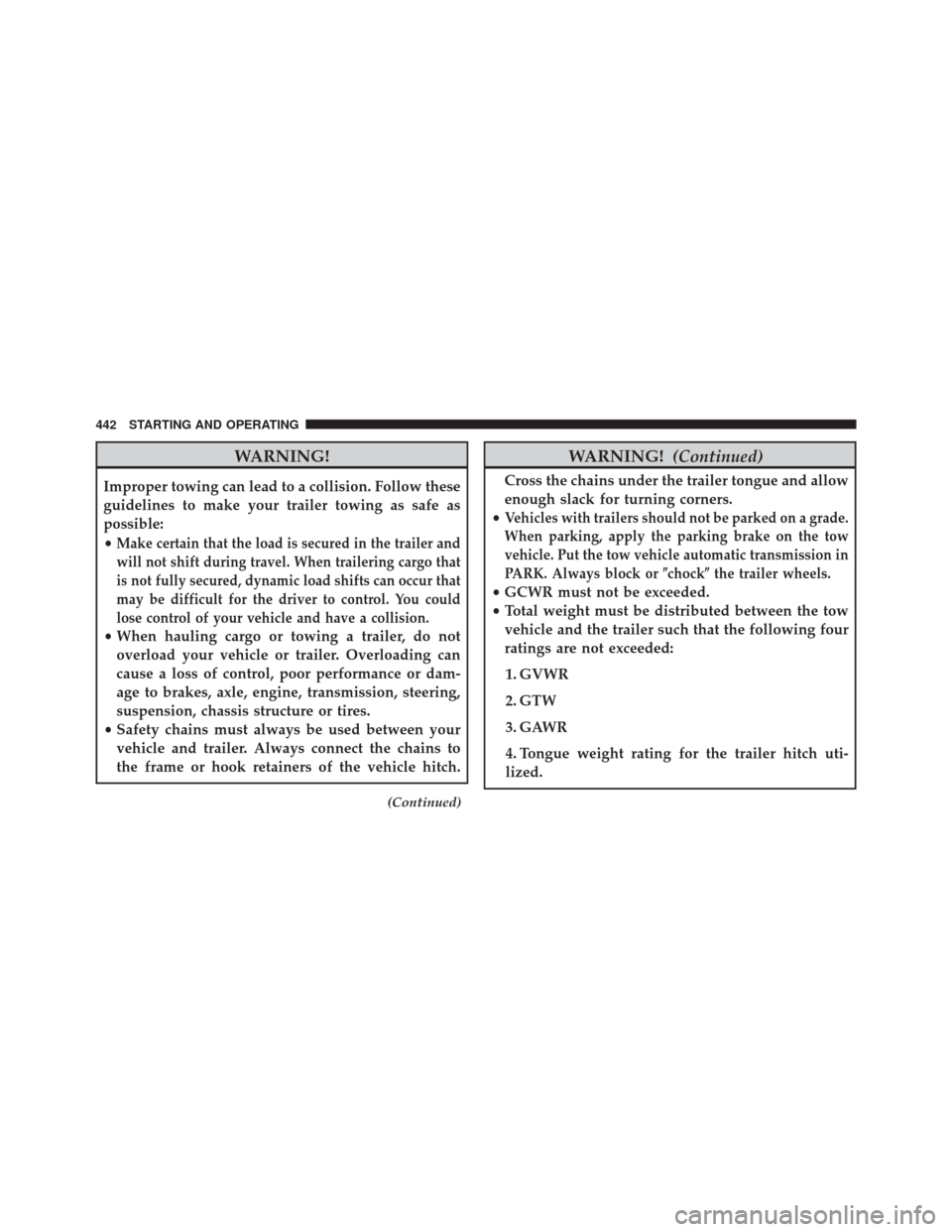
WARNING!
Improper towing can lead to a collision. Follow these
guidelines to make your trailer towing as safe as
possible:
•
Make certain that the load is secured in the trailer and
will not shift during travel. When trailering cargo that
is not fully secured, dynamic load shifts can occur that
may be difficult for the driver to control. You could
lose control of your vehicle and have a collision.
• When hauling cargo or towing a trailer, do not
overload your vehicle or trailer. Overloading can
cause a loss of control, poor performance or dam-
age to brakes, axle, engine, transmission, steering,
suspension, chassis structure or tires.
• Safety chains must always be used between your
vehicle and trailer. Always connect the chains to
the frame or hook retainers of the vehicle hitch.
(Continued)
WARNING! (Continued)
Cross the chains under the trailer tongue and allow
enough slack for turning corners.
•
Vehicles with trailers should not be parked on a grade.
When parking, apply the parking brake on the tow
vehicle. Put the tow vehicle automatic transmission in
PARK. Always block or �chock�the trailer wheels.
•GCWR must not be exceeded.
• Total weight must be distributed between the tow
vehicle and the trailer such that the following four
ratings are not exceeded:
1. GVWR
2. GTW
3. GAWR
4. Tongue weight rating for the trailer hitch uti-
lized.
442 STARTING AND OPERATING
Page 484 of 589

If frequent jump-starting is required to start your vehicle
you should have the battery and charging system in-
spected at your authorized dealer.
CAUTION!
Accessories plugged into the vehicle power outlets
draw power from the vehicle’s battery, even when not
in use (i.e., cellular devices, etc.). Eventually, if
plugged in long enough without engine operation,
the vehicle’s battery will discharge sufficiently to
degrade battery life and/or prevent the engine from
starting.
FREEING A STUCK VEHICLE
If your vehicle becomes stuck in mud, sand or snow, it
can often be moved using a rocking motion. Turn the
steering wheel right and left to clear the area around the
front wheels. Then shift back and forth between DRIVEand REVERSE (with automatic transmission) or 2nd gear
and REVERSE (with manual transmission), while gently
pressing the accelerator. Use the least amount of accel-
erator pedal pressure that will maintain the rocking
motion, without spinning the wheels, or racing the
engine.
CAUTION!
Racing the engine or spinning the wheels may lead to
transmission overheating and failure. Allow the en-
gine to idle with the transmission in NEUTRAL for at
least one minute after every five rocking-motion
cycles. This will minimize overheating and reduce
the risk of clutch or transmission failure during
prolonged efforts to free a stuck vehicle.
482 WHAT TO DO IN EMERGENCIES
Page 493 of 589
ENGINE COMPARTMENT — 2.0L
1 — Washer Fluid Reservoir6 — Air Cleaner Filter
2 — Power Steering Fluid Reservoir 7 — Coolant Pressure Cap
3 — Engine Oil Fill 8 — Engine Oil Dipstick
4 — Brake Fluid Reservoir 9 — Engine Coolant Reservoir
5 — Integrated Power Module (Fuses)
7
MAINTAINING YOUR VEHICLE 491
Page 494 of 589
ENGINE COMPARTMENT — 2.4L
1 — Washer Fluid Reservoir6 — Air Cleaner Filter
2 — Power Steering Fluid Reservoir 7 — Coolant Pressure Cap
3 — Engine Oil Fill 8 — Engine Oil Dipstick
4 — Brake Fluid Reservoir 9 — Engine Coolant Reservoir
5 — Integrated Power Module (Fuses) 492 MAINTAINING YOUR VEHICLE
Page 531 of 589

WARNING!(Continued)
Damaged parts must be replaced immediately. Do not
disassemble or modify the system. Seat belt assem-
blies must be replaced after a collision if they have
been damaged (i.e., bent retractor, torn webbing, etc.).
FUSES
WARNING!
•When replacing a blown fuse, always use an appro-
priate replacement fuse with the same amp rating as
the original fuse. Never replace a fuse with another
fuse of higher amp rating. Never replace a blown
fuse with metal wires or any other material. Failure
to use proper fuses may result in serious personal
injury, fire and/or property damage.
(Continued)
WARNING! (Continued)
•Before replacing a fuse, make sure that the ignition
is off and that all the other services are switched off
and/or disengaged.
• If the replaced fuse blows again, contact an autho-
rized dealer.
• If a general protection fuse for safety systems (air
bag system, braking system), power unit systems
(engine system, gearbox system) or steering system
blows, contact an authorized dealer.
7
MAINTAINING YOUR VEHICLE 529
Page 533 of 589
CavityCartridge Fuse Mini-FuseDescription
1 20 Amp Blue –Trailer Tow – If Equipped
2 – 15 Amp Lt Blue AWD/4WD Control Module –
If Equipped
3 – 10 Amp Red Rear Center Brake Light
Switch
4 – 10 Amp RedIgnition Switch/Clock Spring
5 – 15 Amp Lt Blue Battery Feed For Power Tech
6 – 10 Amp RedPower Mirror/Steering Control
Satellite Radio/Hands-Free Phone
7 – 30 Amp Green Ignition Off Draw
8 – 30 Amp Green Ignition Off Draw
9 40 Amp Green –Power Seats
10 – 20 Amp Yellow Power Locks/Interior Lighting
11 – 15 Amp Lt Blue Power Outlet
7
MAINTAINING YOUR VEHICLE 531
Page 544 of 589
ComponentFluid, Lubricant, or Genuine Part
Brake Master Cylinder We recommend you use MOPAR DOT 3, SAE J1703 should be
used. If DOT 3, SAE J1703 brake fluid is not available, then
DOT 4 is acceptable.
Power Steering Reservoir We recommend you use MOPAR Power Steering Fluid +4,
MOPAR ATF+4 Automatic Transmission Fluid.
542 MAINTAINING YOUR VEHICLE


