Page 586 of 642
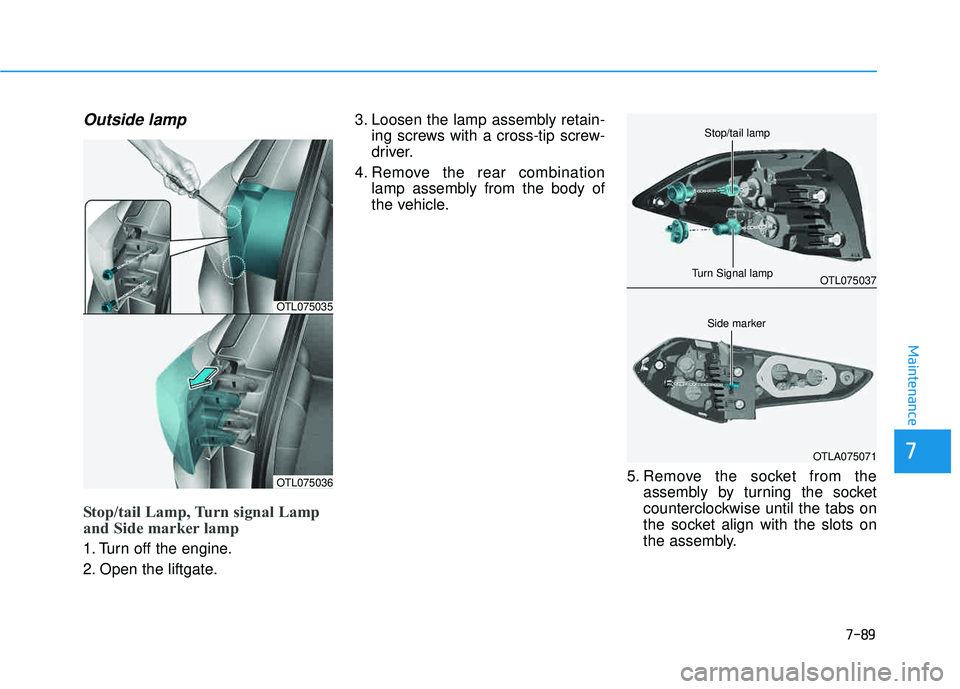
7-73
7
Maintenance
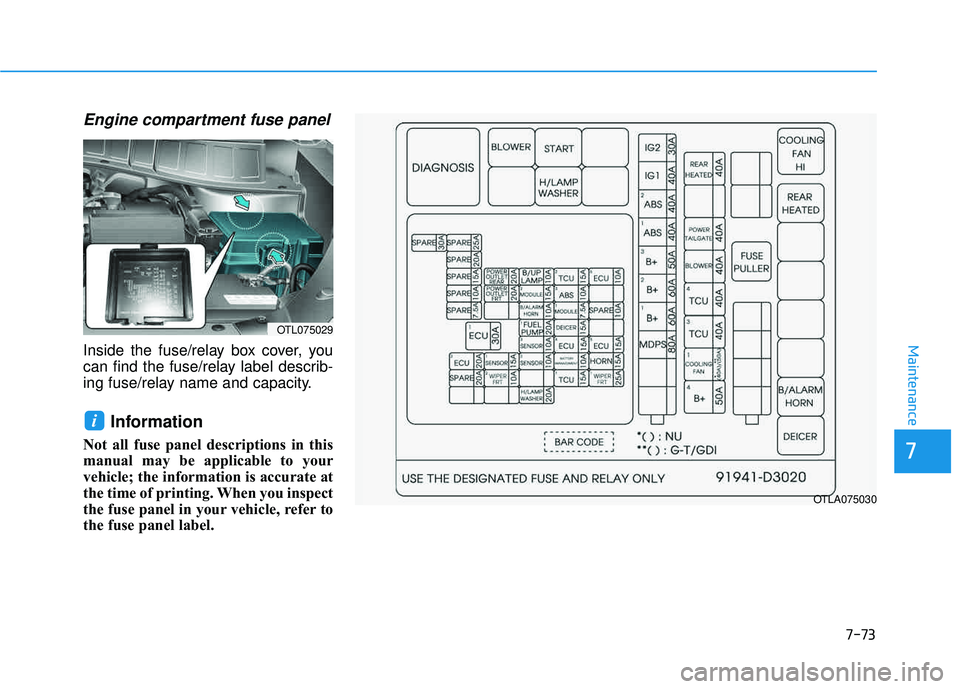
Engine compartment fuse panel
Inside the fuse/relay box cover, you
can find the fuse/relay label describ-
ing fuse/relay name and capacity.
Information
Not all fuse panel descriptions in this
manual may be applicable to your
vehicle; the information is accurate at
the time of printing. When you inspect
the fuse panel in your vehicle, refer to
the fuse panel label.
i
OTL075029
OTLA075030
Page 587 of 642
7-74
Maintenance
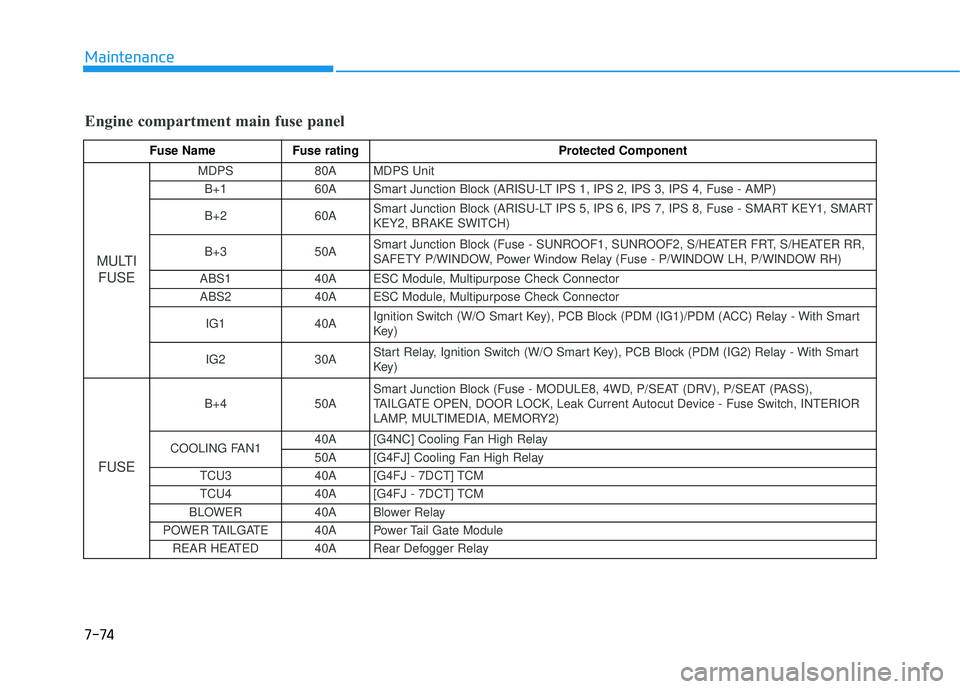
Engine compartment main fuse panel
Fuse Name Fuse rating Protected Component
MULTIFUSE
MDPS 80A MDPS Unit
B+1 60A Smart Junction Block (ARISU-LT IPS 1, IPS 2, IPS 3, IPS 4, Fuse - AMP) B+2 60A Smart Junction Block (ARISU-LT IPS 5, IPS 6, IPS 7, IPS 8, Fuse - SMART KEY1, SMART KEY2, BRAKE SWITCH)
B+3 50A Smart Junction Block (Fuse - SUNROOF1, SUNROOF2, S/HEATER FRT, S/HEATER RR,
SAFETY P/WINDOW, Power Window Relay (Fuse - P/WINDOW LH, P/WINDOW RH)
ABS1 40A ESC Module, Multipurpose Check Connector
ABS2 40A ESC Module, Multipurpose Check Connector
IG1 40A Ignition Switch (W/O Smart Key), PCB Block (PDM (IG1)/PDM (ACC) Relay - With Smart
Key)
IG2 30A Start Relay, Ignition Switch (W/O Smart Key), PCB Block (PDM (IG2) Relay - With Smart
Key)
FUSE
B+4 50A Smart Junction Block (Fuse - MODULE8, 4WD, P/SEAT (DRV), P/SEAT (PASS),
TAILGATE OPEN, DOOR LOCK, Leak Current Autocut Device - Fuse Switch, INTERIOR
LAMP, MULTIMEDIA, MEMORY2)
COOLING FAN1 40A [G4NC] Cooling Fan High Relay
50A [G4FJ] Cooling Fan High Relay
TCU3 40A [G4FJ - 7DCT] TCM
TCU4 40A [G4FJ - 7DCT] TCM
BLOWER 40A Blower Relay
POWER TAILGATE 40A Power Tail Gate Module REAR HEATED 40A Rear Defogger Relay
Page 588 of 642
![HYUNDAI TUCSON 2016 Owners Manual 7-75
7
Maintenance
Engine compartment main fuse panel
Fuse Name Fuse ratingCircuit Protected
WIPER FRT1 25A Ignition Switch (W/O Smart Key), PDM (IG2) Relay (With Smart Key)
TCU1 15A [G4FJ] TCM](/manual-img/35/56201/w960_56201-587.png "HYUNDAI TUCSON 2016 Owners Manual 7-75
7
Maintenance
Engine compartment main fuse panel
Fuse Name Fuse ratingCircuit Protected
WIPER FRT1 25A Ignition Switch (W/O Smart Key), PDM (IG2) Relay (With Smart Key)
TCU1 15A [G4FJ] TCM")
7-75
7
Maintenance
Engine compartment main fuse panel
Fuse Name Fuse ratingCircuit Protected
WIPER FRT1 25A Ignition Switch (W/O Smart Key), PDM (IG2) Relay (With Smart Key)
TCU1 15A [G4FJ] TCM (7DCT)
WIPER FRT2 10A BCM ECU3 20A PCM (G4NC) / ECM (G4FJ)
HORN 15A Horn Relay
BATTERY
MANAGEMENT 10A Battery
Sensor
SENSOR2 10A [G4NC] Oil Control Valve #1/#2, Camshaft Position Sensor #1/#2, Purge Control Solenoid Valve,
Variable Intake Solenoid Valve, Canister Close Valve, Fuel Pump Relay
[G4FJ] Oil Control Valve #1/#2, Purge Control Solenoid Valve, Canister Close Valve, Fuel Pump Relay
SENSOR1 15A [G4NC] PCM, Oxygen Sensor (Up)/(Down) [G4FJ] ECM, Oxygen Sensor (Up)/(Down) ECU2 20A IGNITION COIL #1/#2/#3/#4, Condenser (G4NC)
ECU5 15A PCM (G4NC) / ECM (G4FJ)
ECU4 15A PCM (G4NC) / ECM (G4FJ)
SENSOR3 10A [G4NC] E/R Junction Block (Cooling Fan High Relay)
[G4FJ] Brake Vacuum Switch, RCV Control Solenoid Valve, E/R Junction Block (Cooling Fan High
Relay)
DEICER 15A E/R Junction Block (Front Deicer Relay)
FUEL PUMP1 20A Fuel Pump Relay
MODULE1 7.5A Adaptive Front Lighting Module
B/ALARM HORN 10A E/R Junction Block (B/Alarm Horn Relay) ABS3 10A ESC Module
Page 589 of 642
7-76
Maintenance
Engine compartment main fuse panel
Fuse Name Fuse ratingCircuit Protected
MODULE2 10A [G4FJ] Vacuum Pump
POWER OUTLER FRT 20A Front Power Outlet & Cigarette Lighter
ECU6 10A PCM (G4NC) / ECM (G4FJ) TCU2 15A Transaxle Range Switch, TCM (G4FJ - 7DCT)
B/UP LAMP 10A PCM (G4NC) / TCM (G4FJ), Transaxle Range Switch, Audio, A/V & Navigation Head Unit, Electro
Chromic Mirror, Rear Combination Lamp (IN) LH/RH
POWER OUTLER REAR 20A Rear
Power Outlet
ECU1 30A Engine Control Relay
Page 602 of 642
7-89
7
Maintenance
Outside lamp
Stop/tail Lamp, Turn signal Lamp
and Side marker lamp
1. Turn off the engine.
2. Open the liftgate.3. Loosen the lamp assembly retain-
ing screws with a cross-tip screw-
driver.
4. Remove the rear combination lamp assembly from the body of
the vehicle.
5. Remove the socket from theassembly by turning the socket
counterclockwise until the tabs on
the socket align with the slots on
the assembly.
OTL075035
OTL075036
OTL075037
OTLA075071
Turn Signal lamp
Stop/tail lamp
Side marker
Page 603 of 642
7-90
Maintenance
6. Remove the bulb from the socketby pressing it in and rotating it
counterclockwise until the tabs on
the bulb align with the slots in the
socket. Pull the bulb out of the
socket.
7. Insert a new bulb by inserting it into the socket and rotating it until
it locks into place.
8. Install the socket in the assembly by aligning the tabs on the socket
with the slots in the assembly.
Push the socket into the assembly
and turn the socket clockwise.
9. Reinstall the lamp assembly to the body of the vehicle.
Stop/tail lamp and Side marker
lamp (LED type)
If the LED lamp does not operate,
have the vehicle checked by an
authorized HYUNDAI dealer.
Inside lamp
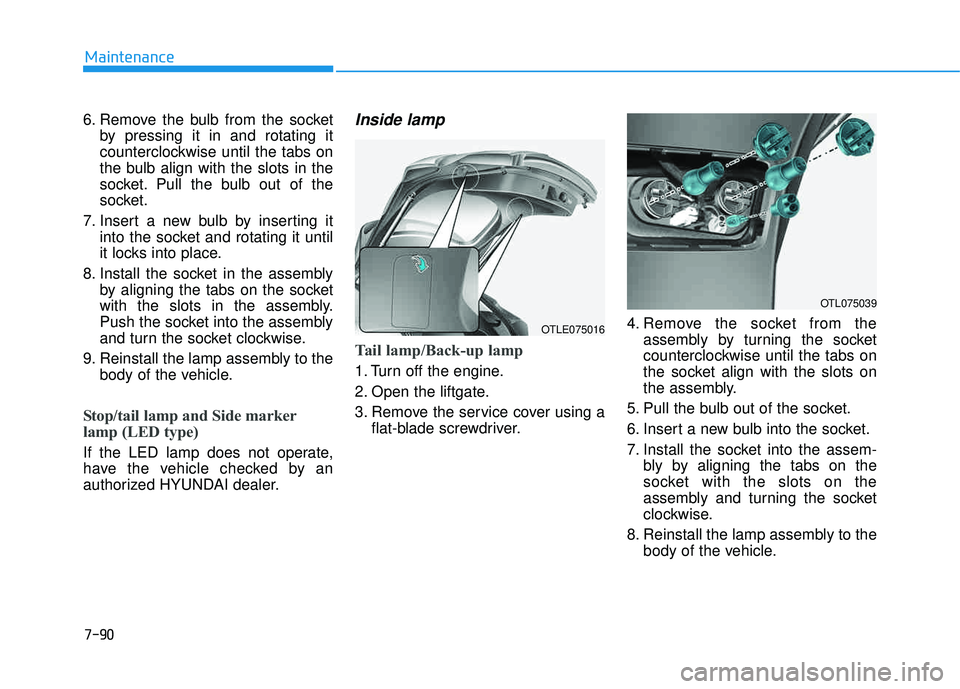
Tail lamp/Back-up lamp
1. Turn off the engine.
2. Open the liftgate.
3. Remove the service cover using aflat-blade screwdriver. 4. Remove the socket from the
assembly by turning the socket
counterclockwise until the tabs on
the socket align with the slots on
the assembly.
5. Pull the bulb out of the socket.
6. Insert a new bulb into the socket.
7. Install the socket into the assem- bly by aligning the tabs on the
socket with the slots on the
assembly and turning the socket
clockwise.
8. Reinstall the lamp assembly to the body of the vehicle.
OTLE075016
OTL075039
Page 608 of 642
7-95
7
Maintenance
Waxing
A good coat of wax provides a barri-
er between your paint and environ-mental contamination.
Keeping a good coat of wax on your
vehicle will help protect it.
Wax the vehicle when water will no longer bead on the paint.
Always wash and dry the vehicle
before waxing. Use a good quality
liquid or paste wax, and follow the
manufacturer’s instructions. Wax all
metal trim to protect it and to main-
tain its luster.
Removing oil, tar, and similar materi-
als with a spot remover will usually
strip the wax from the finish. Be sure
to re-wax these areas even if the rest
of the vehicle does not yet need wax-ing.
OLMB073082
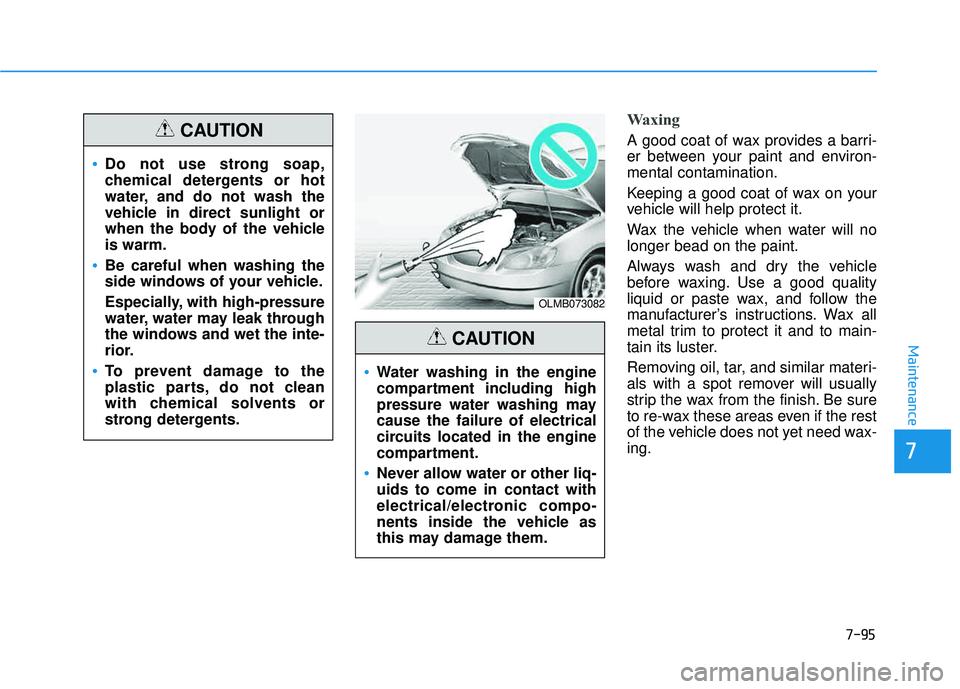
Water washing in the engine
compartment including high
pressure water washing maycause the failure of electrical
circuits located in the engine
compartment.
Never allow water or other liq- uids to come in contact with
electrical/electronic compo-
nents inside the vehicle as
this may damage them.
CAUTION
Do not use strong soap,
chemical detergents or hot
water, and do not wash the
vehicle in direct sunlight or
when the body of the vehicleis warm.
Be careful when washing the
side windows of your vehicle.
Especially, with high-pressure
water, water may leak through
the windows and wet the inte-
rior.
To prevent damage to the
plastic parts, do not clean
with chemical solvents or
strong detergents.
CAUTION
Page 615 of 642
7-102
Maintenance
Canister
Fuel vapors generated inside the fuel tank are absorbed and stored in the
onboard canister. When the engine is
running, the fuel vapors absorbed in
the canister are drawn into the surgetank through the purge control sole-
noid valve.
Purge Control Solenoid Valve(PCSV)
The purge control solenoid valve is
controlled by the Engine Control
Module (ECM); when the engine
coolant temperature is low during
idling, the PCSV closes so that evap-
orated fuel is not taken into the
engine. After the engine warms-up
during ordinary driving, the PCSV
opens to introduce evaporated fuel to
the engine.
3. Exhaust Emission Control System
The Exhaust Emission Control
System is a highly effective system
which controls exhaust emissions
while maintaining good vehicle per-
formance.
When the engine starts or fails to
start, excessive attempts to restart
the engine may cause damage to theemission system.
Vehicle modifications
This vehicle should not be modi-fied. Modification of your vehicle
could affect its performance, safety
or durability and may even violate
governmental safety and emis-
sions regulations.
In addition, damage or performance
problems resulting from any modifi-
cation may not be covered under
warranty.
If you use unauthorized electronic devices, it may cause the vehicle to
operate abnormally, wire damage,
battery discharge and fire. For your
safety, do not use unauthorized
electronic devices.
Engine exhaust (carbon monox-
ide) precautions
Carbon monoxide can be present with other exhaust fumes. If you
smell exhaust fumes of any kind in
your vehicle, drive with all the win-
dows fully open. Have your vehicle
checked and repaired immediately.
Engine exhaust gases contain
carbon monoxide (CO). Though
colorless and odorless, it is
dangerous and could be lethal if
inhaled. Follow the instructions
on this page to avoid CO poi-soning.
WARNING
![HYUNDAI TUCSON 2016 Owners Manual 7-76
Maintenance
Engine compartment main fuse panel
Fuse Name Fuse ratingCircuit Protected
MODULE2 10A [G4FJ] Vacuum Pump
POWER OUTLER FRT 20A Front Power Outlet & Cigarette Lighter
ECU6 10A](/manual-img/35/56201/w960_56201-588.png "HYUNDAI TUCSON 2016 Owners Manual 7-76
Maintenance
Engine compartment main fuse panel
Fuse Name Fuse ratingCircuit Protected
MODULE2 10A [G4FJ] Vacuum Pump
POWER OUTLER FRT 20A Front Power Outlet & Cigarette Lighter
ECU6 10A")