2016 Hyundai Santa Fe load capacity
[x] Cancel search: load capacityPage 492 of 699
Driving your vehicle
34 5
• Full-time 4WD vehicles must be
tested on a special four wheel
chassis dynamometer.
✽NOTICE
Never engage the parking brake
whilst performing these tests.
• A full-time 4WD vehicle should not
be tested on a 2WD roll tester. If a
2WD roll tester must be used, per-
form the following:
WARNING - Jacked
vehicle
Whilst a full-time 4WD vehicle is
being raised on a jack, never
start the engine or cause the
tyres to rotate.
There is a danger that rotating
tyres touching the ground could
cause the vehicle to fall off the
jack and to jump forward or
rearward.
WARNING
Your vehicle is equipped with
tyres designed to provide safe
ride and handling capability. Do
not use a size and type of tyre
and wheel that is different from
the one that is originally
installed on your vehicle. It can
affect the safety and perform-
ance of your vehicle, which
could lead to steering failure or
rollover and serious injury.
When replacing the tyres, be
sure to equip all four tyres with
the tyre and wheel of the same
size, type, tread, brand and
load-carrying capacity. If you
nevertheless decide to equip
your vehicle with any tyre/wheel
combination not recommended
by HYUNDAI for off road driv-
ing, you should not use these
tyres for highway driving.
Page 536 of 699
Driving your vehicle
78 5
Rocking the vehicle
If it is necessary to rock the vehicle
to free it from snow, sand, or mud,
first turn the steering wheel right and
left to clear the area around your
front wheels. Then, shift back and
forth between 1 (First) and R
(Reverse) in vehicles equipped with
a manual transaxle or R (Reverse)
and any forward gear in vehicles
equipped with an automatic
transaxle. Do not race the engine,
and spin the wheels as little as pos-
sible. If you are still stuck after a few
tries, have the vehicle pulled out by a
tow vehicle to avoid engine overheat-
ing and possible damage to the
transaxle.
CAUTION
Prolonged rocking may cause
engine over-heating, transaxle
damage or failure, and tyre dam-
age.
WARNING
Your vehicle is equipped with
tyres designed to provide safe
ride and handling capability. Do
not use a size and type of tyre
and wheel that is different from
the one that is originally
installed on your vehicle. It can
affect the safety and perform-
ance of your vehicle, which
could lead to steering failure or
rollover and serious injury.
When replacing the tyres, be
sure to equip all four tyres with
the tyre and wheel of the same
size, type, tread, brand and
load-carrying capacity. If you
nevertheless decide to equip
your vehicle with any tyre/wheel
combination not recommended
by HYUNDAI for off road driv-
ing, you should not use these
tyres for highway driving.
WARNING - Rollover
As with other Sports Utility
Vehicle (SUV), failure to operate
this vehicle correctly may result
in loss of control, an accident or
vehicle rollover.
• Utility vehicles have a signifi-
cantly higher rollover rate
than other types of vehicles.
• Specific design characteris-
tics (higher ground clearance,
narrower track, etc.) give this
vehicle a higher centre of
gravity than ordinary vehicles.
• A SUV is not designed for cor-
nering at the same speeds as
conventional vehicles.
• Avoid sharp turns or abrupt
manoeuvres.
• In a rollover crash, an unbelt-
ed person is significantly
more likely to die than a per-
son wearing a seat belt. Make
sure everyone in the vehicle is
properly buckled up.
Page 547 of 699
589
Driving your vehicle
Your vehicle can tow a trailer. To
identify what the vehicle trailering
capacity is for your vehicle, you
should read the information in
“Weight of the trailer” that appears
later in this section.
Remember that trailering is different
than just driving your vehicle by itself.
Trailering means changes in han-
dling, durability, and fuel economy.
Successful, safe trailering requires
correct equipment, and it has to be
used properly.
This section contains many time-
tested, important trailering tips and
safety rules. Many of these are
important for your safety and that of
your passengers. Please read this
section carefully before you pull a
trailer.Load-pulling components such as
the engine, transaxle, wheel assem-
blies, and tyres are forced to work
harder against the load of the added
weight. The engine is required to
operate at relatively higher speeds
and under greater loads. This addi-
tional burden generates extra heat.
The trailer also considerably adds
wind resistance, increasing the
pulling requirements.
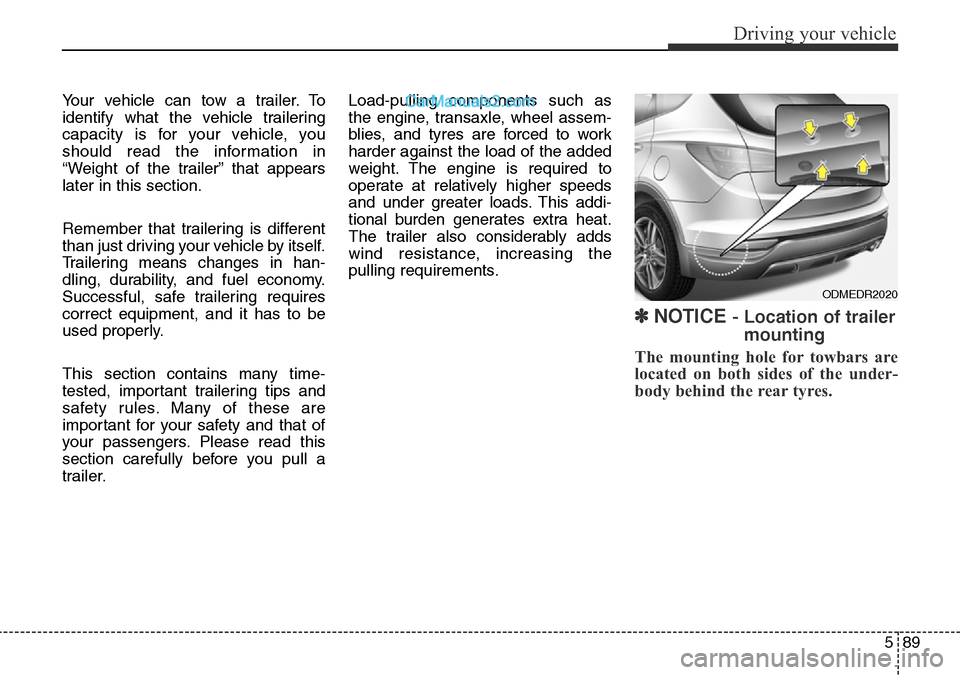
✽NOTICE - Location of trailer
mounting
The mounting hole for towbars are
located on both sides of the under-
body behind the rear tyres.
ODMEDR2020
Page 584 of 699
What to do in an emergency
28 6
When using a compact spare tyre,
observe the following precautions:
• Under no circumstances should
you exceed 50 mph (80 km/h); a
higher speed could damage the
tyre.
• Ensure that you drive slowly
enough for the road conditions to
avoid all hazards. Any road hazard,
such as a pothole or debris, could
seriously damage the compact
spare.
• Any continuous road use of this
tyre could result in tyre failure, loss
of vehicle control, and possible
personal injury.
• Do not exceed the vehicle’s maxi-
mum load rating or the load-carry-
ing capacity shown on the sidewall
of the compact spare tyre.
• Avoid driving over obstacles. The
compact spare tyre diameter is
smaller than the diameter of a con-
ventional tyre and reduces the
ground clearance approximately
25 mm (1 inch), which could result
in damage to the vehicle.• Do not take this vehicle through an
automatic car wash whilst the com-
pact spare tyre is installed.
• Do not use tyre chains on the com-
pact spare tyre. Because of the
smaller size, a tyre chain will not fit
properly. This could damage the
vehicle and result in loss of the
chain.
• The compact spare tyre should not
be installed on the front axle if the
vehicle must be driven in snow or
on ice.
• Do not use the compact spare tyre
on any other vehicle because this
tyre has been designed especially
for your vehicle.
• The compact spare tyre’s tread life
is shorter than a regular tyre.
Inspect your compact spare tyre
regularly and replace worn com-
pact spare tyres with the same size
and design, mounted on the same
wheel.• The compact spare tyre should not
be used on any other wheels, nor
should standard tyres, snow tyres,
wheel covers or trim rings be used
with the compact spare wheel. If
such use is attempted, damage to
these items or other car compo-
nents may occur.
• Do not use more than one tempo-
rary spare tyre at a time.
• Do not tow a trailer whilst the tem-
porary spare tyre is installed.
Page 637 of 699
Maintenance
40 7
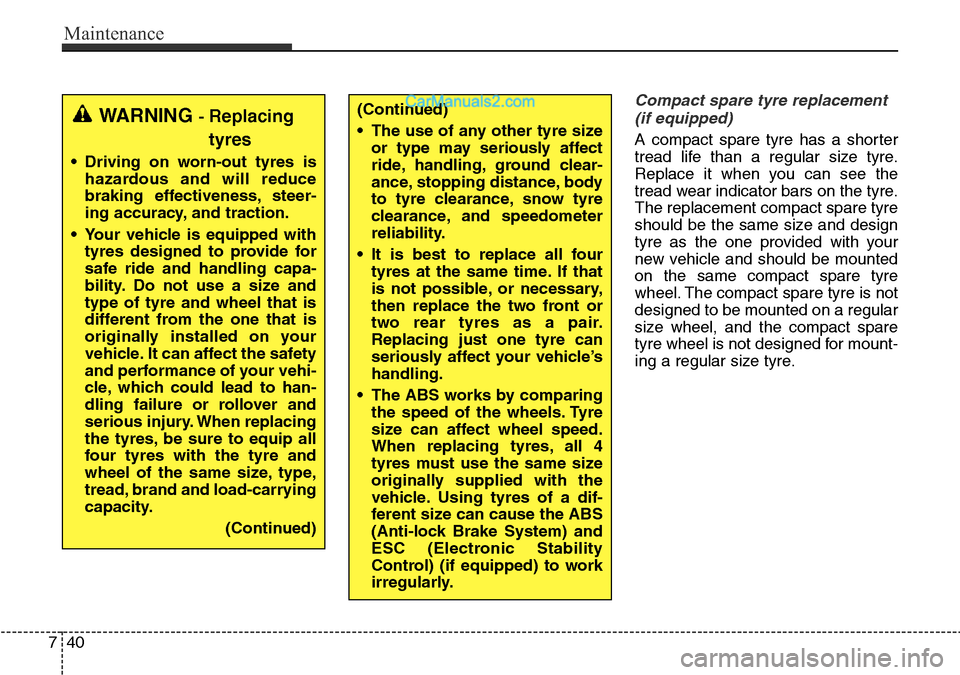
Compact spare tyre replacement
(if equipped)
A compact spare tyre has a shorter
tread life than a regular size tyre.
Replace it when you can see the
tread wear indicator bars on the tyre.
The replacement compact spare tyre
should be the same size and design
tyre as the one provided with your
new vehicle and should be mounted
on the same compact spare tyre
wheel. The compact spare tyre is not
designed to be mounted on a regular
size wheel, and the compact spare
tyre wheel is not designed for mount-
ing a regular size tyre.
(Continued)
• The use of any other tyre size
or type may seriously affect
ride, handling, ground clear-
ance, stopping distance, body
to tyre clearance, snow tyre
clearance, and speedometer
reliability.
• It is best to replace all four
tyres at the same time. If that
is not possible, or necessary,
then replace the two front or
two rear tyres as a pair.
Replacing just one tyre can
seriously affect your vehicle’s
handling.
• The ABS works by comparing
the speed of the wheels. Tyre
size can affect wheel speed.
When replacing tyres, all 4
tyres must use the same size
originally supplied with the
vehicle. Using tyres of a dif-
ferent size can cause the ABS
(Anti-lock Brake System) and
ESC (Electronic Stability
Control) (if equipped) to work
irregularly.WARNING - Replacing
tyres
• Driving on worn-out tyres is
hazardous and will reduce
braking effectiveness, steer-
ing accuracy, and traction.
• Your vehicle is equipped with
tyres designed to provide for
safe ride and handling capa-
bility. Do not use a size and
type of tyre and wheel that is
different from the one that is
originally installed on your
vehicle. It can affect the safety
and performance of your vehi-
cle, which could lead to han-
dling failure or rollover and
serious injury. When replacing
the tyres, be sure to equip all
four tyres with the tyre and
wheel of the same size, type,
tread, brand and load-carrying
capacity.
(Continued)
Page 644 of 699
747
Maintenance
FUSES
A vehicle’s electrical system is pro-
tected from electrical overload dam-
age by fuses.
This vehicle has 2 (or 3) fuse panels,
one located in the driver’s side panel
bolster, the other in the engine com-
partment near the battery.
If any of your vehicle’s lights, acces-
sories, or controls do not work, check
the appropriate circuit fuse. If a fuse
has blown, the element inside the
fuse will be melted.
If the electrical system does not
work, first check the driver’s side
fuse panel.
Before replacing a blown fuse, dis-
connect the negative battery cable.
Always replace a blown fuse with
one of the same rating.
If the replacement fuse blows, this
indicates an electrical problem. Avoid
using the system involved and imme-
diately consult a HYUNDAI autho-
rised repairer.
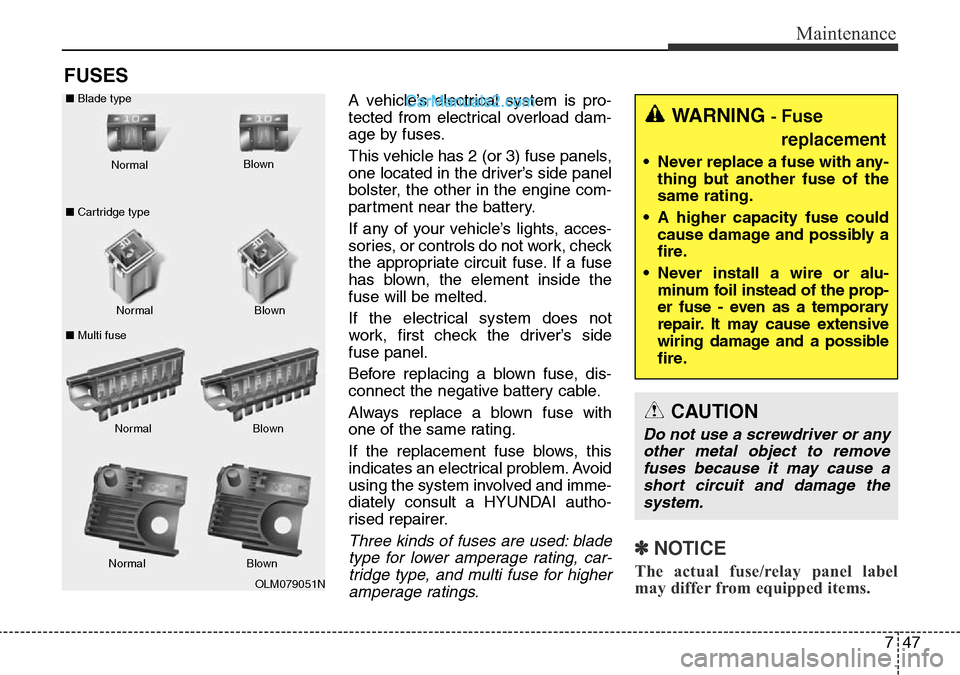
Three kinds of fuses are used: blade
type for lower amperage rating, car-
tridge type, and multi fuse for higher
amperage ratings.✽NOTICE
The actual fuse/relay panel label
may differ from equipped items.
WARNING - Fuse
replacement
• Never replace a fuse with any-
thing but another fuse of the
same rating.
• A higher capacity fuse could
cause damage and possibly a
fire.
• Never install a wire or alu-
minum foil instead of the prop-
er fuse - even as a temporary
repair. It may cause extensive
wiring damage and a possible
fire.
CAUTION
Do not use a screwdriver or any
other metal object to remove
fuses because it may cause a
short circuit and damage the
system.
OLM079051N Normal Normal ■Blade type
■Cartridge type
■Multi fuseBlown
Blown
Normal Blown
Normal Blown
Page 688 of 699
Specifications & Consumer information
Dimensions . . . . . . . . . . . . . . . . . . . . . . . . . . . . . . . . 8-2
Engine . . . . . . . . . . . . . . . . . . . . . . . . . . . . . . . . . . . . 8-2
Bulb wattage . . . . . . . . . . . . . . . . . . . . . . . . . . . . . . . 8-3
Tyres and wheels . . . . . . . . . . . . . . . . . . . . . . . . . . . 8-4
Load and speed capacity tyres . . . . . . . . . . . . . . . . 8-5
Gross vehicle weight. . . . . . . . . . . . . . . . . . . . . . . . . 8-6
Luggage volume . . . . . . . . . . . . . . . . . . . . . . . . . . . . 8-6
Recommended lubricants and capacities . . . . . . . . 8-7
Vehicle identification number (VIN) . . . . . . . . . . 8-10
Vehicle certification label. . . . . . . . . . . . . . . . . . . . 8-10
Tyre specification and pressure label . . . . . . . . . . 8-11
Engine number . . . . . . . . . . . . . . . . . . . . . . . . . . . . 8-11
Air conditioner compressor label . . . . . . . . . . . . . 8-11
Refrigerant label. . . . . . . . . . . . . . . . . . . . . . . . . . . 8-12
Declaration of conformity . . . . . . . . . . . . . . . . . . . 8-12
8
Page 692 of 699
85
Specifications & Consumer information
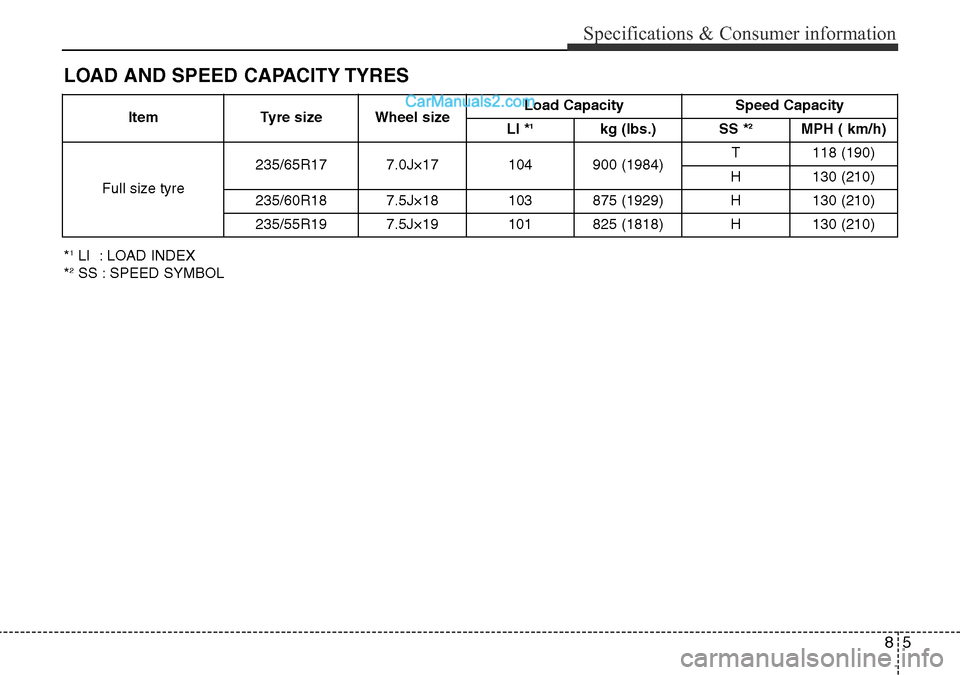
*1LI : LOAD INDEX
*2SS : SPEED SYMBOLItem Tyre size Wheel sizeLoad Capacity Speed Capacity
LI *
1kg (lbs.) SS *2MPH ( km/h)
Full size tyre235/65R17 7.0J×17 104 900 (1984)T 118 (190)
H 130 (210)
235/60R18 7.5J×18 103 875 (1929) H 130 (210)
235/55R197.5J×19101825 (1818)H130 (210)
LOAD AND SPEED CAPACITY TYRES