2016 HYUNDAI IX35 warning
[x] Cancel search: warningPage 388 of 550
Driving your vehicle40
5✽
✽
NOTICEWhen you jump start your vehicle
because of a drained battery, the engine
may not run as smoothly and the ABS
warning light may turn on at the same
time. This happens because of the low
battery voltage. It does not mean your
ABS is malfunctioning.
• Do not pump your brakes!
• Have the battery recharged before
driving the vehicle.
EL(FL) UK 5.QXP 12/16/2014 8:09 PM Page 40
Page 389 of 550
541
Driving your vehicle
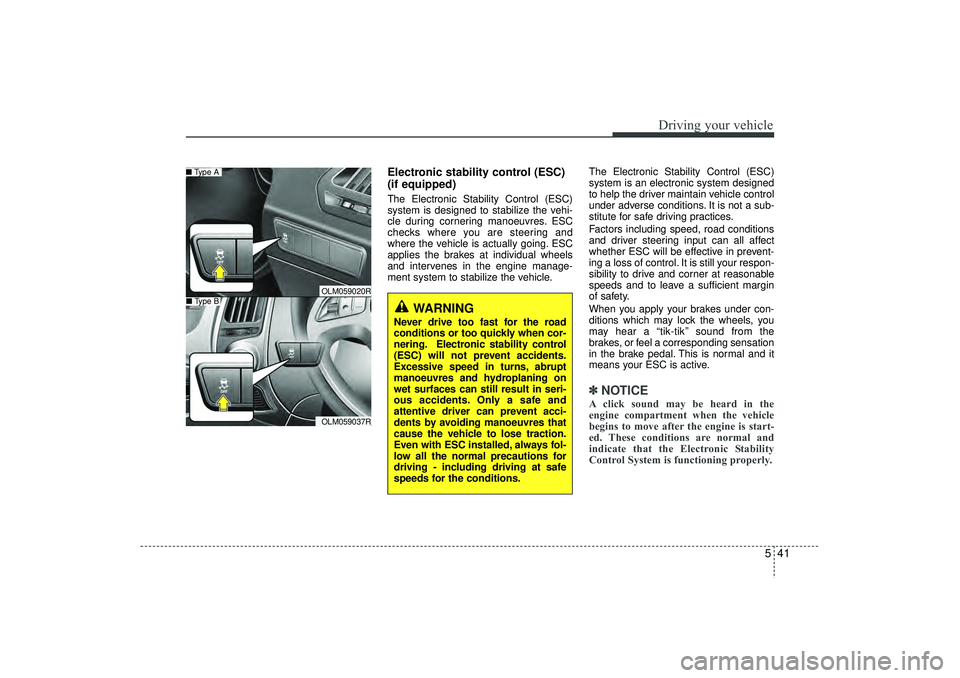
Electronic stability control (ESC)
(if equipped)The Electronic Stability Control (ESC)
system is designed to stabilize the vehi-
cle during cornering manoeuvres. ESC
checks where you are steering and
where the vehicle is actually going. ESC
applies the brakes at individual wheels
and intervenes in the engine manage-
ment system to stabilize the vehicle.The Electronic Stability Control (ESC)
system is an electronic system designed
to help the driver maintain vehicle control
under adverse conditions. It is not a sub-
stitute for safe driving practices.
Factors including speed, road conditions
and driver steering input can all affect
whether ESC will be effective in prevent-
ing a loss of control. It is still your respon-
sibility to drive and corner at reasonable
speeds and to leave a sufficient margin
of safety.
When you apply your brakes under con-
ditions which may lock the wheels, you
may hear a “tik-tik’’ sound from the
brakes, or feel a corresponding sensation
in the brake pedal. This is normal and it
means your ESC is active.
✽ ✽
NOTICEA click sound may be heard in the
engine compartment when the vehicle
begins to move after the engine is start-
ed. These conditions are normal and
indicate that the Electronic Stability
Control System is functioning properly.
WARNING
Never drive too fast for the road
conditions or too quickly when cor-
nering. Electronic stability control
(ESC) will not prevent accidents.
Excessive speed in turns, abrupt
manoeuvres and hydroplaning on
wet surfaces can still result in seri-
ous accidents. Only a safe and
attentive driver can prevent acci-
dents by avoiding manoeuvres that
cause the vehicle to lose traction.
Even with ESC installed, always fol-
low all the normal precautions for
driving - including driving at safe
speeds for the conditions.
OLM059020ROLM059037R
■ Type A■ Type B
EL(FL) UK 5.QXP 12/16/2014 8:09 PM Page 41
Page 391 of 550
543
Driving your vehicle
ESC off state 2
To cancel ESC operation, press the ESC OFF button
(ESC OFF ) for more than
3 seconds. ESC OFF indica-
tor light (ESC OFF ) illumi-
nates and ESC OFF warning
chime will sound. At this
state, the engine control
function and brake control
function do not operate. It
means the car stability con-
trol function does not operate
any more.
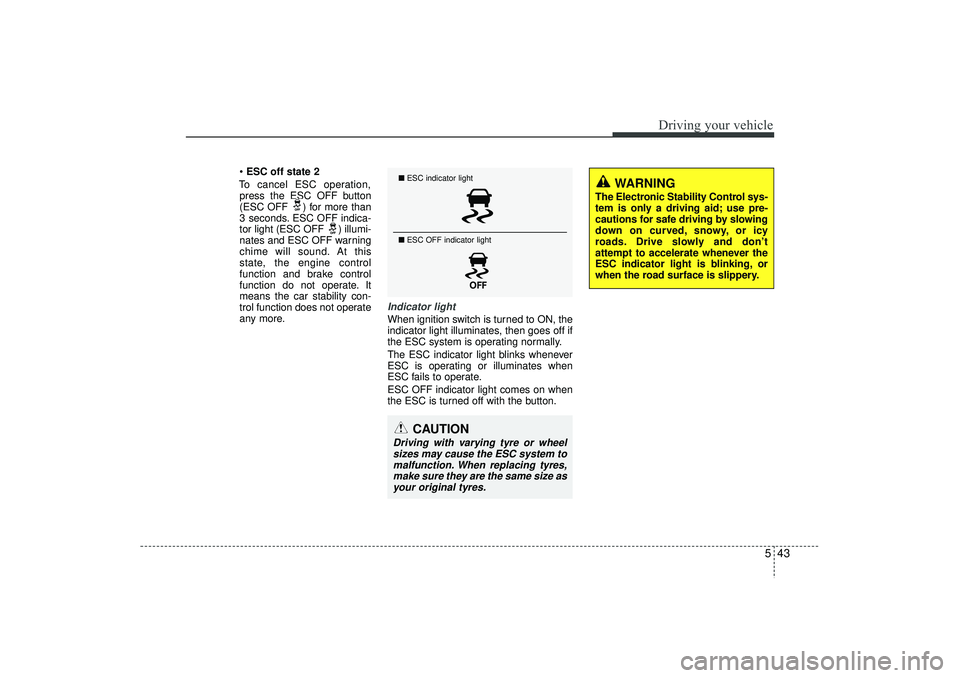
Indicator lightWhen ignition switch is turned to ON, the
indicator light illuminates, then goes off if
the ESC system is operating normally.
The ESC indicator light blinks whenever
ESC is operating or illuminates when
ESC fails to operate.
ESC OFF indicator light comes on when
the ESC is turned off with the button.■ ESC indicator light
■ ESC OFF indicator light
CAUTION
Driving with varying tyre or wheel
sizes may cause the ESC system to malfunction. When replacing tyres,make sure they are the same size as your original tyres.
WARNING
The Electronic Stability Control sys-
tem is only a driving aid; use pre-
cautions for safe driving by slowing
down on curved, snowy, or icy
roads. Drive slowly and don’t
attempt to accelerate whenever the
ESC indicator light is blinking, or
when the road surface is slippery.
EL(FL) UK 5.QXP 12/16/2014 8:09 PM Page 43
Page 392 of 550
Driving your vehicle44
5When driving
ESC should be turned on for daily driv-
ing whenever possible.
To turn ESC off whilst driving, press the ESC OFF button whilst driving on a
flat road surface.✽ ✽ NOTICE• When operating the vehicle on a
dynamometer, ensure that the ESC is
turned off (ESC OFF light illuminat-
ed). If the ESC is left on, it may pre-
vent the vehicle speed from increas-
ing, and result in false diagnosis.
• Turning the ESC off does not affect ABS or brake system operation.
Vehicle stability management
(VSM) (if equipped)This system provides further enhance-
ments to vehicle stability and steering
responses when a vehicle is driving on a
slippery road or a vehicle detected
changes in coefficient of friction between
right wheels and left wheels when brak-
ing.VSM operationWhen the vehicle stability management
is operating properly, you can feel a slight
pulsation in the vehicle. This is only the
effect of brake control and indicates noth-
ing unusual.
The VSM does not operate when:
Driving rearward
ESC OFF indicator light ( ) remains
on the instrument cluster
ESC indicator light remains on the instrument cluster
VSM operation offIf you press the ESC OFF button to turn
off the ESC, the VSM will also cancel and
the ESC OFF indicator light ( ) illumi-
nates.
To turn on the VSM, press the button
again. The ESC OFF indicator light goes
out.Malfunction indicatorThe VSM can be deactivated even if you
don’t cancel the VSM operation by press-
ing the ESC OFF button. It indicates that
a malfunction has been detected some-
where in the Electric Power Steering sys-
tem or VSM system. If the ESC indicator
light ( ) or EPS warning light remains
on, we recommend that the system be
checked by a HYUNDAI authorised
repairer.✽ ✽ NOTICE• The VSM is designed to function
above approximately 9 mph (15 km/h)
on curves.
• The VSM is designed to function above approximately 12 mph (20
km/h) when a vehicle is braking on a
split-mu road. The split-mu road is
made of surfaces which have different
friction forces.
WARNING
Never press the ESC OFF button
whilst ESC is operating (ESC indi-
cator light blinks).
If ESC is turned off whilst ESC is
operating, the vehicle may slip out
of control.
EL(FL) UK 5.QXP 12/16/2014 8:09 PM Page 44
Page 393 of 550
545
Driving your vehicle
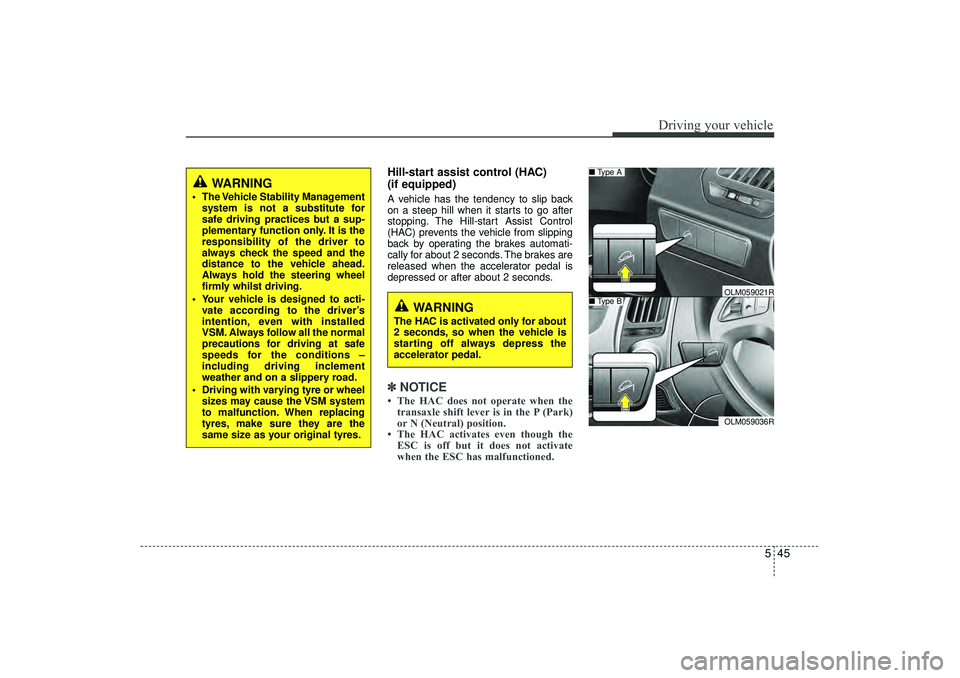
Hill-start assist control (HAC)
(if equipped) A vehicle has the tendency to slip back
on a steep hill when it starts to go after
stopping. The Hill-start Assist Control
(HAC) prevents the vehicle from slipping
back by operating the brakes automati-
cally for about 2 seconds. The brakes are
released when the accelerator pedal is
depressed or after about 2 seconds.✽ ✽NOTICE• The HAC does not operate when the
transaxle shift lever is in the P (Park)
or N (Neutral) position.
• The HAC activates even though the ESC is off but it does not activate
when the ESC has malfunctioned.
WARNING
The Vehicle Stability Management
system is not a substitute for
safe driving practices but a sup-
plementary function only. It is the
responsibility of the driver to
always check the speed and the
distance to the vehicle ahead.
Always hold the steering wheel
firmly whilst driving.
Your vehicle is designed to acti- vate according to the driver’s
intention, even with installed
VSM. Always follow all the normal
precautions for driving at safe
speeds for the conditions –
including driving inclement
weather and on a slippery road.
Driving with varying tyre or wheel sizes may cause the VSM system
to malfunction. When replacing
tyres, make sure they are the
same size as your original tyres.
WARNING
The HAC is activated only for about
2 seconds, so when the vehicle is
starting off always depress the
accelerator pedal.
OLM059036R
■ Type A■ Type B
OLM059021R
EL(FL) UK 5.QXP 12/16/2014 8:09 PM Page 45
Page 394 of 550
Driving your vehicle46
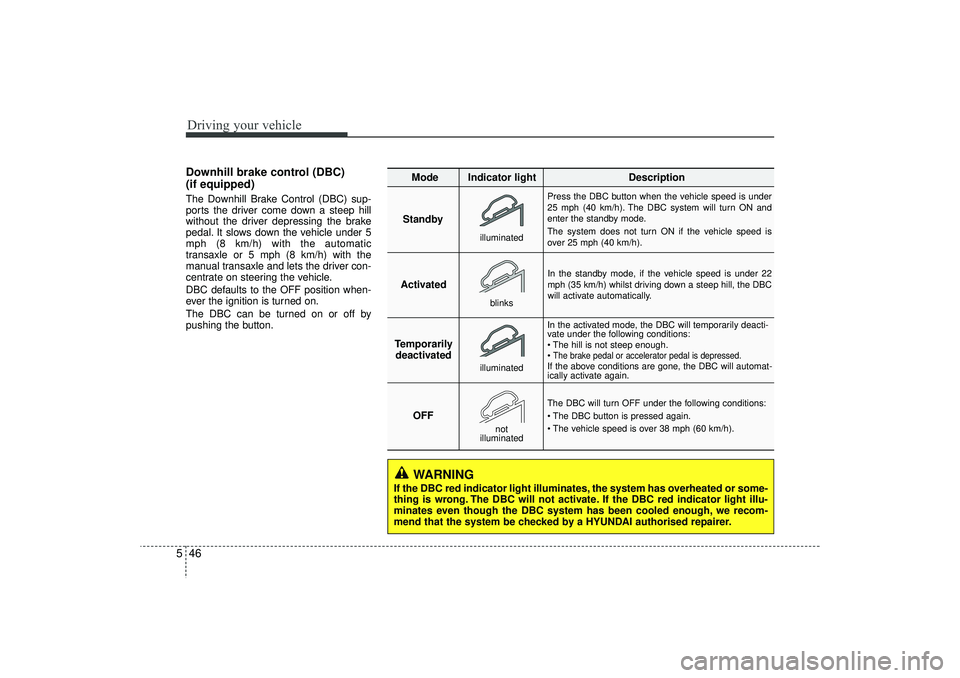
5Downhill brake control (DBC)
(if equipped)The Downhill Brake Control (DBC) sup-
ports the driver come down a steep hill
without the driver depressing the brake
pedal. It slows down the vehicle under 5
mph (8 km/h) with the automatic
transaxle or 5 mph (8 km/h) with the
manual transaxle and lets the driver con-
centrate on steering the vehicle.
DBC defaults to the OFF position when-
ever the ignition is turned on.
The DBC can be turned on or off by
pushing the button.
Standby
Press the DBC button when the vehicle speed is under
25 mph (40 km/h). The DBC system will turn ON and
enter the standby mode.
The system does not turn ON if the vehicle speed is
over 25 mph (40 km/h).
In the standby mode, if the vehicle speed is under 22
mph (35 km/h) whilst driving down a steep hill, the DBC
will activate automatically.
In the activated mode, the DBC will temporarily deacti-
vate under the following conditions:
The hill is not steep enough.
The brake pedal or accelerator pedal is depressed.If the above conditions are gone, the DBC will automat-
ically activate again.
The DBC will turn OFF under the following conditions:
The DBC button is pressed again.
The vehicle speed is over 38 mph (60 km/h).
Activated
Temporarily deactivated
OFF
Mode Indicator light
Description
blinksilluminated
not
illuminated
illuminated
WARNING
If the DBC red indicator light illuminates, the system has overheated or some-
thing is wrong. The DBC will not activate. If the DBC red indicator light illu-
minates even though the DBC system has been cooled enough, we recom-
mend that the system be checked by a HYUNDAI authorised repairer.
EL(FL) UK 5.QXP 12/16/2014 8:09 PM Page 46
Page 395 of 550
547
Driving your vehicle
✽
✽NOTICE• The DBC does not turn ON in the P
(Park) position.
• The DBC may not activate if the ESC (or BAS, if equipped) is activated.
• Noise or vibration may occur from the brakes when the DBC is activated.
• The rear stop light comes on when the DBC is activated.
• In a very steep hill even though the brake pedal or accelerator pedal is
depressed the DBC may not deacti-
vate.
• Always turn OFF the DBC on normal roads. The DBC might activate from
the standby mode when abrupt corn-
ing or driving through speed bumps.
• DBC may activate and cause the engine to stop in vehicles with manual
transaxle if you drive in 3rd gear (or
above) with DBC on. Do not turn on
DBC when driving in 3rd gear (or
above).
ESS : Emergency Stop SignalThe Emergency Stop Signal system
alerts the driver behind by blinking the
stop light when the vehicle suddenly
stops or when the ABS activates in a
stop. (The system activates when the
vehicle speed is over 34 mph (55 km/h)
and the vehicle deceleration is over
7m/s² or the ABS activates when the
vehicle emergency braking.)
When the vehicle speed is under 25 mph
(40 km/h) and the ABS deactivates or the
sudden stop situation is over, the stop
light will not blink. Instead, the hazard
warning flasher will turn on automatically.
The hazard warning flasher will turn off
when the vehicle speed is over 6 mph (10
km/h) after the vehicle has stopped. Also,
it will turn off when the vehicle drives at
low speed for some time. You can turn it
off manually by pushing the hazard warn-
ing flasher switch.
Trailer stability assist (TSA)
(if equipped)Trailer stability assist is operated as vehi-
cle stability control system. Trailer stabili-
ty assist system has an effort to stabilize
the vehicle and trailer when the trailer
sways or oscillates. There are various
reasons making vehicle sway and oscil-
late. Almost case it happens at high
speed however, if the trailer is affected by
crosswinds, buffeting, and improper over-
loading, it may be a risk of swaying.
Factors of swaying such as:
- High speed
- Strong crosswinds
- Improper overloading
- Sudden controlling of steering wheel
- Uneven road
CAUTION
The Emergency Stop Signal system
will not work if the hazard warningflasher is already on.
EL(FL) UK 5.QXP 12/16/2014 8:09 PM Page 47
Page 396 of 550

Driving your vehicle48
5Trailer stability assist system continuous-
ly analyzes the vehicle and trailer insta-
bility. When the Trailer stability assist sys-
tem detects some sway, the brakes are
applied automatically to stabilize the
vehicle on the front wheel. However, if it
is not enough to stabilize, the brakes are
applied on all wheels automatically and
engine power is properly reduced. When
the vehicle is stable from swaying, trailer
stability assist system does not operate.
Good braking practices
Check to be sure the parking brake is
not engaged and that the parking
brake indicator light is out before driv-
ing away.
Driving through water may get the brakes wet. They can also get wet
when the vehicle is washed. Wet
brakes can be dangerous! Your vehicle
will not stop as quickly if the brakes are
wet. Wet brakes may cause the vehicle
to pull to one side.
To dry the brakes, apply the brakes
lightly until the braking action returns to
normal, taking care to keep the vehicle
under control at all times. If the braking
action does not return to normal, stop
as soon as it is safe to do so and we
recommend that you call a HYUNDAI
authorised repairer for assistance.
Don't coast down hills with the vehicle out of gear. This is extremely haz-
ardous. Keep the vehicle in gear at all
times, use the brakes to slow down,
then shift to a lower gear so that
engine braking will help you maintain a
safe speed.
WARNING
Whenever you leave or park yourvehicle, always set the parking
brake as far as possible and fully
engage the vehicle's transaxle
into the P (Park) position. If the
parking brake is not fully
engaged, the vehicle may move
inadvertently and injure yourself
and others.
All vehicles should always have the parking brake fully engaged
when parking to avoid inadver-
tent movement of the vehicle
which can injure occupants or
pedestrians.
EL(FL) UK 5.QXP 12/16/2014 8:09 PM Page 48