Page 345 of 419
715
Maintenance
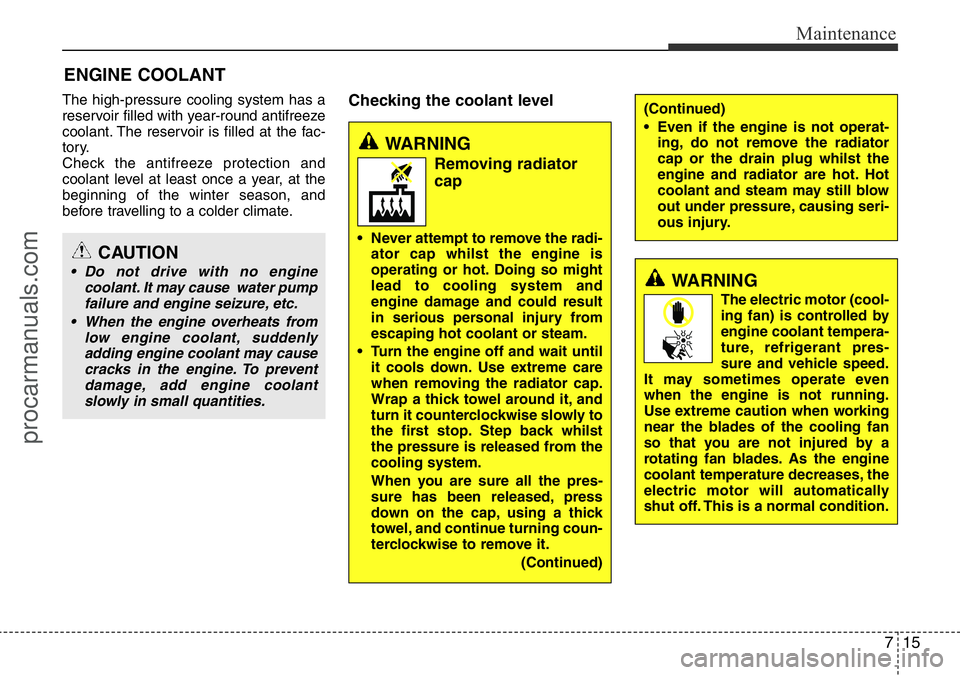
ENGINE COOLANT
The high-pressure cooling system has a
reservoir filled with year-round antifreeze
coolant. The reservoir is filled at the fac-
tory.
Check the antifreeze protection and
coolant level at least once a year, at the
beginning of the winter season, and
before travelling to a colder climate.Checking the coolant level
CAUTION
• Do not drive with no engine
coolant. It may cause water pump
failure and engine seizure, etc.
• When the engine overheats from
low engine coolant, suddenly
adding engine coolant may cause
cracks in the engine. To prevent
damage, add engine coolant
slowly in small quantities.WARNING
The electric motor (cool-
ing fan) is controlled by
engine coolant tempera-
ture, refrigerant pres-
sure and vehicle speed.
It may sometimes operate even
when the engine is not running.
Use extreme caution when working
near the blades of the cooling fan
so that you are not injured by a
rotating fan blades. As the engine
coolant temperature decreases, the
electric motor will automatically
shut off. This is a normal condition.
WARNING
Removing radiator
cap
• Never attempt to remove the radi-
ator cap whilst the engine is
operating or hot. Doing so might
lead to cooling system and
engine damage and could result
in serious personal injury from
escaping hot coolant or steam.
• Turn the engine off and wait until
it cools down. Use extreme care
when removing the radiator cap.
Wrap a thick towel around it, and
turn it counterclockwise slowly to
the first stop. Step back whilst
the pressure is released from the
cooling system.
When you are sure all the pres-
sure has been released, press
down on the cap, using a thick
towel, and continue turning coun-
terclockwise to remove it.
(Continued)
(Continued)
• Even if the engine is not operat-
ing, do not remove the radiator
cap or the drain plug whilst the
engine and radiator are hot. Hot
coolant and steam may still blow
out under pressure, causing seri-
ous injury.
procarmanuals.com
Page 346 of 419

Maintenance
16 7
Check the condition and connections of
all cooling system hoses and heater
hoses. Replace any swollen or deterio-
rated hoses.
The coolant level should be filled
between F and L marks on the side of the
coolant reservoir when the engine is
cool.
If the coolant level is low, add enough
specified coolant to provide protection
against freezing and corrosion. Bring the
level to F, but do not overfill. If frequent
additions are required, we recommend
that the system be inspected by a
HYUNDAI authorised repairer.
Recommended engine coolant
• When adding coolant, use only deion-
ized water or soft water for your vehicle
and never mix hard water in the
coolant filled at the factory. An improp-
er coolant mixture can result in serious
malfunction or engine damage.
• The engine in your vehicle has alu-
minium engine parts and must be pro-
tected by an ethylene-glycol-based
coolant to prevent corrosion and freez-
ing.
• DO NOT USE alcohol or methanol
coolant or mix them with the specified
coolant.
• Do not use a solution that contains
more than 60% antifreeze or less than
35% antifreeze, which would reduce
the effectiveness of the solution.
For mixture percentage, refer to the fol-
lowing table.
OTQ077004
WARNING
Radiator cap
Do not remove the radiator cap
when the engine and radiator are
hot. Scalding hot coolant and
steam may blow out under pres-
sure causing serious injury.
OTQ072005
Ambient
TemperatureMixture Percentage
(volume)
Antifreeze Water
-15°C (5°F) 35 65
-25°C (-13°F) 40 60
-35°C (-31°F) 50 50
-45°C (-49°F) 60 40
procarmanuals.com
Page 347 of 419
717
Maintenance
Changing the coolant
We recommend that the coolant be
replaced by a HYUNDAI authorised
repairer.
CAUTION
Put a thick cloth or fabric around
the radiator cap before refilling the
coolant in order to prevent the
coolant from overflowing into
engine parts such as generator.
WARNING -Coolant
• Do not use radiator coolant or
antifreeze in the washer fluid
reservoir.
• Radiator coolant can severely
obscure visibility when sprayed
on the windscreen and may
cause loss of vehicle control or
damage to paint and body trim.
procarmanuals.com
Page 351 of 419

721
Maintenance
✽NOTICE
“C” (COLD) range is for reference only
and should NOT be used to determine
transmission fluid level.
✽NOTICE
New automatic transmission fluid
should be red. The red dye is added so
the assembly plant can identify it as
automatic transmission fluid and distin-
guish it from engine oil or antifreeze.
The red dye, which is not an indicator of
fluid quality, is not permanent. As the
vehicle is driven, the automatic trans-
mission fluid will begin to look darker.
The colour may eventually appear light
brown. Therefore, we recommend that
the system be replaced by a HYUNDAI
authorised repairer according to the
Scheduled Maintenance at the begin-
ning of this section.
Use only the specified automatic trans-
mission fluid. (Refer to “Recommended
lubricants and capacities” in section 9.)
Changing the automatic transmis-
sion fluid
We recommend that the automatic trans-
mission fluid changed by a HYUNDAI
authorised repairer according to the
maintenance schedule.
WARNING - Transmission
fluid
The transmission fluid level should
be checked when the engine is at
normal operating temperature. This
means that the engine, radiator,
radiator hose and exhaust system
etc., are very hot. Exercise great
care not to burn yourself during
this procedure.
WARNING- Parking brake
To avoid sudden movement of the
vehicle, apply parking brake and
depress the brake pedal before
moving the shift lever.
CAUTION
• Low fluid level causes transmis-
sion slippage. Overfilling can
cause foaming, loss of fluid and
transmission malfunction.
• The use of a non-specified fluid
could result in transmission mal-
function and failure.
procarmanuals.com
Page 352 of 419

Maintenance
22 7
WASHER FLUID
Checking the washer fluid level
The reservoir is translucent so that you
can check the level with a quick visual
inspection.
Check the fluid level in the washer fluid
reservoir and add fluid if necessary. Plain
water may be used if washer fluid is not
available.However, use washer solvent with
antifreeze characteristics in cold climates
to prevent freezing.
Checking the parking brake
Check the stroke of the parking brake by
counting the number of “clicks’’ heard
whilst fully applying it from the released
position. Also, the parking brake alone
should securely hold the vehicle on a fair-
ly steep grade. If the stroke is more or
less than specified, we recommend that
the system be serviced by a HYUNDAI
authorised repairer.
Stroke : 7 “clicks’’ at a force of
44 lbs (20 kg, 196 N).
WARNING - Coolant
• Do not use radiator coolant or
antifreeze in the washer fluid
reservoir.
• Radiator coolant can severely
obscure visibility when sprayed
on the windscreen and may
cause loss of vehicle control or
damage to paint and body trim.
• Windscreen washer fluid agents
contain some amounts of alcohol
and can be flammable under cer-
tain circumstances. Do not allow
sparks or flame to contact the
washer fluid or the washer fluid
reservoir. Damage to the vehicle
or occupants could occur.
• Windscreen washer fluid is poi-
sonous to humans and animals.
Do not drink and avoid contact-
ing windscreen washer fluid.
Serious injury or death could
occur.
OTQ057008
PARKING BRAKE
OTQ077010
OTQ077011
Rear (if equipped)
Front
procarmanuals.com
Page 382 of 419

Maintenance
52 7
Engine compartment main fuse panel
Description Fuse rating Protected component
ALT 150A/200A Fuse(A/CON, FRT DEICER), Fusible link(FRT HTR, RR HTR, RR HTD, C/FAN, F/FILTER, ABS 1/2),
Generator, E/R fuse & relay box RH
B+ 1 50A Fuse(DR LOCK, FRT FOG LP, B/ALARM, Power connector(AUDIO-1, ROOM LP))
B+ 2 30A Fuse(FUEL LID, P/WDW LH/RH, HAZARD), Multipurpose check connector
B+ 3/RAD FAN 5 40A Fuse(STOP LP, BWS), Radiator fan relay(G4KC)
IG 1 40A Ignition switch(ACC, IG1)
IG 2 40A Ignition switch(IG2, START), Start relay
ECU 3 30A/20A Engine control relay
HEATER FRT 40A Front blower relay
REAR HEATED 40A Rear defogger relay
HEATER RR 40A Rear blower relay
ABS 1 40A ABS control module(G4KC)
ABS 2 40A ABS control module(G4KC)
COOLING FAN 1 30A Condenser fan relay 1
COOLING FAN 2 30A Radiator Fan Motor
FUEL HEATER 30A Fuel filter heater relay(DIESEL)
ECU 4/TCU 10A TCM, ECM (Petrol)
HORN 10A Horn relay
HEATER 20A Fuel fired heater control module(D4CB)
FUEL PUMP 15A Fuel pump relay(G4KC)
ALT 10A Generator(D4BH)
H/LAMP HI 15A Head lamp(HIGH) relay, Head lamp(LOW) relay
A/CON 10A A/C relay
DEICER 15A Windscreen defogger relay (if equipped)
TAIL LAMP LH 10A Head lamp LH(Position lamp), Rear combi lamp LH, License lamp LH
procarmanuals.com
Page 418 of 419
95
Specifications
Available Engine oil (For Europe A2 2.5 Diesel engine)
Supplier Product
Shell HELIX ULTRA AP-L 5W-30
Lubricant Volume Classification
CoolantWagonDiesel engine13 l (11,43 Imp. qts.)
Mixture of antifreeze and water
(Ethylene glycol base coolant for aluminium radiator) Petrol engine10,2 l
(8,97 Imp. qts.)
Va nDiesel engine10 l (8,79 Imp. qts.)
Petrol engine7,1 l (6,24 Imp. qts.)
Brake fluid0,7~0,8 l
(0,61~0,70 Imp. qts.)FMVSS116 DOT-3 or DOT-4
Rear axle oil2,1l (1,85 Imp. qts.)The temperate zone (-30°C~30°C) : API GL-4 (SAE 90)
The torrid zone (30°C~) : API GL-4 (SAE 140)
The frigid zone (~-30°C) : API GL-5 (SAE 80)
Urea14,0l (14,79 Imp. qts.)ISO 22241 or DIN70070
Fuel75 l(16,49 Imp. gal.)
-
procarmanuals.com

