Page 217 of 659
3-67
Convenient features of your vehicle
3
Door, Hood, Tailgate open
This warning is displayed indicating
which door, or hood, or tailgate is
open.
Sunroof open (if equipped)
This warning is displayed if you turn
off the engine when the sunroof is
open.
Close the sunroof securely when
leaving your vehicle.
Lights mode
This indicator displays which exterior
light is selected using the lighting
control.
Before driving the vehicle, you
should confirm that the door/
hood/tailgate is fully closed.
Also, check there is no door/
hood/tailgate open warning
light or message displayed on
the instrument cluster.
CAUTION
OPD046115OPD046116OPDE046120
Page 235 of 659
4-3
Multimedia System
4
Antenna
Roof antenna
The roof antenna receives both AM
and FM broadcast signals.
Rotate the roof antenna in a counter-
clockwise direction to remove it.
Rotate it in a clockwise direction to
reinstall it. Before entering a place with low
height clearance or a car wash,
remove the antenna by rotating it
counterclockwise. If not, the
antenna may be damaged.
When reinstalling your antenna, it is important that it is fully
tightened and adjusted to the
upright position to ensure prop-
er reception.
Shark fin antenna
The shark fin antenna receives
transmitted data. (for example:
AM/FM, DAB, GPS/ GNSS)
Do not clean the inside of therear window glass with a cleaner
or use a scraper to remove for-
eign deposits as this may cause
damage to the antenna elements.
Avoid adding metallic coatings such as Ni, Cd, and so on. These
can degrade the receiving AM
and FM broadcast signals.
NOTICE
NOTICE
OPD046412
OPD046345
Page 454 of 659

5-150
Driving your vehicle
Reducing the risk of a rollover
Your multi-purpose passenger vehi-
cle is defined as a Sports Utility
Vehicle (SUV). SUV’s have higher
ground clearance and a narrower
track to make them capable of per-
forming in a wide variety of off-road
applications. The specific design
characteristics give them a higher
center of gravity than ordinary vehi-
cles making them more likely to roll
over if you make abrupt turns. Utility
vehicles have a significantly higher
rollover rate than other types of vehi-
cles. Due to this risk, driver and pas-
sengers are strongly recommended
to buckle their seat belts. In a rollover
crash, an unbelted person is signifi-
cantly more likely to die than a per-
son wearing a seat belt.
There are steps that a driver can
make to reduce the risk of a rollover.
If at all possible, avoid sharp turns or
abrupt maneuvers, do not load your
vehicle with heavy cargo on the roof,
and never modify your vehicle in any
way.Utility vehicles have a signifi-
cantly higher rollover rate than
other types of vehicles. To pre-
vent rollovers or loss of control:
Take corners at slower speeds
than you would with a passen-
ger vehicle.
Avoid sharp turns and abrupt
maneuvers.
Do not modify your vehicle in
any way that you would raise
the center of gravity.
Keep tires properly inflated.
Do not carry heavy cargo on
the roof.
WARNING
In a rollover crash, an unbelted
person is significantly more
likely to die than a person wear-
ing a seat belt. Make sure all
passengers are wearing their
seat belts.
WARNING
Page 528 of 659
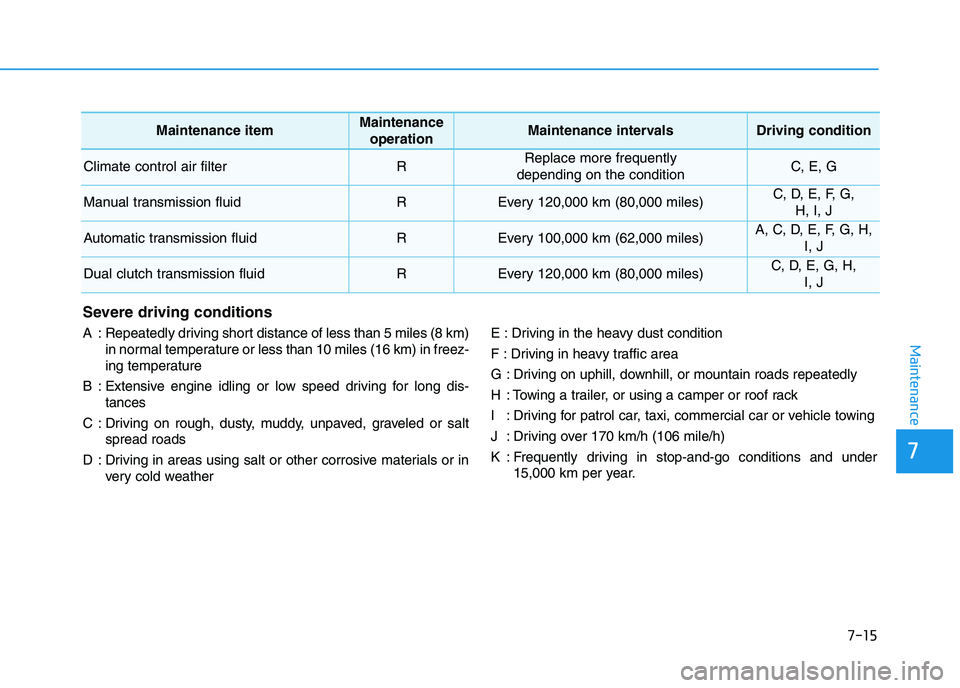
7-15
7
Maintenance
Severe driving conditions
A : Repeatedly driving short distance of less than 5 miles (8 km)in normal temperature or less than 10 miles (16 km) in freez-
ing temperature
B : Extensive engine idling or low speed driving for long dis- tances
C : Driving on rough, dusty, muddy, unpaved, graveled or salt spread roads
D : Driving in areas using salt or other corrosive materials or in very cold weather E : Driving in the heavy dust condition
F : Driving in heavy traffic area
G : Driving on uphill, downhill, or mountain roads repeatedly
H : Towing a trailer, or using a camper or roof rack
I : Driving for patrol car, taxi, commercial car or vehicle towing
J : Driving over 170 km/h (106 mile/h)
K : Frequently driving in stop-and-go conditions and under
15,000 km per year.
Maintenance itemMaintenance
operationMaintenance intervalsDriving condition
Climate control air filter RReplace more frequently
depending on the conditionC, E, G
Manual transmission fluidREvery 120,000 km (80,000 miles)C, D, E, F, G, H, I, J
Automatic transmission fluidREvery 100,000 km (62,000 miles)A, C, D, E, F, G, H, I, J
Dual clutch transmission fluidREvery 120,000 km (80,000 miles)C, D, E, G, H, I, J
Page 534 of 659

7-21
7
Maintenance
Maintenance itemMaintenance operationMaintenance intervalsDriving
condition
Disc brakes and pads, calipers and rotorsIInspect more frequently
depending on the conditionC, D, E, G, H
Parking brake (if equipped)IInspect more frequently
depending on the conditionC, D, G, H
Driveshaft and bootsIInspect more frequently
depending on the conditionC, D, E, F, G, H, I, J
Climate control air filterRReplace more frequently
depending on the conditionC, E, G
Manual transmission fluidREvery 120,000 km (80,000 miles)C, D, E, F, G, H, I, J
Automatic transmission fluidREvery 100,000 km (62,000 miles)A, C, F, G, H, I, J
Dual clutch transmission fluidREvery 120,000 km (80,000 miles)C, D, E, G, H, I, J
Severe driving conditions
A : Repeatedly driving short distance of less than 5 miles (8 km)in normal temperature or less than 10 miles (16 km) in freez-
ing temperature
B : Extensive engine idling or low speed driving for long distances
C : Driving on rough, dusty, muddy, unpaved, graveled or salt spread roads
D : Driving in areas using salt or other corrosive materials or in very cold weather E : Driving in the heavy dust condition
F : Driving in heavy traffic area
G : Driving on uphill, downhill, or mountain roads repeatedly
H : Towing a trailer, or using a camper or roof rack
I : Driving for patrol car, taxi, commercial car or vehicle towing
J : Driving over 170 km/h (106 mile/h)
K : Frequently driving in stop-and-go conditions
Page 539 of 659

Maintenance
7-26
Severe driving conditions
A : Repeatedly driving short distance of less than 5 miles (8 km)in normal temperature or less than 10 miles (16 km) in freez-
ing temperature
B : Extensive engine idling or low speed driving for long dis- tances
C : Driving on rough, dusty, muddy, unpaved, graveled or salt spread roads
D : Driving in areas using salt or other corrosive materials or in very cold weather E : Driving in heavy dust condition
F : Driving in heavy traffic area
G : Driving on uphill, downhill, or mountain roads repeatedly
H : Towing a trailer, or using a camper or roof rack
I : Driving for patrol car, taxi, commercial car or vehicle towing
J : Driving over 170 km/h (106 mile/h)
K : Frequently driving in stop-and-go conditions and under
15,000 km per year.
Maintenance itemMaintenance
operationMaintenance intervalsDriving condition
Climate control air filter RReplace more frequently
depending on the conditionC, E, G
Manual transmission fluidREvery 120,000 km (80,000 miles)C, D, E, F, G, H, I, K
Dual clutch transmission fluidREvery 120,000 km (80,000 miles)C, D, E, G, H, I, K
Page 544 of 659

7-31
7
Maintenance
Maintenance itemMaintenance operationMaintenance intervalsDriving
condition
Climate control air filter RReplace more frequently
depending on the conditionC, E, G
Manual transmission fluidREvery 120,000 km (80,000 miles)C, D, E, F, G, H, I, J
Dual clutch transmission fluidREvery 120,000 km (80,000 miles)C, D, E, G, H, I, J
Severe driving conditions
A : Repeatedly driving short distance of less than 5 miles (8 km)in normal temperature or less than 10 miles (16 km) in freez-
ing temperature
B : Extensive engine idling or low speed driving for long distances
C : Driving on rough, dusty, muddy, unpaved, graveled or salt spread roads
D : Driving in areas using salt or other corrosive materials or in very cold weather E : Driving in heavy dust condition
F : Driving in heavy traffic area
G : Driving on uphill, downhill, or mountain roads repeatedly
H : Towing a trailer, or using a camper or roof rack
I : Driving for patrol car, taxi, commercial car or vehicle towing
J : Driving over 170 km/h (106 mile/h)
K : Frequently driving in stop-and-go conditions
Page 564 of 659

7-51
7
Maintenance
By jump starting
After a jump start from a good bat-
tery, drive the vehicle for 20-30 min-
utes before it is shutoff. The vehicle
may not restart if you shut it off
before the battery had a chance to
adequately recharge. See “Jump
Starting” in chapter 6 for more infor-
mation on jump starting procedures.
Information
An inappropriately disposedbattery can be harmful to
the environment and human
health.
Dispose the battery according to your
local law(s) or regulation.
Reset items
Items should be reset after the bat-
tery has been discharged or the bat-
tery has been disconnected.
Auto up/down window
Sunroof
Trip computer
Climate control system
Driver position memory system
Clock
Audio system
i
AGM battery (if equipped)
Absorbent Glass Matt (AGM)
batteries are maintenance-
free and we recommend that
the AGM battery be serviced
by an authorized HYUNDAI
dealer. For charging your
AGM battery, use only fully
automatic battery chargers
that are specially developed
for AGM batteries.
When replacing the AGM bat-
tery, we recommend that you
use parts for replacement
from an authorized HYUNDAI
dealer.
Do not open or remove the
cap on top of the battery. This
may cause leaks of internal
electrolyte that could result in
severe injury.
CAUTION

