Page 448 of 502

7-42
Maintenance
FUSES
A vehicle’s electrical system is pro-
tected from electrical overload dam-
age by fuses.
This vehicle has 2 (or 3) fuse panels,
one located in the driver’s side panel
bolster, the other in the engine com-
partment near the battery.
If any of your vehicle’s lights, acces-
sories, or controls do not work, check
the appropriate circuit fuse. If a fuse
has blown, the element inside the
fuse will be melted.
If the electrical system does not
work, first check the driver’s side
fuse panel.
Before replacing a blown fuse, dis-
connect the negative battery cable.
Always replace a blown fuse with
one of the same rating.
If the replacement fuse blows, this
indicates an electrical problem. Avoid
using the system involved and imme-
diately consult a HYUNDAI autho-
rised repairer.
Four kinds of fuses are used: blade
type for lower amperage rating, car-
tridge type, multi fuse and fusible link
for higher amperage ratings.
✽NOTICE
The actual fuse/relay panel label
may differ from equipped items.
Fuse replacement
•Never replace a fuse with any-
thing but another fuse of the
same rating.
•A higher capacity fuse could
cause damage and possibly
cause a fire.
•Never install a wire or alu-
minum foil instead of the prop-
er fuse - even as a temporary
repair. It may cause extensive
wiring damage and a possible
fire.
WARNING
Do not use a screwdriver or any
other metal object to remove
fuses because it may cause a
short circuit and damage the
system.
CAUTION
Normal Normal
■Cartridge type
■Multi fuseBlown
Blown
Normal Blown
■Fusible link
NormalBlown
OLMB073029/OBH072060 ■Blade type
Page 459 of 502
7-53
7
Maintenance
Fuse NameSymbolFuse ratingCircuit Protected
IGN 230AIG2 Relay
ECU 330AEngine Control Relay
Module 110AAWD ECM, Smart Cruise Control Radar
Wiper 210AMetal Core Block (PCB #2 - Wiper Relay)
Washer Relay20AWasher Relay
Sensor 210AECM, Oxygen Sensor #1/#2/#3/#4
Sensor 110AECM, Oxygen Sensor #1/#2/#3/#4
Sensor 310AECM, Rear Junction Block (Fuel Pump Relay)
Sensor 410ARLY. 1 (Cooling Fan Relay) : LHD (E/R Junction Block), RHD (Sub E/R Junction Block)
Injector15AInjector Drive Box
Ignition Coil20AG6DG/G6DH/G6DJ : Condenser, Ignition Coil #1/#2/#3/#4/#5/#6,
G8BE : Condenser #1/#2, Ignition Coil #1/#2/#3/#4/#5/#6/#7/#8
Deicer Relay20AMetal Core Block (PCB #2 - Front Deicer Relay)
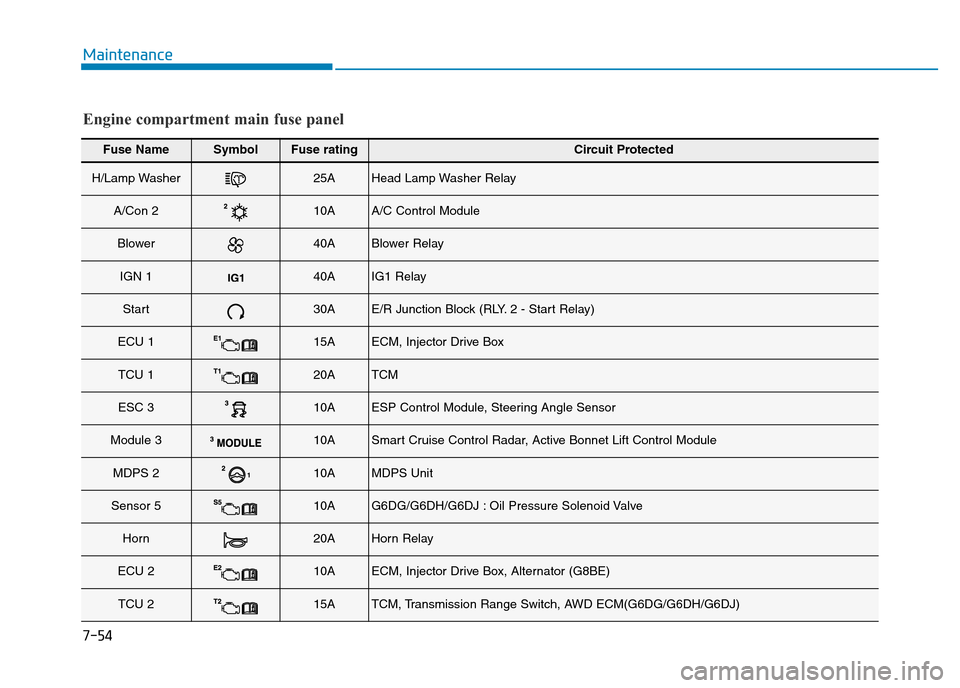
Engine compartment main fuse panel
Page 460 of 502
7-54
Maintenance
Fuse NameSymbolFuse ratingCircuit Protected
H/Lamp Washer25AHead Lamp Washer Relay
A/Con 210AA/C Control Module
Blower40ABlower Relay
IGN 140AIG1 Relay
Start30AE/R Junction Block (RLY. 2 - Start Relay)
ECU 115AECM, Injector Drive Box
TCU 120ATCM
ESC 310AESP Control Module, Steering Angle Sensor
Module 310ASmart Cruise Control Radar, Active Bonnet Lift Control Module
MDPS 210AMDPS Unit
Sensor 510AG6DG/G6DH/G6DJ : Oil Pressure Solenoid Valve
Horn20AHorn Relay
ECU 210AECM, Injector Drive Box, Alternator (G8BE)
TCU 215ATCM, Transmission Range Switch, AWD ECM(G6DG/G6DH/G6DJ)
Engine compartment main fuse panel
Page 482 of 502

7-76
Maintenance
Waxing
Wax the vehicle when water will no
longer bead on the paint.
Always wash and dry the vehicle
before waxing. Use a good quality
liquid or paste wax, and follow the
manufacturer’s instructions. Wax all
metal trim to protect it and to main-
tain its luster. Removing oil, tar, and
similar materials with a spot remover
will usually strip the wax from the fin-
ish. Be sure to re-wax these areas
even if the rest of the vehicle does
not yet need waxing.
ODH073048
Wet brakes
After washing the vehicle, test
the brakes whilst driving slowly
to see if they have been affected
by water. If braking performance
is impaired, dry the brakes by
applying them lightly whilst
maintaining a slow forward
speed.
WARNING
•Water washing in the engine
compartment including high
pressure water washing may
cause the failure of electrical
circuits located in the engine
compartment.
•Never allow water or other liq-
uids to come in contact with
electrical/electronic compo-
nents inside the vehicle as
this may damage them.
CAUTION
•Wiping dust or dirt off the
body with a dry cloth will
scratch the finish.
•Do not use steel wool, abra-
sive cleaners, or strong deter-
gents containing highly alka-
line or caustic agents on
chrome-plated or anodised
aluminum parts. This may
result in damage to the pro-
tective coating and cause dis-
colouration or paint deteriora-
tion.
CAUTION
Page 497 of 502
8-6
Specifications & Consumer information
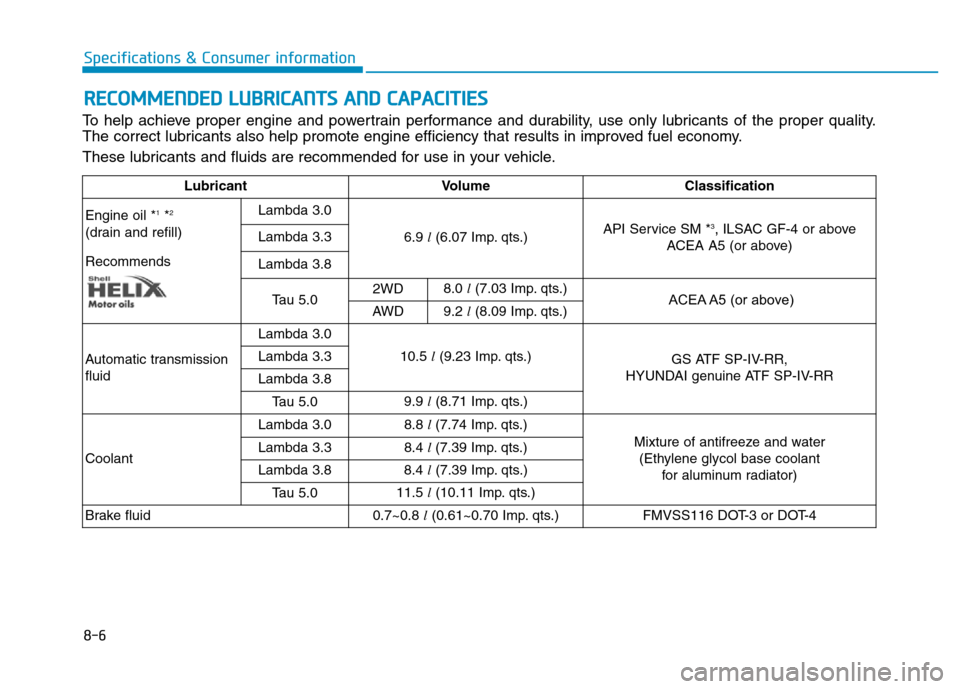
RECOMMENDED LUBRICANTS AND CAPACITIES
To help achieve proper engine and powertrain performance and durability, use only lubricants of the proper quality.
The correct lubricants also help promote engine efficiency that results in improved fuel economy.
These lubricants and fluids are recommended for use in your vehicle.
LubricantVolume Classification
Engine oil *
1*2
(drain and refill)
RecommendsLambda 3.06.9l(6.07 Imp. qts.)API Service SM *3, ILSAC GF-4 or above
ACEA A5 (or above) Lambda 3.3
Lambda 3.8
Tau 5.02WD8.0l(7.03 Imp. qts.)ACEA A5 (or above)AWD9.2l(8.09 Imp. qts.)
Automatic transmission
fluidLambda 3.0
10.5l(9.23 Imp. qts.)
GS ATF SP-IV-RR,
HYUNDAI genuine ATF SP-IV-RR Lambda 3.3
Lambda 3.8
Tau 5.09.9l(8.71 Imp. qts.)
Coolant
Lambda 3.08.8l (7.74 Imp. qts.)
Mixture of antifreeze and water
(Ethylene glycol base coolant
for aluminum radiator) Lambda 3.38.4l (7.39 Imp. qts.)
Lambda 3.8
8.4l(7.39 Imp. qts.)
Tau 5.0
11.5l(10.11 Imp. qts.)
Brake fluid0.7~0.8 l(0.61~0.70 Imp. qts.)FMVSS116 DOT-3 or DOT-4
Page 498 of 502

8-7
8
Specifications & Consumer information*1: Refer to the recommended SAE viscosity numbers on the next page.
*2: Engine oils labelled Energy Conserving Oil are now available. Along with other additional benefits, they contribute to fuel econ-
omy by reducing the amount of fuel necessary to overcome engine friction. Often, these improvements are difficult to measure
in everyday driving, but in a year’s time, they can offer significant cost and energy savings.
*
3: If the API service SM or ACEA A5 engine oil is not available in your country, you are able to use API service SL or ACEA A3.
*4: If the front/rear differential is submerged, we recommend that you visit a HYUNDAI authorised repairer to replace differential
oil.Lubricant Volume Classification
Front (AWD)/rear differential oil *
40.7l(0.61 Imp. qts.) /
1.4l(1.23 Imp. qts.)HYPOID GEAR OIL API GL-5, SAE 75W/90
(SHELL HD AXLE OIL 75W/90 or equivalent)
Transfer case oil (AWD) 0.62l(0.54 Imp. qts.)
SHELL TF0870
Fuel77 l(16.93 Imp. gal.)
Refer to “Fuel Requirements” in the Foreword chapter.
Page 499 of 502

8-8
Specifications & Consumer information
Recommended SAE viscosity
number Engine oil viscosity (thickness) has
an effect on fuel economy and cold
weather operating (engine start and
engine oil flow ability). Lower viscos-
ity engine oils can provide better fuel
economy and cold weather perform-
ance; however, higher viscosity
engine oils are required for satisfac-
tory lubrication in hot weather. Using oils of any viscosity other than
those recommended could result in
engine damage. When choosing an
oil, consider the range of tempera-
ture your vehicle will be operated in
before the next oil change. Proceed
to select the recommended oil vis-
cosity from the chart.
Always be sure to clean the area
around any filler plug, drain
plug, or dipstick before check-
ing or draining any lubricant.
This is especially important in
dusty or sandy areas and when
the vehicle is used on unpaved
roads. Cleaning the plug and
dipstick areas will prevent dirt
and grit from entering the
engine and other mechanisms
that could be damaged.
CAUTION
Temperature Range for SAE Viscosity Numbers
Temperature
Petrol
Engine Oil *
1
°C
(°F)-30 -20 -10 0 10 20 30 40 50
-10 0 20 40 60 80 100 120
20W-50
10W-30
15W-40
5W-30, 5W-40 (For 5.0L)
*1: For better fuel economy, it is recommended to use the engine oil of a viscosity
grade SAE 5W-30 (API SM/ILSAC GF-4 (For 3.0L, 3.3L, 3.8L)/ACEA A5).
However, if the engine oil is not available in your country, select the proper engine
oil using the engine oil viscosity chart.
Page 501 of 502
8-10
Specifications & Consumer information
The tyres supplied on your new vehi-
cle are chosen to provide the best
performance for normal driving.
The tyre label located on the driver's
side centre pillar gives the tyre pres-
sures recommended for your vehicle.
The engine number is stamped on
the engine block as shown in the
drawing.A compressor label informs you the
type of compressor your vehicle is
equipped with such as model, suppli-
er part number, production number,
refrigerant (1) and refrigerant oil (2).
TYRE SPECIFICATION AND
PRESSURE LABELENGINE NUMBER
ODH084005R
ODH083003
ODH083007L
■Lambda Engine
■Tau Engine
OHC081001
AIR CONDITIONER
COMPRESSOR LABEL
Page:
< prev 1-8 9-16 17-24