2016 Hyundai Equus service
[x] Cancel search: servicePage 263 of 477

Automatic transmission opera-
tion
The automatic transmission has 8
forward speed levels and 1 reverse
speed level. Vehicle speed is auto-
matically selected, depending on the
shift lever position.
Information
A new vehicle may experience some-
what abrupt movement during the
first few shifts.
Always depress the brake pedalwhen moving the shift lever from N(Neutral) to a forward or reverse gear.
To avoid damage to your trans- mission, do not depress the
accelerator, when the shift lever
is in R (Reverse) or any forward
gear positions, and when the
brake is set.
(Continued)(Continued)
When a vehicle stops on a
slope, do not stop the vehicle
with the engine power.
Set the service brake or the
parking brake.
Do not shift from N(Neutral)/P(Park) to
D(Drive)/R(Reverse), when the
engine runs faster than the idle
speed.
Transmission ranges
The shift lever position is displayed
on the instrument cluster, when the
Engine Start/Stop button is ON.
P (Park)
Always completely stop the vehicle
before moving the shift lever to P
(Park). This locks the transmission
and prevents the drive wheels from
rotating.
NOTICE
i
5-12
Driving your vehicle
- Automatic transmission
Always take a look around your vehicle for any passers-
by, especially children, before
moving the shift lever to D
(Drive) or R (Reverse).
Before leaving the driver’s seat, always make sure the
shift lever is in P (Park). Then,
fully set the parking brake and
turn the engine OFF.
Unexpected and sudden vehi-
cle movement may occur
when these precautions are
not taken.
WARNING
Moving the shift lever to P(Park), while driving, locks the
drive wheels, possibly result-
ing in your loss of vehicle
control.
Do not set the shift lever in P (Park) instead of setting the
parking brake. Always make
sure the shift lever is latched
in P(Park) position, and the
parking brake is fully set.
Never leave a child unattend- ed in a vehicle.
WARNING
Page 264 of 477

R (Reverse)
Set the shift lever in this position to
drive backwards.
Always completely stop the vehi-
cle before changing the shift lever
to or out of R (Reverse). You may
damage the transmission when
changing the shift lever to R while
driving, except as explained in
"Rocking the Vehicle" in this chap-
ter.
N (Neutral)
The wheels and transmission are not
engaged. The vehicle rolls freely
even on the slightest slope, unless
the parking brake or service brake is
applied.
D (Drive)
This is for the forward driving posi-
tion. The transmission will automati-
cally shift in a 8-gear sequence, pro-
viding the best fuel economy and
power.
For extra power to pass ahead
another vehicle or to climb a slope,
fully depress the accelerator. Then,
the transmission will automatically
downshift to the next lower gear (or
gears, as appropriate).
Information
Always come to a complete stop before
changing the shift lever to D (Drive).
Sports Mode
Whether the vehicle is idle or in
motion, sports mode is selected by
moving the shift lever from D(Drive)
to the manual gate. To return to
D(Drive), push the shift lever back
into the main gate.
In sports mode, moving the shift
lever backwards and forwards will
allow rapid gear shifting.
Up (+) : Push the shift lever for-wards once to shift up one
gear.
Down (-) : Pull the shift lever back- wards once to shift down
one gear.
Information
• In sports mode, the driver must exe-cute upshifts in accordance with
road conditions, taking care to keep
the engine speed below the red zone.
• In sports mode, only the 8 forward gears can be selected. To reverse or
park the vehicle, move the shift
lever to the R (Reverse) or P (Park)
position as required.
(Continued)
i
i
NOTICE
5-13
Driving your vehicle05
OVI055010N
+ (UP)
- (DOWN)
Sports mode
Page 267 of 477

Moving up a steep grade from astanding start
To drive up on a steep slope,
depress the brake pedal, move the
shift gear to D (Drive), and release
the parking brake. Gradually depress
the accelerator while releasing the
service brakes.
When accelerating on a steep
slope, the vehicle may have a ten-
dency to slide backwards. Shifting
to the 2nd gear (Second Gear) will
help prevent the vehicle from slid-
ing backwards.
5-16
Driving your vehicle
Always buckle up! In a colli- sion, an unbelted occupant is
more likely to be seriously
injured or killed than a proper-
ly belted occupant.
Avoid high speeds when cor- nering or turning.
Do not make quick wheel steering, such as sharp lane
changes or fast, sharp turns.
The risk of rollover is greatly increased when you lose con-
trol of your vehicle at a high
speed.
Loss of control often occurs, when two or more wheels are
swerved out of the roadway
and are overly steered to
reenter the roadway.
In the event your vehicle is swerved out of the roadway,
do not make a sharp steering.
Instead, slow down the vehi-
cle before reentering into the
lanes.
Never exceed posted speed limits.
WARNING
When your vehicle is stuck in
snow, mud, sand and others,
you may rock the vehicle by
moving it forward and back-
wards. Do not attempt this pro-
cedure when there are people
or objects near the vehicle.
During the rocking operation,
the vehicle may suddenly move
forwards or backwards as it
becomes unstuck, causing
injury or damage to nearby peo-
ple or objects.
WARNING
Page 269 of 477

In the event of brake failure
When service brakes fail to operate
while driving, you can make an
emergency stop by setting the park-
ing brake. The braking distance,
however, will become longer than
normal.
Disc brakes wear indicator
Your vehicle is equipped with disc
brakes. When your brake pads are
worn down and new pads are
required, you will hear a high-pitched
warning sound from the front or rear
brakes. You may hear this beeping
sound or it may sound when the
brake pedal is depressed.
Please remember that some driving
conditions or climates may cause a
brake squeal when you first apply (or
lightly apply) the brakes. This is nor-
mal and does not indicate a problem
with your brakes.
To prevent costly brake repairs,do not drive continuously with
the worn-down brake pads.
Always replace brake pads in a set of a complete front and rear
axle.
NOTICE
5-18
Driving your vehicle
- Parking brake
Setting the parking brake while
driving at a normal speed may
cause a sudden loss of vehicle
control. If you must set the
parking brake to stop, set it with
great caution.
WARNING
- Brake wear
This brake wear warning sound
indicates that your vehicle
should be repaired. If you
ignore this audible warning
sound, you will eventually lose
braking performance, which
may lead to a serious accident.
WARNING
Page 325 of 477

5-74
Driving your vehicle
An AutoSock, which is in the wrong size or is improperly
installed, may damage brake
lines, suspension, body and
wheels of your vehicle.
Stop driving and retighten the AutoSock, whenever there are
snapping sounds between the
vehicle and the AutoSock.
Use high quality ethylene gly-
col coolant
The cooling system of your vehicle is
filled with the high-quality ethylene
glycol coolant when being delivered.
It is the only type of coolant that your
vehicle is filled with, because it pre-
vents corrosion of the cooling sys-
tem, lubricates the water pump and
prevents freezing. Refill the cooling
system in accordance with your
maintenance schedule in the chapter
7. Before winter, check your coolant
to assure that the freezing point is
sufficiently lower than the expected
winter temperature.
Check battery and cables
The winter temperature increases
the battery consumption. Inspect the
battery and cables, as described in
the chapter 7. The battery charging
level can be checked by an author-
ized EQUUS dealer or in a service
station.
Change to "winter weight" oil,
if necessary
In some regions during the cold win-
ter, it is recommended to use the
"winter weight" oil with lower viscosi-
ty. For further information about this,
refer to the chapter 8. When you can-
not be sure about a type of winter
weight oil, consult an authorized
EQUUS dealer.
Check spark plugs and ignition
system
Inspect your spark plugs and, if nec-
essary, replace them. Also check all
ignition wirings and components for
any cracks, wear-out, and damage.
NOTICE
- Chain installation
When installing the AutoSock,
park the vehicle on level ground
away from other vehicles. Press
ON the Hazard Warning flasher
and place a warning triangle
behind your vehicle, if available.
Place the shift lever in P(Park),
set the parking brake and turn
OFF the engine, before
installing the AutoSock.
WARNING
- Tire chains
The use of the AutoSock may
adversely affect vehicle han-
dling.
Do not drive faster than the lower of the two - 20 mph (30
km/h) and the AutoSock manu-
facturer’s recommended
speed limit.
Drive carefully and avoid bumps, holes, sharp turns, and
other road hazards, which may
bounce the vehicle.
Avoid turning sharply or lock- ing the wheel brake.
WARNING
Page 334 of 477

What to do in an emergency
Road warning..........................................................6-2
Hazard warning flasher ...................................................6-2
In case of an emergency while driving ..............6-2
If the engine stalls at a crossroad or a railroad
crossing........................................................................\
........6-2
If you have a flat tire while driving..............................6-2
If engine stalls while driving...........................................6-3
If the engine will not start ...................................6-3
When the engine does not revolve, or slowly
revolves........................................................................\
........6-3
When the engine normally revolves, but does not
start.....................................................................\
..................6-3
Emergency starting ...............................................6-4
Jump starting ......................................................................6-\
4
Push-starting .....................................................................6-5\
If the engine overheats ........................................6-6
Tire pressure monitoring system (TPMS) ..........6-7
Low tire pressure telltale ................................................6-8
Low tire pressure position telltale ................................6-8
TPMS (Tire Pressure Monitoring System)
malfunction indicator .......................................................6-9
Changing a tire with TPMS...........................................6-10
If you have a flat tire..........................................6-12
Jack and tools ..................................................................6-12
Removing and storing the spare tire .........................6-13
Changing tires .................................................................6-13
Jack label ........................................................................\
...6-19
Towing ...................................................................6-20
Towing service .................................................................6-20
Removable towing hook ................................................6-22
Emergency towing ..........................................................6-22
Page 341 of 477

Always check the TPMS malfunction
telltale after replacing one or more
tires or wheels on your vehicle to
ensure that the replacement or alter-
nate tires and wheels allow the TPMS
to continue to function properly.
Information
If any of the followings happens, we
recommend that the system be
checked by an authorized EQUUS
dealer.
1. The low tire pressure telltale/TPMSmalfunction indicator does not illu-
minate for 3 seconds when the igni-
tion switch is turned ON or engine is
running.
2. The TPMS malfunction indicator remains ON after flashing for
approximately 1 minute.
3. The Low tire pressure position tell- tale remains ON.
Low tire pressure tell-
tale
Low tire pres-
sure position
telltale
When the TPMS malfunction indica-
tor illuminates with a warning mes-
sage on the LCD display, one or
more of your tires are significantly
under-inflated. The low tire pressure
position telltale pinpoints which tire is
significantly under-inflated with the
illumination of the corresponding
position light.
When the low tire pressure telltale
illuminates, immediately decrease
your driving speed, avoid hard cor-
nering and prepare for a longer stop-
ping distance. You should immediate-
ly stop the vehicle and check your
tires. Inflate the tires to the proper
pressure as indicated on the vehi-
cle’s placard or tire inflation pressure
label, which is on the right lower part
of the driver’s door sill.
When you cannot reach to a service
station, or when the tire cannot keep
the inflated air inside, replace the
under-inflated tire with the spare tire.
Until you repair or replace the under-
inflated tire, the low tire pressure tell-
tale remains ON, and the TPMS mal-
function indicator also remains ON
after 1-minute flashing (when the
vehicle is driven for approximately 20
minutes at a speed above 15.5 mph
(25 km/h)).
i
6-8
What to do in an emergency
OVI045740
Page 345 of 477
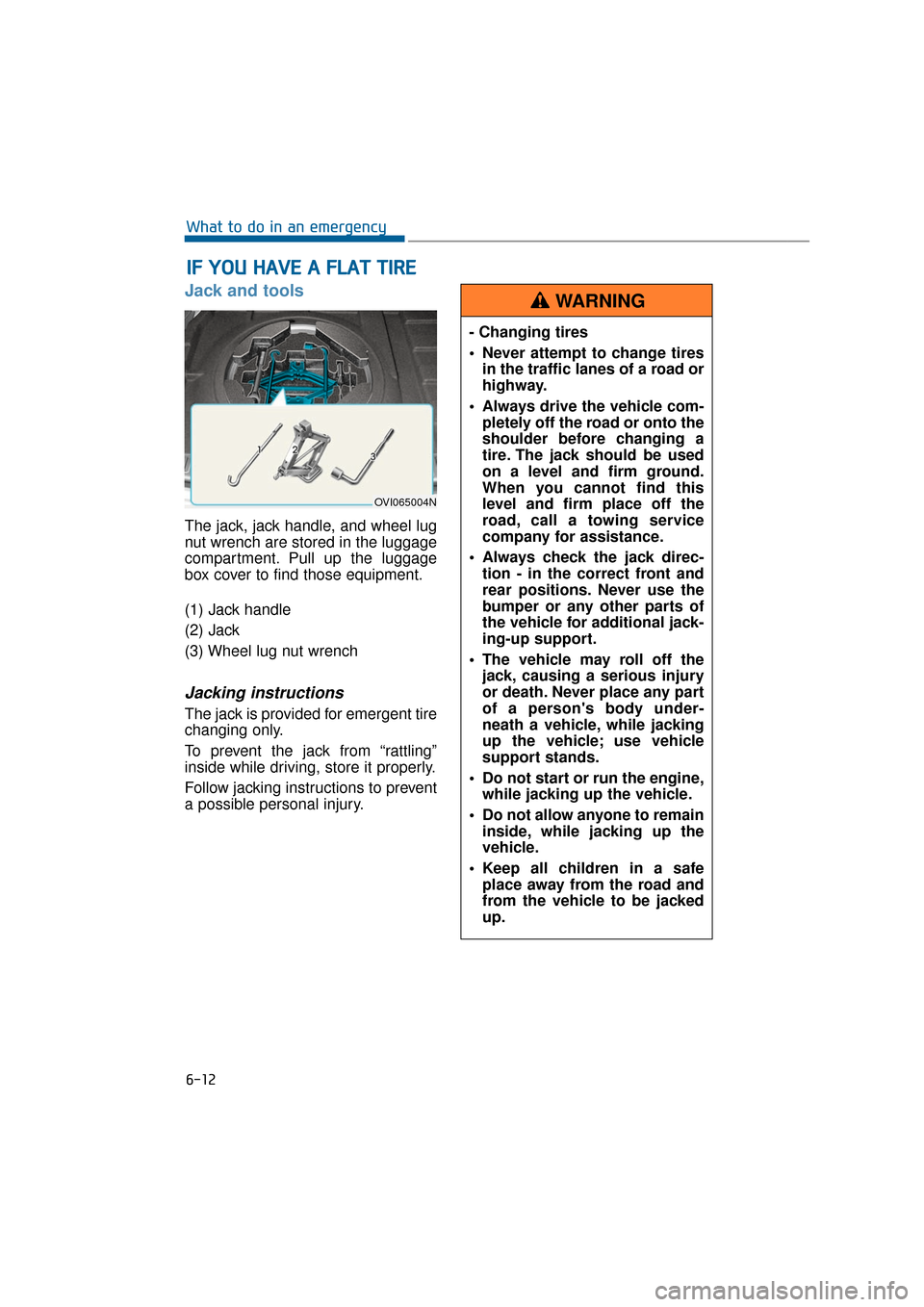
Jack and tools
The jack, jack handle, and wheel lug
nut wrench are stored in the luggage
compartment. Pull up the luggage
box cover to find those equipment.
(1) Jack handle
(2) Jack
(3) Wheel lug nut wrench
Jacking instructions
The jack is provided for emergent tire
changing only.
To prevent the jack from “rattling”
inside while driving, store it properly.
Follow jacking instructions to prevent
a possible personal injury.
I IF
F
Y
Y O
O U
U
H
H A
AV
VE
E
A
A
F
F L
LA
A T
T
T
T I
IR
R E
E
6-12
What to do in an emergency
OVI065004N
- Changing tires
Never attempt to change tires
in the traffic lanes of a road or
highway.
Always drive the vehicle com- pletely off the road or onto the
shoulder before changing a
tire. The jack should be used
on a level and firm ground.
When you cannot find this
level and firm place off the
road, call a towing service
company for assistance.
Always check the jack direc- tion - in the correct front and
rear positions. Never use the
bumper or any other parts of
the vehicle for additional jack-
ing-up support.
The vehicle may roll off the jack, causing a serious injury
or death. Never place any part
of a person's body under-
neath a vehicle, while jacking
up the vehicle; use vehicle
support stands.
Do not start or run the engine, while jacking up the vehicle.
Do not allow anyone to remain inside, while jacking up the
vehicle.
Keep all children in a safe place away from the road and
from the vehicle to be jacked
up.
WARNING