Page 345 of 477
Jack and tools
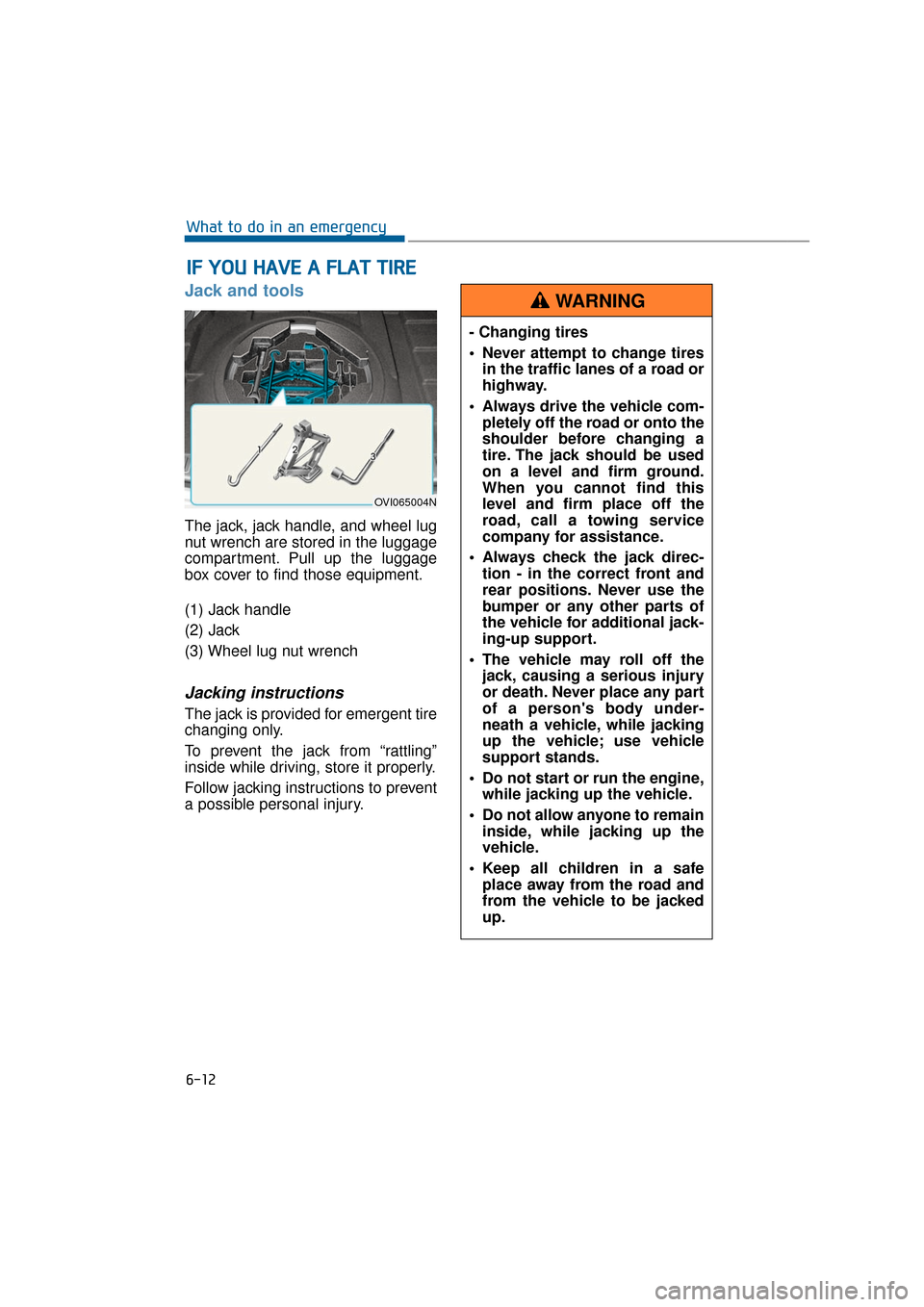
The jack, jack handle, and wheel lug
nut wrench are stored in the luggage
compartment. Pull up the luggage
box cover to find those equipment.
(1) Jack handle
(2) Jack
(3) Wheel lug nut wrench
Jacking instructions
The jack is provided for emergent tire
changing only.
To prevent the jack from “rattling”
inside while driving, store it properly.
Follow jacking instructions to prevent
a possible personal injury.
I IF
F
Y
Y O
O U
U
H
H A
AV
VE
E
A
A
F
F L
LA
A T
T
T
T I
IR
R E
E
6-12
What to do in an emergency
OVI065004N
- Changing tires
Never attempt to change tires
in the traffic lanes of a road or
highway.
Always drive the vehicle com- pletely off the road or onto the
shoulder before changing a
tire. The jack should be used
on a level and firm ground.
When you cannot find this
level and firm place off the
road, call a towing service
company for assistance.
Always check the jack direc- tion - in the correct front and
rear positions. Never use the
bumper or any other parts of
the vehicle for additional jack-
ing-up support.
The vehicle may roll off the jack, causing a serious injury
or death. Never place any part
of a person's body under-
neath a vehicle, while jacking
up the vehicle; use vehicle
support stands.
Do not start or run the engine, while jacking up the vehicle.
Do not allow anyone to remain inside, while jacking up the
vehicle.
Keep all children in a safe place away from the road and
from the vehicle to be jacked
up.
WARNING
Page 352 of 477
1. Model Name
2. Maximum allowable load
3. When using the jack, set yourparking brake.
4. When using the jack, stop the engine.
5. Do not go under a vehicle while jacking up the vehicle.
6. The correct jack position under the frame
7. The base plate of jack must be vertical under the lifting point,
while jacking up the vehicle. 8. Set the shift lever in R(Reverse)
for the manual transmission, or set
the shift lever in P(Park) for the
automatic transmission.
9. The jack should be used on a firm level ground.
10. Jack manufacturing information
11. Production date
12. Representative company and address
6-19
What to do in an emergency06
❈The actual Jack label may differ from the illustration. For more detailed
information, check the label on the jack.
Jack label
OHYK065010
■ Example
OHYK065011
OHYK064002
Page 354 of 477
When emergently towing your vehi-
cle without a wheel dolly:
1.Set the Engine Start/Stop Button inthe ACC position.
2.Place the shift lever in N (Neutral).
3.Release the parking brake. When the ECS malfunction indica-
tor illuminates with no air in the
suspension, the vehicle height is
very low. Thus, do not drive the
vehicle to protect it from any pro-
jections on the ground. Tow your
vehicle to an authorized EQUUS
dealer and have the system
checked. You should tow the vehi-
cle as shown in the illustration.
When loading the vehicle onto the
tow truck, the loading slope angle (1)
should be less than 6°.
NOTICE
6-21
What to do in an emergency06
Do not tow the vehicle, drag-
ging the rear wheels on the
ground. This may damage the
vehicle.
Do not tow with a sling-type equipment. Use a wheel lift or
a flatbed.
CAUTION
Failure to set the shift lever in
N(Neutral) may cause internal
damage of the transmission.
CAUTION
OVI065102N
OVI065103N
OVI065014N
OVI065013N
Page 357 of 477

Use a towing strap, which is 16 feet(5 m) or shorter. Tie a white or red
cloth (about 12 inches (30 cm)
wide) in the middle of the strap for
the better visibility.
Drive carefully not to loosen the towing strap, while towing.
Information
Emergency towing is illegal in some
states. Contact an authorized EQUUS
dealer and tow the vehicle.
Emergency towing precautions
Set the shift lever in N (Neutral).
Release the parking brake.
Depress the brake pedal with extraforce, because the brake perform-
ance may be reduced.
Put extra force into the steering wheel operation, because the
power steering system may be dis-
abled.
Driving down a long slope may overheat the brakes, reducing the
brake performance. Stop driving at
intervals and cool off the brake
system. - Automatic transmission
When the car is towed, dragging
all four wheels on the ground, it
should be done only in a forward
direction. Be sure to set the shift
lever in N(Neutral). Unlock the
steering wheel by pressing the
Engine Start/Stop button to the
ACC position. A driver must be
in the towed vehicle to operate
both the steering wheel and
brakes.
To avoid a serious damage to the automatic transmission
while towing, limit the vehicle
speed to 10 mph (15 km/h) and
drive shorter than 1 mile (1.5
km).
Before towing, check any fluid lick of the automatic transmis-
sion. When it leaks, flatbed
equipment or a towing dolly
must be used.
NOTICE
i
6-24
What to do in an emergency
OVI065020N
Page 358 of 477

Maintenance
Engine compartment .............................................7-4
Maintenance services ...........................................7-5
Owner's responsibility ......................................................7-5
Owner's maintenance precautions ...............................7-6
Owner's maintenance ...........................................7-7
Owner's maintenance schedule ....................................7-7
Scheduled maintenance service ..........................7-8
Normal maintenance schedule .......................................7-9
Maintenance under severe usage conditions ..........7-22
Explanation of scheduled maintenance
items.......................................................................7\
-23
Engine oil ..............................................................7-25
Checking the engine oil level ....................................7-25
Changing the engine oil and filter ..............................7-26
Engine coolant......................................................7-27
Checking the coolant level ...........................................7-27
Changing the coolant .....................................................7-29
Brake fluid ............................................................7-30
Checking the brake fluid level .....................................7-30
Power steering fluid ............................................7-31
Checking the power steering fluid level ...................7-31
Checking the power steering hose.............................7-31
Washer fluid .........................................................7-32
Checking the washer fluid level ..................................7-32
Air cleaner ............................................................7-33
Filter replacement ...........................................................7-33
Page 360 of 477

Fuses ......................................................................7-\
56
Inner panel fuse replacement ......................................7-57
Engine compartment fuse replacement ....................7-59
Fuse/relay panel description .......................................7-60
Light bulbs.............................................................7-69
Headlight, position light, turn signal light,
side marker light and front fog light bulb
replacement ......................................................................7-\
70
Side repeater light bulb replacement.........................7-74
Rear combination light bulb replacement .................7-75
High mounted stop light ................................................7-75
License plate lamp replacement ..................................7-79
Interior light bulb replacement ....................................7-82
Appearance care ..................................................7-83
Exterior care ....................................................................7-83\
Interior care......................................................................7-\
88
Emission control system .....................................7-89
Crankcase emission control system ...........................7-89
Evaporative emission control system.........................7-89
Exhaust emission control system ...............................7-90
California perchlorate notice .............................7-92
Page 361 of 477
1. Engine coolant reservoir
2. Radiator cap
3. Brake fluid reservoir
4. Air cleaner
5. Engine oil dipstick6. Engine oil filler cap
7. Windshield washer fluid reservoir
8. Fuse box
9. Power steering fluid reservoir
10. Jumper terminal
E E
N
N G
GI
IN
N E
E
C
C O
O M
M P
PA
A R
RT
TM
M E
EN
N T
T
7-4
OVI015006N
Maintenance
❈ The actual engine compartment in the vehicle may differ from the illustration.
❈ The battery is in the trunk.
Page 363 of 477

7-6
Owner's maintenance precau-
tions
Improper or incomplete maintenance
may lead to a vehicle problem. This
section is to instruct only the simple
maintenance procedures that are
easy to perform.
As written above, complex mainte-
nance procedures must be done only
by an authorized EQUUS dealer with
special tools.
Information
Improper vehicle maintenance may
affect your warranty coverage, even
before the warranty expires. For more
information, refer to the separate
Owner’s Handbook & Warranty
Information booklet. When you are
unsure about any services or mainte-
nance procedures, contact an author-
ized EQUUS dealer.
i
Maintenance- Vehicle maintenance
Vehicle maintenance may bedangerous procedures. You
may be seriously injured
while performing some main-
tenance procedures. When
you do not have sufficient
maintenance knowledge and
experience, or you are not
equipped with the proper
tools, have those done by an
authorized EQUUS dealer.
Maintenance, with the hood opened and with the engine
running, is dangerous. It
becomes even more danger-
ous, when you wear jewelry or
loose clothes. Those items
may become entangled in
moving parts and result in a
injury.
Therefore, when you must run
the engine and open the hood,
you must take off all jewelry
(i.e. rings, bracelets, watches
and necklaces), ties, scarves,
and loose clothes before
approaching the engine or
cooling fans.
WARNING


