2016 Hyundai Elantra ECU
[x] Cancel search: ECUPage 10 of 669

13
Introduction
Your new vehicle is designed to use
only unleaded fuel having a pump
octane number ((R+M)/2) of 87 or
higher. (Do not use methanol blend-
ed fuels.)
Your new vehicle is designed to
obtain maximum performance with
UNLEADED FUEL, as well as mini-
mize exhaust emissions and spark
plug fouling.Gasoline containing alcohol andmethanol
Gasohol, a mixture of gasoline and
ethanol (also known as grain alco-
hol), and gasoline or gasohol con-
taining methanol (also known as
wood alcohol) are being marketed
along with or instead of leaded or
unleaded gasoline.
Do not use gasohol containing more
than 10% ethanol, and do not use
gasoline or gasohol containing any
methanol. Either of these fuels may
cause drivability problems and dam-
age to the fuel system, engine con-
trol system and emission control sys-
tem.
Discontinue using gasohol of any
kind if drivability problems occur.
Vehicle damage or drivability prob-
lems may not be covered by the
manufacturer’s warranty if they result
from the use of:
1. Gasohol containing more than 10% ethanol.
2. Gasoline or gasohol containing methanol.
3. Leaded fuel or leaded gasohol. "E85" fuel is an alternative fuel com-
prised of 85 percent ethanol and 15
percent gasoline, and is manufac-
tured exclusively for use in Flexible
Fuel Vehicles. “E85” is not compati-
ble with your vehicle. Use of “E85”
may result in poor engine perform-
ance and damage to your vehicle's
engine and fuel system. HYUNDAI
recommends that customers do not
use fuel with an ethanol content
exceeding 10 percent.
FUEL REQUIREMENTS
CAUTION
Never add any fuel system
cleaning agents to the fuel tankother than what has been speci-fied. (Consult an authorizedHYUNDAI dealer for details.)CAUTION
Your New Vehicle LimitedWarranty does not cover dam-age to the fuel system or anyperformance problems causedby the use of “E85” fuel.
CAUTION
Never use gasohol which con-tains methanol. Discontinue useof any gasohol product whichimpairs driveability.
WARNING
Do not "top off" after the noz- zle automatically shuts off
when refueling.
Always check that the fuel cap is installed securely to pre-
vent fuel spillage in the event
of an accident.
UD(FL) HMA 1.QXP 8/28/2014 5:02 PM Page 3
Page 32 of 669
Safety features of your vehicle
313
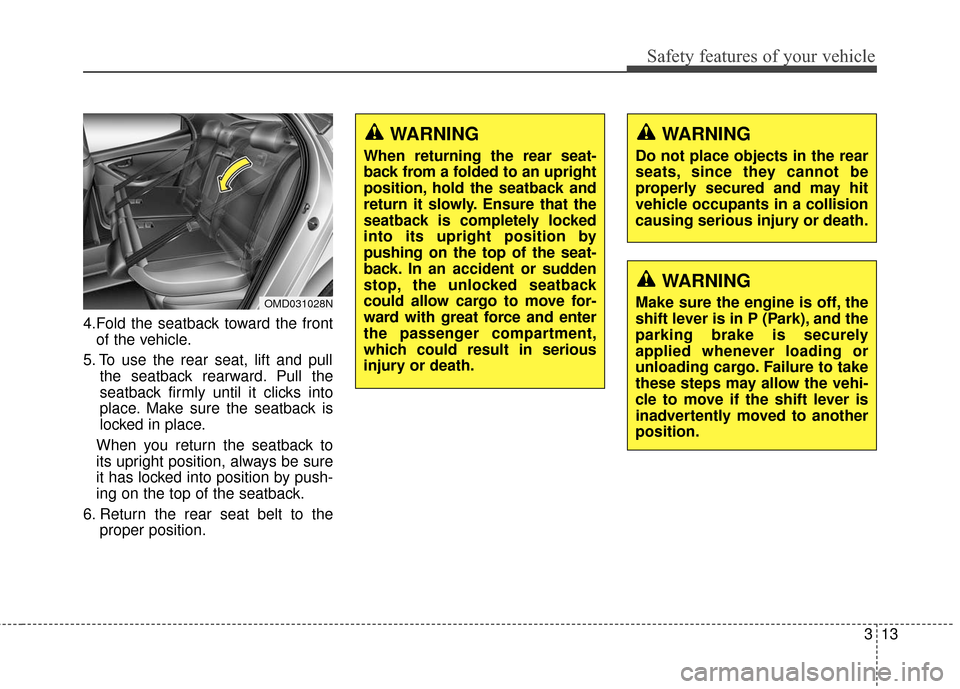
4.Fold the seatback toward the frontof the vehicle.
5. To use the rear seat, lift and pull the seatback rearward. Pull the
seatback firmly until it clicks into
place. Make sure the seatback is
locked in place.
When you return the seatback to
its upright position, always be sure
it has locked into position by push-
ing on the top of the seatback.
6. Return the rear seat belt to the proper position.
OMD031028N
WARNING
When returning the rear seat-
back from a folded to an upright
position, hold the seatback and
return it slowly. Ensure that the
seatback is completely locked
into its upright position by
pushing on the top of the seat-
back. In an accident or sudden
stop, the unlocked seatback
could allow cargo to move for-
ward with great force and enter
the passenger compartment,
which could result in serious
injury or death.
WARNING
Do not place objects in the rear
seats, since they cannot be
properly secured and may hit
vehicle occupants in a collision
causing serious injury or death.
WARNING
Make sure the engine is off, the
shift lever is in P (Park), and the
parking brake is securely
applied whenever loading or
unloading cargo. Failure to take
these steps may allow the vehi-
cle to move if the shift lever is
inadvertently moved to another
position.
Page 33 of 669

Safety features of your vehicle
14
3
Armrest
The armrest is located in the center
of the rear seat. Pull the armrest
down from the seatback to use it.
You will find cup holders on the cen-
ter armrest. Carrying long/narrow cargo
(if equipped)
Pull the armrest down using the strap
provided on the armrest. Pull the
cover down while pushing the release
lever (1) down. Additional cargo
space is provided to accommodate
long/narrow cargo (skis, poles, lum-
ber, etc.) not able to fit properly in the
trunk when closed.
OMD030029N
OMD030031
CAUTION
Make sure the engine is off,
the transaxle is in P and theparking brake is appliedwhenever loading or unload-ing cargo. Vehicle may move ifshift lever is inadvertentlymoved to another position.
Be careful when loading cargo through the rear passengerseats to prevent damage tothe vehicle interior.
When cargo is loaded through the rear passenger seats,ensure the cargo is properlysecured to prevent it frommoving while driving.
Unsecured cargo in the pas-senger compartment cancause damage to the vehicleor injury to it’s occupants.
Page 40 of 669

Safety features of your vehicle
321
This section describes how to use the
seat belts properly. It also describes
some of the things not to do when
using seat belts.
Seat belt safety precautions
Always fasten your seat belt and
make sure all passengers have fas-
tened their seat belts before starting
any trip. Air bags are designed to
supplement the seat belt as an addi-
tional safety device, but they are not a
substitute. Most states require all
occupants of a vehicle to wear seat
belts.
SEAT BELTS
WARNING
Seat belts must be used by ALL
passengers whenever the vehi-
cle is moving. Take the following
precautions when adjusting and
wearing seat belts:
ALWAYS properly restrain
children under age 13 in the
rear seats.
NEVER allow children to ride
in the front passenger seat. If
a child age 13 or older must be
seated in the front seat, move
the seat as far back as possi-
ble and properly restrain them
in the seat belt.
NEVER allow an infant or child
to be carried on an occupant’s
lap.
NEVER ride with the seatback
reclined when the vehicle is
moving.
Do not allow children to share
a seat or seat belt.
Do not wear the shoulder belt
under your arm or behind your
back.(Continued)
(Continued)
Do not use the seat belt if it is
twisted. A twisted seat belt
will not protect you properly
in an accident.
Do not use a seat belt if the
webbing or hardware is dam-
aged.
Do not latch the seat belt into
the buckles of other seats.
NEVER unfasten the seat belt
while driving. This may cause
loss of vehicle control result-
ing in an accident.
Make sure there is nothing in
the buckle interfering with the
seat belt latch mechanism.
This may prevent the seat belt
from fastening securely.
No modifications or additions
should be made by the user
which will either prevent the
seat belt adjusting devices
from operating to remove
slack, or prevent the seat belt
assembly from being adjusted
to remove slack.
Page 44 of 669

Seat Belt – Passenger’s 3-pointsystem with combination lockingretractor
This type of seat belt combines the
features of both an emergency lock-
ing retractor seat belt and an auto-
matic locking retractor seat belt.
Combination retractor type seat belts
are installed in the rear seat positions
to help accommodate the installation
of child restraint systems. Although a
combination retractor is also installed
in the front passenger seat position,
NEVER place any infant restraint sys-
tem in the front seat of the vehicle. To fasten your seat belt:
Pull the seat belt out of the retractor
and insert the metal tab into the
buckle. There will be an audible
"click" when the tab locks into the
buckle. When not securing a child
restraint, the seat belt operates in the
same way as the driver's seat belt
(Emergency Locking Retractor
Type). It automatically adjusts to the
proper length only after the lap belt
portion of the seat belt is adjusted
manually so that it fits snugly across
your hips.
When the seat belt is fully extended
from the retractor to allow the instal-
lation of a child restraint system, the
seat belt operation changes to allow
the belt to retract, but not to extend
(Automatic Locking Retractor Type).
Refer to “Using a Child Restraint
System” in this chapter.
Safety features of your vehicle
325
(Continued)
Position one arm under the
shoulder belt and the other over
the belt, as shown in the illus-
tration.
Always position the shoulder
belt anchor into the locked
position at the appropriate
height.
Never position the shoulder
belt across your neck or face.
Page 50 of 669

Safety features of your vehicle
331
Larger children
Children under age 13 and who are
too large for a booster seat must
always occupy the rear seat and use
the available lap/shoulder belts. A
seat belt should lie across the upper
thighs and be snug across the shoul-
der and chest to restrain the child
safely. Check belt fit periodically. A
child's squirming could put the belt
out of position. Always have the
LATCH system inspected by your
authorized HYUNDAI dealer after an
accident. An accident can damage
the LATCH system and may not
properly secure the child restraint.
If a larger child over age 13 must be
seated in the front seat, the child
must be securely restrained by the
available lap/shoulder belt and the
seat should be placed in the rear-
most position.
If the shoulder belt portion slightly
touches the child’s neck or face, try
placing the child closer to the center
of the vehicle. If the shoulder belt still
touches their face or neck they need
to be returned to an appropriate
booster seat.Transporting an injured person
A seat belt should be used when an
injured person is being transported.
Consult a physician for specific rec-
ommendations.
One person per belt
Two people (including children) should
never attempt to use a single seat belt.
This could increase the severity of
injuries in case of an accident.
WARNING
Always make sure children
are wearing their seat belts
and that they are properly
adjusted before driving.
NEVER allow the shoulder
belt to contact the child’s
neck or face.
Do not allow more than one
child to use a single seat belt.
Page 53 of 669

Safety features of your vehicle
34
3 Children under age 13 must always
ride in the rear seats and must
always be properly restrained to min-
imize the risk of injury in an accident,
sudden stop or sudden maneuver.
According to accident statistics, chil-
dren are safer when properly
restrained in the rear seats than in
the front seat.
Even with air bags,
children can be seriously injured
or killed. Children too large for a
child restraint must use the seat belts
provided.
All 50 states have child restraint laws
which require children to travel in
approved child restraint devices. The
laws governing the age or
height/weight restrictions at which
seat belts can be used instead of
child restraints differs among states,
so you should be aware of the spe-
cific requirements in your state, and
where you are travelling. Child restraint systems must be
properly placed and installed in the
rear seat. You must use a commer-
cially available child restraint system
that meets the requirements of the
Federal Motor Vehicle Safety
Standards (FMVSS).
Child restraint systems are generally
designed to be secured in a vehicle
seat by lap belt portion of a
lap/shoulder belt, or by a LATCH sys-
tem in the rear seats of the vehicle.
CHILD RESTRAINT SYSTEM (CRS)
WARNING
Always properly restrain chil-
dren in the rear seats of the
vehicle.
Children of all ages are safer
when restrained in the rear seat.
A child riding in the front pas-
senger seat can be forcefully
struck by an inflating air bag
resulting in SERIOUS INJURY
or DEATH.
Page 54 of 669

Safety features of your vehicle
335
Child restraint system (CRS)
Infants and younger children must be
restrained in an appropriate rear-fac-
ing or forward-facing CRS that has
first been properly secured to the
rear seat of the vehicle. Read and
comply with the instructions for
installation and use provided by the
manufacturer of the child restraint.
Selecting a Child Restraint
System (CRS)
When selecting a CRS for your child,
always:
Make sure the CRS has a labelcertifying that it meets applicable
Federal Motor Vehicle Safety
Standards (FMVSS 213).
Select a child restraint based on your child’s height and weight. The
required label or the instructions
for use typically provide this infor-
mation.
Select a child restraint that fits the vehicle seating position where it
will be used.
Read and comply with the warn- ings and instructions for installation
and use provided with the child
restraint system.
WARNING
An improperly secured child
restraint can increase the risk
of SERIOUS INJURY or DEATH
in an accident. Always take the
following precautions when
using a child restraint system:
NEVER install a child or infant
restraint in the front passen-
ger’s seat.
Always properly secure the
child restraint to a rear seat of
the vehicle.
(Continued)
(Continued)
Always follow the child
restraint system manufactur-
er’s instructions for installa-
tion and use.
Always properly restrain your
child in the child restraint.
Do not use an infant carrier or
a child safety seat that
“hooks” over a seatback, it
may not provide adequate
protection in an accident.
After an accident, have a
HYUNDAI dealer check the
child restraint system, seat
belts, tether anchors and
lower anchors.