2016 HYUNDAI COUPE deactivate
[x] Cancel search: deactivatePage 63 of 475

343
Safety features of your vehicle
Occupant classification sys-
tem
Your vehicle is equipped with an
occupant classification system in the
front passenger's seat.
The occupant classification system
is designed to detect the presence of
a properly-seated front passenger
and determine if the passenger's
front air bag should be enabled (may
inflate) or not. The driver's front air
bag is not affected or controlled by
the occupant classification system.
Main components of occupant
classification system
A detection device located withinthe front passenger seat track.
Electronic system to determine whether the passenger air bag
systems should be activated or
deactivated.
A warning light located on the instrument panel which illuminates
the words PASSENGER AIR BAG
"OFF" indicating the front passen-
ger air bag system is deactivated.
The instrument panel air bag warn- ing light is interconnected with the
occupant classification system.
If the front passenger seat is occu-
pied by a person that the system
determines to be of adult size, and
he/she sits properly (sitting upright
with the seatback in an upright posi-
tion, centered on the seat cushion
with their seat belt on, legs comfort-
ably extended and their feet on the
floor), the PASSENGER AIR BAG
"OFF" indicator will be turned off and
the front passenger's air bag will be
able to inflate, if necessary, in frontal
crashes. You will find the PASSENGER AIR
BAG "OFF" indicator on the center
facia panel. This system detects the
conditions 1~4 in the following table
and activates or deactivates the front
passenger air bag based on these
conditions.
OBK032058N
procarmanuals.com
Page 64 of 475

Safety features of your vehicle
44
3
Always be sure that you and all vehi-
cle occupants are seated and
restrained properly (sitting upright with
the seat in an upright position, cen-
tered on the seat cushion, with the
person's legs comfortably extended,
feet on the floor, and wearing the safe-
ty belt properly) for the most effective
protection by the air bag and the safe-
ty belt.
The OCS may not function proper-
ly if the passenger takes actions
which can affect the detection sys-
tem. These include:
(1) Failing to sit in an upright posi- tion.
(2) Leaning against the door or center console.
(3) Sitting towards the sides or the front of the seat.
(4) Putting legs on the dashboard or resting them on other loca-
tions which reduce the passen-
ger weight on the front seat.
(5) Improperly wearing the safety belt.
(6) Reclining the seat back.Condition and operation of the front passenger occupant classification system
*1) The system judges a person of adult size as an adult. When a
smaller adult sits in the front pas-
senger seat, the system may rec-
ognize him/her as a child depend-
ing on his/her physique and pos-
ture.
*2) Do not allow children to ride in the front passenger seat. When a
smaller child than the same age
sits in the front passenger seat,
the system may recognize
him/her as an infant depending on
his/her physique or posture. *3) Never install a child restraint sys-
tem on the front passenger seat.
WARNING
Riding in an improper position
or placing weight on the front
passenger's seat when it is
unoccupied by a passenger
adversely affects the occupant
classification system (OCS).
(Continued)
Condition detected by
the occupant classifica- tion system
1. Adult *
1
2. Child *2*3 of about 36
months old and
younger with child
restraint system
3. Unoccupied
4. There is a malfunc- tion in the system
Off
On
On
Off Off
Off
Off
On Activated
Deactivated
Deactivated Activated
PASSENGER AIR BAG "OFF" indicator lightSRS warning lightFront passenger air bag
Indicator/Warning light Devices
procarmanuals.com
Page 87 of 475

Features of your vehicle
44
Immobilizer system
(if equipped)
Your vehicle is equipped with an
electronic engine immobilizer system
to reduce the risk of unauthorized
vehicle use.
Your immobilizer system is com-
prised of a small transponder in the
ignition key and electronic devices
inside the vehicle.
With the immobilizer system, when-
ever you insert your ignition key into
the ignition switch and turn it to ON,
it checks and determines and verifies
that the ignition key is valid.
If the key is determined to be valid,
the engine will start.If the key is determined to be invalid,
the engine will not start.
To deactivate the immobilizer
system:
Insert the ignition key into the key
cylinder and turn it to the ON position.
To activate the immobilizer sys-tem:
Turn the ignition key to the OFF posi-
tion. The immobilizer system acti-
vates automatically. Without a valid
ignition key for your vehicle, the
engine will not start.
✽ ✽ NOTICE
When starting the engine, do not use
the key with other immobilizer keys
around. Otherwise the engine may
not start or may stop soon after it
starts. Keep each key separate in
order to avoid a starting malfunc-
tion.
✽ ✽NOTICE
If you need additional keys or lose
your keys, consult an authorized
HYUNDAI dealer.
WARNING
In order to prevent theft of your
vehicle, do not leave spare keys
anywhere in your vehicle. Your
Immobilizer password is a cus-
tomer unique password and
should be kept confidential. Do
not leave this number anywhere
in your vehicle.
OHD046100
CAUTION
Do not put metal accessories
near the ignition switch.
Metal accessories may interruptthe transponder signal and mayprevent the engine from beingstarted.
procarmanuals.com
Page 137 of 475
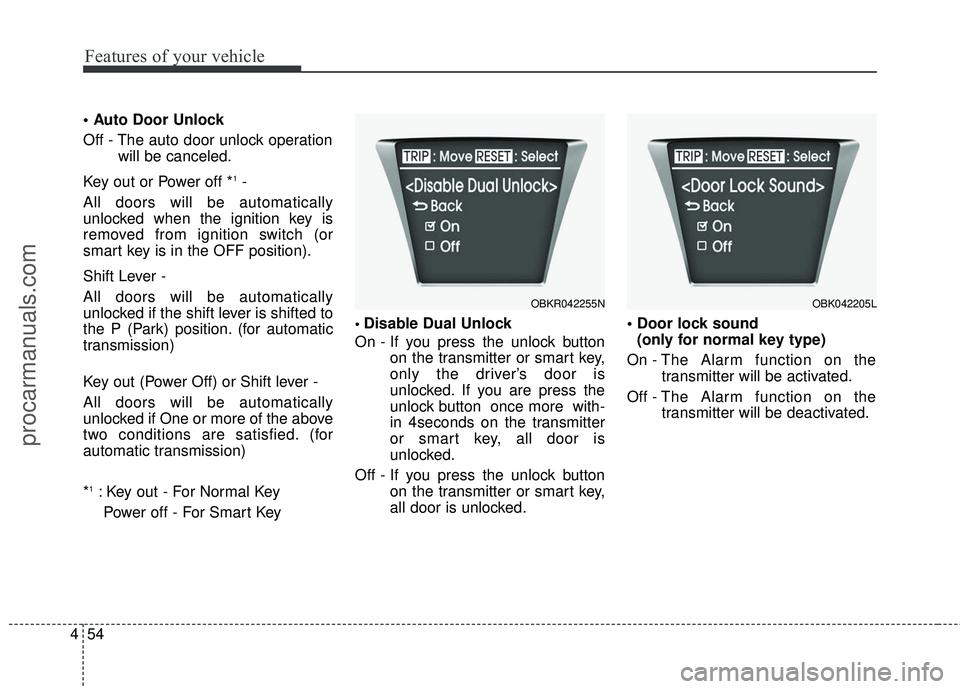
Features of your vehicle
54
4
Off - The auto door unlock operation
will be canceled.
Key out or Power off *
1-
All doors will be automatically
unlocked when the ignition key is
removed from ignition switch (or
smart key is in the OFF position).
Shift Lever -
All doors will be automatically
unlocked if the shift lever is shifted to
the P (Park) position. (for automatic
transmission)
Key out (Power Off) or Shift lever -
All doors will be automatically
unlocked if One or more of the above
two conditions are satisfied. (for
automatic transmission)
*
1: Key out - For Normal Key Power off - For Smart Key
Disable Dual Unlock
On - If you press the unlock button on the transmitter or smart key,
only the driver’s door is
unlocked. If you are press the
unlock button once more with-
in 4seconds on the transmitter
or smart key, all door is
unlocked.
Off - If you press the unlock button on the transmitter or smart key,
all door is unlocked.
(only for normal key type)
On - The Alarm function on the transmitter will be activated.
Off - The Alarm function on the
transmitter will be deactivated.
OBK042205LOBKR042255N
procarmanuals.com
Page 138 of 475

455
Features of your vehicle
On - The Headlamp Escort andEscort Welcome function will be
activated
Off - The Headlamp Escort and
Escort Welcome function will be
deactivated
For details, refer to “Lighting” in sec-
tion 4.
On - The lane change signals will
blink 3, 5 o 7 times when the turn
signal lever is moved slightly.
Off - The Auto Triple Turn function will be deactivated.
Auto Reset - The average fuel econ-
omy will reset automat-
ically when you drive
after refueling.
Manual Reset - The average fuel
economy will not
reset automatically
when you drive after
refueling.
OBK044207LOBK042208LOBK042206L
procarmanuals.com
Page 152 of 475

469
Features of your vehicle
ESC indicator(Electronic StabilityControl)
The ESC indicator will illuminate
when the ignition switch is turned
ON, but should go off after approxi-
mately 3 seconds. When the ESC is
on, it monitors the driving conditions.
Under normal driving conditions, the
ESC light will remain off. When a
slippery or low traction condition is
encountered, the ESC will operate,
and the ESC indicator will blink to
indicate the ESC is operating.
The ESC indicator stays on when the
ESC may have a malfunction. Take
your car to an authorized HYUNDAI
dealer and have the system
checked.
ESC OFF indicator
The ESC OFF indicator will illumi-
nate when the ignition switch is
turned ON, but should go off after
approximately 3 seconds. To switch
to ESC OFF mode, press the ESC
OFF button . The ESC OFF indica-
tor will illuminate indicating the
ESC is deactivated.
With the ESC system in the stand by
position, if you use the parking brake
to stop the vehicle due abnormal
brake operation, the ESC system
may be stopped and ESC OFF indi-
cator may illuminate for about 5
minutes.
Cruise indicator (if equipped)
CRUISE indicator
The indicator light illuminates when
the cruise control system is enabled.
The cruise indicator light in the
instrument cluster is illuminated
when the cruise control ON-OFF but-
ton on the steering wheel is pushed.
The indicator light turns off when the
cruise control ON-OFF button is
pushed again. For more information
about the use of cruise control, refer to
“Cruise control system” in section 5.
CAUTION
Do not use the parking brake tostop the vehicle, except in anemergency situation.
CRUISE
procarmanuals.com
Page 321 of 475

Driving your vehicle
34
5
ESC OFF indicator
The ESC OFF indicator will illumi-
nate when the ignition switch is
turned ON, but should go off after
approximately 3 seconds. To switch
to ESC OFF mode, press the ESC
OFF button . The ESC OFF indica-
tor will illuminate indicating the
ESC is deactivated.
If this indicator stays on when ESC
OFF is not selected, the ESC may
have a malfunction. Take your car to
an authorized HYUNDAI dealer and
have the system checked.
With the ESC system in the stand by
position, if you use the parking brake
to stop the vehicle due to abnormal
brake operation, the ESC system
may be stopped and ESC OFF indi-
cator may illuminate for about 5
minutes.
ESC OFF usage
When driving
ESC should be turned on for daily
driving whenever possible. If ESC
is turned off, it may be difficult to
make a turn or drive up a hill.
To turn ESC off while driving, press the ESC OFF button while driv-
ing on a flat road surface.
Never press the ESC OFF button
while ESC is operating (ESC indica-
tor light blinks).
If ESC is turned off while ESC is
operating, it may be very dangerous
because of unexpected vehicle slip.
✽ ✽ NOTICE
• When operating the vehicle on a
dynamometer, ensure that the
ESC is turned off (ESC OFF light illuminated). If the ESC is left
on, it may prevent the vehicle
speed from increasing, and result
in false diagnosis.
• Turning the ESC off does not affect ABS or brake system opera-
tion.
CAUTION
Driving with varying tire or
wheel sizes may cause the ESCsystem to malfunction. Whenreplacing tires, make sure theyare the same size as your origi-nal tires.
WARNING
The Electronic Stability Control
system is only a driving aid; use
precautions for safe driving by
slowing down on curved, snowy,
or icy roads. Drive slowly and
don’t attempt to accelerate
whenever the ESC indicator
light is blinking, or when the
road surface is slippery.
CAUTION
Do not use the parking brake tostop the vehicle, except in anemergency situation.
procarmanuals.com