2016 Hyundai Azera battery
[x] Cancel search: batteryPage 397 of 521

What to do in an emergency
46
IF THE ENGINE DOES NOT START
If engine does not turn over or
turns over slowly
1. If your vehicle has an automatictransaxle, be sure the shift lever is
in N (Neutral) or P (Park) and the
emergency brake is set.
2. Check the battery connections to be sure they are clean and tight.
3. Turn on the interior light. If the light dims or goes out when you oper-
ate the starter, the battery is dis-
charged.
4. Do not push or pull the vehicle to start it. See instructions for "Jump
starting".
If engine turns over normally
but does not start
1. Check fuel level.
2. With the ignition switch in the OFFposition, check all connectors at
the ignition coils and spark plugs.
Reconnect any that may be dis-
connected or loose.
3. Check the fuel line in the engine compartment.
4. If the engine still does not start, call an authorized HYUNDAI deal-
er or seek other qualified assis-
tance.
WARNING - Push/pull
start
Do not push or pull the vehicle to
start it. Push or pull starting may
cause the catalytic converter to
overload and create a fire hazard.
Page 398 of 521

65
What to do in an emergency
EMERGENCY STARTING
Connect cables in numerical order
and disconnect in reverse order.Positive (+) battery terminal on
your vehicle
Positive (+) battery terminal on
the booster battery
Negative (-) battery terminal on
the booster battery
Negative (-) cable to a solid, sta-
tionary metallic point on the
engine (such as the engine lifting
bracket). DO NOT connect it
directly to the negative battery
terminal.
Jump starting
Jump starting can be dangerous if
done incorrectly. Therefore, to avoid
harm to yourself or damage to your
vehicle or battery, follow the jump
starting procedures. If in doubt, we
strongly recommend that you have a
competent technician or towing serv-
ice jump start your vehicle.
1VQA4001
■Engine compartment
CAUTION - 12 volt
battery
Use only a 12-volt jumper sys-tem. You can damage a 12-voltstarting motor, ignition system,and other electrical partsbeyond repair by use of a 24-volt power supply (either two12-volt batteries in series or a24-volt motor generator set).
WARNING - Battery
Never attempt to check the elec-
trolyte level of the battery as this
may cause the battery to rupture
or explode causing serious
injury.
WARNING - Frozen
batteries
Do not attempt to jump start the
vehicle if the discharged battery
is frozen or if the electrolyte level
is low as the battery may rupture
or explode causing serious
injury.
WARNING - Battery
Keep all flames or sparks away
from the battery. The battery
produces hydrogen gas which
will explode if exposed to flame
or sparks causing serious
injury.
WARNING - Sulfuric acid
risk
When jump starting your vehicle
be careful not to get acid on
yourself, your clothing or on the
vehicle. Automobile batteries
contain sulfuric acid. This is poi-
sonous and highly corrosive.
➀
➁
➂
➃
Page 399 of 521

What to do in an emergency
66
Jump starting procedure
1. Make sure the booster battery is 12-volt and that its negative terminal is
grounded.
2. If the booster battery is in another vehicle, do not allow the vehicles to
touch.
3. Turn off all unnecessary electrical loads.
4. Connect the jumper cables in the exact sequence shown in the illustra-
tion.
Connect one end of the red
jumper cable to the positive termi-
nal on your vehicle (1).
Connect the other end of the red
jumper cable to the positive termi-
nal on the booster battery (2).
Connect one end of the black
jumper cable to the negative ter-
minal of the booster battery (3).
Connect the other end of the
black jumper cable to a solid, sta-
tionary metallic point on the
engine (such as the engine lifting
bracket). DO NOT connect it
directly to the negative battery
terminal. Do not connect it to or
near any part that moves when
the engine is cranked. Do not allow the jumper cables to
contact anything except the correct
battery terminals or the correct
ground. Do not lean over the battery
when making connections.
5. Start the engine of the vehicle with
the booster battery and let it run at
2,000 rpm, then start the engine of
the vehicle with the discharged
battery.
6. Once the engine has started, care- fully remove the jumper cables in
the reverse order of attachment.
If the cause of your battery discharg-ing is not apparent, you should haveyour vehicle checked by an author-ized HYUNDAI dealer.
Push-starting
Vehicles equipped with automatic
transaxle cannot be push-started.
Follow the directions in this section
for jump-starting.
➀
➁
➂
➃
CAUTION - Battery cables
Do not connect the jumper cablefrom the negative terminal of thebooster battery to the negativeterminal of the discharged bat-tery. This can cause the dis-charged battery to overheat andcrack, releasing battery acid.
Page 418 of 521
Maintenance
Engine compartment . . . . . . . . . . . . . . . . . . . . . . . . 7-3
Maintenance services . . . . . . . . . . . . . . . . . . . . . . . . 7-4
• Owner’s responsibility. . . . . . . . . . . . . . . . . . . . . . 7-4
. . . . . . . . . . . . . . . 7-5
Owner maintenance . . . . . . . . . . . . . . . . . . . . . . . . . 7-6
. . . . . . . . . . . . . . . . . 7-6
Scheduled maintenance service . . . . . . . . . . . . . . . 7-8
. . . . . . . . . . . . . . . . 7-9
. . . . . . 7-19
Explanation of scheduled maintenance items . . . . 7-20
Engine oil . . . . . . . . . . . . . . . . . . . . . . . . . . . . . . . . . 7-23
Engine coolant . . . . . . . . . . . . . . . . . . . . . . . . . . . . . 7-24
Brake fluid . . . . . . . . . . . . . . . . . . . . . . . . . . . . . . . . 7-27
Washer fluid . . . . . . . . . . . . . . . . . . . . . . . . . . . . . . . 7-28
Parking brake . . . . . . . . . . . . . . . . . . . . . . . . . . . . . . 7-28
Air cleaner . . . . . . . . . . . . . . . . . . . . . . . . . . . . . . . . 7-29
Climate control air filter . . . . . . . . . . . . . . . . . . . . . 7-30
Wiper blades . . . . . . . . . . . . . . . . . . . . . . . . . . . . . . . 7-32
Battery. . . . . . . . . . . . . . . . . . . . . . . . . . . . . . . . . . . . \
7-34 Tires and wheels . . . . . . . . . . . . . . . . . . . . . . . . . . . . 7-37
7-37
7-37
. . . . . . . . . . . . . . . . . 7-38
. . . . . . . . . . . . . . . . . . . . . . . . . . . . . . . . . 7-39
. . . . . . . . . . . . . . . 7-40
. . . . . . . . . . . . . . . . . . . . . . . . . . . . . . 7-40
. . . . . . . . . . . . . . . . . . . . . . . . . . . . 7-42
. . . . . . . . . . . . . . . . . . . . . . . . . . . . . . . . . 7-42
. . . . . . . . . . . . . . . . . . . . . . . . . . . . . 7-42
. . . . . . . . . . . . . . . . . . . . . . . . . . 7-43
. . . . . . . . . . . . . . . . . . . . . . . . . . 7-46
7-47
. . . . . . . . . . . . . . . . . . . . . . . . . . . . . . . 7-49
. . . . . . . . . . . . . . . . . . . . . . . . . . . . . . . . . 7-49
. . . . . . . . . . . . . . . . . . . . . . . . . . . . . . . . . . . 7-49
. . . . . . . . . . . . . . . . . . . . . . . . . . . . . . . . . . . 7-50
. . . . . . . . . . . . . . . . . . . . . . . . . . . . . . . 7-50
Fuses . . . . . . . . . . . . . . . . . . . . . . . . . . . . . . . . . . . . \
. 7-51
. . . . . . . . . . . . . 7-52
. . . . . . . . . . 7-53
. . . . . . . . . . . . . . . . . . . . 7-55
7
Page 420 of 521
73
Maintenance
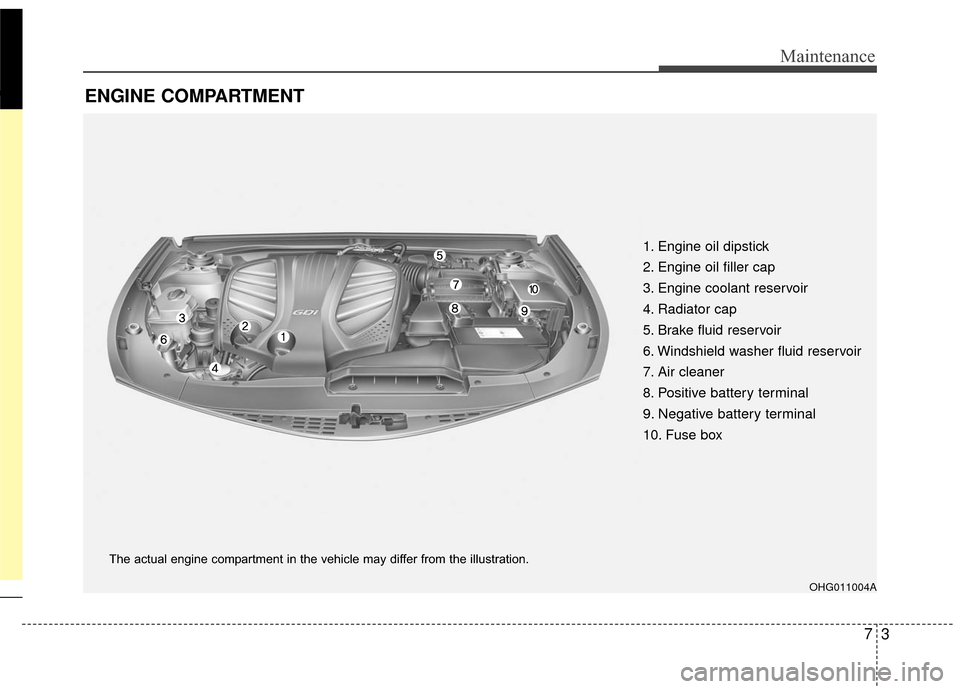
ENGINE COMPARTMENT
OHG011004A
The actual engine compartment in the vehicle may differ from the illustration.
1. Engine oil dipstick
2. Engine oil filler cap
3. Engine coolant reservoir
4. Radiator cap
5. Brake fluid reservoir
6. Windshield washer fluid reservoir
7. Air cleaner
8.
Positive battery terminal
9. Negative battery terminal
10. Fuse box
Page 424 of 521
77
Maintenance
At least monthly:
Check coolant level in the enginecoolant reservoir.
Check the operation of all exterior lights, including the stoplights, turn
signals and hazard warning flash-
ers.
Check the inflation pressures of all tires including the spare.
At least twice a year (i.e., every Spring and Fall):
Check radiator, heater and air con- ditioning hoses for leaks or dam-
age.
Check windshield washer spray and wiper operation. Clean wiper
blades with clean cloth dampened
with washer fluid.
Check headlight alignment.
Check muffler, exhaust pipes, shields and clamps.
Check the lap/shoulder belts for wear and function.
Check for worn tires and loose wheel lug nuts.
At least once a year:
Clean body and door drain holes.
Lubricate door hinges and checks,and hood hinges.
Lubricate door and hood locks and latches.
Lubricate door rubber weather- strips.
Check the air conditioning system.
Inspect and lubricate automatic transaxle linkage and controls.
Clean battery and terminals.
Check the brake fluid level.
Page 426 of 521

79
Maintenance
NORMAL MAINTENANCE SCHEDULE
The following maintenance services must be performed to ensure good emission control and performance. Keep
receipts for all vehicle emission services to protect your warranty. Where both mileage and time are shown, the fre-
quency of service is determined by whichever occurs first.
15,000 miles (24,000 km) or 12 months
❑ Rotate tire
❑ Inspect battery condition
❑Inspect air cleaner filter
❑Inspect vacuum hose
❑Inspect air conditioning refrigerant
❑Inspect brake hoses and lines
❑Inspect drive shafts and boots
❑Inspect exhaust pipe and muffler
❑Inspect front brake disc/pads, calipers
❑Inspect rear brake disc/pads
❑Inspect steering gear box, linkage &
boots/lower arm ball joint, upper arm ball joint
(Continued)
22,500 miles (36,000 km) or 18 months
❑ Rotate tire
❑ Inspect battery condition
❑Inspect air cleaner filter
❑Inspect vacuum hose
❑Replace engine oil and filter
(22,500 miles (36,000 km) or 36 months)
❑Add fuel additive *1
(22,500 miles (36,000 km) or 36 months)
7,500 miles (12,000 km) or 6 months
❑ Rotate tire
❑ Inspect battery condition
❑Inspect air cleaner filter
❑Inspect vacuum hose
❑Replace engine oil and filter
(7,500 miles (12,000 km) or 12 months)
❑Add fuel additive *1(7,500 miles (12,000 km) or 12 months)
(Continued)
❑ Inspect suspension mounting bolts
❑Replace climate control air filter (for evaporator and blower unit)
❑ Replace engine oil and filter
(15,000 miles (24,000 km) or 24 months)
❑ Add fuel additive *1
(15,000 miles (24,000 km) or 24 months)
*1: If TOP TIER Detergent Gasoline is not available, one bottle of addi-
tive is recommended. Additives are available from your authorized
HYUNDAI dealer along with information on how to use them. Do not
mix other additives.
❈ Inspect : Inspect and if necessary, adjust, correct, clean or replace.
Page 427 of 521

Maintenance
10
7
NORMAL MAINTENANCE SCHEDULE (CONT.)
37,500 miles (60,000 km) or 30 months
❑ Rotate tire
❑Inspect battery condition
❑Inspect air cleaner filter
❑Inspect vacuum hose
❑Replace engine oil and filter
(37,500 miles (60,000 km) or 60 months)
❑Add fuel additive *2
(37,500 miles (60,000 km) or 60 months)
*1: Fuel filter & Fuel tank air filter are considered to be maintenance free\
but periodic inspection is recommended for this maintenance sched-
ule depends on fuel quality. If there are some important safety matters
like fuel flow restriction, surging, loss of power, hard starting problem
etc, replace the fuel filter immediately regardless of maintenance
schedule and consult an authorized HYUNDAI dealer for details.
*
2: If TOP TIER Detergent Gasoline is not available, one bottle of addi- tive is recommended. Additives are available from your authorized
HYUNDAI dealer along with information on how to use them. Do
not mix other additives.
❈ Inspect : Inspect and if necessary, adjust, correct, clean or replace.
30,000 miles (48,000 km) or 24 months
❑Rotate tire
❑Inspect battery condition
❑Inspect vacuum hose
❑Inspect air conditioning refrigerant
❑Inspect brake hoses and lines
❑Inspect exhaust pipe and muffler
❑Inspect front brake disc/pads, calipers
❑Inspect rear brake disc/pads
❑Inspect steering gear box, linkage &
boots/lower arm ball joint, upper arm ball joint
❑Inspect suspension mounting bolts
❑Inspect brake fluid
❑Inspect fuel filter *1
❑Inspect fuel lines, fuel hoses and connections
❑Inspect fuel tank air filter *1
❑Inspect parking brake
❑Inspect vapor hose and fuel filler cap
❑Replace climate control air filter (for evaporator and blower unit)
❑ Replace air cleaner filter
❑Replace engine oil and filter
(30,000 miles (48,000 km) or 48 months)
❑Add fuel additive *2
(30,000 miles (48,000 km) or 48 months)