2016 HONDA FIT belt
[x] Cancel search: beltPage 11 of 75

14 || 15
S
AFETY
SAFETY
Airbag Care
You do not need to, and should not, perform any maintenance on or replace any
airbag system components yourself. However, you should have your vehicle inspected by a dealer in the following situations:
When the airbags have deployed
If an airbag has inlated, the control unit and other related parts must be replaced.
Similarly, once an automatic seat belt tensioner has been activated, it must be replaced.
When the vehicle has been in a moderate-to-severe collision
Even if the airbags did not inlate, have your dealer inspect the following: the
driver’s seat position sensor, weight sensors in the passenger’s seat, front seat belt tensioners, and each seat belt that was worn during the crash.
Do not remove or modify a front seat without first consulting a dealer
This would likely disable the driver’s seat position sensor or the weight sensors
in the passenger’s seat. If it is necessary to remove or modify a front seat to
accommodate a person with disabilities, contact a Honda dealer. For U.S.
vehicles, call Honda Automobile Customer Service at (800) 999-1009. For Canadian vehicles, call Honda Canada Customer Relations at (888) 946-6329.
Child Safety
Each year, many children are injured or killed in vehicle crashes because they are either unrestrained or not properly restrained. In fact, vehicle collisions are the
number one cause of death of children ages 12 and under.
The National Highway Trafc Safety Administration and Transport Canada recommend that all children ages 12 and under be properly restrained in a rear seat.
Some states or provinces/territories have laws restricting where children may ride.
To reduce the number of child deaths and injuries, every state, Canadian province and territory requires that infants and children be properly restrained when they ride in a vehicle.
Protecting Child Passengers
• An inlating front or side airbag can injure or kill a child sitting in the front seat.
• A child in the front seat is more likely to interfere with the driver’s ability to safely control the vehicle.
• Statistics show that children of all sizes and ages are safer when they are
properly restrained in a rear seat.
• Any child who is too small to wear a seat belt correctly must be restrained in an
approved child seat that is properly secured to the vehicle using either the lap
belt portion of the lap/shoulder belt or the lower anchors of the LATCH system.
• Never hold a child on your lap because it is impossible to protect them in the event of a collision.
• Never put a seat belt over yourself and a child. During a crash, the belt would
likely press deep into the child and cause serious or fatal injuries.
• Never let two children use the same seat belt. Both children could be very
seriously injured in a crash.
• Do not allow children to operate the doors, windows, or seat adjusters.
• Do not leave children in the vehicle unattended, especially in hot weather when the inside of the vehicle can get hot enough to kill them. They could also activate
vehicle controls, causing it to move unexpectedly.
Children who are unrestrained or improperly restrained can be seriously injured or killed in a crash. Any child too small for a seat belt should be properly restrained in a child
seat. A larger child should be properly restrained with a seat belt, using a
booster seat if necessary.
WARNING
Page 12 of 75

16 || 17
S
AFETY
SAFETY
Protecting Infants
An infant must be properly restrained in a rear-facing, reclining child seat until the
infant reaches the seat maker’s weight or height limit for the seat, and the infant
is at least one year old. Many experts recommend use of a rear-facing seat for
a child up to two years old if the child’s height and weight are appropriate for a
rear-facing seat. Child seats must be placed and secured in a rear
seating position. Rear-facing child seats should never be installed in a forward-facing position.
When properly installed, a rear-facing child seat may prevent the driver or a front
passenger from moving their seat all the way back, or from locking their seat-back in the desired position. If this occurs, we recommend that you install the child
seat directly behind the front passenger’s seat, move the seat as far forward as
needed, and leave it unoccupied. Or, you may wish to get a smaller rear-facing child seat.
Placing a rear-facing child seat in the front seat can result in serious injury or death during a crash.
Always place a rear-facing child seat in the rear seat, not the front.
WARNING
Allowing a child to play with a seat belt or wrap one around their neck can result in serious injury or death.
Instruct children not to play with any seat belt and make sure any unused seat belt a child can reach is buckled, fully retracted, and locked.
WARNING Protecting Smaller Children
If a child is at least one year old and within the weight range indicated by the child
seat manufacturer, the child should be properly restrained in a irmly secured forward-facing child seat.
We strongly recommend placing a forward-facing child seat in a rear seating position. Placing a forward-facing child seat in the front seat
can be hazardous, even with advanced front airbags
that automatically turn the passenger’s front airbag off. A rear seat is the safest place for a child.Placing a forward-facing child seat in the front seat can result in serious injury or death if the front airbag inlates.
If you must place a forward-facing child seat in front, move the vehicle seat as far back as possible, and properly restrain the child.
WARNING
Selecting a Child Seat
Most child seats are LATCH-compatible (Lower Anchors and Tethers for CHildren).
Some have a rigid-type connector, while others have a lexible-type connector.
Both are equally easy to use. Some existing and previously owned child seats can
only be installed using the seat belt. Whichever type you choose, follow the child
seat manufacturer’s use and care instructions as well as the instructions in this
manual. Proper installation is key to maximizing your child’s safety.
In seating positions and vehicles not equipped with LATCH, a LATCH-compatible
child seat can be installed using the seat belt and a top tether for added security. This is because all child seats are required to be designed so that they can be secured with a lap belt or the lap part of a lap/shoulder belt. In addition, the
child seat manufacturer may advise that a seat belt be used to attach a LATCH-compatible seat once a child reaches a speciied weight. Please read the child
seat owner’s manual for proper installation instructions.
Important considerations when selecting a child seat
Make sure the child seat meets the following three requirements:
• The child seat is the correct type and size for the child. • The child seat is the correct type for the seating position.
• The child seat is compliant with Federal Motor Vehicle Safety Standard 213 or
Canadian Motor Vehicle Safety Standard 213.
Page 13 of 75
18 || 19
S
AFETY
SAFETY
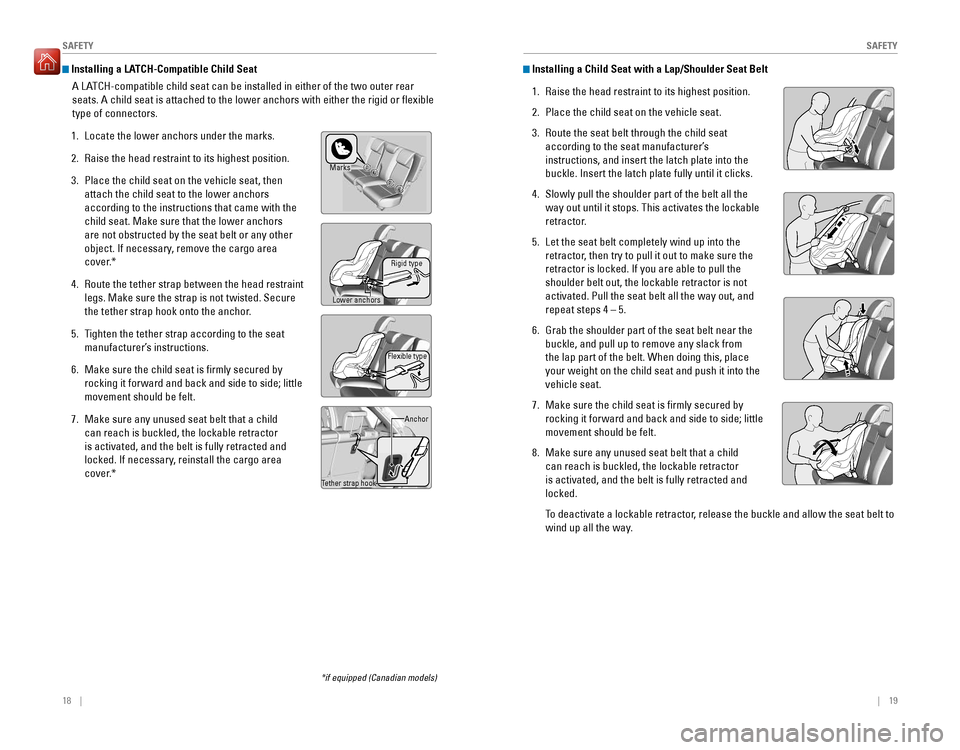
Installing a LATCH-Compatible Child Seat
A LATCH-compatible child seat can be installed in either of the two outer rear
seats. A child seat is attached to the lower anchors with either the rigid or lexible type of connectors.
1. Locate the lower anchors under the marks.
2. Raise the head restraint to its highest position.
3. Place the child seat on the vehicle seat, then attach the child seat to the lower anchors according to the instructions that came with the child seat. Make sure that the lower anchors are not obstructed by the seat belt or any other
object. If necessary, remove the cargo area
cover.*
4. Route the tether strap between the head restraint legs. Make sure the strap is not twisted. Secure
the tether strap hook onto the anchor.
5. Tighten the tether strap according to the seat manufacturer’s instructions.
6. Make sure the child seat is irmly secured by rocking it forward and back and side to side; little movement should be felt.
7. Make sure any unused seat belt that a child
can reach is buckled, the lockable retractor is activated, and the belt is fully retracted and
locked. If necessary, reinstall the cargo area
cover.*
Installing a Child Seat with a Lap/Shoulder Seat Belt
1. Raise the head restraint to its highest position.
2. Place the child seat on the vehicle seat.3. Route the seat belt through the child seat
according to the seat manufacturer’s instructions, and insert the latch plate into the buckle. Insert the latch plate fully until it clicks.
4. Slowly pull the shoulder part of the belt all the way out until it stops. This activates the lockable
retractor.
5. Let the seat belt completely wind up into the
retractor, then try to pull it out to make sure the retractor is locked. If you are able to pull the shoulder belt out, the lockable retractor is not activated. Pull the seat belt all the way out, and repeat steps 4 – 5.
6. Grab the shoulder part of the seat belt near the buckle, and pull up to remove any slack from the lap part of the belt. When doing this, place your weight on the child seat and push it into the vehicle seat.
7. Make sure the child seat is irmly secured by rocking it forward and back and side to side; little movement should be felt.
8. Make sure any unused seat belt that a child
can reach is buckled, the lockable retractor is activated, and the belt is fully retracted and locked.
To deactivate a lockable retractor, release the buckle and allow the seat belt to wind up all the way.
Marks
*if equipped (Canadian models)
Rigid type
Lower anchors
Flexible type
Anchor
Tether strap hook
Page 14 of 75

20 || 21
S
AFETY
SAFETY
Adding Security with a Tether
Two tether anchorage points are provided behind the rear outer seating positions
and one in the ceiling for the rear center. A child seat that is installed with a seat
belt and comes with a tether can use the tether for additional security.
1. Using an outer anchor: If necessary, remove the
cargo area cover.* Raise the head restraint to its highest position, then route the tether strap through the head restraint legs. Using the center anchor: Lower the head
restraint to its lowest position. Open the anchor
cover. Route the tether strap over the head restraint.
2. Secure the tether strap hook onto the anchor. Make sure the strap is not twisted.
3. Tighten the tether strap according to the seat manufacturer’s instructions. If necessary,
reinstall the cargo area cover.*
Protecting Larger Children
When a child is too big for a child seat, secure the child in a rear seat using the lap/shoulder seat belt. Have the child sit upright and all the way back, then ensure the following:
• The child’s knees bend comfortably over the edge of the seat.
• The shoulder belt crosses between the child’s
neck and arm.
• The lap part of the seat belt is as low as possible,
touching the child’s thighs.
• The child can stay seated for the whole trip.
If a lap/shoulder belt cannot be used properly, position the child in a booster seat
in a rear seating position. For the child’s safety, check that the child meets the
booster seat manufacturer’s recommendations. Some U.S. states and Canadian provinces/territories require children to use a
booster seat until they reach a given age or weight (e.g., 6 years or 60 lbs). Be sure to check current laws in the state or province/territory where you intend to drive.
Allowing a child age 12 or under to sit in the front can result in injury or death
if the passenger’s front airbag inlates.
If a larger child must ride in front, move the vehicle seat as far to the rear as possible, then have the child sit up properly and wear the seat belt properly, using a booster seat if needed.
WARNING
Tether
anchorage points
Tether strap hook Anchor
*if equipped (Canadian models)
Tether anchorage point
Anchor
Anchor cover
Page 16 of 75

24 || 25
I
NSTRUMENT PANEL
INSTRUMENT PANEL
Smart Entry system* There is a problem with the smart entry system. Malfunction indicator lamp (check engine light)
• The emissions control system may have a problem, or the fuel cap is loose or missing.
• (Blinks) A misire in the engine’s cylinders is detected. Stop in a safe place,
and wait for the engine to cool down. Anti-lock Brake System (ABS)
There is a problem with the anti-lock brake system. Your vehicle still has
normal braking ability, but no anti-lock function.
Tire Pressure Monitoring System (TPMS) (U.S. models only)
There is a problem with the tire pressure monitoring system, or the vehicle is tted with the compact spare tire.
Vehicle Stability Assist (VSA ®
)
There is a problem with the VSA system or hill start assist system. Brake system There is a problem with a braking system component. Electric power steering There is a problem with the system. Stop in a safe place, and restart the vehicle. Starter system* There is a problem with the starter system. High temperature The engine coolant temperature is high. Drive slowly to prevent overheating. If the indicator remains on, immediately stop the vehicle in a safe place (see page 100). Low temperature
The engine coolant temperature is low. If the indicator remains on, there may be a problem with temperature sensors.
Canada U.S.
U.S.
Canada
Learn about the indicators, gauges, and displays related to driving the vehicle. Indicators briely appear with each engine start and then go out. Red and amber
indicators are most critical. Blue and green indicators are used for general information.
Malfunction Indicators
These are the most critical indicators. If they come on and stay lit while driving or at
any other time, there may be a problem. See your dealer if necessary.
Brake system
• Brake luid is low.• The brake system has a problem.Press the brake pedal lightly to check pedal pressure. If normal, check
the brake luid level when you stop. If abnormal, take immediate action. If
necessary, downshift the transmission to slow the vehicle using engine
braking. Have your vehicle repaired immediately. Low oil pressure
Engine oil pressure is low. Stop in a safe place. Open the hood. Check the oil
level, and add oil if necessary (see page 117). If the indicator does not turn
off, have your vehicle repaired immediately. Charging system
The battery is not charging. Turn off all electrical items, but do not turn off the vehicle to prevent further battery discharge. Have your vehicle repaired
immediately. Supplemental Restraint System (SRS)
There is a problem with one of the airbag systems or seat belt tensioners.
Canada
U.S.
INSTRUMENT PANEL
*if equipped
Page 17 of 75

26 || 27
I
NSTRUMENT PANEL
INSTRUMENT PANEL
Condition Indicators
These indicators may require you to perform an action.
Parking brake
Release the parking brake before driving. You will hear a beep if you drive with it not fully released. Seat belt reminder Make sure seat belts are fastened for you and all passengers. The indicator blinks and beeps sound continuously if you or your front passenger has not fastened your seat belts when you begin driving. If the indicator remains on
after seat belts are fastened, see your dealer. Door/tailgate open
A door or the tailgate is open. A beep sounds if any door or the tailgate is open while driving. Low fuel
Refuel as soon as possible. If the indicator blinks, there is a problem with the
fuel gauge. See your dealer. Low tire pressure
Stop in a safe place, check tire pressures, and inlate tire(s) if necessary. If the indicator remains on after tire inlation, you need to calibrate the system (see page 102). The indicator also appears if your vehicle is tted with the
compact spare tire. Have your regular tire repaired or replaced as soon as possible.
Washer uid level (Canadian models only)
Washer uid is low. Rell the reservoir (see page 119).Maintenance Minder™ Scheduled maintenance for your vehicle is due (see page 113).
Ca nada
U.S.
Immobilizer
Your key or remote transmitter cannot be recognized by the vehicle. If the
indicator blinks, you may not be able to start the engine. Turn the vehicle off, and then on again. If it continues to blink, there may be a problem with the
system. See your dealer.
On/Off Indicators
These indicators remind you when an item is on or off.
VSA off VSA on (blinks)
CRUISE MAIN onCRUISE CONTROL on
Turn signals/hazards on Fog lights* onHigh beams onExterior lights onECON mode* on
*if equipped
Page 23 of 75

38 || 39
V
EHICLE CONTROLS
VEHICLE CONTROLS
Reclining the seat-back too far can result in serious injury or death in a crash. Adjust the seat-back to an upright position, and sit well back in the seat.
WARNING
Adjusting the Seats
Make seat adjustments before driving to ensure the best comfort and safety.
Adjusting the Front Seats
Adjust the driver’s seat as far back as possible while allowing you to maintain full control of the vehicle.
You should be able to sit upright and well back in the seat, adequately press the pedals without leaning
forward, and grip the steering wheel comfortably.
The passenger’s seat should be adjusted so that it is as far back from the front airbag in the dashboard as possible.
The National Highway Trafc Safety Administration and Transport Canada
recommend that drivers allow at least 10 inches (25 cm) between the center of the steering wheel and the chest.
Move back and allow
sufcient space.
Height adjustment (Driver’s seat only)
Pull up or push down the lever to raise or lower the seat. Seat-back angle adjustment
Pull up the lever to change the angle.
Horizontal position adjustment
Pull up on the bar to move the
seat, then release the bar. Sitting improperly or out of position can result in serious injury or death in a crash.
Always sit upright, well back in the seat, with your feet on the loor.
WARNING
Floor Mats*
Position the front seat oor mats properly, and
anchor them. If they are not properly positioned, the oor mats can interfere with the front seat functions. Do not put additional oor mats on top of the anchored mats.
Unlock
Lock
Sitting too close to a front airbag can result in serious injury or death if the front airbags inlate. Always sit as far back from the front airbags as possible while maintaining control of the vehicle.
WARNING
Reclining the Front Seats
You can recline the seat-backs of the front seats so they are level with the rear seat cushions to make a large cushioned area.
1. Remove the front head restraints (see page 40). Store the head restraints in the cargo area.
2. Adjust the front seats forward as far as possible.
3. Pivot the seat-back backward with the seat-back angle adjustment lever to be level with the rear seat cushion.
4. Move the front seat backward until it touches the rear seat.
5. Unlatch the detachable anchor from the anchor buckle, and store the rear center seat belt (see page 8).
6. Adjust the rear seat-back to the desired position.
To return the front seats to their original positions, reverse this procedure. When you return the seat-back to its upright position, hold the seat-back to keep it from
going up too quickly.
*if equipped
Page 24 of 75

40 || 41
V
EHICLE CONTROLS
VEHICLE CONTROLS
Improperly positioning head restraints reduces their effectiveness and increases the likelihood of serious injury in a crash.
Make sure head restraints are in place and positioned properly before driving.
WARNING
Failure to reinstall, or correctly reinstall, the head restraints can result in severe injury during a crash. Always replace the head restraints before driving.
WARNING
Adjusting the Head Restraints
Your vehicle is equipped with head restraints in all seating positions. Head
restraints are most effective for protection against whiplash and other rear-impact crash injuries.
The center of the back of the occupant’s head should rest against the center of the restraint. The
tops of the occupant’s ears should be level with the center height of the restraint.
To raise the head restraint: Pull it upward.
To lower the head restraint: Push it down while
pressing the release button.
To remove the head restraint: Pull the restraint up as
far as it will go. Then push the release button, and pull the restraint up and out.
To reinstall a head restraint: Insert the legs back
in place, then adjust the head restraint to an appropriate height while pressing the release button. Pull up on the restraint to make sure it is locked in position. In order for the head restraint system to work properly:
• Do not hang any items on the head restraints, or from the restraint legs.
• Do not place any object between an occupant and the seat-back.
• Install each restraint in its proper location.
Rear outer seat shown
Rear Seats
Fold rear seats up or down to allow for additional storage space.
Folding Down Rear Seats
1. Store the center seat belt. Insert the latch plate into the slot on the side of the anchor buckle. Retract the seat belt into the holder on the ceiling (see page 8).
2. Lower the head restraint to its lowest position (see page 40).
3. Pull the release lever and fold down the seat-back.
Make sure all items in the cargo area or items extending to the rear seats are properly secured. Loose items can ly forward if you have to brake hard.
To return the seat to the original position, pull up the seat-back to the upright position.
Folding Up Rear Seats
1. Make sure the seat belt buckles are in their loops on the seat.
2. Pull up the rear seat cushion.
3. Fold the seat leg down while pushing the seat cushion irmly against the seat-back to lock it.
To return the seat to its original position, hold the seat cushion in the upright position, and pull up the
seat leg fully. Slowly put down the seat cushion and set the seat leg in the oor guide. A latch comes out
when the leg is set properly. Make sure the seat is irmly secured by rocking it forward and back.
Release lever
Loop
Seat leg
Seat leg Latch
Floor guide