2016 GMC SAVANA cooling
[x] Cancel search: coolingPage 229 of 343

GMC Savana Owner Manual (GMNA-Localizing-U.S./Canada-9159232) -
2016 - crc - 11/11/15
228 Vehicle Care
Caution
If the pressure cap is not tightly
installed, coolant loss and
possible engine damage may
occur. Be sure the cap is properly
and tightly secured.
Engine Overheating
If the vehicle has a diesel engine,
see the Duramax diesel
supplement.
The vehicle has an indicator to warn
of engine overheating.
There is an engine coolant
temperature gauge on the vehicle's
instrument cluster. SeeEngine
Coolant Temperature Gauge 097.
If the decision is made not to lift the
hood when this warning appears,
but instead get service help right
away, see Roadside Assistance
Program 0313.
If the decision is made to lift the
hood, make sure the vehicle is
parked on a level surface. Then check to see if the engine
cooling fans are running. If the
engine is overheating, the fan
should be running. If it is not, do not
continue to run the engine and have
the vehicle serviced.
See if the engine cooling fan speed
increases when idle speed is
doubled by pushing the accelerator
pedal down. If it does not, the
vehicle needs service. Turn off the
engine.
Caution
Running the engine without
coolant may cause damage or a
fire. Vehicle damage would not be
covered by the vehicle warranty.
If Steam is Coming from the
Engine Compartment
{Warning
Steam from an overheated engine
can burn you badly, even if you
just open the hood. Stay away
from the engine if you see or hear
steam coming from it. Just turn it
off and get everyone away from
the vehicle until it cools down.
Wait until there is no sign of
steam or coolant before you open
the hood.
If you keep driving when the
engine is overheated, the liquids
in it can catch fire. You or others
could be badly burned. Stop the
engine if it overheats, and get out
of the vehicle until the engine
is cool.
If No Steam is Coming from
the Engine Compartment
If an engine overheat warning is
displayed but no steam can be seen
or heard, the problem may not be
Page 230 of 343

GMC Savana Owner Manual (GMNA-Localizing-U.S./Canada-9159232) -
2016 - crc - 11/11/15
Vehicle Care 229
too serious. Sometimes the engine
can get a little too hot when the
vehicle:
.Climbs a long hill on a hot day.
. Stops after high-speed driving.
. Idles for long periods in traffic.
. Tows a trailer. See “Driving on
Grades” underTrailer
Towing 0204.
If the overheat warning is displayed
with no sign of steam: 1. Turn the air off.
2. Turn the heater on to the highest temperature and to the
highest fan speed. Open the
windows as necessary.
3. When it is safe to do so, pull off the road, shift to P (Park) or
N (Neutral) and let the
engine idle.
If the engine coolant temperature
gauge is no longer in the overheat
zone or an overheat warning no
longer displays, the vehicle can be
driven. Continue to drive the vehicle
slowly for about 10 minutes. Keep a
safe vehicle distance from the vehicle in front. If the warning does
not come back on, continue to drive
normally and have the cooling
system checked for proper fill and
function.
If the warning continues, pull over,
stop, and park the vehicle
right away.
If there is still no sign of steam,
push down the accelerator until the
engine speed is about twice as fast
as normal idle speed for at least
three minutes while parked. If the
warning is still on, turn off the
engine until it cools down.
If the decision is made not to lift the
hood, get service help right away.
Engine Fan
The vehicle has a clutched engine
cooling fan. When the clutch is
engaged, the fan spins faster to
provide more air to cool the engine.
In most everyday driving conditions,
the fan is spinning slower and the
clutch is not fully engaged. This
improves fuel economy and reduces
fan noise. Under heavy vehicle
loading, trailer towing, and/or highoutside temperatures, the fan speed
increases as the clutch more fully
engages, so an increase in fan
noise may be heard. This is normal
and should not be mistaken as the
transmission slipping or making
extra shifts. It is merely the cooling
system functioning properly. The fan
will slow down when additional
cooling is not required and the
clutch partially disengages.
This fan noise may be heard when
starting the engine. It will go away
as the fan clutch partially
disengages.
Power Steering Fluid
The power steering fluid reservoir is
in the engine compartment on the
driver side of the vehicle. See
Engine Compartment Overview
0
216 for reservoir location.
Page 246 of 343

GMC Savana Owner Manual (GMNA-Localizing-U.S./Canada-9159232) -
2016 - crc - 11/11/15
Vehicle Care 245
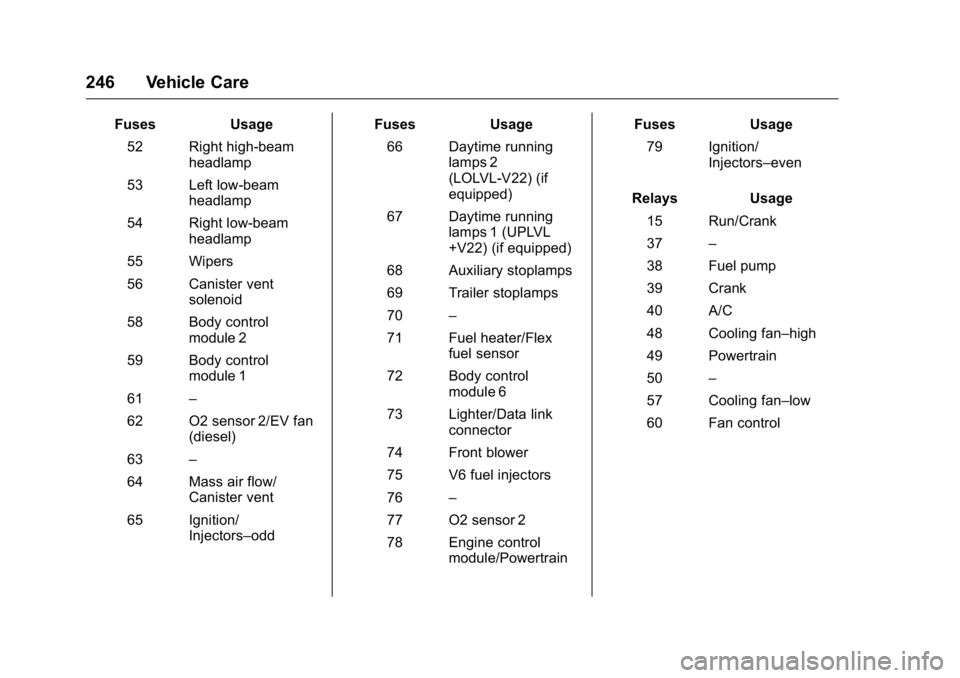
The vehicle may not be equipped
with all of the fuses, relays, and
features shown.Fuses Usage
1 ABS motor
2 ABS module
3 Right trailer stoplamp/Turnlamp
4 –
5 –
6 Fuel system control module/Ignition
7 Body control module 5
8 Body control module 7
9 Body control module 4
10 Instrument cluster 11 Trailer wiring
12 Interior rear vision camera module
13 –
14 Windshield washer Fuses Usage
16 Horn
17 Transmission
18 A/C
19 Engine control module battery
20 –
21 Left trailer stoplamp/Turnlamp
22 –
23 –
24 Fuel pump
25 Auxiliary power outlet
26 Body control module 3
27 Special equipment option
28 Airbag
29 Steering wheel sensor
30 Engine control module/Ignition/
Glow plug module Fuses Usage
31 Transmission control module/
Ignition
32 Transmission control module
battery
33 Rear parking aid module
34 –
35 Fuel operated heater module
36 Fuel system control module battery
41 –
42 Trailer wiring
43 Cooling fan–high
44 Starter solenoid
45 Engine control module/Powertrain
46 –
47 Cooling fan–low
51 Left high-beam headlamp
Page 247 of 343
GMC Savana Owner Manual (GMNA-Localizing-U.S./Canada-9159232) -
2016 - crc - 11/11/15
246 Vehicle Care
FusesUsage
52 Right high-beam headlamp
53 Left low-beam headlamp
54 Right low-beam headlamp
55 Wipers
56 Canister vent solenoid
58 Body control module 2
59 Body control module 1
61 –
62 O2 sensor 2/EV fan (diesel)
63 –
64 Mass air flow/ Canister vent
65 Ignition/ Injectors–odd Fuses
Usage
66 Daytime running lamps 2
(LOLVL-V22) (if
equipped)
67 Daytime running lamps 1 (UPLVL
+V22) (if equipped)
68 Auxiliary stoplamps
69 Trailer stoplamps
70 –
71 Fuel heater/Flex fuel sensor
72 Body control module 6
73 Lighter/Data link connector
74 Front blower
75 V6 fuel injectors
76 –
77 O2 sensor 2
78 Engine control module/Powertrain Fuses
Usage
79 Ignition/ Injectors–even
Relays Usage
15 Run/Crank
37 –
38 Fuel pump
39 Crank
40 A/C
48 Cooling fan–high
49 Powertrain
50 –
57 Cooling fan–low
60 Fan control
Page 270 of 343
GMC Savana Owner Manual (GMNA-Localizing-U.S./Canada-9159232) -
2016 - crc - 11/11/15
Vehicle Care 269
Caution
The wrong wheel can also cause
problems with bearing life, brake
cooling, speedometer or
odometer calibration, headlamp
aim, bumper height, vehicle
ground clearance, and tire or tire
chain clearance to the body and
chassis.
Used Replacement Wheels
{Warning
Replacing a wheel with a used
one is dangerous. How it has
been used or how far it has been
driven may be unknown. It could
fail suddenly and cause a crash.
When replacing wheels, use a
new GM original equipment
wheel.
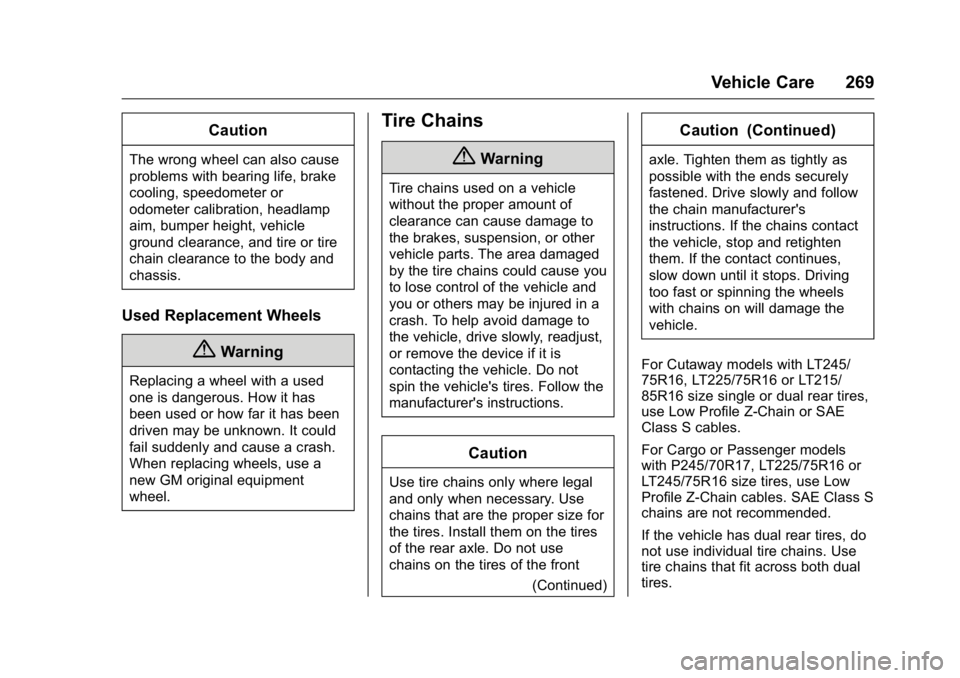
Tire Chains
{Warning
Tire chains used on a vehicle
without the proper amount of
clearance can cause damage to
the brakes, suspension, or other
vehicle parts. The area damaged
by the tire chains could cause you
to lose control of the vehicle and
you or others may be injured in a
crash. To help avoid damage to
the vehicle, drive slowly, readjust,
or remove the device if it is
contacting the vehicle. Do not
spin the vehicle's tires. Follow the
manufacturer's instructions.
Caution
Use tire chains only where legal
and only when necessary. Use
chains that are the proper size for
the tires. Install them on the tires
of the rear axle. Do not use
chains on the tires of the front(Continued)
Caution (Continued)
axle. Tighten them as tightly as
possible with the ends securely
fastened. Drive slowly and follow
the chain manufacturer's
instructions. If the chains contact
the vehicle, stop and retighten
them. If the contact continues,
slow down until it stops. Driving
too fast or spinning the wheels
with chains on will damage the
vehicle.
For Cutaway models with LT245/
75R16, LT225/75R16 or LT215/
85R16 size single or dual rear tires,
use Low Profile Z-Chain or SAE
Class S cables.
For Cargo or Passenger models
with P245/70R17, LT225/75R16 or
LT245/75R16 size tires, use Low
Profile Z-Chain cables. SAE Class S
chains are not recommended.
If the vehicle has dual rear tires, do
not use individual tire chains. Use
tire chains that fit across both dual
tires.
Page 298 of 343

GMC Savana Owner Manual (GMNA-Localizing-U.S./Canada-9159232) -
2016 - crc - 11/11/15
Service and Maintenance 297
Maintenance Schedule
Additional Required
Services - Normal12 000 km/7,500 mi
24 000 km/15,000 mi
36 000 km/22,500 mi
48 000 km/30,000 mi
60 000 km/37,500 mi
72 000 km/45,000 mi
84 000 km/52,500 mi
96 000 km/60,000 mi
108 000 km/67,500 mi
120 000 km/75,000 mi
132 000 km/82,500 mi
144 000 km/90,000 mi
156 000 km/97,500 mi
168 000 km/105,000 mi 180 000 km/112,500 mi
192 000 km/120,000 mi
204 000 km/127,500 mi
216 000 km/135,000 mi
228 000 km/142,500 mi
240 000 km/150,000 mi
Rotate tires and perform Required Services.
Check engine oil level and oil life percentage.
Change engine oil and filter, if needed.
Lubricate the steering linkage.@ @ @ @ @ @ @ @ @ @ @ @ @ @ @ @ @ @ @ @
Inspect evaporative control system. (1)@ @@
Replace engine air cleaner filter. (2)@@@
Replace spark plugs. Inspect spark plug wires.@
Drain and fill engine cooling system. (3)@
Visually inspect accessory drive belts. (4)@
Replace brake fluid. (5)
Footnotes—Maintenance
Schedule Additional Required
Services - Normal
(1) Check all fuel and vapor lines
and hoses for proper hook-up,
routing, and condition. (2)
Or every four years, whichever
comes first. If driving in dusty
conditions, inspect the filter at each
oil change or more often as needed.
(3) Or every five years, whichever
comes first. See Cooling
System 0224. (4)
Or every 10 years, whichever
comes first. Inspect for fraying,
excessive cracking, or damage;
replace, if needed.
(5) Replace brake fluid every five
years. See Brake Fluid 0232.
Page 299 of 343

GMC Savana Owner Manual (GMNA-Localizing-U.S./Canada-9159232) -
2016 - crc - 11/11/15
298 Service and Maintenance
Maintenance Schedule
Additional Required
Services - Severe12 000 km/7,500 mi
24 000 km/15,000 mi
36 000 km/22,500 mi
48 000 km/30,000 mi
60 000 km/37,500 mi
72 000 km/45,000 mi
84 000 km/52,500 mi
96 000 km/60,000 mi
108 000 km/67,500 mi
120 000 km/75,000 mi
132 000 km/82,500 mi
144 000 km/90,000 mi
156 000 km/97,500 mi
168 000 km/105,000 mi 180 000 km/112,500 mi
192 000 km/120,000 mi
204 000 km/127,500 mi
216 000 km/135,000 mi
228 000 km/142,500 mi
240 000 km/150,000 mi
Rotate tires and perform Required Services.
Check engine oil level and oil life percentage.
Change engine oil and filter, if needed.
Lubricate the steering linkage.@ @ @ @ @ @ @ @ @ @ @ @ @ @ @ @ @ @ @ @
Inspect evaporative control system. (1)@ @@
Replace engine air cleaner filter. (2)@@@
Change automatic transmission fluid and filter.@@@
Replace spark plugs. Inspect spark plug wires.@
Drain and fill engine cooling system. (3)@
Visually inspect accessory drive belts. (4)@
Replace brake fluid. (5)
Footnotes—Maintenance
Schedule Additional Required
Services - Severe
(1) Check all fuel and vapor lines
and hoses for proper hook-up,
routing, and condition. (2)
Or every four years, whichever
comes first. If driving in dusty
conditions, inspect the filter at each
oil change or more often as needed.
(3) Or every five years, whichever
comes first. See Cooling
System 0224. (4)
Or every 10 years, whichever
comes first. Inspect for fraying,
excessive cracking, or damage;
replace, if needed.
(5) Replace brake fluid every five
years. See Brake Fluid 0232.
Page 307 of 343

GMC Savana Owner Manual (GMNA-Localizing-U.S./Canada-9159232) -
2016 - crc - 11/11/15
306 Technical Data
Vehicle Data
Capacities and Specifications
If the vehicle has a diesel engine, see the Duramax diesel supplement for more information.
The following approximate capacities are given in metric and English conversions. SeeRecommended Fluids and
Lubricants 0302 for more information.
Application Capacities
Metric English
Air Conditioning Refrigerant R134a For the air conditioning system refrigerant charge amount, see the refrigerant label located under thehood. See your dealer for more information.
Cooling System without Rear Heat
4.8L V8 11.8 L 12.4 qt
6.0L V8 13.1 L 13.8 qt
Cooling System with Rear Heat
4.8L V8 14.6 L 15.4 qt
6.0L V8 16.1 L 17.0 qt
Engine Oil with Filter 5.7 L 6.0 qt
Fuel Tank Cutaway (Optional Tank)* 215.7 L 57.0 gal
Cutaway (Standard Tank) 124.9 L 33.0 gal