2016 FORD TAURUS seats
[x] Cancel search: seatsPage 126 of 424
2. Press and hold the desired preset
button for five seconds. A tone sounds
after about two seconds. Continue
holding until you hear a second tone.
3. Within three seconds, press the lock button on the remote control you are
linking.
To unlink a remote control, follow the
same procedure – except in Step 3, press
the unlock button on the remote control.
Easy Entry and Exit Feature (If
Equipped)
If you enable the easy entry and exit
feature, it automatically moves the driver
seat position rearward up to two inches
(five centimeters) and the steering column
up and forward when you switch the
ignition off.
When you switch the ignition on, the driver
seat and steering column return to the
previous position.
You can enable or disable this feature in
the information display. See Information
Displays
(page 86).
REAR SEATS
Split-folding Rear Seat WARNING
Before returning the seatback to its
original position, make sure that
cargo or any objects are not trapped
behind the seatback. After returning the
seatback to its original position, pull on the
seatback to make sure that it has fully
latched. An unlatched seat may become
dangerous in the event of a sudden stop
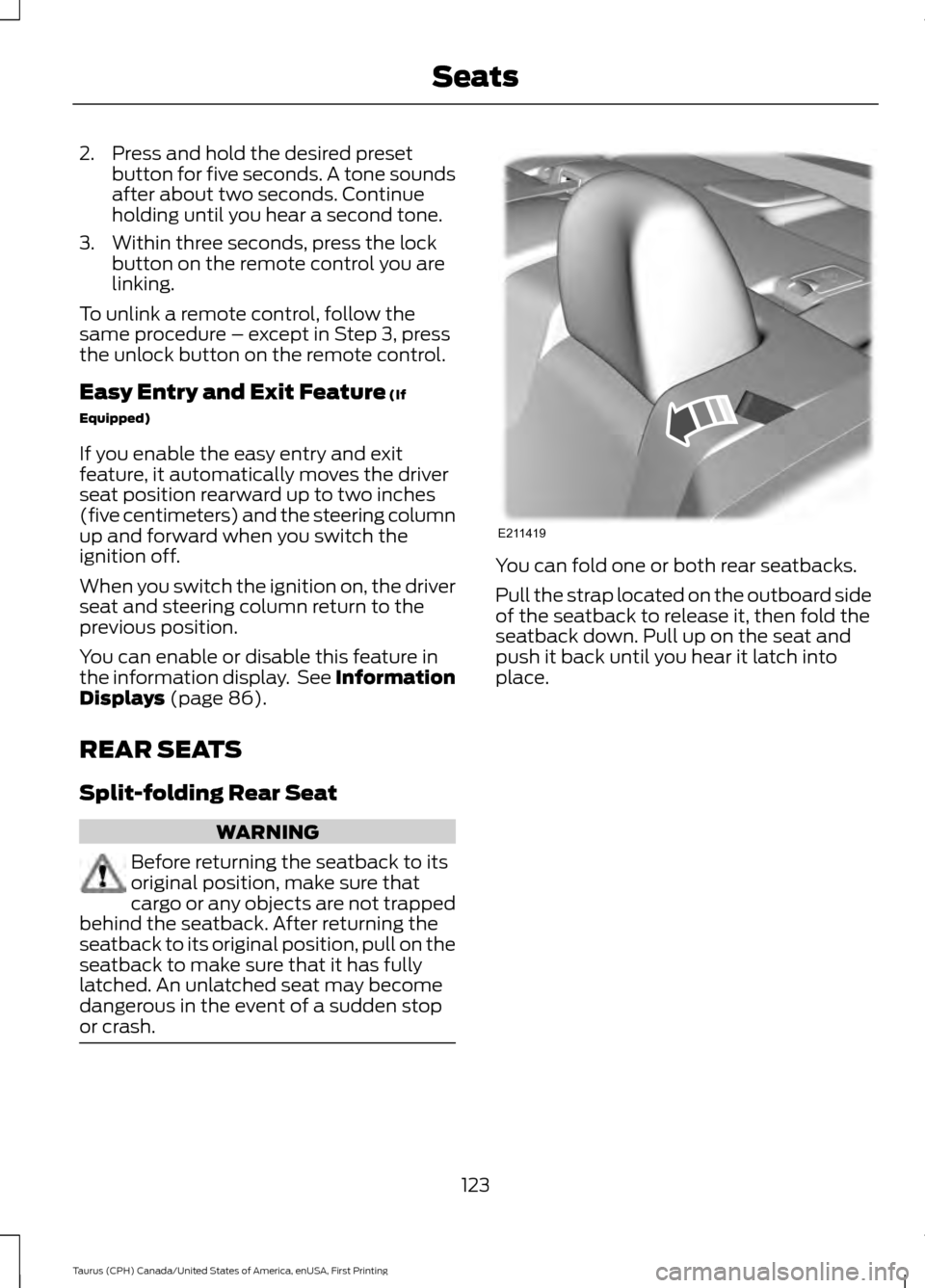
or crash. You can fold one or both rear seatbacks.
Pull the strap located on the outboard side
of the seatback to release it, then fold the
seatback down. Pull up on the seat and
push it back until you hear it latch into
place.
123
Taurus (CPH) Canada/United States of America, enUSA, First Printing SeatsE211419
Page 127 of 424
HEATED SEATS (If Equipped)
WARNING
People who are unable to feel pain
to their skin because of advanced
age, chronic illness, diabetes, spinal
cord injury, medication, alcohol use,
exhaustion or other physical conditions,
must exercise care when using the heated
seat. The heated seat may cause burns
even at low temperatures, especially if
used for long periods of time. Do not place
anything on the seat that insulates against
heat, such as a blanket or cushion. This
may cause the heated seat to overheat.
Do not puncture the seat with pins, needles
or other pointed objects. This may damage
the heating element which may cause the
heated seat to overheat. An overheated
seat may cause serious personal injury. Do not do the following:
•
Place heavy objects on the seat.
• Operate the heated seat if water or any
other liquid spills on the seat. Allow the
seat to dry thoroughly.
Note: You must switch the ignition on to
use this feature. Press the heated seat symbol to cycle
through the various heat settings and off.
More indicator lights indicate warmer
settings. Rear Heated Seats (If Equipped) WARNING
People who are unable to feel pain
to the skin because of advanced age,
chronic illness, diabetes, spinal cord
injury, medication, alcohol use, exhaustion,
or other physical conditions, must exercise
care when using the seat heater. The seat
heater may cause burns even at low
temperatures, especially if used for long
periods of time. Do not place anything on
the seat that insulates against heat, such
as a blanket or cushion, because this may
cause the seat heater to overheat. Do not
puncture the seat with pins, needles, or
other pointed objects because this may
damage the heating element which may
cause the seat heater to overheat. An
overheated seat may cause serious
personal injury. Do not do the following:
•
Place heavy objects on the seat.
• Operate the heated seat if water or any
other liquid spills on the seat. Allow the
seat to dry thoroughly.
Note: You must switch the ignition on to
use this feature.
The rear seat heat controls are located on
the rear of the center console. Press the indicated side of the control for
minimum heat. Press again to turn off.
124
Taurus (CPH) Canada/United States of America, enUSA, First Printing SeatsE146322 E166817
Page 128 of 424
Press the indicated side of the control for
maximum heat. Press again to turn off.
The indicator light will illuminate when the
heated seats have been activated.
CLIMATE CONTROLLED SEATS
(If Equipped)
Heated Seats
WARNING
Persons who are unable to feel pain
to the skin because of advanced age,
chronic illness, diabetes, spinal cord
injury, medication, alcohol use, exhaustion,
or other physical conditions, must exercise
care when using the seat heater. The seat
heater may cause burns even at low
temperatures, especially if used for long
periods of time. Do not place anything on
the seat that insulates against heat, such
as a blanket or cushion, because this may
cause the seat heater to overheat. Do not
puncture the seat with pins, needles, or
other pointed objects because this may
damage the heating element which may
cause the seat heater to overheat. An
overheated seat may cause serious
personal injury. Note:
Do not do the following:
• Place heavy objects on the seat.
• Operate the seat heater if water or any
other liquid spills on the seat. Allow the
seat to dry thoroughly. The heated seats will only function when
the engine is running.
Press the heated seat symbol to cycle
through the various heat settings and off.
More indicator lights indicate warmer
settings.
If the engine falls below 350 RPM while
the heated seats are on, the feature will
turn itself off. You will need to reactivate
it.
Cooled Seats
The cooled seats will only function when
the engine is running.
Press the cooled seat symbol to cycle
through the various cooling settings and
off. More indicator lights indicate cooler
settings.
If the engine falls below 350 RPM while
the cooled seats are on, the feature will
turn itself off. You will need to reactivate
it.
125
Taurus (CPH) Canada/United States of America, enUSA, First Printing SeatsE146322 E146322 E146309
Page 129 of 424

Climate Controlled Seat Air Filter
Replacement
The climate controlled seat system
includes air filters. You must replace them
periodically. See Scheduled
Maintenance (page 375).
Locate the filters under each front seat and
access them from the second-row footwell
area. Move the front seats all the way
forward and to the full up positions to ease
access. To remove an air filter:
1. Turn the vehicle off.
2. Push up on the outside rigid edge of
the filter and rotate counterclockwise
once the tabs are released, then
remove the filter. To install a filter: 1. First, position the filter in its housing
making sure that the far forward end
is all the way up in the housing.
2. Push in on the center of the outside edge of the filter and rotate up into the
housing until it clips into position.
REAR SEAT ARMREST
(If Equipped) WARNING
Use only soft cups in the cupholder.
Hard objects can injure you in a crash.
Fold the armrest down to use the armrest
and cupholder. To open the optional
storage compartment, pull up on the latch.
126
Taurus (CPH) Canada/United States of America, enUSA, First Printing SeatsE146319 E146321 E144635
Page 136 of 424

CENTER CONSOLE
Stow items in the cup holder carefully as
items may become loose during hard
braking, acceleration or crashes, including
hot drinks which may spill.
Available console features include:
Cup holder.
A
Center storage compartment
with auxiliary power point and
two USB ports.
B
Auxiliary power point and rear
heated seats control.
C Note:
Some consoles have panel doors
covering the cup holders and switches. Press
the doors to open them. Note:
Some cup holders have a divider. Pull
up on the divider and move it in the slots to
best fit the cup you are using.
OVERHEAD CONSOLE Press near the rear edge of the door to
open it.
133
Taurus (CPH) Canada/United States of America, enUSA, First Printing Storage CompartmentsE212007 E212008 E75193
Page 165 of 424

PRINCIPLE OF OPERATION
WARNINGS
Vehicle modifications involving
braking system, aftermarket roof
racks, suspension, steering system,
tire construction and wheel and tire size
may change the handling characteristics
of your vehicle and may adversely affect
the performance of the electronic stability
control system. In addition, installing any
stereo loudspeakers may interfere with
and adversely affect the electronic stability
control system. Install any aftermarket
stereo loudspeaker as far as possible from
the front center console, the tunnel, and
the front seats in order to minimize the risk
of interfering with the electronic stability
control sensors. Reducing the
effectiveness of the electronic stability
control system could lead to an increased
risk of loss of vehicle control, vehicle
rollover, personal injury and death. Remember that even advanced
technology cannot defy the laws of
physics. It’
s always possible to lose
control of a vehicle due to inappropriate
driver input for the conditions. Aggressive
driving on any road condition can cause
you to lose control of your vehicle
increasing the risk of personal injury or
property damage. Activation of the
electronic stability control system is an
indication that at least some of the tires
have exceeded their ability to grip the road;
this could reduce the operator ’s ability to
control the vehicle potentially resulting in
a loss of vehicle control, vehicle rollover,
personal injury and death. If your electronic
stability control system activates, SLOW
DOWN. The system automatically turns on each
time you switch the ignition on. If a driving condition activates either the
stability control or the traction control
system you may experience the following
conditions:
•
The stability and traction control light
flashes.
• Your vehicle slows down.
• Reduced engine power.
• A vibration in the brake pedal.
• The brake pedal is stiffer than usual.
• If the driving condition is severe and
your foot is not on the brake, the brake
pedal may move as the system applies
higher brake forces.
The stability control system has several
features built into it to help you maintain
control of your vehicle:
Electronic Stability Control
The system enhances your vehicle ’s ability
to prevent skids or lateral slides by
applying brakes to one or more of the
wheels individually and, if necessary,
reducing engine power.
162
Taurus (CPH) Canada/United States of America, enUSA, First Printing Stability Control
Page 228 of 424
Protected components
Fuse amp rating
Fuse or relay number
Not used.
-
7
Moonroof.
20A **
8
Power sunshade.
Second row power point.
20A **
9
Not used.
-
10
Heated rear window relay.
Relay
11
Not used.
-
12
Starter motor relay.
Relay
13
Left-hand cooling fan number 2 relay.
Relay
14
Fuel pump relay.
Relay
15
Not used.
-
16
Not used.
-
17
Front blower motor relay.
40A **
18
Starter relay.
30A **
19
Storage bin power point.
20A **
20
Rear heated seat module.
20A **
21
Not used.
-
22
Driver power seat.
30A **
23
Memory module.
Not used.
-
24
Not used.
-
25
Heated rear window relay.
40A **
26
Cigar lighter.
20A **
27
Climate controlled seats.
30A **
28
Electric fan relay 1.
40A **
29
225
Taurus (CPH) Canada/United States of America, enUSA, First Printing Fuses
Page 230 of 424

Protected components
Fuse amp rating
Fuse or relay number
Not used.
-
56
Left-hand high intensity discharge head-
lamp.
20A
*
57
Alternator A-line.
10A *
58
Brake on/off switch.
10A *
59
Not used.
-
60
Not used.
-
61
A/C clutch relay.
10A *
62
Not used.
-
63
Massage control seats.
15A *
64
Fuel pump relay.
30A *
65
Fuel injectors.
Powertrain control module relay.
Relay
66
Oxygen sensor heater.
20A *
67
Mass airflow sensor.
Variable camshaft timing solenoid valve.
Canister vent solenoid.
Canister purge solenoid.
Ignition coils.
20A *
68
Vehicle power 1 (powertrain control
module).
20A
*
69
A/C clutch.
15A *
70
Fan control relay coils 1-3.
Variable air conditioning compressor.
Auxiliary transmission warmup.
Turbo charge waste-gate control.
Electronic compressor bypass valve.
All-wheel drive module.
Positive crankcase ventilation heater.
Not used.
-
71
Not used.
-
72
Not used.
-
73
227
Taurus (CPH) Canada/United States of America, enUSA, First Printing Fuses