2016 FORD POLICE INTERCEPTOR UTILITY brake light
[x] Cancel search: brake lightPage 161 of 350

3.
Remove your foot from the brake pedal
and press the START/STOP button
to switch off the ignition.
4. You can either attempt to start the engine by pressing the brake pedal and
the
START/STOP button, or switch
on the ignition only by pressing the
START/STOP
button without
pressing the brake pedal. Both ways
re-enable the fuel system.
Note: When you try to restart your vehicle
after a fuel shutoff, the vehicle makes sure
that various systems are safe to restart.
Once your vehicle determines that the
systems are safe, then the vehicle will allow
you to restart.
Note: In the event that your vehicle does
not restart after your third attempt, contact
an authorized dealer.
JUMP STARTING THE VEHICLE WARNINGS
Batteries normally produce explosive
gases which can cause personal
injury. Therefore, do not allow
flames, sparks or lighted substances to
come near the battery. When working near
the battery, always shield your face and
protect your eyes. Always provide correct
ventilation. Keep batteries out of reach of
children. Batteries contain sulfuric
acid. Avoid contact with skin, eyes or
clothing. Shield your eyes when working
near the battery to protect against possible
splashing of acid solution. In case of acid
contact with skin or eyes, flush
immediately with water for a minimum of
15 minutes and get prompt medical
attention. If acid is swallowed, call a
physician immediately. Use only adequately sized cables
with insulated clamps. Preparing Your Vehicle
Do not attempt to push-start your
automatic transmission vehicle.
Note:
Attempting to push-start a vehicle
with an automatic transmission may cause
transmission damage.
Note: Use only a 12-volt supply to start your
vehicle.
Note: Do not disconnect the battery of the
disabled vehicle as this could damage the
vehicle electrical system.
Park the booster vehicle close to the hood
of the disabled vehicle, making sure the
two vehicles do not touch.
Connecting the Jumper Cables WARNINGS
Do not attach the cables to fuel lines,
engine rocker covers, the intake
manifold or electrical components
as grounding points. Stay clear of moving
parts. To avoid reverse polarity
connections, make sure that you correctly
identify the positive (+) and negative (-)
terminals on both the disabled and booster
vehicles before connecting the cables. Do not attach the end of the positive
cable to the studs or L-shaped eyelet
located above the positive (+)
terminal of your vehicle ’s battery. High
current may flow through and cause
damage to the fuses. Do not connect the end of the
second cable to the negative (-)
terminal of the battery to be jumped.
A spark may cause an explosion of the
gases that surround the battery. Note:
In the illustration, the bottom vehicle
represents the booster vehicle.
158
Explorer (TUB), enUSA, Edition date: 03/2015, First Printing Roadside Emergencies
Page 186 of 350

Severe Climates
If you drive in extremely cold climates:
•
It may be necessary to have a Ford
authorized dealer increase the coolant
concentration above 50%.
• A coolant concentration of 60%
provides improved freeze point
protection. Engine coolant
concentrations above 60% decrease
the overheat protection characteristics
of the engine coolant and may cause
engine damage.
If you drive in extremely hot climates:
• It may be necessary to have a Ford
authorized dealer decrease the coolant
concentration to 40%.
• A coolant concentration of 40%
provides improved overheat protection.
Engine coolant concentrations below
40% decrease the freeze and corrosion
protection characteristics of the engine
coolant and may cause engine
damage.
Vehicles driven year-round in non-extreme
climates should use prediluted engine
coolant for optimum cooling system and
engine protection.
What You Should Know About Fail-
Safe Cooling
If you deplete the engine coolant supply,
fail-safe cooling allows you to temporarily
drive your vehicle before you incur
incremental component damage. The
fail-safe distance depends on ambient
temperatures, vehicle load and terrain.
How Fail-Safe Cooling Works
If the engine begins to overheat, the engine
coolant temperature gauge will move to
the red (hot) area and: the coolant temperature warning
light will illuminate the service engine soon indicator
will illuminate.
If the engine reaches a preset
over-temperature condition, the engine
automatically switches to alternating
cylinder operation. Each disabled cylinder
acts as an air pump and cools the engine.
When this occurs, your vehicle will still
operate. However:
• The engine power will be limited.
• This will disable the air conditioning
system.
Continued operation increases the engine
temperature, causing the engine to
completely shut down. Your steering and
braking effort increases in this situation.
When the engine temperature cools, you
can re-start your engine. Take your vehicle
to an authorized dealer as soon as possible
to minimize engine damage.
When Fail-Safe Mode Is Activated WARNINGS
Fail-safe mode is for use during
emergencies only. Operate your
vehicle in fail-safe mode only as long
as necessary to bring your vehicle to rest
in a safe location and seek immediate
repairs. When in fail-safe mode, your
vehicle will have limited power, will not be
able to maintain high-speed operation, and
may completely shut down without
warning, potentially losing engine power,
power steering assist, and power brake
assist, which may increase the possibility
of a crash resulting in serious injury. Never remove the coolant reservoir
cap while the engine is running or hot.
183
Explorer (TUB), enUSA, Edition date: 03/2015, First Printing Maintenance
Page 206 of 350

General
•
Store all vehicles in a dry, ventilated
place.
• Protect from sunlight, if possible.
• If vehicles are stored outside, they
require regular maintenance to protect
against rust and damage.
Body
• Wash your vehicle thoroughly to
remove dirt, grease, oil, tar or mud from
exterior surfaces, rear-wheel housing
and the underside of front fenders.
• Periodically wash your vehicle if it is
stored in exposed locations.
• Touch-up exposed or primed metal to
prevent rust.
• Cover chrome and stainless steel parts
with a thick coat of auto wax to prevent
discoloration. Re-wax as necessary
when you wash your vehicle.
• Lubricate all hood, door and luggage
compartment hinges and latches with
a light grade oil.
• Cover interior trim to prevent fading.
• Keep all rubber parts free from oil and
solvents.
Engine
• Change the engine oil and filter prior to
storage because used engine oil
contains contaminates which may
cause engine damage.
• Start the engine every 15 days for a
minimum of 15 minutes. Run at fast idle
with the climate controls set to defrost
until the engine reaches normal
operating temperature. •
With your foot on the brake, shift
through all the gears while the engine
is running.
• We recommend that you change the
engine oil before you use your vehicle
again.
Fuel system
• Fill the fuel tank with high-quality fuel
until the first automatic shutoff of the
fuel pump nozzle.
Cooling system
• Protect against freezing temperatures.
• When removing your vehicle from
storage, check coolant fluid level.
Confirm that there are no cooling
system leaks and that fluid is at the
recommended level.
Battery
• Check and recharge as necessary. Keep
connections clean.
• If storing your vehicle for more than 30
days without recharging the battery,
we recommend that you disconnect
the battery cables to maintain battery
charge for quick starting.
Note: It is necessary to reset memory
features if battery cables are disconnected.
Brakes
• Make sure the brakes and parking brake
release fully.
Tires
• Maintain recommended air pressure.
203
Explorer (TUB), enUSA, Edition date: 03/2015, First Printing Vehicle Care
Page 230 of 350

How Temperature Affects Your Tire
Pressure
The tire pressure monitoring system
monitors tire pressure in each pneumatic
tire. While driving in a normal manner, a
typical passenger tire inflation pressure
may increase about 2 to 4 psi (14 to 28
kPa) from a cold start situation. If the
vehicle is stationary overnight with the
outside temperature significantly lower
than the daytime temperature, the tire
pressure may decrease about 3 psi (21
kPa) for a drop of 30°F (17°C) in ambient
temperature. This lower pressure value
may be detected by the tire pressure
monitoring system as being significantly
lower than the recommended inflation
pressure and activate the system warning
light for low tire pressure. If the low tire
pressure warning light is on, visually check
each tire to verify that no tire is flat. If one
or more tires are flat, repair as necessary.
Check the air pressure in the road tires. If
any tire is under-inflated, carefully drive
the vehicle to the nearest location where
air can be added to the tires. Inflate all the
tires to the recommended inflation
pressure.
CHANGING A ROAD WHEEL
WARNINGS
The use of tire sealant may damage
your tire pressure monitoring system
and should only be used in roadside
emergencies. If you must use a sealant, the
Ford Tire Mobility Kit sealant should be
used. The tire pressure monitoring system
sensor and valve stem on the wheel must
be replaced by an authorized dealer after
use of the sealant. See Tire Pressure Monitoring
System (page 223). If the tire
pressure monitor sensor becomes
damaged, it will no longer function. Note:
The tire pressure monitoring system
indicator light will illuminate when the spare
tire is in use. To restore the full function of
the monitoring system, all road wheels
equipped with tire pressure monitoring
sensors must be mounted on the vehicle.
If you get a flat tire while driving, do not
apply the brake heavily. Instead, gradually
decrease your speed. Hold the steering
wheel firmly and slowly move to a safe
place on the side of the road.
Have a flat serviced by an authorized
dealer in order to prevent damage to the
tire pressure monitoring system sensors.
See
Tire Pressure Monitoring System
(page 223). Replace the spare tire with a
road tire as soon as possible. During
repairing or replacing of the flat tire, have
the authorized dealer inspect the tire
pressure monitoring system sensor for
damage.
Dissimilar Spare Wheel and Tire
Assembly Information WARNING
Failure to follow these guidelines
could result in an increased risk of
loss of vehicle control, injury or death.
If you have a dissimilar spare wheel and
tire, then it is intended for temporary use
only. This means that if you need to use it,
you should replace it as soon as possible
with a road wheel and tire assembly that
is the same size and type as the road tires
and wheels that were originally provided
by Ford. If the dissimilar spare tire or wheel
is damaged, it should be replaced rather
than repaired.
A dissimilar spare wheel and tire assembly
is defined as a spare wheel and tire
assembly that is different in brand, size or
appearance from the road tires and wheels
and can be one of three types:
227
Explorer (TUB), enUSA, Edition date: 03/2015, First Printing Wheels and Tires
Page 301 of 350
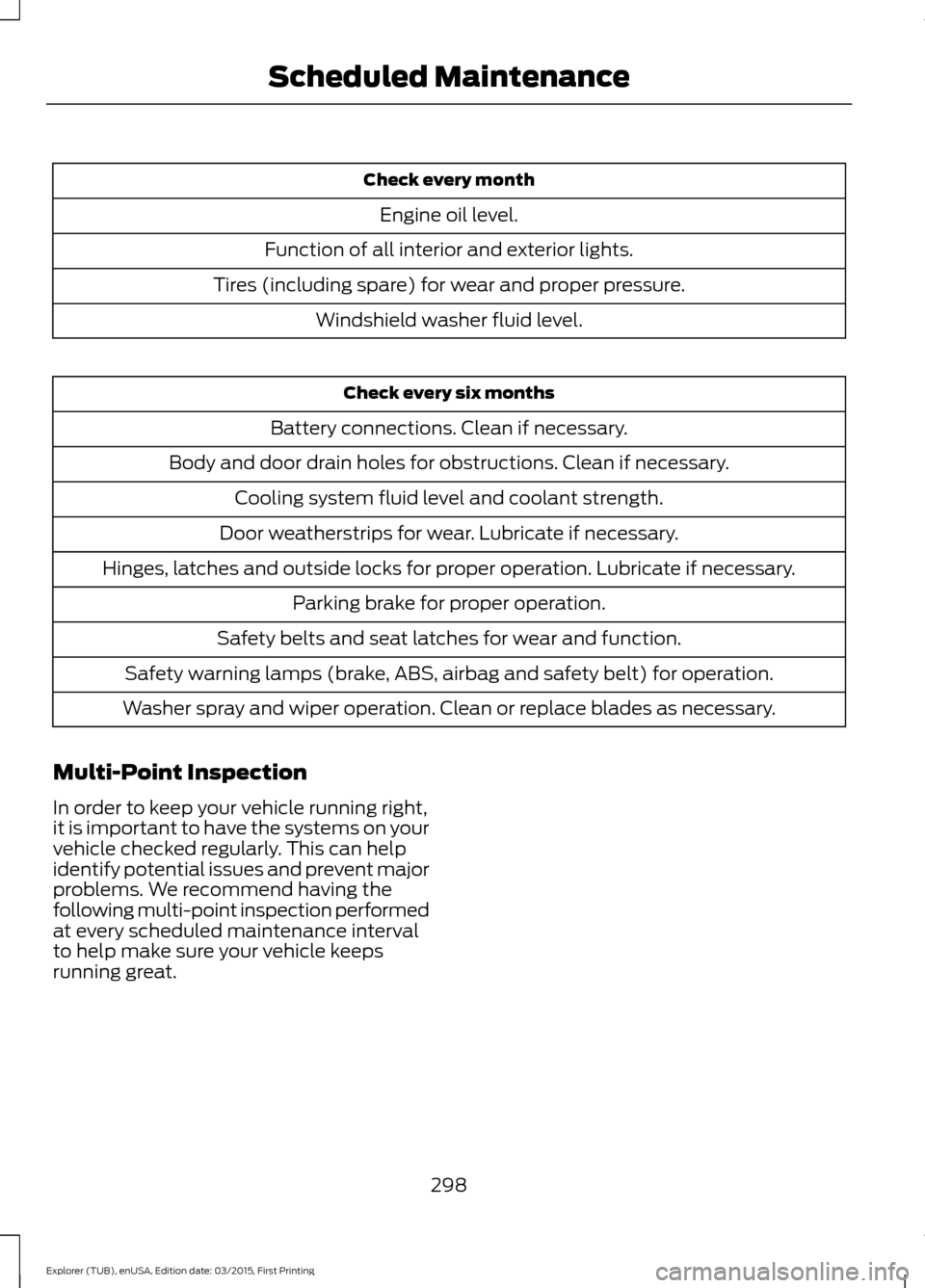
Check every month
Engine oil level.
Function of all interior and exterior lights.
Tires (including spare) for wear and proper pressure. Windshield washer fluid level. Check every six months
Battery connections. Clean if necessary.
Body and door drain holes for obstructions. Clean if necessary. Cooling system fluid level and coolant strength.
Door weatherstrips for wear. Lubricate if necessary.
Hinges, latches and outside locks for proper operation. Lubricate if necessary. Parking brake for proper operation.
Safety belts and seat latches for wear and function.
Safety warning lamps (brake, ABS, airbag and safety belt) for operation.
Washer spray and wiper operation. Clean or replace blades as necessary.
Multi-Point Inspection
In order to keep your vehicle running right,
it is important to have the systems on your
vehicle checked regularly. This can help
identify potential issues and prevent major
problems. We recommend having the
following multi-point inspection performed
at every scheduled maintenance interval
to help make sure your vehicle keeps
running great.
298
Explorer (TUB), enUSA, Edition date: 03/2015, First Printing Scheduled Maintenance
Page 345 of 350

Head Restraints..............................................90
Adjusting the Head Restraint........................... 91
Tilting Head Restraints ...................................... 91
Heated Windows and Mirrors...................88 Heated Exterior Mirror........................................ 88
Heated Rear Window......................................... 88
Heating See: Climate Control.......................................... 86
Hints on Controlling the Interior Climate
............................................................87
Cooling the Interior Quickly.............................. 87
General Hints......................................................... 87
Heating the Interior Quickly.............................. 87
Maximum Cooling Performance in Instrument Panel or Instrument Panel
and Footwell Positions................................. 88
Recommended Settings for Cooling ...........88
Recommended Settings for Heating............87
Side Window Defogging in Cold Weather.............................................................. 88
Vehicle Stationary for Extended Periods During Extreme High Ambient
Temperatures................................................... 88
Hints on Driving With Anti-Lock Brakes.............................................................119
Hood Lock See: Opening and Closing the Hood............177
I
Ignition Switch
.................................................97
In California (U.S. Only).............................162
Information Display Control.......................54 Information Display Control Features..........54
Information Displays.....................................73 General Information............................................ 73Information Messages..................................76
AdvanceTrac ™....................................................... 77
Alarm........................................................................\
. 77
AWD........................................................................\
... 77
Battery and Charging System.......................... 78
Blind Spot Information and Cross Traffic Alert System...................................................... 78
Brake System......................................................... 79
Doors and Locks................................................... 79
Electronic Stability Control............................... 79
Engine...................................................................... 80
Fuel........................................................................\
... 80
Keys and Intelligent Access............................. 80
Lane Keeping System.......................................... 81
Maintenance........................................................... 81
Park Aid.................................................................... 82
Park Brake............................................................... 82
Power Steering...................................................... 83
Seats........................................................................\
. 83
Starting System.................................................... 83
Tire Pressure Monitoring System................... 84
Traction Control.................................................... 84
Transmission......................................................... 84
Installing Child Seats.....................................14 Child Seats............................................................... 14
Using Lap and Shoulder Belts.......................... 15
Using Lower Anchors and Tethers for CHildren (LATCH)............................................. 17
Using Tether Straps.............................................. 19
Instrument Cluster.........................................67
Instrument Lighting Dimmer.....................60
Interior Lamps..................................................61 Dome Lamp............................................................ 61
Dome Task Lamp.................................................. 61
Front Map Lamps.................................................. 61
Rear Interior Lamp............................................... 62
Interior Mirror
...................................................65
Auto-Dimming Mirror......................................... 65
Introduction........................................................5
J
Jump Starting the Vehicle
.........................158
Connecting the Jumper Cables..................... 158
Jump Starting....................................................... 159
Preparing Your Vehicle..................................... 158
Removing the Jumper Cables........................ 159
342
Explorer (TUB), enUSA, Edition date: 03/2015, First Printing Index
Page 346 of 350

K
Keys and Remote Controls........................46
Principle of Operation........................................ 46
L
Lighting Control..............................................58
Headlamp Flasher............................................... 59
High Beams............................................................ 58
Spot Lamp Control.............................................. 59
Lighting..............................................................58 General Information............................................ 58
Load Carriers See: Roof Racks and Load Carriers..............137
Load Carrying
..................................................137
Load Limit.......................................................138
Special Loading Instructions for Owners of
Pick-up Trucks and Utility-type
Vehicles............................................................. 145
Vehicle Loading - with and without a Trailer .................................................................. 138
Locking and Unlocking
................................48
Battery Saver......................................................... 50
Hidden Rear Door Locks.................................... 48
Illuminated Entry.................................................. 50
Illuminated Exit..................................................... 50
Independent Liftgate Locking Feature........49
Locking and Unlocking the Doors with the Key Blade........................................................... 49
Opening a Rear Door From the Inside..........50
Power Door Locks................................................ 48
Remote Control.................................................... 48
Locks...................................................................48
Lug Nuts See: Changing a Road Wheel........................ 227
M
Maintenance...................................................176 General Information........................................... 176
Manual Climate Control..............................86
Manual Liftgate
..............................................50
Closing the Liftgate.............................................. 51
Opening the Liftgate............................................ 51Manual Seats
...................................................92
Lumbar Adjustment............................................ 93
Moving the Seat Backward and Forward............................................................... 92
Recline Adjustment............................................. 92
Message Center See: Information Displays................................. 73
Mirrors See: Heated Windows and Mirrors................88
See: Windows and Mirrors................................ 63
Mobile Communications Equipment........11
Motorcraft Parts - 3.5L Ecoboost™.................................................234
Motorcraft Parts - 3.7L...............................235
N
Normal Scheduled Maintenance
..........299
Intelligent Oil-Life Monitor™........................ 299
Normal Maintenance Intervals.................... 300
O
Oil Change Indicator Reset.......................180
Oil Check See: Engine Oil Check....................................... 180
Opening and Closing the Hood
................177
Closing the Hood................................................ 178
Opening the Hood............................................... 177
Ordering Additional Owner's Literature......................................................165
Obtaining a French Owner ’s Manual..........165
Overhead Console
.........................................96
P
Parking Aids
....................................................124
Principle of Operation....................................... 124
Parking Brake.................................................120
Passenger Knee Airbag................................39
Pedals.................................................................55
Perchlorate..........................................................9
Personal Safety System ™
..........................33
How Does the Personal Safety System
Work?................................................................... 33
Post-Crash Alert System
...........................160
Power Door Locks See: Locking and Unlocking............................. 48
343
Explorer (TUB), enUSA, Edition date: 03/2015, First Printing Index
Page 349 of 350

Using All-Wheel Drive..................................112
Driving In Special Conditions With
All-Wheel Drive (AWD)................................ 114
How Utility Vehicles Differ from Other Vehicles.............................................................. 114
Operating AWD Vehicles With Mismatched Tires..................................................................... 114
Operating AWD Vehicles With Spare Tires...................................................................... 113
Using Cruise Control....................................129 Switching Cruise Control Off......................... 130
Switching Cruise Control On.......................... 129
Using Snow Chains.....................................222
Using Stability Control................................123 AdvanceTrac® with Roll Stability Control ™
(RSC®).............................................................. 123
Using Summer Tires....................................221
Using SYNC™ With Your Media Player.............................................................277
Accessing Your USB Song Library................281
Bluetooth Devices and System Settings............................................................ 283
Connecting Your Digital Media Player to the USB Port............................................................ 277
Media Menu Features....................................... 281
Media Voice Commands................................. 278
USB 2...................................................................... 283
Voice Commands for Audio Sources.........284
Using SYNC™ With Your Phone...........260 Accessing Features through the Phone
Menu.................................................................. 265
Accessing Your Phone Settings................... 268
Bluetooth Devices............................................. 269
Making Calls........................................................ 263
Pairing a Phone for the First Time..............260
Pairing Subsequent Phones........................... 261
Phone Options during an Active Call.........264
Phone Voice Commands................................ 262
Receiving Calls.................................................... 263
System Settings................................................. 270
Text Messaging.................................................. 266
Using Traction Control.................................121 Switching the System Off................................. 121
System Indicator Lights and Messages........................................................... 121
Using a Switch...................................................... 121
Using the Information Display Controls.............................................................. 121Using Voice Recognition...........................258
Initiating a Voice Session................................ 258
System Interaction and Feedback..............259
Utilizing the Mediation/Arbitration Program (Canada Only).........................163
V
Vehicle Care
...................................................198
General Information.......................................... 198
Vehicle Certification Label........................237
Vehicle Identification Number................236
Vehicle Storage............................................202 Battery................................................................... 203
Body........................................................................\
203
Brakes.................................................................... 203
Cooling system................................................... 203
Engine.................................................................... 203
Fuel system.......................................................... 203
General.................................................................. 203
Miscellaneous..................................................... 204
Removing Vehicle From Storage.................204
Tires........................................................................\
203
Ventilation See: Climate Control.......................................... 86
VIN See: Vehicle Identification Number............236
346
Explorer (TUB), enUSA, Edition date: 03/2015, First Printing Index