2016 FORD POLICE INTERCEPTOR SEDAN instrument panel
[x] Cancel search: instrument panelPage 7 of 358

Changing a Bulb...........................................189
Bulb Specification Chart...........................190
Changing the Engine Air Filter.................192
Vehicle Care
General Information
....................................193
Cleaning Products
........................................193
Cleaning the Exterior
...................................193
Waxing..............................................................194
Cleaning the Engine.....................................195
Cleaning the Windows and Wiper Blades...........................................................195
Cleaning the Interior....................................196
Cleaning the Instrument Panel and Instrument Cluster Lens
........................196
Cleaning Leather Seats
..............................197
Repairing Minor Paint Damage................197
Cleaning the Alloy Wheels........................197
Vehicle Storage
.............................................198
Wheels and Tires
General Information
..................................200
Tire Sealant and Inflator Kit
....................200
Tire Care
.........................................................206
Using Summer Tires
...................................220
Using Snow Chains.....................................220
Tire Pressure Monitoring System...........220
Changing a Road Wheel...........................224
Technical Specifications
...........................228
Capacities and Specific- ations
Engine Specifications - 2.0L EcoBoost™................................................229
Engine Specifications - 3.5L Duratec........................................................229
Engine Specifications - 3.5L Ecoboost™................................................230
Engine Specifications - 3.7L......................231
Motorcraft Parts - 2.0L EcoBoost™
......231
Motorcraft Parts - 3.5L Duratec.............233 Motorcraft Parts - 3.5L Ecoboost™
......234
Motorcraft Parts - 3.7L...............................235
Vehicle Identification Number................236
Vehicle Certification Label........................237
Transmission Code Designation.............237
Capacities and Specifications - 2.0L EcoBoost™................................................238
Capacities and Specifications - 3.5L Duratec.........................................................241
Capacities and Specifications - 3.5L Ecoboost™
................................................245
Capacities and Specifications - 3.7L.....249
Audio System
General Information
...................................254
Audio Unit - Vehicles With: AM/FM/CD/ SYNC/Satellite Radio
............................255
Audio Input Jack...........................................259
USB Port
.........................................................260
Media Hub......................................................260
SYNC™
General Information....................................261
Using Voice Recognition...........................263
Using SYNC™ With Your Phone............266
SYNC™ Applications and Services......279
SYNC™ AppLink ™
......................................287
Using SYNC™ With Your Media Player...........................................................289
SYNC™ Troubleshooting.........................299
Extended Service Plan (ESP)
Extended Service Plan (ESP).................308
Scheduled Maintenance
General Maintenance Information
........310
Normal Scheduled Maintenance............313
Special Operating Conditions Scheduled Maintenance..............................................316
Scheduled Maintenance Record...........320
4
Police Interceptor (CPH), enUSA, Edition date: 10/2015, First Printing Table of Contents
Page 39 of 358

Children must always be properly
restrained. Accident statistics suggest that
children are safer when properly restrained
in the rear seating positions than in the
front seating position. Failure to follow
these instructions may increase the risk of
injury in a crash.
FRONT PASSENGER SENSING
SYSTEM
WARNINGS
Even with Advanced Restraints
Systems, children 12 and under
should be properly restrained in a
rear seating position. Failure to follow this
could seriously increase the risk of injury or
death. Sitting improperly out of position or
with the seatback reclined too far
can take off weight from the seat
cushion and affect the decision of the front
passenger sensing system, resulting in
serious injury or death in a crash. Always
sit upright against your seatback, with your
feet on the floor. Any alteration or modification to the
front passenger seat may affect the
performance of the front passenger
sensing system which could seriously
increase the risk of injury or death. This system works with sensors that are
part of the front passenger seat and
seatbelt to detect the presence of a
properly-seated occupant and determine
if the front passenger frontal airbag should
be enabled (may inflate) or not.
The front passenger sensing system uses
a passenger airbag status indicator that
will illuminate indicating that the front
passenger frontal airbag is either ON
(enabled) or OFF (disabled).
The indicator lamp is located in the center
stack of the instrument panel.
Note:
The passenger airbag status indicator
OFF and ON indicator lamps will illuminate
for a short period of time when the ignition
is first turned on to confirm it is functional.
The front passenger sensing system is
designed to disable (will not inflate) the
front passenger frontal airbag when the
front passenger seat is unoccupied, or a
rear facing infant seat, a forward-facing
child restraint, or a booster seat is
detected. Even with this technology,
parents are strongly encouraged to
always properly restrain children in the rear
seat. The sensor also turns off the
passenger front airbag and seat-mounted
side airbag when the passenger seat is
empty.
36
Police Interceptor (CPH), enUSA, Edition date: 10/2015, First Printing Supplementary Restraints SystemE142846 E224573
Page 47 of 358
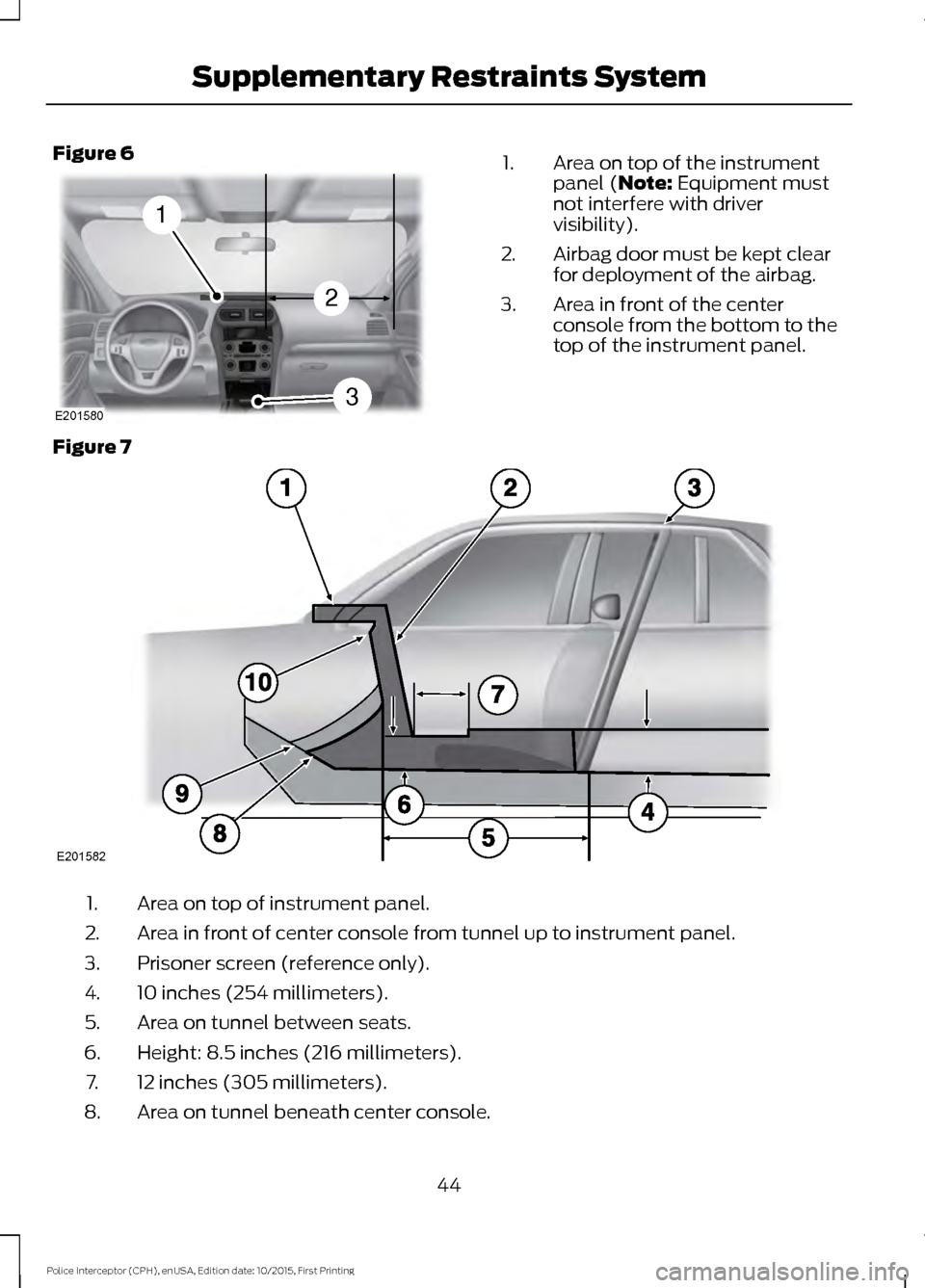
Figure 6
Area on top of the instrument
panel (Note: Equipment must
not interfere with driver
visibility).
1.
Airbag door must be kept clear
for deployment of the airbag.
2.
Area in front of the center
console from the bottom to the
top of the instrument panel.
3.
Figure 7 Area on top of instrument panel.
1.
Area in front of center console from tunnel up to instrument panel.
2.
Prisoner screen (reference only).
3.
10 inches (254 millimeters).
4.
Area on tunnel between seats.
5.
Height: 8.5 inches (216 millimeters).
6.
12 inches (305 millimeters).
7.
Area on tunnel beneath center console.
8.
44
Police Interceptor (CPH), enUSA, Edition date: 10/2015, First Printing Supplementary Restraints System1
3
2
E201580 E201582
Page 48 of 358
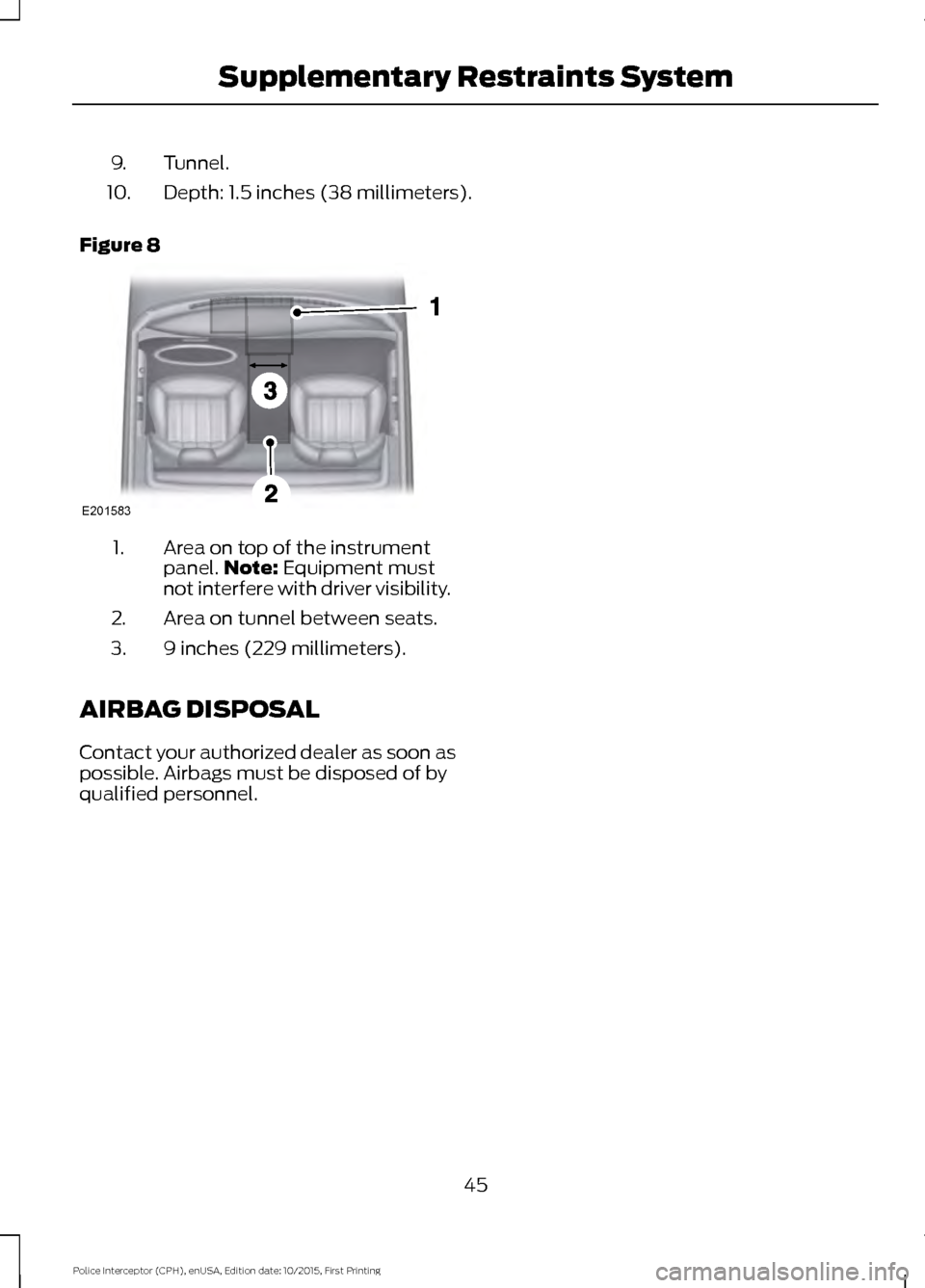
Tunnel.
9.
Depth: 1.5 inches (38 millimeters).
10.
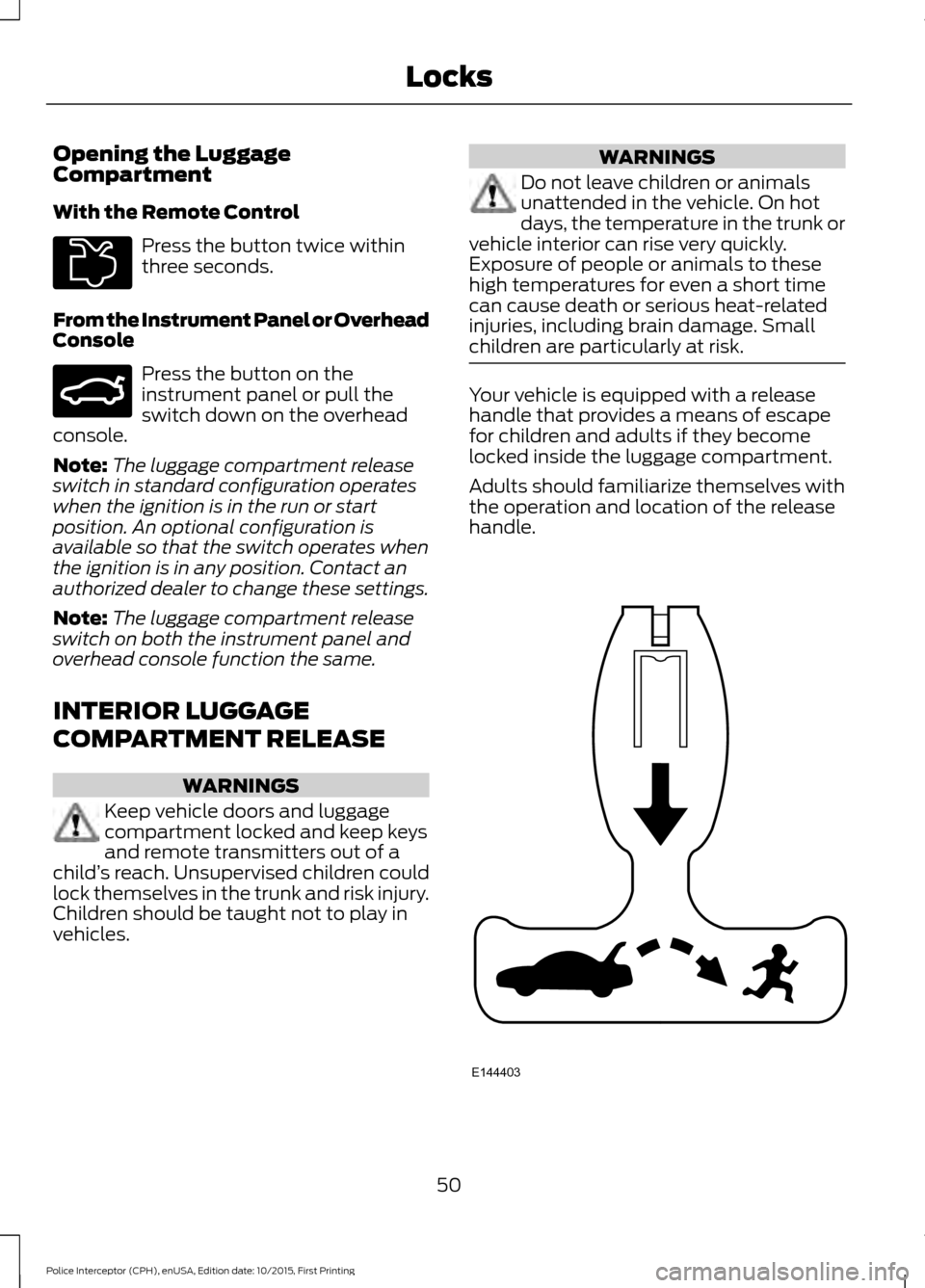
Figure 8 Area on top of the instrument
panel.
Note: Equipment must
not interfere with driver visibility.
1.
Area on tunnel between seats.
2.
9 inches (229 millimeters).
3.
AIRBAG DISPOSAL
Contact your authorized dealer as soon as
possible. Airbags must be disposed of by
qualified personnel.
45
Police Interceptor (CPH), enUSA, Edition date: 10/2015, First Printing Supplementary Restraints SystemE201583
Page 53 of 358
Opening the Luggage
Compartment
With the Remote Control
Press the button twice within
three seconds.
From the Instrument Panel or Overhead
Console Press the button on the
instrument panel or pull the
switch down on the overhead
console.
Note: The luggage compartment release
switch in standard configuration operates
when the ignition is in the run or start
position. An optional configuration is
available so that the switch operates when
the ignition is in any position. Contact an
authorized dealer to change these settings.
Note: The luggage compartment release
switch on both the instrument panel and
overhead console function the same.
INTERIOR LUGGAGE
COMPARTMENT RELEASE WARNINGS
Keep vehicle doors and luggage
compartment locked and keep keys
and remote transmitters out of a
child ’s reach. Unsupervised children could
lock themselves in the trunk and risk injury.
Children should be taught not to play in
vehicles. WARNINGS
Do not leave children or animals
unattended in the vehicle. On hot
days, the temperature in the trunk or
vehicle interior can rise very quickly.
Exposure of people or animals to these
high temperatures for even a short time
can cause death or serious heat-related
injuries, including brain damage. Small
children are particularly at risk. Your vehicle is equipped with a release
handle that provides a means of escape
for children and adults if they become
locked inside the luggage compartment.
Adults should familiarize themselves with
the operation and location of the release
handle.
50
Police Interceptor (CPH), enUSA, Edition date: 10/2015, First Printing LocksE211694 E159323 E144403
Page 60 of 358
GENERAL INFORMATION
Condensation in Lamp Assemblies
Exterior lamps have vents to
accommodate normal changes in air
pressure.
Condensation can be a natural by-product
of this design. When moist air enters the
lamp assembly through the vents, there is
a possibility that condensation can occur
when the temperature is cold. When
normal condensation occurs, a fine mist
can form on the interior of the lens. The
fine mist eventually clears and exits
through the vents during normal operation.
Clearing time may take as long as 48 hours
under dry weather conditions.
Examples of acceptable condensation are:
•
The presence of a fine mist (no streaks,
drip marks or large droplets).
• A fine mist covers less than 50% of the
lens.
Examples of unacceptable condensation
are:
• A water puddle inside the lamp.
• Streaks, drip marks or large droplets
present on the interior of the lens.
If you see any unacceptable condensation,
have your vehicle checked by an authorized
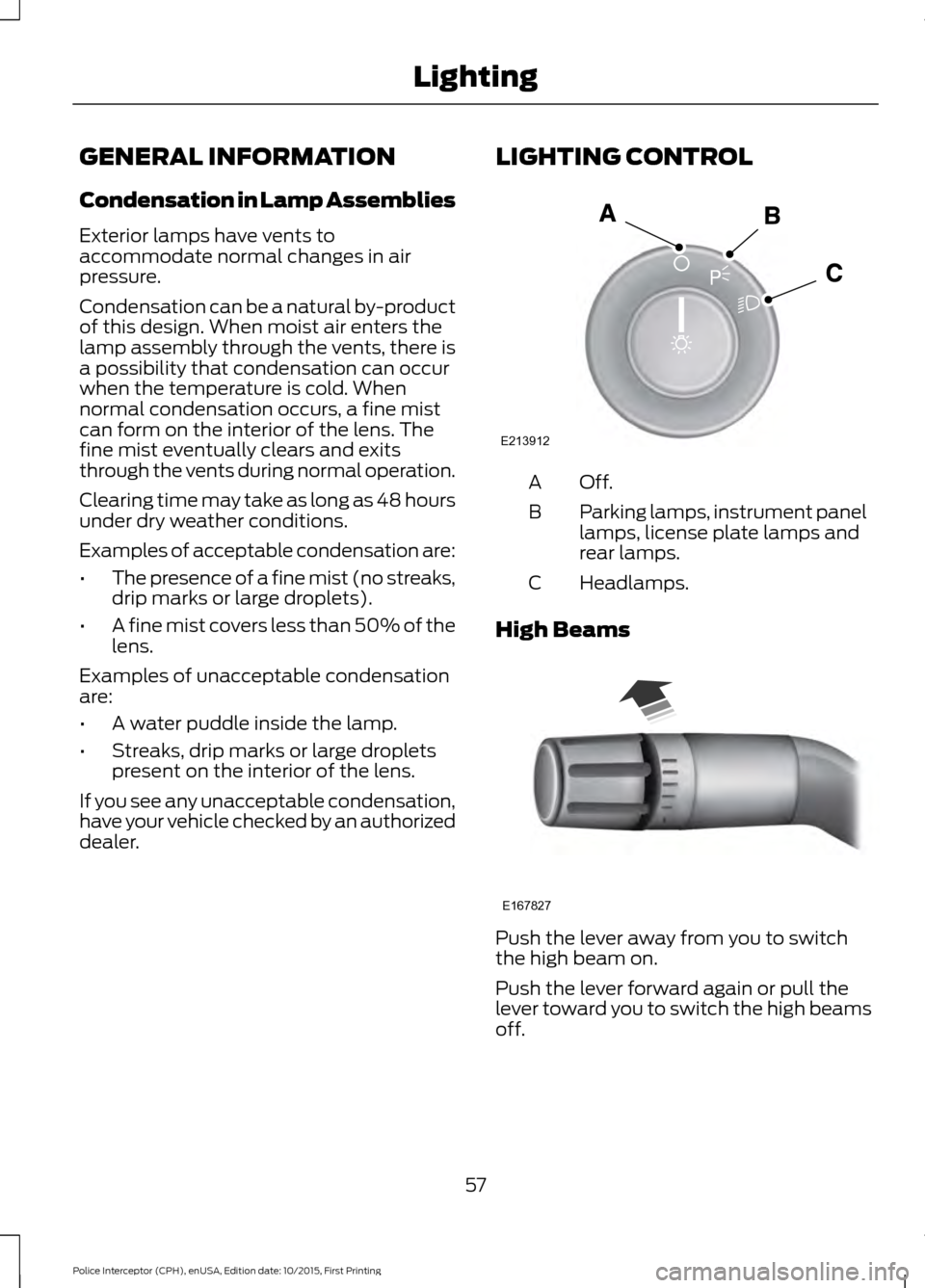
dealer. LIGHTING CONTROL Off.A
Parking lamps, instrument panel
lamps, license plate lamps and
rear lamps.
B
Headlamps.
C
High Beams Push the lever away from you to switch
the high beam on.
Push the lever forward again or pull the
lever toward you to switch the high beams
off.
57
Police Interceptor (CPH), enUSA, Edition date: 10/2015, First Printing LightingE213912 E167827
Page 62 of 358

The daytime running lamps turn on when:
1. The ignition is switched to the on
position.
2. The lighting control is in the off position, parking lamps position or the
autolamps position, and the sensor
detects daylight.
DIRECTION INDICATORS •
To operate the left direction indicator,
push the lever down until it stops.
• To operate the right direction indicator,
push the lever up until it stops.
Note: Tap the lever up or down to make the
direction indicators flash three times. INTERIOR LAMPS
Front Map Lamps (If Equipped) The lamps will switch on when:
•
You open any door.
• You press the instrument panel dimmer
button until the courtesy lamp turns
on.
• You press a remote control button and
the ignition is off.
To manually switch on the map lamps,
press the outer edge of the clear lens.
Note: If equipped with Dark Car feature, the
courtesy lamps will not turn on.
59
Police Interceptor (CPH), enUSA, Edition date: 10/2015, First Printing LightingE163272 E163273
Page 82 of 358
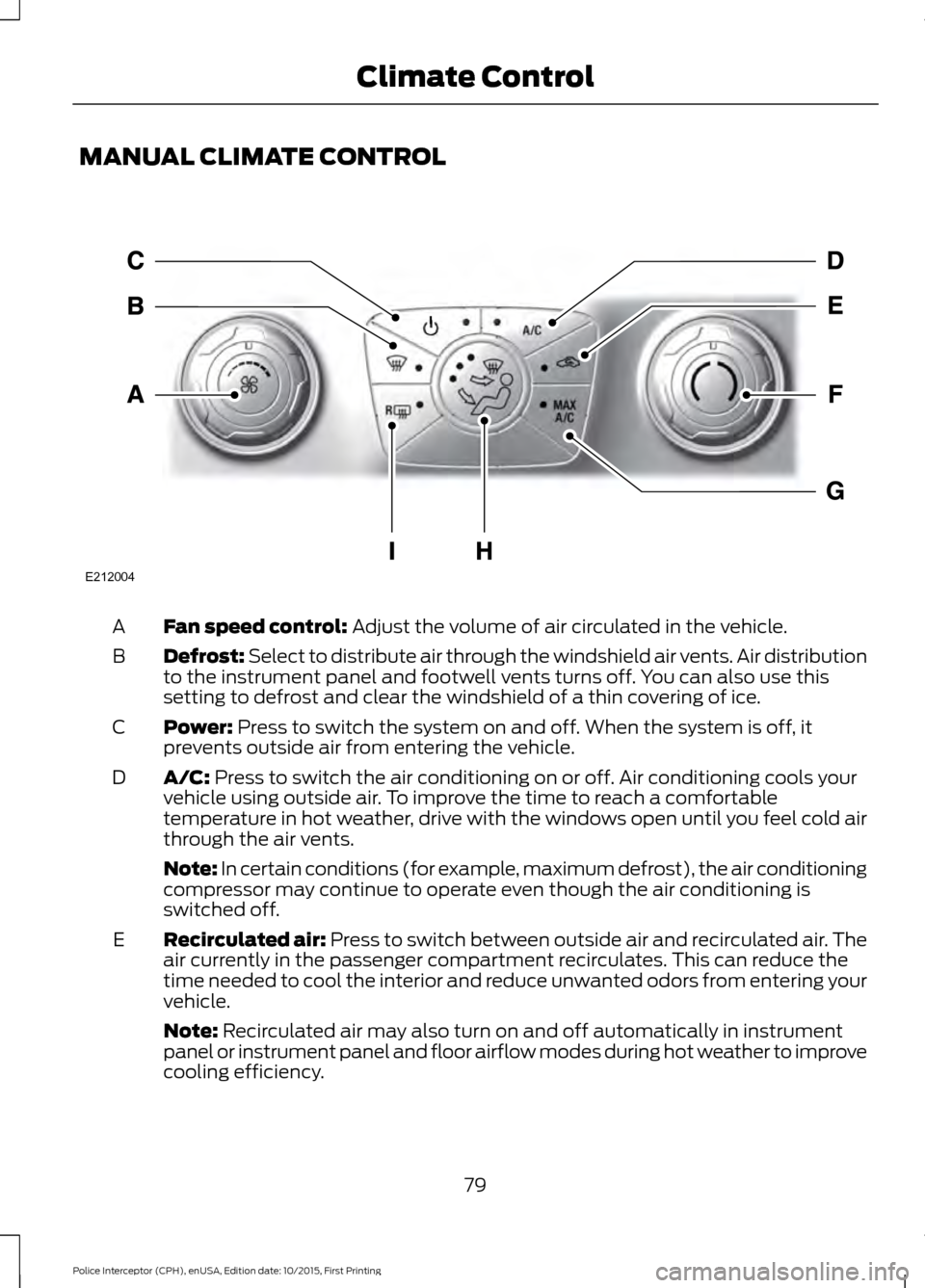
MANUAL CLIMATE CONTROL
Fan speed control: Adjust the volume of air circulated in the vehicle.
A
Defrost: Select to distribute air through the windshield air vents. Air distribution
to the instrument panel and footwell vents turns off. You can also use this
setting to defrost and clear the windshield of a thin covering of ice.
B
Power:
Press to switch the system on and off. When the system is off, it
prevents outside air from entering the vehicle.
C
A/C:
Press to switch the air conditioning on or off. Air conditioning cools your
vehicle using outside air. To improve the time to reach a comfortable
temperature in hot weather, drive with the windows open until you feel cold air
through the air vents.
D
Note: In certain conditions (for example, maximum defrost), the air conditioning
compressor may continue to operate even though the air conditioning is
switched off.
Recirculated air:
Press to switch between outside air and recirculated air. The
air currently in the passenger compartment recirculates. This can reduce the
time needed to cool the interior and reduce unwanted odors from entering your
vehicle.
E
Note:
Recirculated air may also turn on and off automatically in instrument
panel or instrument panel and floor airflow modes during hot weather to improve
cooling efficiency.
79
Police Interceptor (CPH), enUSA, Edition date: 10/2015, First Printing Climate ControlE212004