2016 FORD FOCUS door
[x] Cancel search: doorPage 4 of 385

Introduction
About This Manual...........................................7
Symbols Glossary
.............................................7
Data Recording
..................................................9
California Proposition 65..............................11
Perchlorate.........................................................11
Ford Credit
..........................................................11
Replacement Parts Recommendation
........................................11
Special Notices................................................12
Mobile Communications Equipment.....................................................12
Export Unique Options..................................13
Environment
Protecting the Environment........................14
Child Safety
General Information
.......................................15
Installing Child Restraints
............................16
Booster Seats
..................................................23
Child Restraint Positioning.........................25
Child Safety Locks.........................................26
Seatbelts
Principle of Operation
..................................28
Fastening the Seatbelts..............................29
Seatbelt Height Adjustment
.......................31
Seatbelt Warning Lamp and Indicator Chime
..............................................................32
Seatbelt Reminder.........................................32
Child Restraint and Seatbelt Maintenance................................................34
Personal Safety System ™
Personal Safety System ™
..........................35
Supplementary Restraints System
Principle of Operation..................................36 Driver and Passenger Airbags....................37
Front Passenger Sensing System
............38
Side Airbags
.....................................................40
Driver Knee Airbag
..........................................41
Safety Canopy ™
.............................................42
Crash Sensors and Airbag Indicator........43
Airbag Disposal...............................................44
Keys and Remote Controls
General Information on Radio Frequencies..................................................45
Remote Control - Vehicles With: Integrated Key Transmitter
....................45
Remote Control - Vehicles With: Keyless Entry
................................................................47
Remote Control - Vehicles With: Keyless Entry with Remote Start.........................49
Replacing a Lost Key or Remote Control............................................................52
MyKey ™
Principle of Operation..................................53
Creating a MyKey
...........................................54
Clearing All MyKeys.......................................55
Checking MyKey System Status...............56
Using MyKey With Remote Start Systems.........................................................56
MyKey Troubleshooting...............................56
Locks
Locking and Unlocking
.................................58
Manual Liftgate
...............................................62
Keyless Entry
....................................................63
Interior Luggage Compartment Release - 4-Door
.........................................................64
Security
Passive Anti-Theft System........................66
Anti-Theft Alarm
...........................................68
1
Focus (CDH) Canada/United States of America, enUSA, First Printing Table of Contents
Page 11 of 385

Brake system
Cabin air filter
Check fuel cap
Child safety door lock or unlock
Child seat lower anchor
Child seat tether anchor
Cruise control
Do not open when hot
Engine air filter
Engine coolant
Engine coolant temperature
Engine oil
Explosive gas
Fan warning
Fasten seatbelt Front airbag
Front fog lamps
Fuel pump reset
Fuse compartment
Hazard warning flashers
Heated rear window
Heated windshield
Interior luggage compartment
release
Jack
Keep out of reach of children
Lighting control
Low tire pressure warning
Maintain correct fluid level
Note operating instructions
Panic alarm
8
Focus (CDH) Canada/United States of America, enUSA, First Printing Introduction E71340 E161353
Page 24 of 385
Combining Safety Belt and LATCH
Lower Anchors for Attaching Child
Safety Seats
When used in combination, either the
safety belt or the LATCH lower anchors
may be attached first, provided a proper
installation is achieved. Attach the tether
strap afterward, if included with the child
seat.
Using Tether Straps
Many forward-facing child safety
seats include a tether strap
which extends from the back of
the child safety seat and hooks to an
anchoring point called the top tether
anchor. Tether straps are available as an
accessory for many older safety seats.
Contact the manufacturer of your child
seat for information about ordering a
tether strap, or to obtain a longer tether
strap if the tether strap on your safety seat
does not reach the appropriate top tether
anchor in your vehicle.
The rear seats of your vehicle are equipped
with built-in tether strap anchors located
behind the seats as described below.
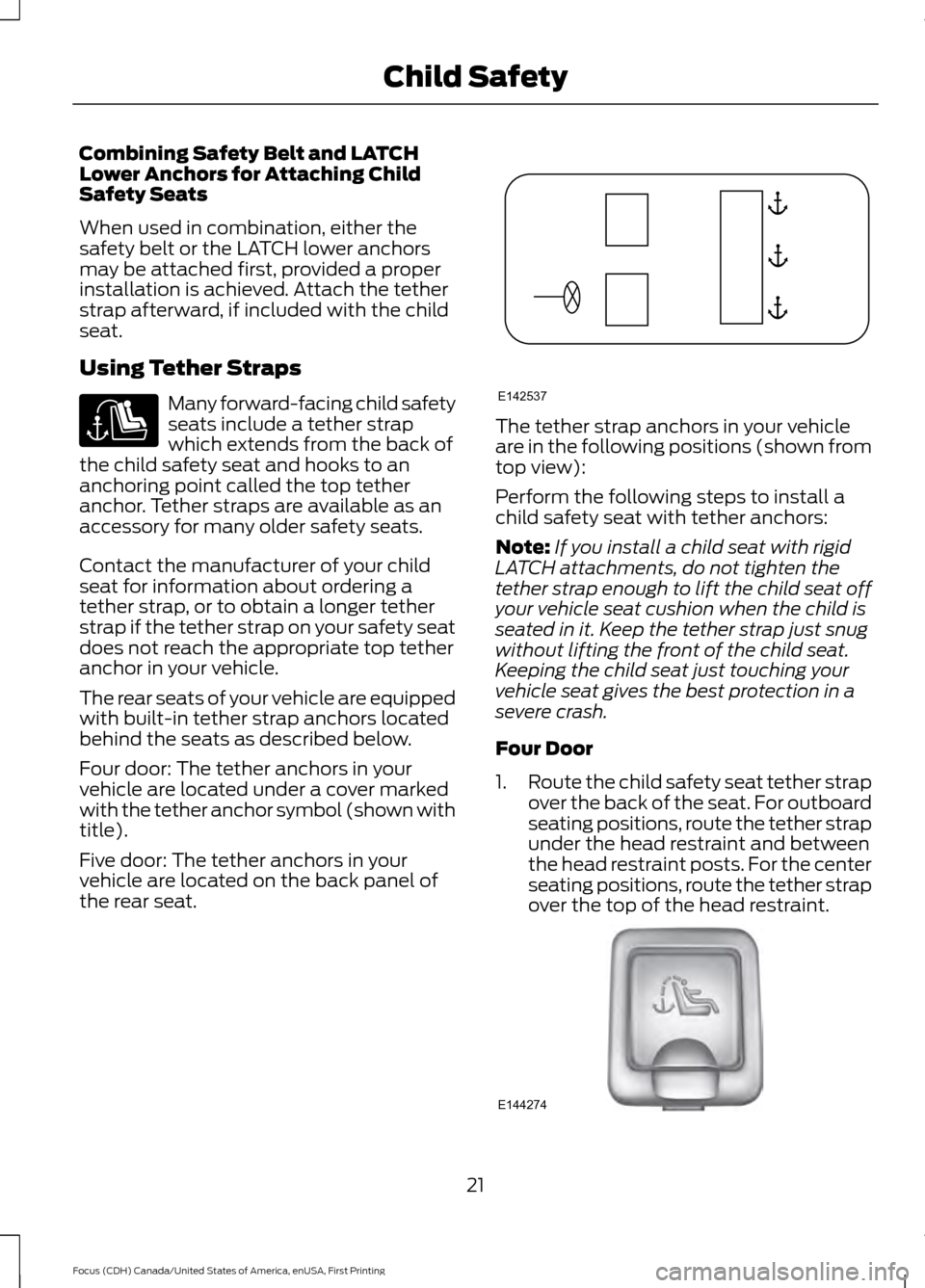
Four door: The tether anchors in your
vehicle are located under a cover marked
with the tether anchor symbol (shown with
title).
Five door: The tether anchors in your
vehicle are located on the back panel of
the rear seat. The tether strap anchors in your vehicle
are in the following positions (shown from
top view):
Perform the following steps to install a
child safety seat with tether anchors:
Note:
If you install a child seat with rigid
LATCH attachments, do not tighten the
tether strap enough to lift the child seat off
your vehicle seat cushion when the child is
seated in it. Keep the tether strap just snug
without lifting the front of the child seat.
Keeping the child seat just touching your
vehicle seat gives the best protection in a
severe crash.
Four Door
1. Route the child safety seat tether strap
over the back of the seat. For outboard
seating positions, route the tether strap
under the head restraint and between
the head restraint posts. For the center
seating positions, route the tether strap
over the top of the head restraint. 21
Focus (CDH) Canada/United States of America, enUSA, First Printing Child Safety E142537 E144274
Page 25 of 385
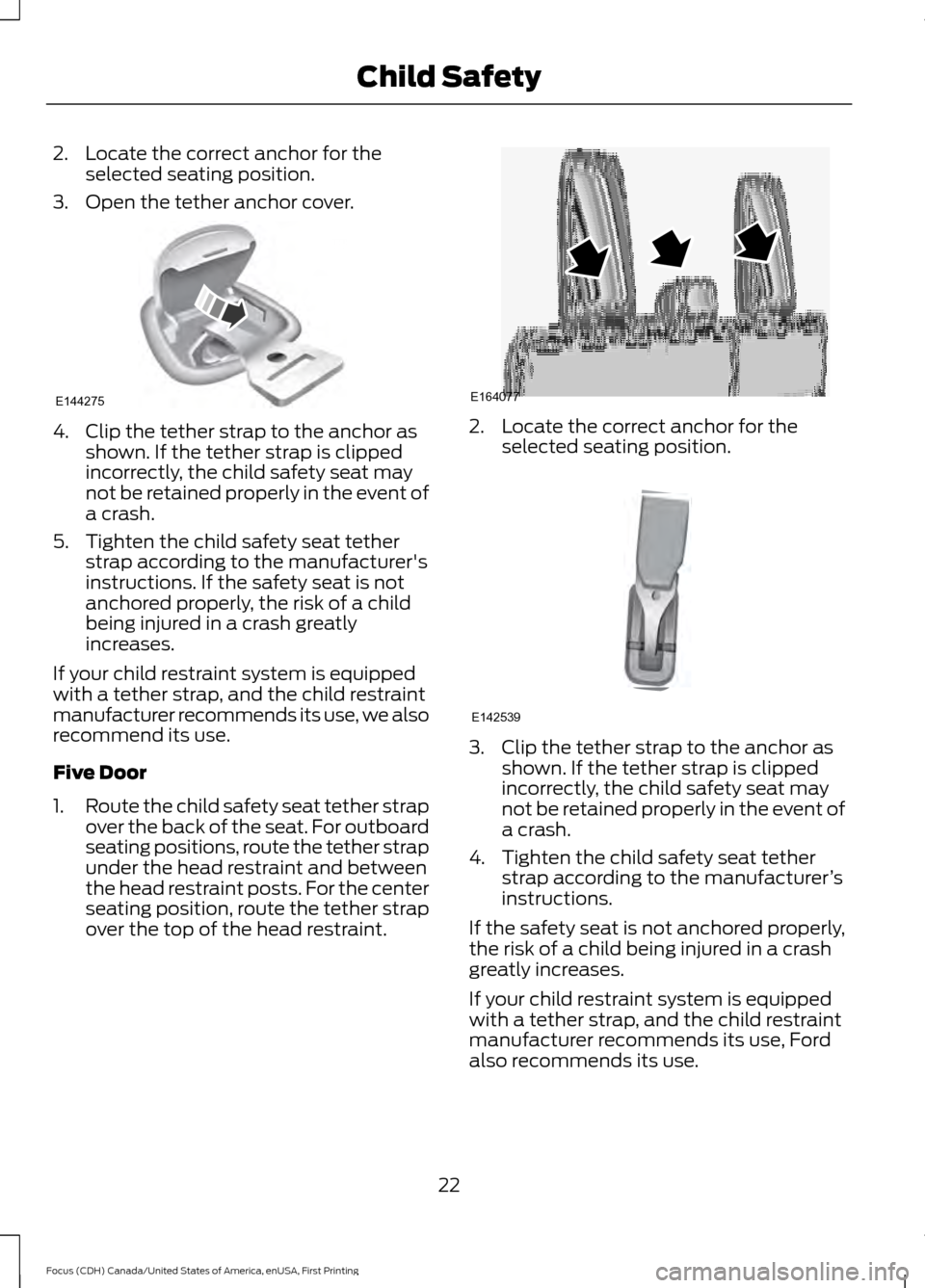
2. Locate the correct anchor for the
selected seating position.
3. Open the tether anchor cover. 4. Clip the tether strap to the anchor as
shown. If the tether strap is clipped
incorrectly, the child safety seat may
not be retained properly in the event of
a crash.
5. Tighten the child safety seat tether strap according to the manufacturer's
instructions. If the safety seat is not
anchored properly, the risk of a child
being injured in a crash greatly
increases.
If your child restraint system is equipped
with a tether strap, and the child restraint
manufacturer recommends its use, we also
recommend its use.
Five Door
1. Route the child safety seat tether strap
over the back of the seat. For outboard
seating positions, route the tether strap
under the head restraint and between
the head restraint posts. For the center
seating position, route the tether strap
over the top of the head restraint. 2. Locate the correct anchor for the
selected seating position. 3. Clip the tether strap to the anchor as
shown. If the tether strap is clipped
incorrectly, the child safety seat may
not be retained properly in the event of
a crash.
4. Tighten the child safety seat tether strap according to the manufacturer ’s
instructions.
If the safety seat is not anchored properly,
the risk of a child being injured in a crash
greatly increases.
If your child restraint system is equipped
with a tether strap, and the child restraint
manufacturer recommends its use, Ford
also recommends its use.
22
Focus (CDH) Canada/United States of America, enUSA, First Printing Child SafetyE144275 E164077 E142539
Page 29 of 385
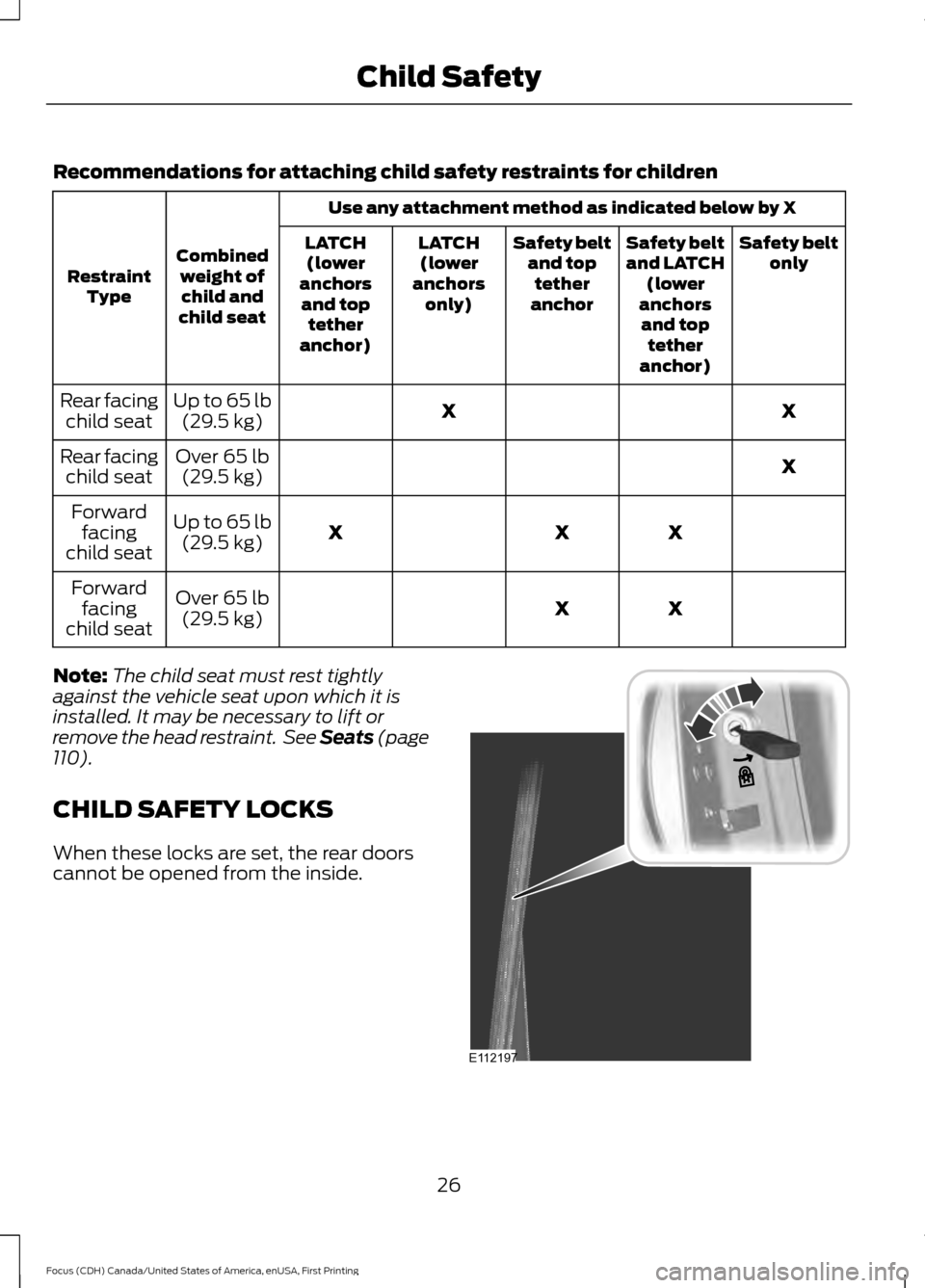
Recommendations for attaching child safety restraints for children
Use any attachment method as indicated below by X
Combined weight ofchild and
child seat
Restraint
Type Safety belt
only
Safety belt
and LATCH
(lower
anchors and top tether
anchor)
Safety belt
and toptether
anchor
LATCH
(lower
anchors only)
LATCH
(lower
anchors and top tether
anchor)
X
X
Up to 65 lb
(29.5 kg)
Rear facing
child seat
X
Over
65 lb
(29.5 kg)
Rear facing
child seat
X
X
X
Up to
65 lb
(29.5 kg)
Forward
facing
child seat
X
X
Over
65 lb
(29.5 kg)
Forward
facing
child seat
Note: The child seat must rest tightly
against the vehicle seat upon which it is
installed. It may be necessary to lift or
remove the head restraint. See Seats (page
110
).
CHILD SAFETY LOCKS
When these locks are set, the rear doors
cannot be opened from the inside. 26
Focus (CDH) Canada/United States of America, enUSA, First Printing Child SafetyE112197
Page 30 of 385
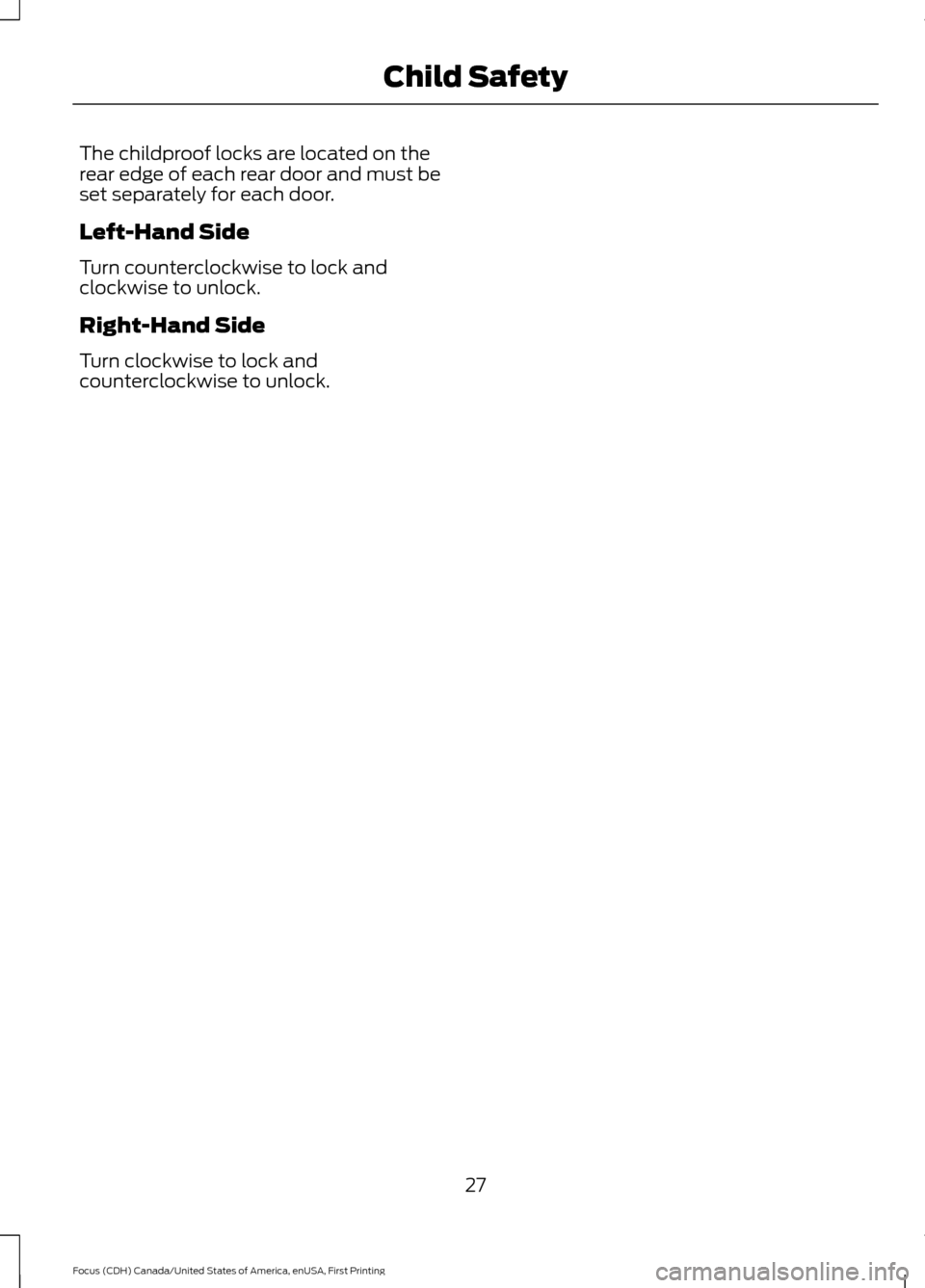
The childproof locks are located on the
rear edge of each rear door and must be
set separately for each door.
Left-Hand Side
Turn counterclockwise to lock and
clockwise to unlock.
Right-Hand Side
Turn clockwise to lock and
counterclockwise to unlock.
27
Focus (CDH) Canada/United States of America, enUSA, First Printing Child Safety
Page 44 of 385

WARNINGS
Do not use accessory seat covers.
The use of accessory seat covers
may prevent the deployment of the
side airbags and increase the risk of injury
in an accident. Do not lean your head on the door.
The side airbag could injure you as it
deploys from the side of the
seatback. Do not attempt to service, repair, or
modify the airbag, its fuses or the
seat cover on a seat containing an
airbag as you could be seriously injured or
killed. Contact your authorized dealer as
soon as possible. If the side airbag has deployed, the
airbag will not function again. The
side airbag system (including the
seat) must be inspected and serviced by
an authorized dealer. If the airbag is not
replaced, the unrepaired area will increase
the risk of injury in a crash. The side airbags are located on the
outboard side of the seatbacks of the front
seats. In certain sideways crashes, the
airbag on the side affected by the crash
will be inflated. The airbag was designed
to inflate between the door panel and
occupant to further enhance the protection
provided occupants in side impact crashes. The system consists of the following:
•
A label or embossed side panel
indicating that side airbags are fitted
to your vehicle.
• Side airbags located inside the driver
and front passenger seatbacks.
• Front passenger sensing system. •
Crash sensors and monitoring system
with readiness indicator. See Crash
Sensors and Airbag Indicator (page
43
).
Note: The passenger sensing system will
deactivate the passenger seat-mounted
side airbag if it detects an empty passenger
seat.
The design and development of the side
airbag system included recommended
testing procedures that were developed
by a group of automotive safety experts
known as the Side Airbag Technical
Working Group. These recommended
testing procedures help reduce the risk of
injuries related to the deployment of side
airbags.
DRIVER KNEE AIRBAG
A driver's knee airbag is located under the
instrument panel. During a crash, the
restraints control module may activate the
driver's knee airbag based on crash severity
and occupant conditions. Under certain
crash and occupant conditions, the driver ’s
knee airbag may deploy but the driver ’s
front airbag may not activate. As with front
and side airbags, it is important to be
properly seated and restrained to reduce
the risk of death or serious injury. Make sure the knee airbag is
operating properly. See
Crash
Sensors and Airbag Indicator
(page
43).
41
Focus (CDH) Canada/United States of America, enUSA, First Printing Supplementary Restraints SystemE152533
Page 45 of 385

SAFETY CANOPY™
WARNINGS
Do not place objects or mount
equipment on or near the headliner
at the siderail that may come into
contact with a deploying curtain airbag.
Failure to follow these instructions may
increase the risk of personal injury in the
event of a crash. Do not lean your head on the door.
The curtain airbag could injure you
as it deploys from the headliner.
Do not attempt to service, repair, or
modify the curtain airbags, its fuses,
the A, B, or C pillar trim, or the
headliner on a vehicle containing curtain
airbags as you could be seriously injured
or killed. Contact your authorized dealer
as soon as possible. All occupants of your vehicle
including the driver should always
wear their safety belts even when an
airbag supplemental restraint system and
curtain airbag is provided. Failure to
properly wear your safety belt could
seriously increase the risk of injury or death. To reduce risk of injury, do not
obstruct or place objects in the
deployment path of the curtain
airbag. If the curtain airbags have deployed,
the curtain airbags will not function
again. The curtain airbags (including
the A, B and C pillar trim and headliner)
must be inspected and serviced by an
authorized dealer. If the curtain airbag is
not replaced, the unrepaired area will
increase the risk of injury in a crash. The Safety Canopy will deploy during
significant side crashes or when a certain
likelihood of a rollover event is detected
by the rollover sensor. The Safety Canopy
is mounted to the roof side-rail sheet
metal, behind the headliner, above each
row of seats. In certain sideways crashes
or rollover events, the Safety Canopy will
be activated, regardless of which seats are
occupied. The Safety Canopy is designed
to inflate between the side window area
and occupants to further enhance
protection provided in side impact crashes
and rollover events.
The system consists of the following:
•
Safety canopy curtain airbags located
above the trim panels over the front
and rear side windows identified by a
label or wording on the headliner or
roof-pillar trim.
• A flexible headliner which opens above
the side doors to allow air curtain
deployment · Crash sensors and monitoring
system with a readiness
indicator. See Crash Sensors
and Airbag Indicator (page 43).
42
Focus (CDH) Canada/United States of America, enUSA, First Printing Supplementary Restraints SystemE75004