2016 FORD FOCUS tires
[x] Cancel search: tiresPage 266 of 385
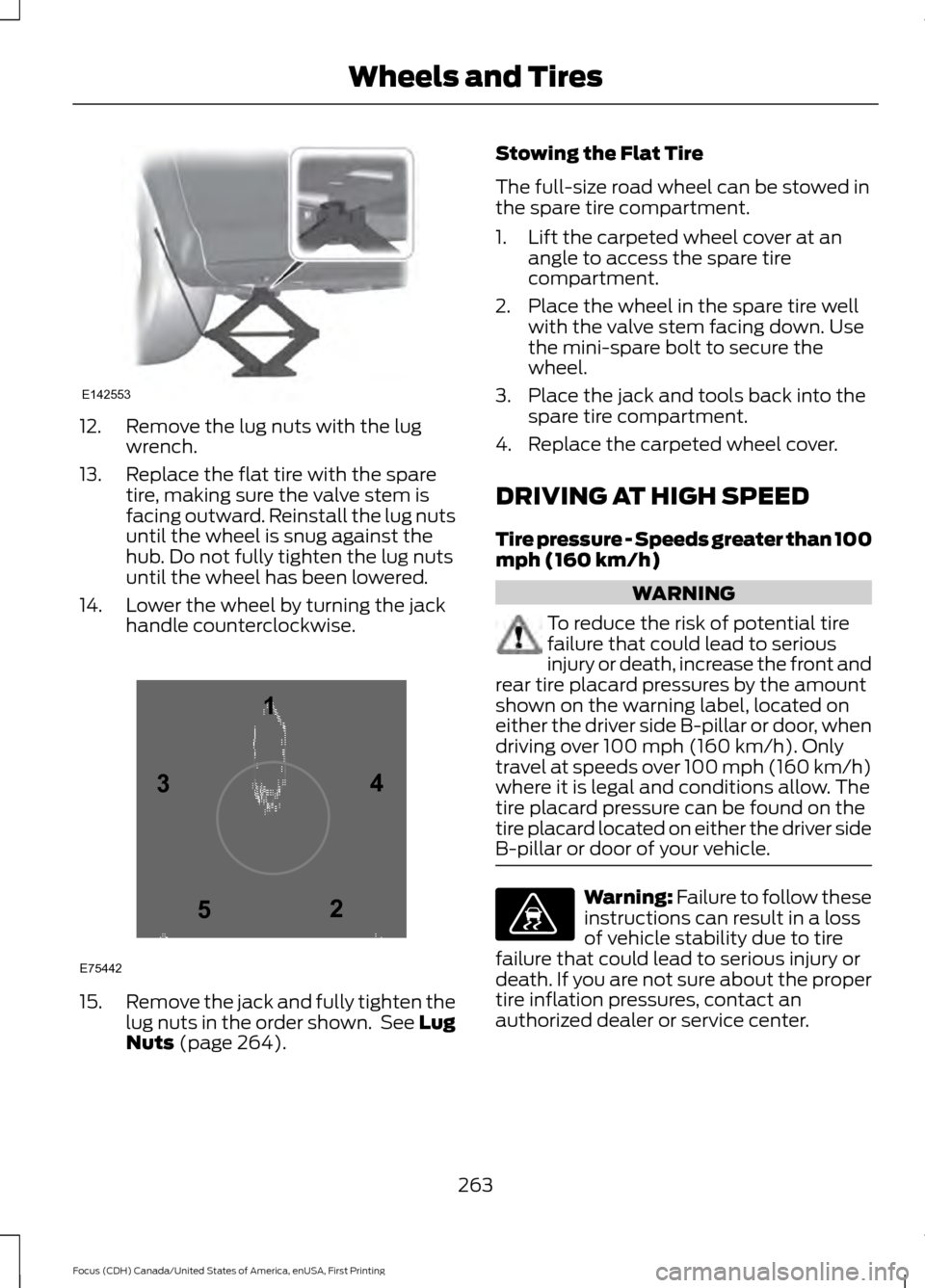
12. Remove the lug nuts with the lug
wrench.
13. Replace the flat tire with the spare tire, making sure the valve stem is
facing outward. Reinstall the lug nuts
until the wheel is snug against the
hub. Do not fully tighten the lug nuts
until the wheel has been lowered.
14. Lower the wheel by turning the jack handle counterclockwise. 15.
Remove the jack and fully tighten the
lug nuts in the order shown. See Lug
Nuts (page 264). Stowing the Flat Tire
The full-size road wheel can be stowed in
the spare tire compartment.
1. Lift the carpeted wheel cover at an
angle to access the spare tire
compartment.
2. Place the wheel in the spare tire well with the valve stem facing down. Use
the mini-spare bolt to secure the
wheel.
3. Place the jack and tools back into the spare tire compartment.
4. Replace the carpeted wheel cover.
DRIVING AT HIGH SPEED
Tire pressure - Speeds greater than 100
mph (160 km/h) WARNING
To reduce the risk of potential tire
failure that could lead to serious
injury or death, increase the front and
rear tire placard pressures by the amount
shown on the warning label, located on
either the driver side B-pillar or door, when
driving over
100 mph (160 km/h). Only
travel at speeds over 100 mph (160 km/h)
where it is legal and conditions allow. The
tire placard pressure can be found on the
tire placard located on either the driver side
B-pillar or door of your vehicle. Warning: Failure to follow these
instructions can result in a loss
of vehicle stability due to tire
failure that could lead to serious injury or
death. If you are not sure about the proper
tire inflation pressures, contact an
authorized dealer or service center.
263
Focus (CDH) Canada/United States of America, enUSA, First Printing Wheels and TiresE142553 12
3
4
5
E75442 E176077
Page 267 of 385
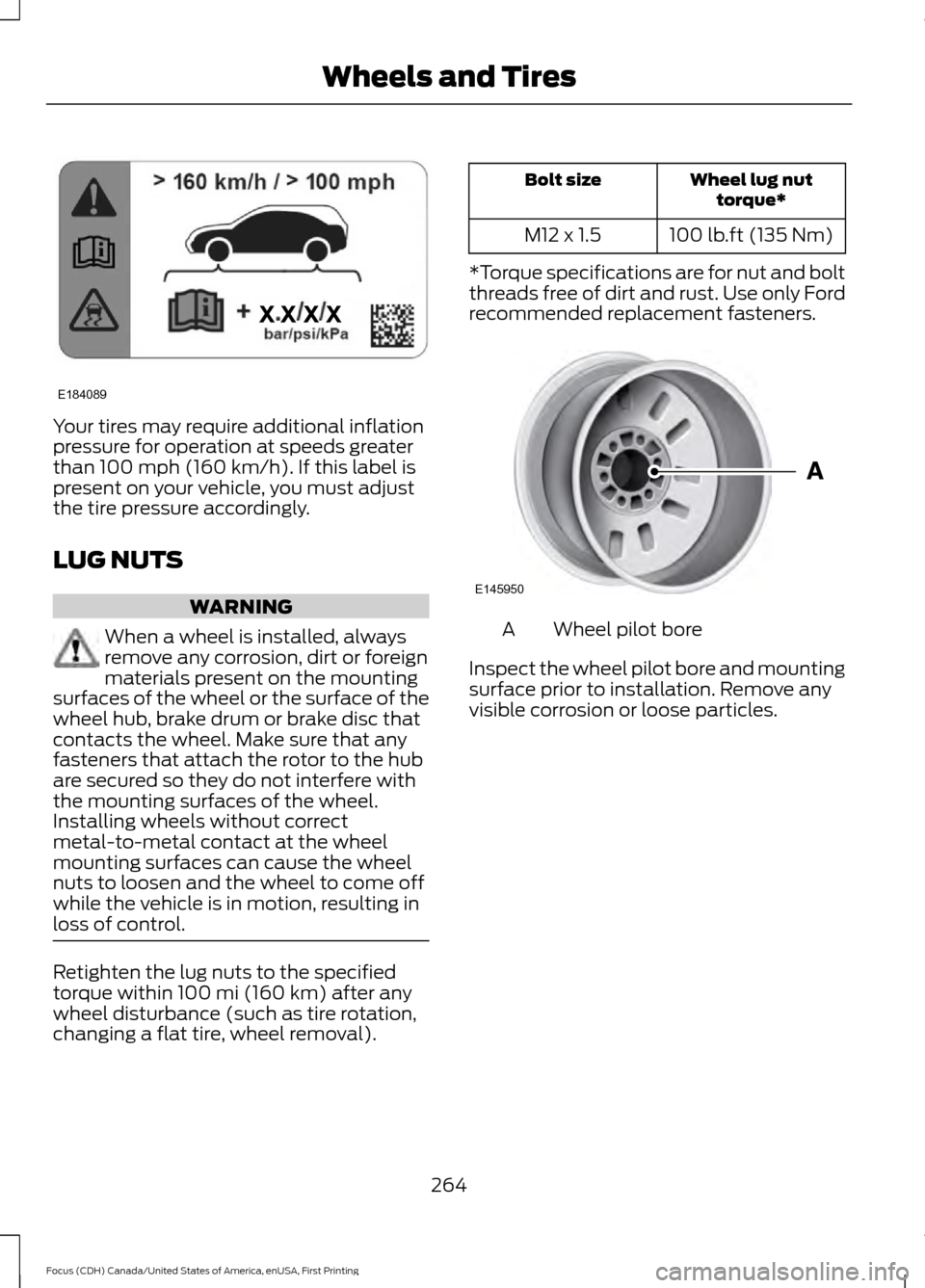
Your tires may require additional inflation
pressure for operation at speeds greater
than 100 mph (160 km/h). If this label is
present on your vehicle, you must adjust
the tire pressure accordingly.
LUG NUTS WARNING
When a wheel is installed, always
remove any corrosion, dirt or foreign
materials present on the mounting
surfaces of the wheel or the surface of the
wheel hub, brake drum or brake disc that
contacts the wheel. Make sure that any
fasteners that attach the rotor to the hub
are secured so they do not interfere with
the mounting surfaces of the wheel.
Installing wheels without correct
metal-to-metal contact at the wheel
mounting surfaces can cause the wheel
nuts to loosen and the wheel to come off
while the vehicle is in motion, resulting in
loss of control. Retighten the lug nuts to the specified
torque within
100 mi (160 km) after any
wheel disturbance (such as tire rotation,
changing a flat tire, wheel removal). Wheel lug nut
torque*
Bolt size
100 lb.ft (135 Nm)
M12 x 1.5
*Torque specifications are for nut and bolt
threads free of dirt and rust. Use only Ford
recommended replacement fasteners. Wheel pilot bore
A
Inspect the wheel pilot bore and mounting
surface prior to installation. Remove any
visible corrosion or loose particles.
264
Focus (CDH) Canada/United States of America, enUSA, First Printing Wheels and TiresE184089 E145950
Page 341 of 385

Check every month
Engine oil level.
Function of all interior and exterior lights.
Tires (including spare) for wear and proper pressure. Windshield washer fluid level. Check every six months
Battery connections. Clean if necessary.
Body and door drain holes for obstructions. Clean if necessary. Cooling system fluid level and coolant strength.
Door weatherstrips for wear. Lubricate if necessary.
Hinges, latches and outside locks for proper operation. Lubricate if necessary. Parking brake for proper operation.
Safety belts and seat latches for wear and function.
Safety warning lamps (brake, ABS, airbag and safety belt) for operation.
Washer spray and wiper operation. Clean or replace blades as necessary.
Multi-Point Inspection
In order to keep your vehicle running right,
it is important to have the systems on your
vehicle checked regularly. This can help
identify potential issues and prevent major
problems. We recommend having the
following multi-point inspection performed
at every scheduled maintenance interval
to help make sure your vehicle keeps
running great.
338
Focus (CDH) Canada/United States of America, enUSA, First Printing Scheduled Maintenance
Page 342 of 385

Multi-Point inspection
Hazard warning system operation
Accessory drive belt(s)
Horn operation
Battery performance
Radiator, cooler, heater and air conditioninghoses
Engine air filter
Suspension components for leaks ordamage
Exhaust system
Steering and linkage
Exterior lamps operation
Tires (including spare) for wear and properpressure**
Fluid levels *
; fill if necessary
Windshield for cracks, chips or pits
For oil and fluid leaks
Washer spray and wiper operation
Half-shaft dust boots
* Brake, coolant recovery reservoir, automatic transmission and window washer
** If your vehicle is equipped with a temporary mobility kit, check the tire sealant expiration
Use By date on the canister. Replace as needed.
Be sure to ask your dealership service
advisor or technician about the multi-point
vehicle inspection. It is a comprehensive
way to perform a thorough inspection of
your vehicle. Your checklist gives you
immediate feedback on the overall
condition of your vehicle.
NORMAL SCHEDULED
MAINTENANCE
Intelligent Oil-Life Monitor™
Your vehicle is equipped with an Intelligent
Oil-Life Monitor that determines when you
should change the engine oil based on how
your vehicle is used. By using several
important factors in its calculations, the
monitor helps reduce the cost of owning
your vehicle and reduces environmental
waste at the same time. This means you do not have to remember
to change the oil on a mileage-based
schedule. Your vehicle lets you know when
an oil change is due by displaying a
message in the information display.
The following table provides examples of
vehicle use and its impact on oil change
intervals. It is a guideline only. Actual oil
change intervals depend on several factors
and generally decrease with severity of
use.
339
Focus (CDH) Canada/United States of America, enUSA, First Printing Scheduled Maintenance
Page 343 of 385
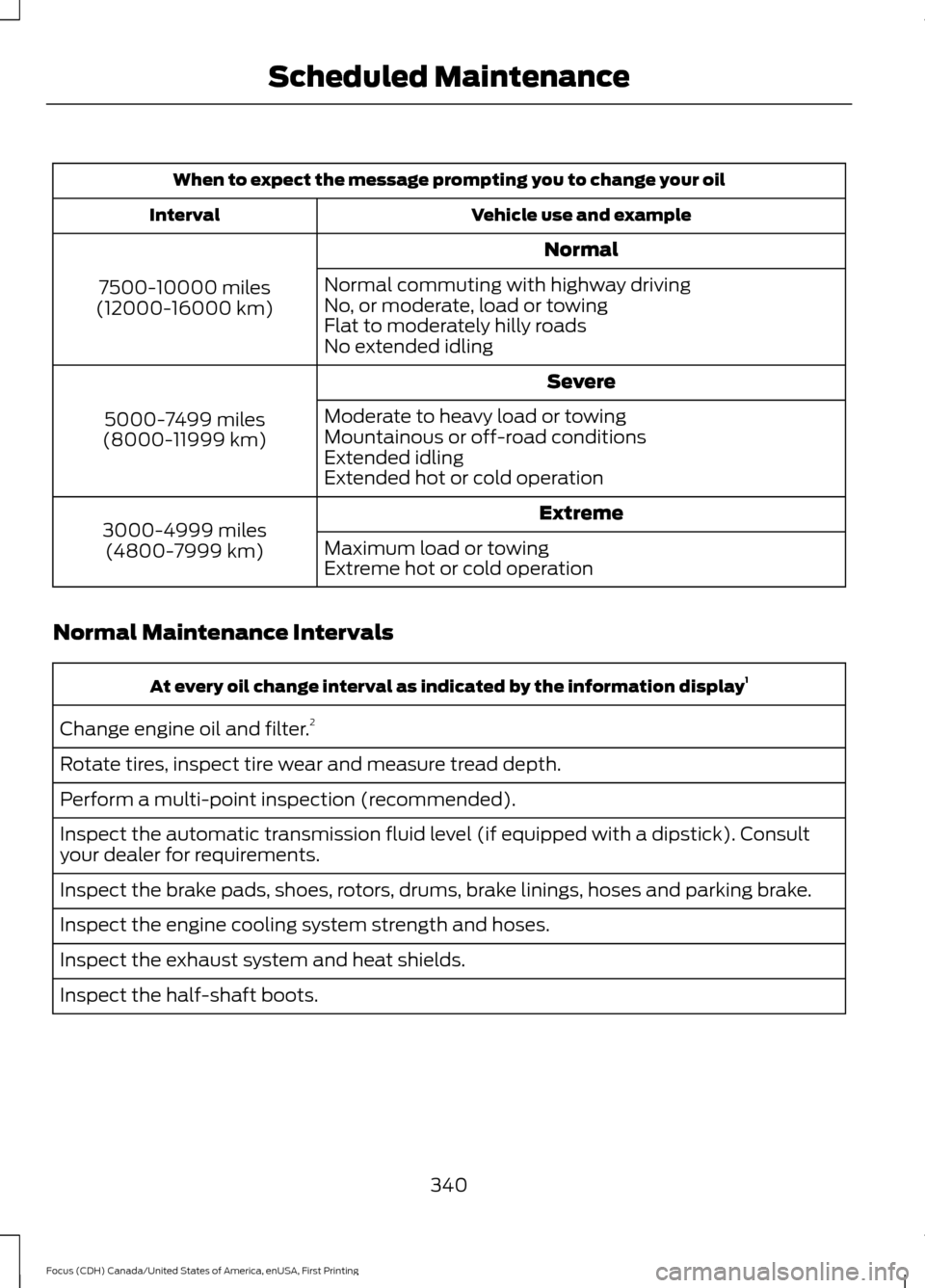
When to expect the message prompting you to change your oil
Vehicle use and example
Interval
Normal
7500-10000 miles
(12000-16000 km) Normal commuting with highway driving
No, or moderate, load or towing
Flat to moderately hilly roads
No extended idling
Severe
5000-7499 miles
(8000-11999 km) Moderate to heavy load or towing
Mountainous or off-road conditions
Extended idling
Extended hot or cold operation
Extreme
3000-4999 miles
(4800-7999 km) Maximum load or towing
Extreme hot or cold operation
Normal Maintenance Intervals At every oil change interval as indicated by the information display
1
Change engine oil and filter. 2
Rotate tires, inspect tire wear and measure tread depth.
Perform a multi-point inspection (recommended).
Inspect the automatic transmission fluid level (if equipped with a dipstick). Consult
your dealer for requirements.
Inspect the brake pads, shoes, rotors, drums, brake linings, hoses and parking brake.
Inspect the engine cooling system strength and hoses.
Inspect the exhaust system and heat shields.
Inspect the half-shaft boots.
340
Focus (CDH) Canada/United States of America, enUSA, First Printing Scheduled Maintenance
Page 346 of 385

Operating in dusty or sandy conditions (such as unpaved or dusty roads)
Replace cabin air filter.
Inspect frequently, service
as required
Replace engine air filter.
Inspect the wheels and related components for abnormal
noise, wear, looseness or drag.
Every 5000 miles (8000
km)
Rotate tires, inspect tires for wear and measure tread
depth.
Change engine oil and filter.*
Every 5000 miles (8000
km) or six months
Perform multi-point inspection.
Change manual transmission fluid.
Every 50000 miles (80000
km)
* Reset your Intelligent Oil-Life Monitor after engine oil and filter changes. See Engine
Oil Check (page 216). Exclusive use of E85 (flex fuel vehicles only)
If ran exclusively on E85, fill the fuel tank full with regular
unleaded fuel.
Every oil change
Exceptions
There are several exceptions to the Normal
Schedule:
California Fuel Filter Replacement
If you register your vehicle in California, the
California Air Resources Board has
determined that the failure to perform this
maintenance item does not nullify the
emission warranty or limit recall liability
before the completion of your vehicle's
useful life. Ford Motor Company, however,
urges you to have all recommended
maintenance services performed at the
specified intervals and to record all vehicle
service. Hot Climate Oil Change Intervals
Vehicles operating in the Middle East,
North Africa, Sub-Saharan Africa or
locations with similar climates using an
American Petroleum Institute (API)
Certified for Gasoline Engines (Certification
mark) oil of SM or SN quality, the normal
oil change interval is 3000 miles (5000
kilometers).
If the available API SM or SN oils are not
available, then the oil change interval is
1800 miles (3000 kilometers).
343
Focus (CDH) Canada/United States of America, enUSA, First Printing Scheduled Maintenance
Page 383 of 385

Seatbelt Warning Lamp and Indicator
Chime...............................................................32
Conditions of operation..................................... 32
Seats..................................................................110
Security..............................................................66
Side Airbags.....................................................40
Sitting in the Correct Position...................110
Snow Chains See: Using Snow Chains................................. 256
Special Notices................................................12 New Vehicle Limited Warranty......................... 12
On-board Diagnostics (OBD-II)....................... 12
Special Instructions.............................................. 12
Special Operating Conditions Scheduled Maintenance...............................................342
Exceptions............................................................ 343
Speed Control See: Cruise Control............................................ 159
Stability Control
............................................148
Principle of Operation....................................... 148
Starter Switch See: Ignition Switch............................................ 118
Starting a Gasoline Engine.........................121 Automatic Engine Shutdown......................... 122
Failure to Start..................................................... 122
Guarding Against Exhaust Fumes................124
Important Ventilating Information...............124
Stopping the Engine When Your Vehicle is Moving................................................................ 123
Stopping the Engine When Your Vehicle is Stationary......................................................... 123
Vehicles with an Ignition Key........................... 121
Vehicles with Keyless Start.............................. 121
Starting and Stopping the Engine...........118 General Information........................................... 118
Steering.............................................................172 Electric Power Steering..................................... 172
Steering Wheel
...............................................69
Storage Compartments..............................117
Sunroof See: Moonroof....................................................... 84
Sun Visors
.........................................................84
Illuminated Vanity Mirror................................... 84
Supplementary Restraints System.........36 Principle of Operation........................................ 36
Symbols Glossary
.............................................7 SYNC™ Applications and Services
.......310
911 Assist................................................................ 310
SYNC Mobile Apps............................................. 312
SYNC™...........................................................294 General Information......................................... 294
SYNC™ Troubleshooting
..........................324
T
Tailgate See: Manual Liftgate........................................... 62
Technical Specifications See: Capacities and Specifications............265
The Better Business Bureau (BBB) Auto Line Program (U.S. Only).......................196
Tire Care
...........................................................241
Glossary of Tire Terminology......................... 243
Important Information for 235/40R18 Low-Profile Tires and Wheels................... 241
Information About Uniform Tire Quality Grading.............................................................. 241
Information Contained on the Tire Sidewall........................................................... 244
Temperature A B C............................................ 242
Traction AA A B C............................................... 242
Treadwear............................................................. 242
Tire Pressure Monitoring System...........257 Changing Tires With a Tire Pressure
Monitoring System....................................... 258
Understanding Your Tire Pressure Monitoring System ...................................... 258
Tires See: Wheels and Tires...................................... 241
Towing a Trailer.............................................182
Towing the Vehicle on Four Wheels - 1.0L EcoBoost™, Automatic
Transmission...............................................183
Emergency Towing............................................. 183
Recreational Towing.......................................... 183
Towing the Vehicle on Four Wheels - 2.0L, Automatic Transmission
..............183
Emergency Towing............................................. 183
Recreational Towing......................................... 184
Towing the Vehicle on Four Wheels - Manual Transmission...............................182
Recreational Towing.......................................... 182
Towing
..............................................................182
380
Focus (CDH) Canada/United States of America, enUSA, First Printing Index
Page 384 of 385
Traction Control.............................................147
Principle of Operation....................................... 147
Transmission Code Designation............269
Transmission...................................................137
Transmission See: Transmission............................................... 137
Transporting the Vehicle............................182
Trip Computer
.................................................94
All Values................................................................ 94
Average Fuel Consumption.............................. 94
Distance to Empty............................................... 94
Outside Air Temperature................................... 94
Resetting the Trip Computer........................... 94
Trip Odometer....................................................... 94
Trip Timer................................................................ 94
Type Approvals
.............................................370
U
Under Hood Overview - 1.0L EcoBoost™..................................................214
Under Hood Overview - 2.0L....................215
Unique Driving Characteristics................126
USB Port
.........................................................293
Using Cruise Control....................................159 Switching Cruise Control Off......................... 159
Switching Cruise Control On.......................... 159
Using MyKey With Remote Start Systems
..........................................................56
Using Snow Chains.....................................256
Using Stability Control...............................149
Using SYNC™ With Your Media Player
..............................................................315
Accessing Your USB Song Library................319
Bluetooth Devices and System
Settings.............................................................. 321
Connecting Your Digital Media Player to the USB Port............................................................ 315
Media Menu Features....................................... 319
Media Voice Commands................................. 316
USB 2....................................................................... 321
Voice Commands for Audio Sources..........322 Using SYNC™ With Your Phone
............298
Accessing Features through the Phone
Menu.................................................................. 303
Accessing Your Phone Settings................... 306
Bluetooth Devices............................................. 307
Making Calls......................................................... 301
Pairing a Phone for the First Time..............298
Pairing Subsequent Phones.......................... 299
Phone Options during an Active Call.........302
Phone Voice Commands............................... 300
Receiving Calls................................................... 302
System Settings................................................ 308
Text Messaging.................................................. 304
Using Traction Control
................................147
Switching the System Off................................ 147
System Indicator Lights and Messages........................................................... 147
Using a Switch...................................................... 147
Using the Information Display Controls............................................................. 147
Using Voice Recognition
...........................296
Initiating a Voice Session................................ 296
System Interaction and Feedback..............297
Utilizing the Mediation/Arbitration Program (Canada Only)
..........................197
V
Vehicle Care
...................................................234
General Information......................................... 234
Vehicle Certification Label.......................269
Vehicle Identification Number
...............268
Vehicle Storage............................................239 Battery................................................................... 240
Body........................................................................\
239
Brakes.................................................................... 240
Cooling system................................................... 240
Engine.................................................................... 239
Fuel system......................................................... 240
General.................................................................. 239
Miscellaneous..................................................... 240
Removing Vehicle From Storage.................240
Tires........................................................................\
240
Ventilation See: Climate Control......................................... 103
VIN See: Vehicle Identification Number............268
Voice Control...................................................70
381
Focus (CDH) Canada/United States of America, enUSA, First Printing Index