2016 FORD FOCUS ELECTRIC brake
[x] Cancel search: brakePage 150 of 276
BREAKING-IN
You need to break in new tires for
approximately 300 mi (480 km). During
this time, your vehicle may exhibit some
unusual driving characteristics.
Avoid hard accelerations and driving too
fast during the first
1,000 mi (1,600 km).
COLD WEATHER
PRECAUTIONS
The functional operation of some
components and systems can be affected
at temperatures below
-13°F (-25°C).
DRIVING THROUGH WATER WARNING
Do not drive through flowing or deep
water as you may lose control of your
vehicle.
Note:
Driving through standing water can
cause vehicle damage.
Note: Engine damage can occur if water
enters the air filter.
Before driving through standing water,
check the depth. Never drive through water
that is higher than the bottom of the front
rocker area of your vehicle. When driving through standing water, drive
very slowly and do not stop your vehicle.
Your brake performance and traction may
be limited. After driving through water and
as soon as it is safe to do so:
•
Lightly press the brake pedal to dry the
brakes and to check that they work.
• Check that the horn works.
• Check that the exterior lights work.
• Turn the steering wheel to check that
the steering power assist works.
FLOOR MATS WARNINGS
Always use floor mats that are
designed to fit the foot well of your
vehicle. Only use floor mats that
leave the pedal area unobstructed. Only
use floor mats that are firmly secured to
retention posts so that they cannot slip out
of position and interfere with the pedals
or impair safe operation of your vehicle in
other ways. Pedals that cannot move freely can
cause loss of vehicle control and
increase the risk of serious personal
injury.
147
Focus (CDH) Battery Electric Vehicle (BEV), Canada/United States of America, enUSA, First Printing Driving HintsE176360
Page 155 of 276
COLLISION, DAMAGE OR FIRE
EVENT
Guidance for Ford Motor Company
Electric and Hybrid-Electric
Vehicles Equipped With High
Voltage Batteries
(Vehicle Owner/Operator/General
Public)
Electric and Hybrid-Electric Vehicle
Considerations
In the event of damage or fire involving
an electric vehicle (EV) or
hybrid-electric vehicle (HEV):
•
Always assume the high-voltage
battery and associated components
are energized and fully charged.
• Exposed electrical components, wires
and high-voltage batteries present
potential high-voltage shock hazards.
• Venting/off-gassing high-voltage
battery vapors are potentially toxic and
flammable.
• Physical damage to the vehicle or
high-voltage battery may result in
immediate or delayed release of toxic,
flammable gases and fire.
Vehicle Information and General
Safety Practices
• Know the make and model of your
vehicle.
• Review the owner ’s manual and
become familiar with your vehicle ’s
safety information and recommended
safety practices.
• Do not attempt to repair damaged
electric and hybrid-electric vehicles
yourself. Contact an authorized Ford
Dealer or vehicle manufacturer
representative for service. Crashes
A crash or impact significant enough to
require an emergency response for
conventional vehicles would also require
the same response for an electric or
hybrid-electric vehicle.
If possible
•
Move your car to a safe, nearby
location and remain on the scene.
• Roll down the windows before shutting
your vehicle off.
• Place your vehicle in Park, set the
parking brake, turn off the vehicle,
activate the hazard lights, and move
your key(s) at least 16 feet (5 meters)
away from the vehicle.
Always
• Call 911 if assistance is needed and
advise that an electric or hybrid-electric
vehicle is involved.
• Do not touch exposed electrical
components or the engine
compartment, as a shock hazard may
exist.
• Avoid contact with leaking fluids and
gases, and remain out of the way of
oncoming traffic until emergency
responders arrive.
• When emergency responders arrive,
tell them that the vehicle involved is an
electric vehicle or hybrid vehicle.
Fires
As with any vehicle, call 911 immediately if
you see sparks, smoke or flames coming
from the vehicle.
• Exit the vehicle immediately.
• Advise 911 that an electric or
hybrid-electric vehicle is involved.
152
Focus (CDH) Battery Electric Vehicle (BEV), Canada/United States of America, enUSA, First Printing Roadside Emergencies
Page 165 of 276
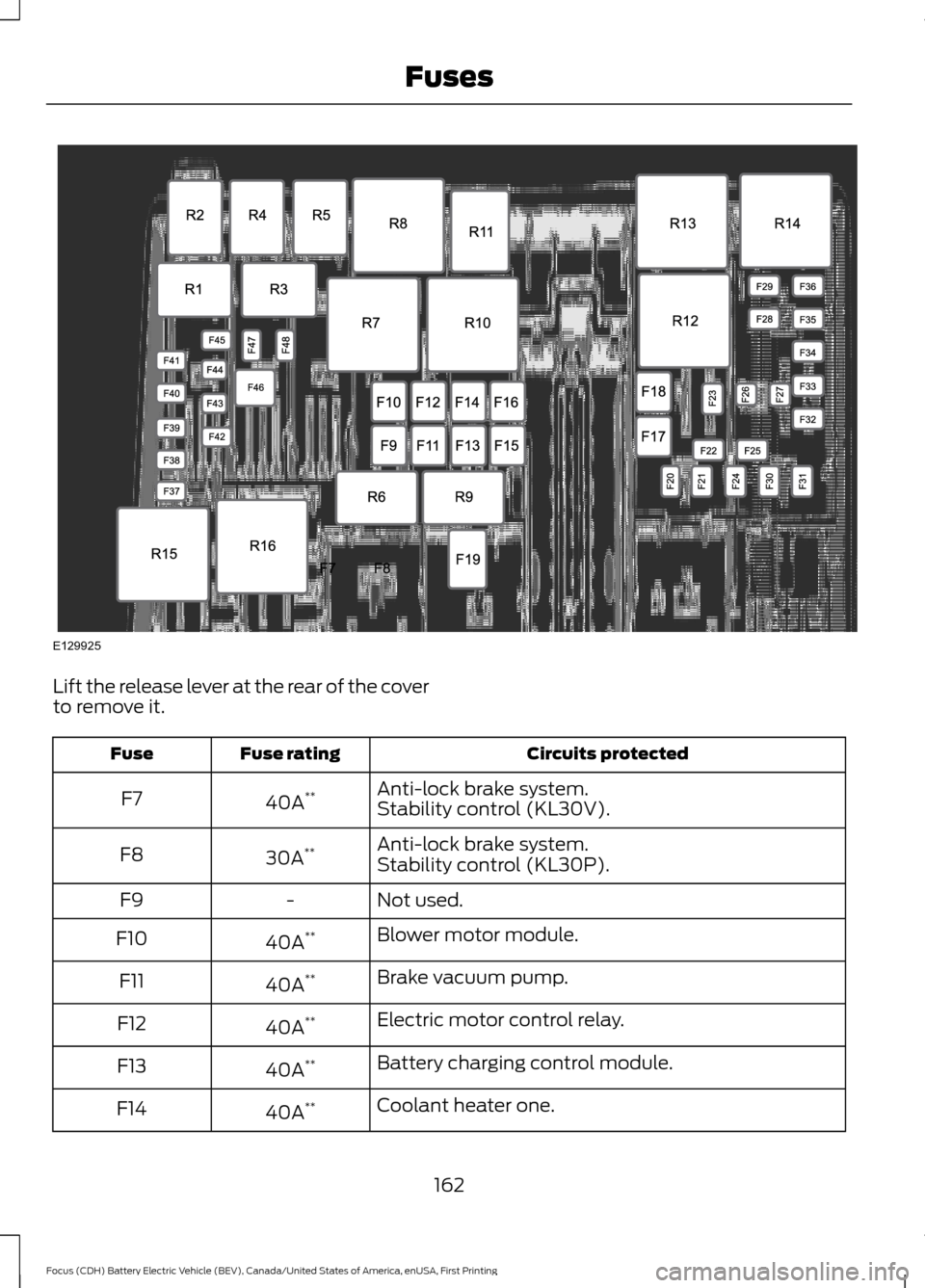
Lift the release lever at the rear of the cover
to remove it.
Circuits protected
Fuse rating
Fuse
Anti-lock brake system.
40A **
F7
Stability control (KL30V).
Anti-lock brake system.
30A **
F8
Stability control (KL30P).
Not used.
-
F9
Blower motor module.
40A **
F10
Brake vacuum pump.
40A **
F11
Electric motor control relay.
40A **
F12
Battery charging control module.
40A **
F13
Coolant heater one.
40A **
F14
162
Focus (CDH) Battery Electric Vehicle (BEV), Canada/United States of America, enUSA, First Printing FusesE129925
Page 166 of 276
Circuits protected
Fuse rating
Fuse
Body control module (KL30C supply).
30A **
F15
Coolant heater two.
40A **
F16
Not used.
-
F17
Windshield wiper.
20A **
F18
Anti-lock brake system.
5A *
F19
Stability control (KL15).
Horn.
15A *
F20
Stop lamp switch.
5A *
F21
Battery monitoring system.
15A *
F22
Relay coils.
5A *
F23
Lighting control switch module.
5A *
F24
Not used.
-
F25
Powertrain control module.
10A *
F26
Charge port light ring.
15A *
F27
Vacuum pump monitor.
5A *
F28
Not used.
-
F29
Transmission control module (12V supply).
5A *
F30
Smart data link/on-board diagnostic connector.
10A *
F31
Coolant valve.
10A *
F32 Air conditioning solenoid.
Chiller solenoid.
Powertrain control module.
10A *
F33
A/C compressor PSR feedback.
High voltage battery.
15A *
F34
Not used.
-
F35
163
Focus (CDH) Battery Electric Vehicle (BEV), Canada/United States of America, enUSA, First Printing Fuses
Page 168 of 276
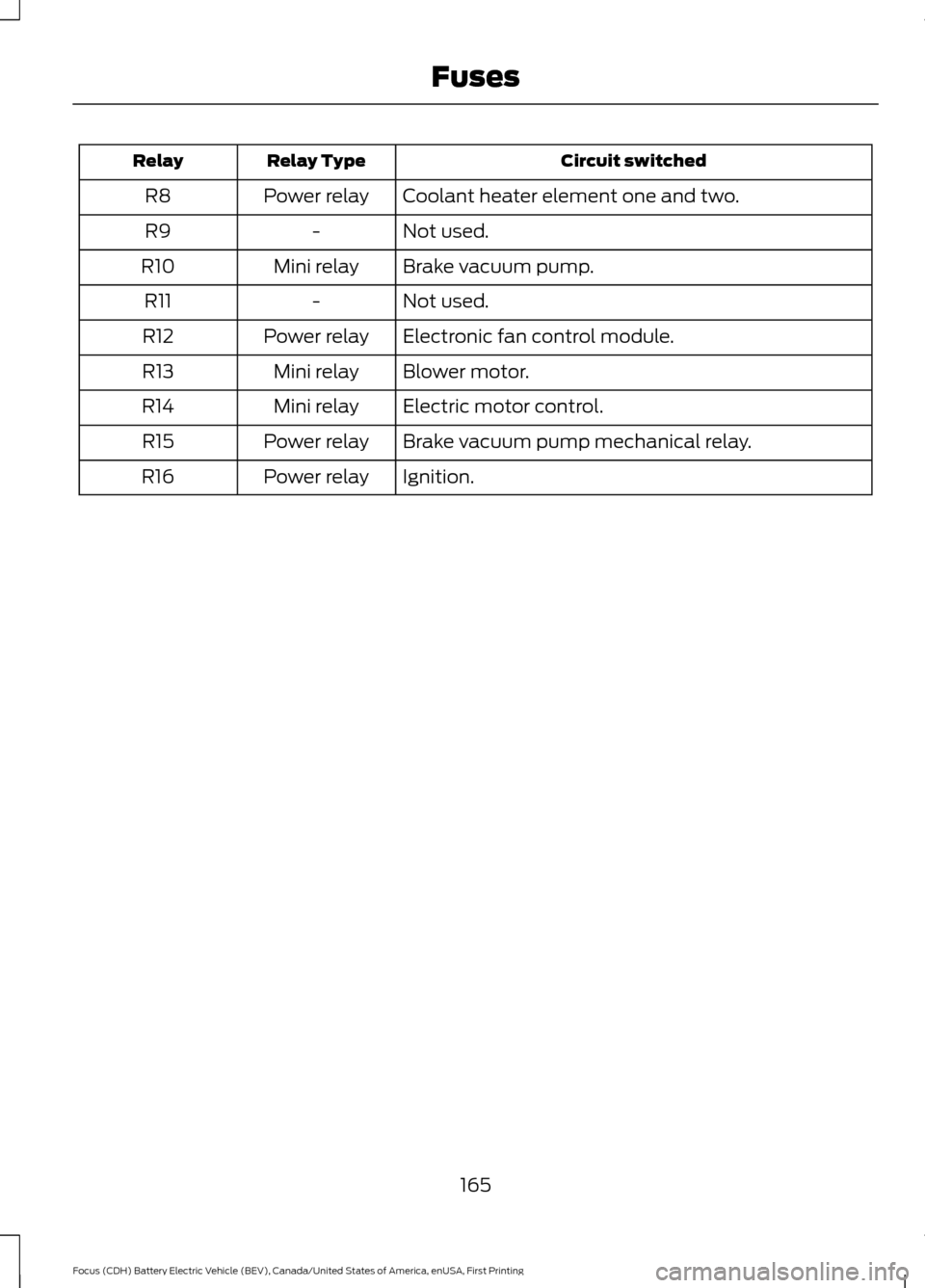
Circuit switched
Relay Type
Relay
Coolant heater element one and two.
Power relay
R8
Not used.
-
R9
Brake vacuum pump.
Mini relay
R10
Not used.
-
R11
Electronic fan control module.
Power relay
R12
Blower motor.
Mini relay
R13
Electric motor control.
Mini relay
R14
Brake vacuum pump mechanical relay.
Power relay
R15
Ignition.
Power relay
R16
165
Focus (CDH) Battery Electric Vehicle (BEV), Canada/United States of America, enUSA, First Printing Fuses
Page 175 of 276
GENERAL INFORMATION
WARNINGS
Switch your vehicle off before
carrying out any under hood check
or adjustment. Failure to follow this
warning could result in serious personal
injury or death. Do not touch any under hood
components after you have switched
your vehicle on. Failure to follow this
warning could result in serious personal
injury or death. Keep clear of the cooling fan. Under
certain conditions, the cooling fan
continues to run after you have
switched your vehicle off. Failure to follow
this warning could result in serious
personal injury. High Voltage Information
WARNING
Exposure to high voltage could result
in severe personal injury or death. A
trained service technician must
service high voltage components. Failure
to follow this warning could result in
serious personal injury. Your vehicle has various high voltage
components and wiring. All of the high
voltage power flows through specific wiring
assemblies. These are labeled accordingly
or are covered with a orange convolute
tube or orange stripe tape. Do not touch
any of the high voltage components. Regular Maintenance
Have your vehicle serviced regularly to help
maintain its roadworthiness and resale
value. There is a large network of Ford
authorized repairers that are there to help
you with their professional servicing
expertise. Ford authorized repairers are
best qualified to service your vehicle
correctly using specialized tools.
In addition to regular servicing, we
recommend that you carry out the
following checks.
Note:
Make sure that you fit filler caps
securely after carrying out maintenance
checks.
Daily Checks
• Exterior lamps.
• Interior lamps.
• Warning lamps and indicators.
Weekly Checks
• Brake fluid level. See Brake Fluid
Check (page 176).
• Washer fluid level. See
Washer Fluid
Check (page 177).
• Tire condition. See Wheels and Tires
(page
193).
• Tire pressures (when cold).
Monthly Checks
• Coolant level. See
Coolant Check
(page 174).
• Pipes, hoses and reservoirs for leaks.
• Air conditioning operation.
• Parking brake operation.
• Horn operation.
• Tightness of lug nuts. See
Lug Nuts
(page 219).
172
Focus (CDH) Battery Electric Vehicle (BEV), Canada/United States of America, enUSA, First Printing Maintenance
Page 177 of 276
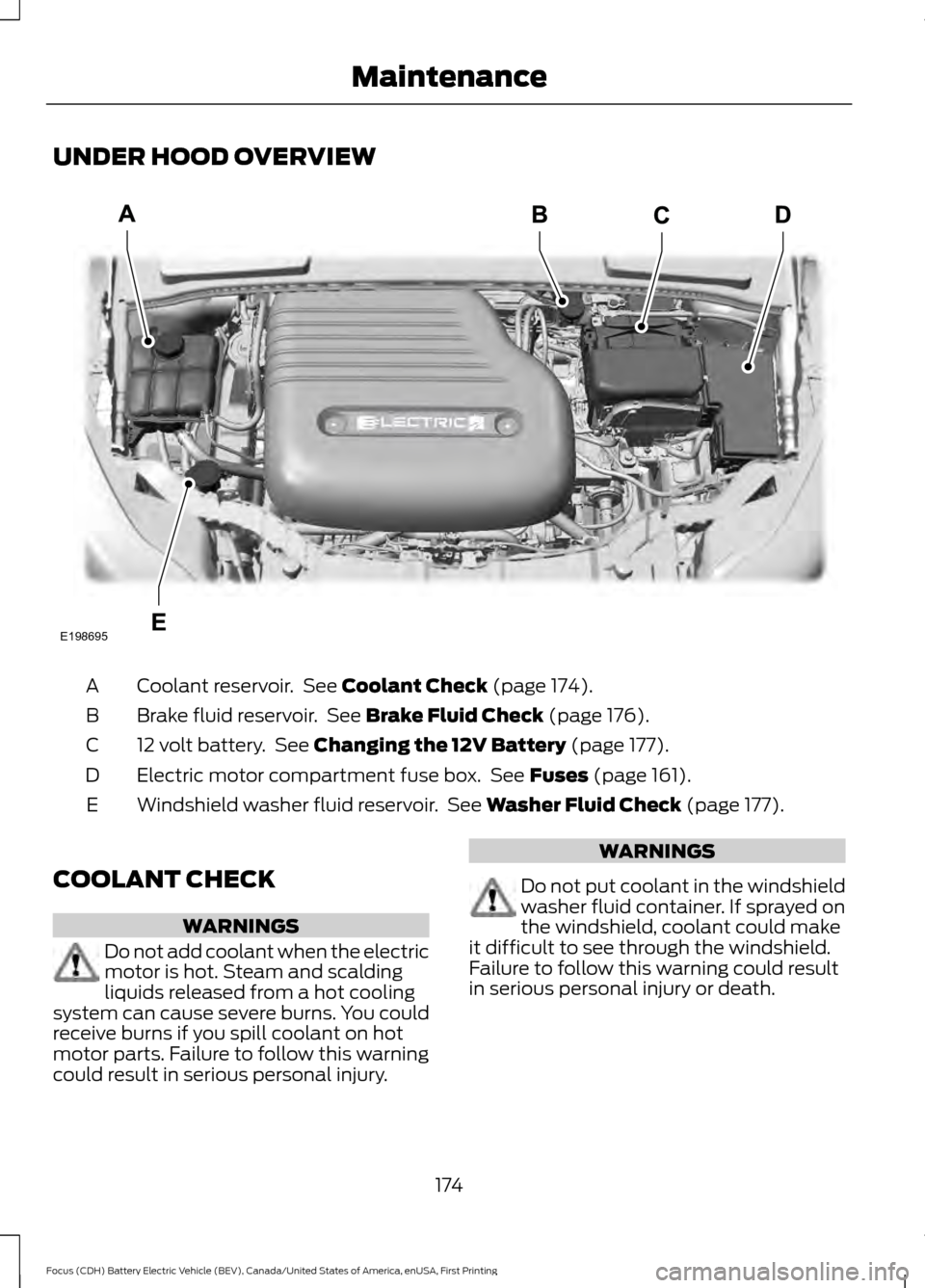
UNDER HOOD OVERVIEW
Coolant reservoir. See Coolant Check (page 174).
A
Brake fluid reservoir. See
Brake Fluid Check (page 176).
B
12 volt battery. See
Changing the 12V Battery (page 177).
C
Electric motor compartment fuse box. See
Fuses (page 161).
D
Windshield washer fluid reservoir. See
Washer Fluid Check (page 177).
E
COOLANT CHECK WARNINGS
Do not add coolant when the electric
motor is hot. Steam and scalding
liquids released from a hot cooling
system can cause severe burns. You could
receive burns if you spill coolant on hot
motor parts. Failure to follow this warning
could result in serious personal injury. WARNINGS
Do not put coolant in the windshield
washer fluid container. If sprayed on
the windshield, coolant could make
it difficult to see through the windshield.
Failure to follow this warning could result
in serious personal injury or death.
174
Focus (CDH) Battery Electric Vehicle (BEV), Canada/United States of America, enUSA, First Printing MaintenanceE198695
Page 179 of 276
Water alone, without coolant, can cause
vehicle damage from corrosion,
overheating, freezing or plugging.
Do not use the following as a coolant
substitute:
•
Alcohol.
• Methanol.
• Brine.
• Any coolant mixed with alcohol or
methanol antifreeze or coolant.
Alcohol and other liquids can cause vehicle
damage from overheating or freezing.
Do not add extra inhibitors or additives to
the coolant. These can be harmful and
compromise the corrosion protection of
the coolant.
When adding coolant:
1. Unscrew the cap slowly. Any pressure will escape as you unscrew the cap.
2. Add prediluted coolant meeting the Ford specification. See Capacities
and Specifications (page 220).
3. Check the coolant level in the coolant reservoir the next few times you drive
your vehicle.
4. If necessary, add enough prediluted coolant to bring the coolant level to
the proper level.
Whenever coolant has been added, the
coolant level in the coolant reservoir
should be checked the next few times you
drive the vehicle. If necessary, add enough
prediluted coolant to bring the coolant
level to the correct level.
Recycled Coolant
Ford Motor Company does not recommend
the use of recycled coolant since a
Ford-approved recycling process is not yet
available. Used coolant should be disposed of in an
appropriate manner. Follow your
community
’s regulations and standards
for recycling and disposing of automotive
fluids.
Severe Climates
If you drive in extremely cold climates:
• It may be necessary to have a Ford
authorized dealer increase the coolant
concentration above 50%.
• A coolant concentration of 60%
provides improved freeze point
protection. Coolant concentrations
above 60% will decrease the overheat
protection characteristics of the
coolant and may cause electric motor
damage.
If you drive in extremely hot climates:
• It may be necessary to have a Ford
authorized dealer decrease the coolant
concentration to 40%.
• A coolant concentration of 40%
provides improved overheat protection.
Coolant concentrations below 40%
will decrease the freeze and corrosion
protection characteristics of the
coolant and may cause electric motor
damage.
Vehicles driven year-round in non-extreme
climates should use prediluted coolant for
optimum cooling system and vehicle
protection.
BRAKE FLUID CHECK WARNINGS
Do not use any fluid other than the
recommended brake fluid as this will
reduce brake efficiency. Use of
incorrect fluid could result in the loss of
vehicle control, serious personal injury or
death.
176
Focus (CDH) Battery Electric Vehicle (BEV), Canada/United States of America, enUSA, First Printing Maintenance