2016 FORD FIESTA service indicator
[x] Cancel search: service indicatorPage 201 of 363
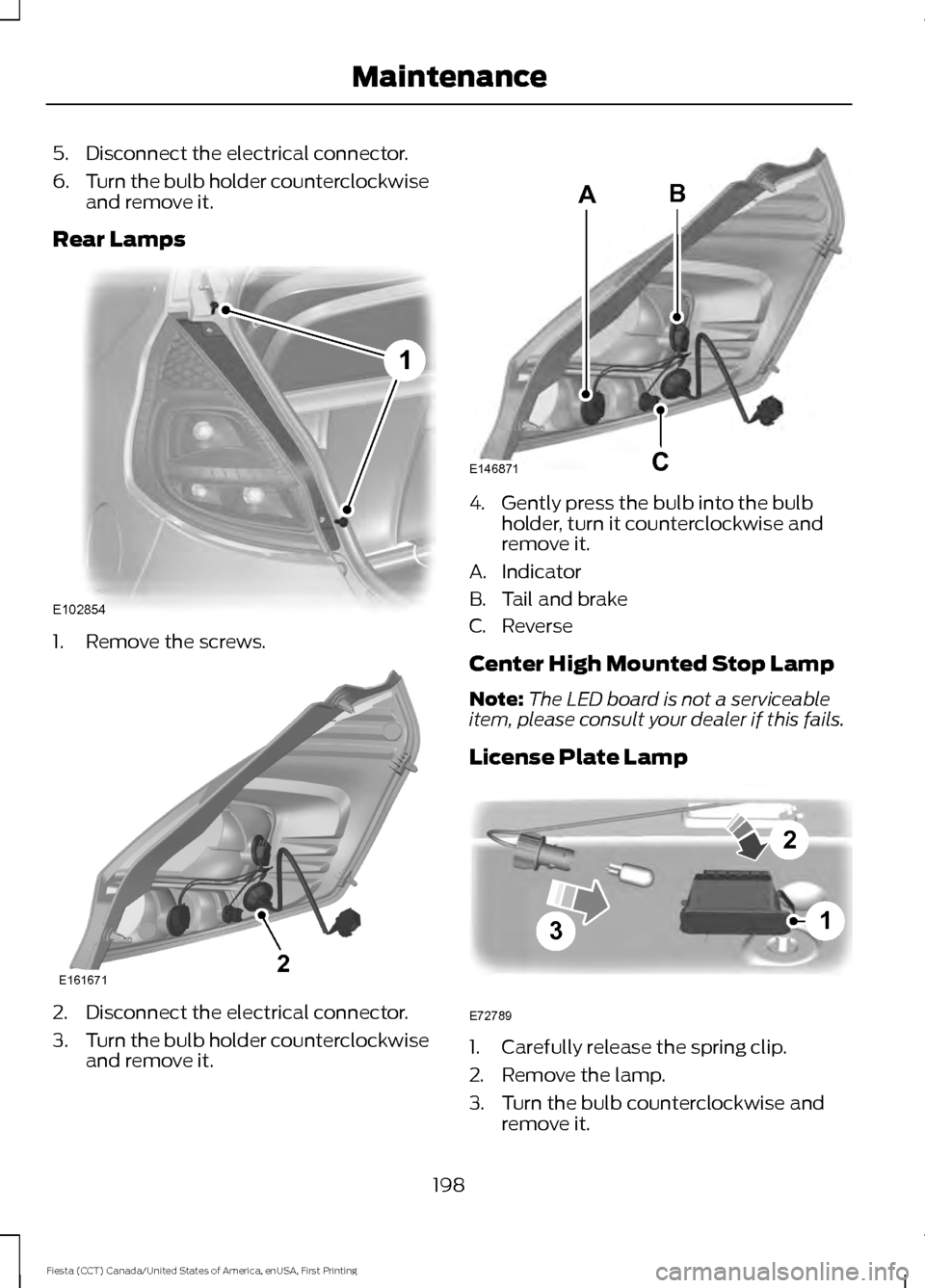
5. Disconnect the electrical connector.
6.
Turn the bulb holder counterclockwise
and remove it.
Rear Lamps 1. Remove the screws.
2. Disconnect the electrical connector.
3.
Turn the bulb holder counterclockwise
and remove it. 4. Gently press the bulb into the bulb
holder, turn it counterclockwise and
remove it.
A. Indicator
B. Tail and brake
C. Reverse
Center High Mounted Stop Lamp
Note: The LED board is not a serviceable
item, please consult your dealer if this fails.
License Plate Lamp 1. Carefully release the spring clip.
2. Remove the lamp.
3. Turn the bulb counterclockwise and
remove it.
198
Fiesta (CCT) Canada/United States of America, enUSA, First Printing MaintenanceE102854
1 E1616712 E146871
AB
C 3
2
1
E72789
Page 203 of 363

BULB SPECIFICATION CHART
Exterior Lamps
Power (watt)
Specification
Lamp
27/7
PY27/7
Front direction indicator.
55
H11
Headlamp low beam.
55
H1LL
Headlamp high beam.
55
H11
Front fog lamp.
5
WY5W
Side direction indicator.
27/7
PY27/7
Rear lamp, brake lamp and rear direc-
tion indicator.
16
W16W
Reversing lamp.
5
W5W
License plate lamp.
Note: On some vehicles the lamps are LED. These are not serviceable items, have your
vehicle checked by an authorized dealer as soon as possible.
Interior Lamps Power (watt)
Specification
Lamp
6
W6W
Interior lamp.
5
W5W
Map lamp.
6
W6W
Luggage compartment lamp.
200
Fiesta (CCT) Canada/United States of America, enUSA, First Printing Maintenance
Page 229 of 363

As an added safety feature, your vehicle
has been equipped with a Tire Pressure
Monitoring System (TPMS) that
illuminates a low tire pressure telltale
when one or more of your tires is
significantly under-inflated. Accordingly,
when the low tire pressure telltale
illuminates, you should stop and check
your tires as soon as possible, and inflate
them to the proper pressure. Driving on a
significantly under-inflated tire causes the
tire to overheat and can lead to tire failure.
Under-inflation also reduces fuel efficiency
and tire tread life, and may affect the
vehicle
’s handling and stopping ability.
Please note that the TPMS is not a
substitute for proper tire maintenance, and
it is the driver ’s responsibility to maintain
correct tire pressure, even if under-inflation
has not reached the level to trigger
illumination of the TPMS low tire pressure
telltale.
Your vehicle has also been equipped with
a TPMS malfunction indicator to indicate
when the system is not operating properly.
The TPMS malfunction indicator is
combined with the low tire pressure
telltale. When the system detects a
malfunction, the telltale will flash for
approximately one minute and then remain
continuously illuminated. This sequence
will continue upon subsequent vehicle
start-ups as long as the malfunction exists.
When the malfunction indicator is
illuminated, the system may not be able
to detect or signal low tire pressure as
intended. TPMS malfunctions may occur
for a variety of reasons, including the
installation of replacement or alternate
tires or wheels on the vehicle that prevent
the TPMS from functioning properly.
Always check the TPMS malfunction
telltale after replacing one or more tires or
wheels on your vehicle to ensure that the
replacement or alternate tires and wheels
allow the TPMS to continue to function
properly. The tire pressure monitoring system
complies with part 15 of the FCC rules and
with RSS-210 of Industry Canada.
Operation is subject to the following two
conditions: (1) This device may not cause
harmful interference, and (2) This device
must accept any interference received,
including interference that may cause
undesired operation.
Changing Tires With a Tire
Pressure Monitoring System
Note:
Each road tire is equipped with a tire
pressure sensor located inside the wheel
and tire assembly cavity. The pressure
sensor is attached to the valve stem. The
pressure sensor is covered by the tire and is
not visible unless the tire is removed. Take
care when changing the tire to avoid
damaging the sensor
You should always have your tires serviced
by an authorized dealer.
Check the tire pressure periodically (at
least monthly) using an accurate tire
gauge. See Inflating Your Tires in this
chapter.
226
Fiesta (CCT) Canada/United States of America, enUSA, First Printing Wheels and TiresE142549
Page 232 of 363

How Temperature Affects Your Tire
Pressure
The tire pressure monitoring system
monitors tire pressure in each pneumatic
tire. While driving in a normal manner, a
typical passenger tire inflation pressure
may increase about 2 to 4 psi (14 to 28
kPa) from a cold start situation. If the
vehicle is stationary overnight with the
outside temperature significantly lower
than the daytime temperature, the tire
pressure may decrease about 3 psi (21
kPa) for a drop of 30°F (17°C) in ambient
temperature. This lower pressure value
may be detected by the tire pressure
monitoring system as being significantly
lower than the recommended inflation
pressure and activate the system warning
light for low tire pressure. If the low tire
pressure warning light is on, visually check
each tire to verify that no tire is flat. If one
or more tires are flat, repair as necessary.
Check the air pressure in the road tires. If
any tire is under-inflated, carefully drive
the vehicle to the nearest location where
air can be added to the tires. Inflate all the
tires to the recommended inflation
pressure.
CHANGING A ROAD WHEEL
WARNINGS
The use of tire sealants may damage
your tire pressure monitoring system
and should only be used in roadside
emergencies. If you must use a sealant, the
Ford Tire Mobility Kit sealant should be
used. The tire pressure monitoring system
sensor and valve stem on the wheel must
be replaced by an authorized dealer after
use of the sealant. See Tire Pressure Monitoring
System (page 225). If the tire
pressure monitor sensor becomes
damaged, it will no longer function. Note:
The tire pressure monitoring system
indicator light will illuminate when the spare
tire is in use. To restore the full functionality
of the monitoring system, all road wheels
equipped with tire pressure monitoring
sensors must be mounted on the vehicle.
If you get a flat tire while driving, do not
apply the brake heavily. Instead, gradually
decrease your speed. Hold the steering
wheel firmly and slowly move to a safe
place on the side of the road.
Have a flat serviced by an authorized
dealer in order to prevent damage to the
tire pressure monitoring system sensors.
See
Tire Pressure Monitoring System
(page 225). Replace the spare tire with a
road tire as soon as possible. During
repairing or replacing of the flat tire, have
an authorized dealer inspect the tire
pressure monitoring system sensor for
damage.
Dissimilar Spare Wheel and Tire
Assembly Information WARNING
Failure to follow these guidelines
could result in an increased risk of
loss of vehicle control, injury or death.
If you have a dissimilar spare wheel and
tire, then it is intended for temporary use
only. This means that if you need to use it,
you should replace it as soon as possible
with a road wheel and tire assembly that
is the same size and type as the road tires
and wheels that were originally provided
by Ford. If the dissimilar spare tire or wheel
is damaged, it should be replaced rather
than repaired.
A dissimilar spare wheel and tire assembly
is defined as a spare wheel and tire
assembly that is different in brand, size or
appearance from the road tires and wheels
and can be one of three types:
229
Fiesta (CCT) Canada/United States of America, enUSA, First Printing Wheels and Tires
Page 320 of 363

When ENGINE OIL CHANGE DUE NEXT
SERVICE or OIL CHANGE REQUIRED
appears in the information display, it is
time for an oil change; the oil change must
be done within two weeks or 500 miles
(800 kilometers) of the
ENGINE OIL
CHANGE DUE NEXT SERVICE or OIL
CHANGE REQUIRED message appearing.
The oil minder system must be reset after
each oil change. See
Oil Change
Indicator Reset (page 183).
If your information display resets
prematurely or becomes inoperative, you
should perform the oil change interval at
six months or 5000 miles (8000
kilometers) from your last oil change.
Never exceed one year or 10000 miles
(16000 kilometers) between oil change
intervals.
Your vehicle is very sophisticated and built
with multiple, complex, performance
systems. Every manufacturer develops
these systems using different
specifications and performance features.
That is why it is important to rely upon your
dealership to properly diagnose and repair
your vehicle.
Ford Motor Company has recommended
maintenance intervals for various parts
and component systems based upon
engineering testing. Ford Motor Company
relies upon this testing to determine the
most appropriate mileage for replacement
of oils and fluids to protect your vehicle at
the lowest overall cost to you and
recommends against maintenance
schedules that deviate from the scheduled
maintenance information. We strongly recommend the use of only
genuine Ford, Motorcraft or
Ford-authorized re-manufactured
replacement parts engineered for your
vehicle.
Additives and Chemicals
This owner's manual and the Ford
Workshop Manual list the recommended
additives and chemicals for your vehicle.
We do not recommend using chemicals or
additives not approved by us as part of
your vehicle
’s normal maintenance. Please
consult your warranty information.
Oils, Fluids and Flushing
In many cases, fluid discoloration is a
normal operating characteristic and, by
itself, does not necessarily indicate a
concern or that the fluid needs to be
changed. However, a qualified expert, such
as the factory-trained technicians at your
dealership, should inspect discolored fluids
that also show signs of overheating or
foreign material contamination
immediately.
Make sure to change your vehicle ’s oils and
fluids at the specified intervals or in
conjunction with a repair. Flushing is a
viable way to change fluid for many vehicle
sub-systems during scheduled
maintenance. It is critical that systems are
flushed only with new fluid that is the same
as that required to fill and operate the
system or using a Ford-approved flushing
chemical.
Owner Checks and Services
Make sure you perform the following basic
maintenance checks and inspections every
month or at six-month intervals.
317
Fiesta (CCT) Canada/United States of America, enUSA, First Printing Scheduled Maintenance
Page 323 of 363

Every 10000 miles (16000 kilometers) or 12 months
*
Change engine oil and filter. **
Rotate the tires.
Perform a multi-point inspection (recommended).
Inspect the automatic transmission fluid level. Consult your dealer for requirements.
Inspect the brake pads, shoes, rotors, drums, brake linings, hoses and parking brake.
Inspect the engine cooling system strength and hoses.
Inspect the exhaust system and heat shields.
Inspect the half-shaft boots.
Inspect the steering linkage, ball joints, suspension, tire-rod ends, driveshaft and U-
joints. Lubricate any areas with grease fittings.
Inspect the tires, tire wear and measure the tread depth.
Inspect the wheels and related components for abnormal noise, wear, looseness or
drag.
* Do not exceed one year or 10000 miles (16000 kilometers) between service intervals.
** Reset the oil minder system after each engine oil and filter change. See Oil Change
Indicator Reset (page 183). Other maintenance items
1
Replace cabin air filter.
Every 20000 miles (32000
km)
Replace engine air filter.
Every 30000 miles (48000
km)
Change engine coolant.2
At 100000 miles (160000
km)
Replace spark plugs.
Every 100000 miles
(160000 km) Inspect accessory drive belt(s). 3
Change transmission fluid.
Every 150000 miles
(240000 km) Replace accessory drive belt(s). 4
320
Fiesta (CCT) Canada/United States of America, enUSA, First Printing Scheduled Maintenance
Page 326 of 363

Operating in dusty or sandy conditions (such as unpaved or dusty roads)
Rotate tires, inspect tires for wear and measure tread
depth.
Change engine oil and filter. *
Every 5000 miles (8000
km) or six months
Perform multi-point inspection.
Change automatic transmission fluid.
Every 30000 miles (48000
km)
Change manual transmission fluid.
Every 50000 miles (80000
km)
* Reset your oil life monitor system after each engine oil and filter change. See Oil Change
Indicator Reset (page 183). Exclusive use of E85 (flex fuel vehicles only)
If ran exclusively on E85, fill the fuel tank full with regular
unleaded fuel.
Every oil change
Exceptions
There are several exceptions to the Normal
Schedule:
California Fuel Filter Replacement
If you register your vehicle in California, the
California Air Resources Board has
determined that the failure to perform this
maintenance item does not nullify the
emission warranty or limit recall liability
before the completion of your vehicle's
useful life. Ford Motor Company, however,
urges you to have all recommended
maintenance services performed at the
specified intervals and to record all vehicle
service. Hot Climate Oil Change Intervals
Vehicles operating in the Middle East,
North Africa, Sub-Saharan Africa or
locations with similar climates using an
American Petroleum Institute (API)
Certified for Gasoline Engines (Certification
mark) oil of SM or SN quality, the normal
oil change interval is 3000 miles (5000
kilometers).
If the available API SM or SN oils are not
available, then the oil change interval is
1800 miles (3000 kilometers).
Engine Air Filter and Cabin Air Filter
Replacement
The life of the engine air filter and cabin air
filter is dependent on exposure to dusty
and dirty conditions. Vehicles operated in
these conditions require frequent
inspection and replacement of the engine
air filter and cabin air filter.
323
Fiesta (CCT) Canada/United States of America, enUSA, First Printing Scheduled Maintenance
Page 356 of 363

Creating a MyKey.............................................51
Programming/Changing Configurable
Settings................................................................ 51
Cruise Control..................................................67 Principle of Operation...................................... 140
Cruise control See: Using Cruise Control................................ 140
Customer Assistance..................................162
D
Data Recording..................................................9
Event Data Recording........................................... 9
Service Data Recording........................................ 9
Daytime Running Lamps.............................72
Digital Radio
..................................................260
HD Radio Reception and Station
Troubleshooting............................................. 261
Direction Indicators
........................................73
Driver and Passenger Airbags....................37 Children and Airbags........................................... 37
Proper Driver and Front Passenger Seating Adjustment........................................................ 37
Driver Knee Airbag
..........................................41
Driving Aids.....................................................142
Driving Hints...................................................154
Driving Through Water................................154
DRL See: Daytime Running Lamps.......................... 72
E
Economical Driving......................................154
Emission Control System..........................120 On-Board Diagnostics (OBD-II)..................... 121
Readiness for Inspection/Maintenance (I/M) Testing..................................................... 121
End User License Agreement
..................334
VEHICLE SOFTWARE END USER LICENSE
AGREEMENT (EULA) ................................. 334
Engine Block Heater
.....................................114
Using the Engine Block Heater....................... 115
Engine Coolant Check................................184 Adding Engine Coolant.................................... 184
Checking the Engine Coolant........................ 184
Recycled Engine Coolant................................. 185
Severe Climates.................................................. 185Engine Immobilizer
See: Passive Anti-Theft System..................... 63
Engine Oil Check...........................................182 Adding Engine Oil............................................... 183
Engine Oil Dipstick - 1.0L EcoBoost™..................................................182
Engine Oil Dipstick - 1.6L Duratec-16V Ti-VCT (Sigma)
..........................................182
Engine Oil Dipstick - 1.6L EcoBoost™..................................................182
Engine Specifications
................................234
Drivebelt Routing............................................... 234
Environment......................................................14
Event Data Recording See: Data Recording.............................................. 9
Export Unique Options..................................13
Extended Service Plan (ESP)
..................314
SERVICE PLANS (CANADA ONLY).............315
SERVICE PLANS (U.S. Only).......................... 314
Exterior Mirrors
................................................76
Fold-Away Exterior Mirrors................................ 77
Integrated Blind Spot Mirrors........................... 77
Power Exterior Mirrors......................................... 76
F
Fastening the Safety Belts..........................29 Safety Belt Extension Assembly...................... 31
Safety Belt Locking Modes............................... 30
Using Safety Belts During Pregnancy...........29
Floor Mats
........................................................155
Fog Lamps - Front See: Front Fog Lamps......................................... 73
Ford Credit
..........................................................11
(U.S. Only)................................................................. 11
Front Fog Lamps.............................................73
Front Passenger Sensing System
............38
Fuel and Refueling........................................116
Fuel Consumption.........................................119 Calculating Fuel Economy.............................. 120
Filling the Tank..................................................... 119
Fuel Filter.........................................................186
Fuel Quality - Gasoline
.................................117
Choosing the Right Fuel.................................... 117
Fuel Shutoff
....................................................158
Fuses.................................................................168
353
Fiesta (CCT) Canada/United States of America, enUSA, First Printing Index