2016 FIAT TALENTO bonnet
[x] Cancel search: bonnetPage 6 of 232

WARNINGS AND PRECAUTIONS
While reading this Owner Handbook you will find a series ofWARNINGSto prevent procedures that could damage your
vehicle.
There are alsoPRECAUTIONSthat must be carefully followed to prevent incorrect use of the components of the vehicle,
which could cause accidents or injuries.
Therefore allWARNINGSandPRECAUTIONSmust always be carefully followed.
WARNINGSandPRECAUTIONSare recalled in the text with the following symbols:
personal safety;
vehicle integrity;
environmental protection.
NOTE These symbols, when necessary, are indicated besides the title or at the end of the line and are followed by a number.
That number recalls the corresponding warning at the end of the relevant section.
IMPORTANT
This Owner Handbook describes all Fiat Talento versions. Options, equipment dedicated to specific markets or
versions are not explicitly indicated in the text: as a consequence, you should only consider the information which
is related to the trim level, engine and version that you have purchased. Any content introduced throughout the
production of the model, outside the explicit request of options at the time of purchase, will be identified with the
wording (for versions/markets, where provided).
All data contained in this publication are intended to help you use your vehicle in the best possible way. FCA Italy
S.p.A. aims at a constant improvement of the vehicles produced. For this reason it reserves the right to make
changes to the model described for technical and/or commercial reasons.
For further information, contact a Fiat Dealership.
SYMBOLS
Some vehicle components have coloured labels whose symbols indicate precautions to be observed when using this
component. Under the bonnet there is also a label that summarises all the symbols.
4
Page 15 of 232

KNOWING YOUR VEHICLE
In-depth knowledge of your new vehicle
starts here.
The handbook that you are reading
simply and directly explains how it is
made and how it works.
That’s why we advise you to read it
seated comfortably on board, so that
you can see what is described here for
yourself.THE KEYS.................14
DOORS...................21
HEADRESTS................28
SEATS....................29
STEERING WHEEL/POWER
STEERING.................33
START&STOP SYSTEM.........34
REAR VIEW MIRRORS.........36
EXTERNAL LIGHTS...........37
INTERIOR LIGHTS............40
WINDSCREEN / REAR WINDOW
WIPERS..................41
REFUELLING THE VEHICLE......43
ADBLUE ADDITIVE RESERVOIR . . .45
IGNITION DEVICE............46
CLIMATE CONTROL...........46
RADAR PARKING.............57
REAR CAMERA..............58
ELECTRIC WINDOWS..........60
ENGINE BONNET............61
INTERIOR FITTINGS...........62
RADIO....................69
BAGGAGE COVER............70
CRUISE CONTROL
(constant speed
regulator) . . .....70
SPEED LIMITER..............73
PROTECTING THE ENVIRONMENT .75
DIESEL VERSION
PARTICULARITIES............76
13
Page 36 of 232
START&STOP
SYSTEM
29)
This system lets you reduce fuel
consumption and harmful gas
emissions. When you start the vehicle,
the system is automatically activated.
When driving, the system stops the
engine (in stand-by) while the vehicle is
not moving (traffic jam, stop for a traffic
light, etc.).
OPERATING MODE
The engine is put in stand-by if:the vehicle was driven since its last
stop;
the gear is in neutral;
the clutch pedal is released;
the vehicle speed is lower than
3 km/h.
2) 3) 4)
The instrument panel warning lightturns on to indicate the engine is in
standby.
The vehicle's equipment remains
functioning for the entire time the
engine is off.
The engine is automatically restarted
when the clutch pedal is pressed and
the vehicle is put in gear.
ACTIVATION AND
DEACTIVATION OF THE
SYSTEM
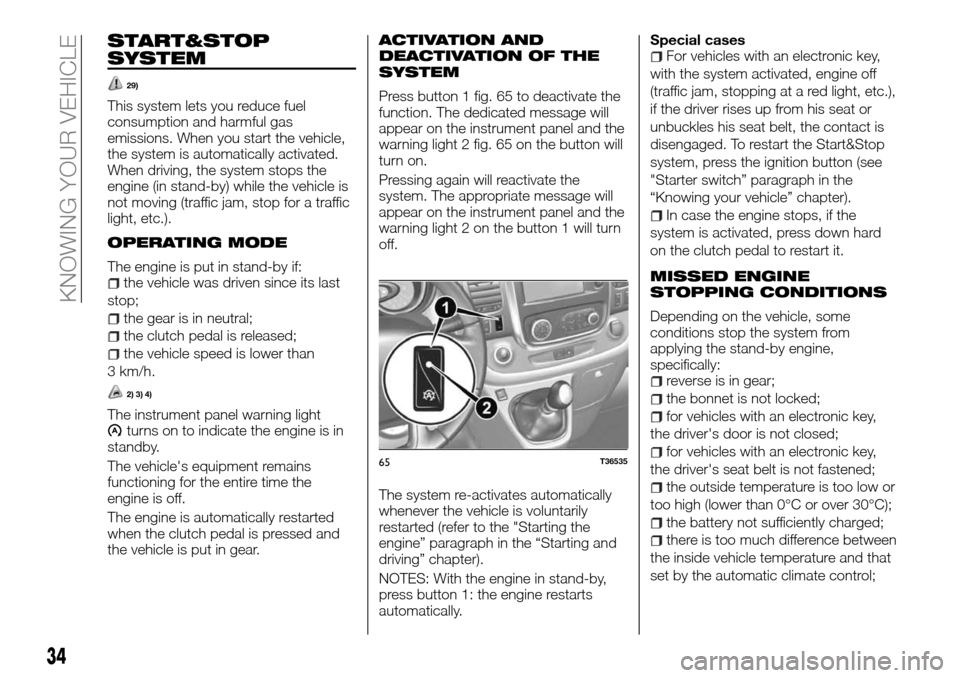
Press button 1 fig. 65 to deactivate the
function. The dedicated message will
appear on the instrument panel and the
warning light 2 fig. 65 on the button will
turn on.
Pressing again will reactivate the
system. The appropriate message will
appear on the instrument panel and the
warning light 2 on the button 1 will turn
off.
The system re-activates automatically
whenever the vehicle is voluntarily
restarted (refer to the "Starting the
engine” paragraph in the “Starting and
driving” chapter).
NOTES: With the engine in stand-by,
press button 1: the engine restarts
automatically.Special cases
For vehicles with an electronic key,
with the system activated, engine off
(traffic jam, stopping at a red light, etc.),
if the driver rises up from his seat or
unbuckles his seat belt, the contact is
disengaged. To restart the Start&Stop
system, press the ignition button (see
"Starter switch” paragraph in the
“Knowing your vehicle” chapter).
In case the engine stops, if the
system is activated, press down hard
on the clutch pedal to restart it.
MISSED ENGINE
STOPPING CONDITIONS
Depending on the vehicle, some
conditions stop the system from
applying the stand-by engine,
specifically:
reverse is in gear;
the bonnet is not locked;
for vehicles with an electronic key,
the driver's door is not closed;
for vehicles with an electronic key,
the driver's seat belt is not fastened;
the outside temperature is too low or
too high (lower than 0°C or over 30°C);
the battery not sufficiently charged;
there is too much difference between
the inside vehicle temperature and that
set by the automatic climate control;
65T36535
34
KNOWING YOUR VEHICLE
Page 63 of 232

NOTE If the window encounters any
resistance during closing (for example a
tree branch, etc.) it stops and lowers a
few centimetres again.
Irregular operation
If the window closing fails to function,
the system moves to no pressure
mode: pull the concerned switch up as
much as needed until the window
closes completely (the window goes
back up gradually); then keep the
switch pulled up (always on the closing
side) for a second, then lower it and
raise it back up completely to reinstate
the system.
If necessary, contact a Fiat Dealership.
Rear sliding windows:
56)
Use the handle 4 fig. 108 and run the
window to the desired stop.
WARNING
54)Incorrect use of the electric windows
may be dangerous. Before and during
operation, always check that nobody is
exposed to the risk of being injured either
directly by the moving window or through
objects getting caught or hit by it. When
leaving the vehicle (equipped with
mechanical key with remote control),
always remove the key from the ignition
device to prevent accidental operation of
the electric windows from being a hazard
for those still on board.
55)When you close the windows, check
that no part of a body (arm, hand, etc.) is
sticking out from the vehicle. Danger of
serious injury.
56)Before manoeuvring it, make sure no
occupant is sticking out of a window or an
open door.
ENGINE BONNET
57) 58) 59) 60) 61) 62) 63)
16)
To open, pull lever 1 fig. 109.
Unlocking bonnet safety catch
To open it, push lever 2 fig. 110 to the
left: the bonnet will be lifted.
107T36560-1108T36562
109T36581
110T36594
61
Page 64 of 232

Opening the bonnet
Lift the bonnet and accompany it.
Lifting is aided by side dampers.
Closing the bonnet
Make sure nothing has been left in the
engine compartment. Lower the bonnet
to approximately 30 centimetres from
the engine compartment then let it
drop. Make sure that the bonnet is
completely closed and not only
fastened by the locking device by trying
to open it. If it is not perfectly closed,
do not try to press the bonnet lid down
but open it and repeat the procedure.
WARNING
57)Before any intervention, the engine
must be turned off (and not in stand-by):
you must turn the engine off (refer to the
"Starting the engine" paragraph in the
“Starting and driving” chapter).
58)Do not lean on the bonnet: it could
close involuntarily.
59)When you intervene near the engine,
this last could be hot. Moreover, the
cooling fan could start up at any time. Risk
of injury.
60)When working in the engine
compartment, make sure that the
windscreen wiper is in the stopped
position. Risk of injury.
61)In case of a collision, even a light one
like against the cowling or bonnet, have it
checked at a Fiat Dealership as soon as
possible.62)Use both hands to lift the bonnet.
Before lifting, check that the windscreen
wiper arms are not raised from the
windscreen, that the vehicle is stationary
and that the parking brake is engaged.
63)For safety reasons, the bonnet must
always be properly closed while the car is
travelling. Therefore, make sure that the
bonnet is properly closed and that the lock
is engaged. If you discover that the bonnet
is not perfectly closed during travel, stop
immediately and close the bonnet in the
correct manner.
IMPORTANT
16)After every intervention in the engine
compartment, make sure you have not left
anything (rags, tools, etc.); basically these
could damage the engine or start a fire.
INTERIOR FITTINGS
SUN VISORS
Lower the sun visor 1 fig. 111. You can
tilt the sun visor against the side
window.
For versions/markets where provided,
lower the sun visor 3 fig. 112 to access
the mirror.
111T36563
112T36564
62
KNOWING YOUR VEHICLE
Page 150 of 232

Bayonet light bulb P 21W.Number plate lights
The bulb can be reached in the same
way as in vehicles with swing doors as
for tailgate.
Remove the lens 12 fig. 245 (using a
screwdriver).
Remove the cover to access the bulb.
Types of bulbs: W5W.
WARNING
156)Modifications or repairs to the electric
system that are not carried out properly or
do not take the system technical
specifications into account can cause
malfunctions leading to the risk of fire.
157)Halogen bulbs contain pressurised
gas, in the case of breakage they may
burst causing glass fragments to be
projected outwards.158)Only replace bulbs when the engine is
off. Also ensure that the engine is cold,
RISK OF BURNS!
159)When intervening under the bonnet,
the solenoid valve could start up
automatically at any time. Risk of injury.
160)The bulbs are under pressure and
could explode while being replaced. Risk of
injury.
IMPORTANT
29)Halogen bulbs must be handled
holding the metallic part only. Touching the
transparent part of the bulb with your
fingers may reduce the intensity of the
emitted light and even reduce the lifespan
of the bulb. In the event of accidental
contact, wipe the bulb with a cloth
moistened with alcohol and let the bulb dry.
243T36684
245T38814
148
IN AN EMERGENCY
Third brake light on tailgate
Undo the nuts 10 fig. 242.
From the outside, pull out the light
cluster and reach bulb 11 fig. 243.
242
Page 160 of 232

JUMP STARTING
173) 174) 175) 176) 177)
39)
WARNING
173)Check that the wires A and B are not
touching and that the positive cable A does
not touch any metal component of the
vehicle providing the current. You risk injury
and/or damage to the vehicle.
174)Before opening the bonnet, make
sure that the engine is off and that the
ignition key is in the "S" (Stop) position.
Follow the indications on the plate
underneath the bonnet.
175)Do not get too close to the radiator
cooling fan: the electric fan may start;
danger of injury. Scarves, ties and other
loose clothing might be pulled by moving
parts.
176)Remove any metal objects (e.g. rings,
watches, bracelets), that might cause an
accidental electrical contact and cause
serious injury.
177)The batteries contain acid that can
burn skin or eyes. Batteries produce
hydrogen, which is easily flammable and
explosive. Therefore, keep away flames or
devices which may cause sparks.
IMPORTANT
39)Never use a fast battery-charger to
start the engine as this could damage the
electronic systems of your vehicle,
particularly the ignition and engine fuel
supply control units.
260T36708
261T36629
158
IN AN EMERGENCY
Starting the engine that supplies
electrical power and keeping it at
medium speed.
To start, if you use the battery from
another vehicle, you need to have the
right cables (large size) from a Fiat
Dealership or, if you already have them,
make sure they are in perfect condition.
The two batteries have to have nominal
identical voltage: 12 Volt The battery
that supplies the power has to have a
capacity (amperes/hour, Ah) that is at
least identical to the dead battery.
Make sure that there is no contact
between the two vehicles (risk of short
circuit at the moment the positive poles
are in contact) and that the dead
battery is well connected. Disengage
the starter device.Depending on the versions, unhook the
battery guard.
Connect positive cable A fig. 260 to
terminal 1 (+) fig. 260 then to terminal 4
(+) fig. 260 of the battery supplying the
power.
Connect negative cable B fig. 260 to
terminal 3 (-) fig. 260 from the battery
supplying power, then to terminal 2 (-)
fig. 260 of the dead battery.
Start the engine and as soon as it turns
over, disconnect cables A and B in
reverse order (2-3-4-1) .
Page 167 of 232

Thousands of kilometres40 80 120 160 200
Years246810
Check windscreen/rearscreen wiper blade position/wear
(for markets/versions, where present)
Check operation of windscreen washer system and adjust
jets if necessary
Check cleanliness of bonnet and boot locks, cleanliness
and lubrication of linkage
Visually check front disc brake pad condition and wear
Visually check rear disc brake pad condition and wear
Visually inspect the accessories drive belt/s condition
Check accessory drive belt tensioning
Change engine oil and replace oil filter(3)
Replacing accessories drive belt/s(4)
Replace fuel filter cartridge(5)
(3) The actual interval for changing engine oil and replacing the engine oil filter depends on the vehicle usage conditions and is signalled by the warning light or
message on the instrument panel. It must never exceed 2 years or 40,000 km. Change engine oil and filter every year if the vehicle is driven mainly in town.
(4) Areas that are not dusty: recommended maximum mileage 160,000 km. The belt must be replaced every 6 years, regardless of distance travelled. Dustyareas
and/or heavy conditions (cold climates, urban driving, long periods of idling): the recommended maximum distance is 60,000 km. The belt must be replaced
every 4 years, regardless of distance travelled.
(5) When refuelling the vehicle with a quality below the relevant European specification, this filter must be replaced every 20,000 km
165