2016 FIAT PANDA lock
[x] Cancel search: lockPage 124 of 204

SCHEDULED
SERVICING
Correct servicing is crucial for
guaranteeing a long life for the vehicle
under the best conditions. For this
reason, Fiat has planned a series of
checks and services at fixed distance
intervals and, where provided, at fixed
time intervals, as described in the
Scheduled Servicing Plan.
Before each service, it is always
necessary to carefully follow the
instructions in the Scheduled Servicing
Plan (e.g. periodically check level of
fluids, tyre pressure, etc.).
Scheduled Servicing is offered by all
Fiat Dealerships according to a set time
schedule. If, during each operation, in
addition to the ones scheduled, the
need arises for further replacements or
repairs, these may be carried out with
your explicit agreement only. If your
vehicle is used frequently for towing,
the interval between one service
operation and the next should be
reduced.IMPORTANT Scheduled Servicing
interventions are set out by the
Manufacturer. Failure to have them
carried out may invalidate the warranty.
It is advisable to inform a Fiat
Dealership of any small operating
irregularities without waiting for the next
service.
PERIODIC CHECKS
Every1,000km or before long
journeys, check and if necessary, top
up: engine coolant level; brake fluid
level; screen washer fluid level; tyre
inflation pressure and condition; lighting
system operation (headlights, direction
indicators, hazard warning lights, etc.);
screen washer/wiper system operation
and positioning/wear of windscreen/
rear window wiper blades.
Every3,000km, check and top up if
required: engine oil level.HEAVY-DUTY USE OF THE
VEHICLE
If the vehicle is used under one of the
following conditions: towing a trailer
or motorhome; dusty roads; short (less
than 7-8 km) and repeated journeys
with sub-zero outside temperatures;
engine often idling or driving long
distances at low speed or long periods
of inactivity, the following checks must
be carried out more often than
indicated in the Scheduled Servicing
Plan:
❒check front disc brake pad condition
and wear;
❒check cleanliness of bonnet and
luggage compartment locks,
cleanliness and lubrication of linkage;
❒visually inspect conditions of: engine,
gearbox, transmission, pipes and
hoses (exhaust/fuel system/brakes) and
rubber elements (gaiters/sleeves/
bushes, etc.);
❒check battery charge and battery
fluid level (electrolyte);
❒visually inspect conditions of the
auxiliary drive belts;
❒check and, if necessary, change
engine oil and replace oil filter / pollen
filter / air cleaner.
12
SERVICING AND MAINTENANCE
2
Page 126 of 204

Thousands of miles 9 18 27 36 45 54 63 72 81 90
Thousands of kilometres 15 30 45 60 75 90 105 120 135 150
Years12345678910
Check operation of the windscreen wiper/washer system
and adjust jets, if necessary●●●●●
Check cleanliness of bonnet and luggage compartment
locks, as well as cleanliness and lubrication of linkages●●●●●
Check handbrake lever travel and adjust, if necessary●●●●●
Check/adjust clutch pedal travel●●●●●
Visually inspect condition and wear of front disc brake
pads and operation of pad wear indicator (for versions/
markets where provided)●●●●●●●●●●
Visually inspect condition and wear of rear disc brake pads
and operation of pad wear indicator (for versions/markets
where provided)●●●●●●●●●●
Visually inspect condition and wear of the rear drum brake
lining●●●●●●●●●●
Visually inspect conditions of the accessory drive belt(s)●
Check tension of accessory drive belt (versions without
automatic tensioner)●●
Visually inspect condition of toothed timing drive belt (0.9
TwinAir 60 HP/65 HP and 0.9 TwinAir Turbo 80 HP/85 HP
versions excluded)●
Check tappet clearance and adjust if necessary (1.2 8V
●●
124
SERVICING AND MAINTENANCE
69 HP versions)
Page 131 of 204

Thousands of miles 12 24 36 48 60 72 84 96 108 120
Thousands of kilometres 20 40 60 80 100 120 140 160 180 200
Years12345678910
Check operation of the windscreen wiper/washer system
and adjust jets, if necessary●●●●●
Check cleanliness of bonnet and luggage compartment
locks, as well as cleanliness and lubrication of linkages●●●●●
Check handbrake lever travel and adjust, if necessary●●●●●
Visually inspect condition and wear of front disc brake
pads and operation of pad wear indicator (for versions/
markets where provided)●●●●●●●●●●
Visually inspect condition and wear of rear disc brake pads
and operation of pad wear indicator (for versions/markets
where provided)●●●●●●●●●●
Visually inspect condition and wear of the rear drum brake
lining●●●●●●●●●●
Visually inspect conditions of the accessory drive belt(s)●●
Check manual gearbox oil level●●●
Check drive transmission idler unit (PTU) oil level (Panda
Cross and Panda 4x4 versions only)●●●
Check rear differential oil level (Panda Cross and Panda
4x4 versions only)●●●
129
Page 140 of 204

WARNING
174)Battery fluid is poisonous and
corrosive: avoid contact with your skin and
eyes. The battery should be charged in a
well ventilated place, away from naked
flames or possible sources of sparks:
danger of explosion and fire.
175)Do not attempt to charge a frozen
battery: it must be thawed first, otherwise it
may explode. If freezing has occurred, the
battery should be checked by skilled
personnel to make sure that the internal
elements are not damaged and that the
body is not cracked, with the risk of leaking
poisonous and corrosive acid.
WINDSCREEN/REAR
WINDOW WIPER
176)61)
REPLACING THE
WINDSCREEN WIPER
BLADES
❒raise the wiper arm, press tab A fig.
124 of the attachment spring and
remove the blade from the arm;
❒fit the new blade, inserting the tab
into the special slot in the arm, making
sure that it is locked;
❒lower the wiper arm on the
windscreen.REPLACING THE REAR
WINDOW WIPER BLADE
Proceed as follows:
❒raise cover A fig. 125, undo nut B
and remove arm C;
❒correctly position the new arm, fully
tighten the nut B then lower the cover
A.
SPRAY NOZZLES
Windscreen washer
The windscreen washer jets can be
adjusted rotating the side notch with a
screwdriver. If there is no jet of fluid,
firstly check that there is fluid in the
reservoir (see "Checking fluid levels" in
this chapter). Then check that the
nozzle holes are not clogged; use a
needle to unblock them if necessary.
124F1D0100
125F1D0101
138
SERVICING AND MAINTENANCE
Page 144 of 204

IDENTIFICATION
DATA
VIN PLATE
This is applied on the left side of the
luggage compartment fig. 127 (lift the
mat for access) and bears the following
data:
BType-approval number.
CVehicle type identification code.
DChassis serial number.
EMaximum permitted weight of vehicle
fully laden.
FMaximum permitted weight of vehicle
fully laden plus trailer.
GMaximum permitted weight on first
axle (front).
HMaximum permitted weight on
second axle (rear).
IEngine type.
LBodywork version code.
MSpare part number.
NCorrect value of smoke coefficient
(for diesel engines).
BODYWORK PAINT
IDENTIFICATION PLATE
This is applied inside the bonnet (left
side) and bears the following data
fig. 128:
APaint manufacturer.
BColour name.
CFiat colour code.
DRespray and touch up code.
CHASSIS MARKING
This is located on the right side of the
luggage compartment rear floor and
gives the following identification data:
❒type of vehicle;
❒chassis serial number.ENGINE MARKING
It is stamped on the cylinder block and
includes the type and the engine serial
number.
127F1D0142
128F1D0128
142
TECHNICAL SPECIFICATIONS
Page 179 of 204

RADIO
186) 187)
The radio has been designed according
to the specifications of the passenger
compartment, with a personalised
design matching the style of the
dashboard perfectly.
TIPS
Road safety
Please, learn how to use all different
radio functions (e.g. save stations)
before beginning to drive.
Care and maintenance
Clean the cover with a soft antistatic
cloth only. Cleaning and polishing
products may damage the surface.
ANTI-THEFT
PROTECTION
The radio is equipped with an anti-theft
protection system based on the
exchange of information between the
radio and the electronic control unit
(Body Computer) on the car.
This system guarantees maximum
safety and prevents the secret code
from being entered each time the radio
power supply is disconnected.If the check has a positive outcome, the
radio will start to function, whereas if
the comparison codes are not the
same or if the electronic control unit
(Body Computer) is replaced, the
device will ask the user to enter the
secret code according to the procedure
described in the paragraph below.
Entering the secret code
When the radio is switched on, if the
code is requested, the display will show
"Radio code" for about 2 seconds
followed by four dashes "----".
The code is made up of four numbers
from 1 to 6, each corresponding to one
of the dashes.
To enter the first digit of the code, press
the corresponding button of the
pre-selected stations (from 1 to 6).
Enter the other code digits in the same
way.
If the four digits are not entered within
20 seconds, the display will show
"Enter code----".Ifthis occurs, it is
not considered an incorrect code entry.
After entering the fourth digit (within
20 seconds), the car radio will start to
work.
If an incorrect code is entered, the radio
will emit a sound and the display
shows the text "Radio blocked/wait" to
notify the user of the need to enter
the correct code.Each time the user enters an incorrect
code, the waiting time will gradually
increase (1 min, 2 min, 4 min, 8 min, 16
min, 30 min, 1 h, 2 h, 4 h, 8 h, 16 h,
24 h) up to a maximum of 24 hours.
The waiting time will be shown on the
display with the text "Radio blocked/
wait". After the text has disappeared it
is possible to start the code entering
procedure again.
Car radio passport
This document certifies the ownership
of the car radio. The car radio passport
shows the radio model, serial number
and secret code.
IMPORTANT Keep the radio passport in
a safe place so that you can give the
information to the relevant authorities if
the radio is stolen.
In the case of loss of the vehicle radio
passport, contact the Fiat Dealership,
taking an ID document and the vehicle
ownership documents.
177
Page 193 of 204

191
RIGHT HAND DRIVE VERSIONS
REPLACING FUSES
Dashboard fuse box
To access the fuses, remove the plastic
cover fig. 3 . The fuses are located in
the fuse box shown in fig. 4 .
F0W0294
F0W0295
FUSE LOCATION
3
4
PARKING
Switch off the engine and engage the
handbrake. Engage a gear (1stgear if parked
uphill or reverse if facing downhill) and leave
the wheels turned. If the car is parked on
a steep slope block the wheels with a wedge
or stone. Always remove the ignition key when
leaving the car.
HANDBRAKE
To engage the handbrake pull lever A f i g . 5
upwards until the car is secured. To
release the handbrake, raise lever
A slightly, hold down button B and
lower the lever.
If the car is parked on a steep slope, it
is also advisable to block the wheels
with a wedge or stone.
Never leave children alone in the
unattended car. Always remove the
ignition key when leaving the car and
take it with you.
F0W02965
Page 201 of 204
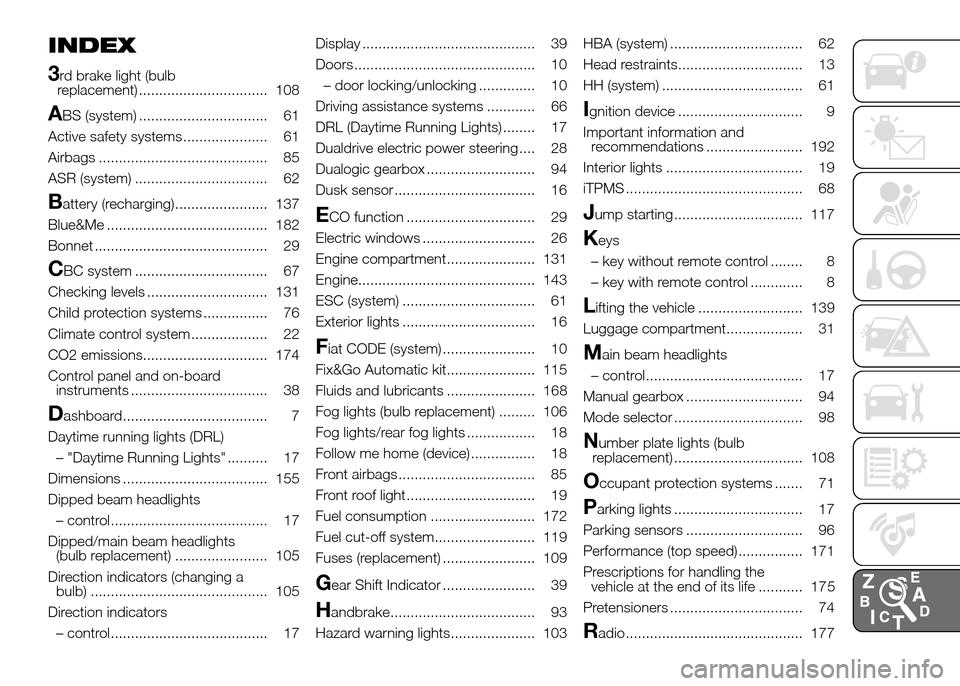
INDEX
3
rd brake light (bulb
replacement) ................................ 108
ABS (system) ................................ 61
Active safety systems ..................... 61
Airbags .......................................... 85
ASR (system) ................................. 62
Battery (recharging)....................... 137
Blue&Me ........................................ 182
Bonnet ........................................... 29
CBC system ................................. 67
Checking levels .............................. 131
Child protection systems ................ 76
Climate control system ................... 22
CO2 emissions............................... 174
Control panel and on-board
instruments .................................. 38
Dashboard.................................... 7
Daytime running lights (DRL)
– "Daytime Running Lights" .......... 17
Dimensions .................................... 155
Dipped beam headlights
– control....................................... 17
Dipped/main beam headlights
(bulb replacement) ....................... 105
Direction indicators (changing a
bulb) ............................................ 105
Direction indicators
– control....................................... 17Display ........................................... 39
Doors ............................................. 10
– door locking/unlocking .............. 10
Driving assistance systems ............ 66
DRL (Daytime Running Lights) ........ 17
Dualdrive electric power steering .... 28
Dualogic gearbox ........................... 94
Dusk sensor ................................... 16
ECO function ................................ 29
Electric windows ............................ 26
Engine compartment...................... 131
Engine............................................ 143
ESC (system) ................................. 61
Exterior lights ................................. 16
Fiat CODE (system) ....................... 10
Fix&Go Automatic kit...................... 115
Fluids and lubricants ...................... 1
Fog lights (bulb replacement) ......... 106
Fog lights/rear fog lights ................. 18
Follow me home (device) ................ 18
Front airbags .................................. 85
Front roof light ................................ 19
Fuel consumption .......................... 172
Fuel cut-off system......................... 119
Fuses (replacement) ....................... 109
Gear Shift Indicator ....................... 39
Handbrake.................................... 93
Hazard warning lights..................... 103HBA (system) ................................. 62
Head restraints............................... 13
HH (system) ................................... 61
Ignition device ............................... 9
Important information and
recommendations ........................ 19
Interior lights .................................. 19
iTPMS ............................................ 68
Jump starting ................................ 117
Keys
– key without remote control ........ 8
– key with remote control ............. 8
Lifting the vehicle .......................... 139
Luggage compartment................... 31
Main beam headlights
– control....................................... 17
Manual gearbox ............................. 94
Mode selector ................................ 98
Number plate lights (bulb
replacement) ................................ 108
Occupant protection systems ....... 71
Parking lights ................................ 17
Parking sensors ............................. 96
Performance (top speed) ................ 17
Prescriptions for handling the
vehicle at the end of its life ........... 17 5
Pretensioners ................................. 74
Radio ............................................ 1
682
1
77