2016 FIAT PANDA door
[x] Cancel search: doorPage 28 of 204

ELECTRIC WINDOWS
FRONT ELECTRIC
WINDOWS
19) 20)These operate when the ignition key is
turned to MAR and for about three
minutes after turning the ignition key to
STOP or removing it.
The electric window control buttons are
fig. 25 located beside the gear lever
and activate:
A Opening/closing of the left window.
B Opening/closing of the right
window.
With the ignition key at MAR, a long
press activates the automatic operation
of the window: raising/lowering on the
driver's side and lowering only the
passenger side.MANUAL REAR WINDOW
WINDERS
To open/close the window operate the
handle on the door panel.
WARNING
19)Incorrect use of the electric windows
may be dangerous. Before and during
operation, always check that nobody
is exposed to the risk of being injured
either directly by the moving window or
through objects getting caught or by being
hit.
20)When leaving the vehicle, always
remove the ignition key to avoid the risk of
injury of people still on board due to
accidental operation of the electric
windows.
ELECTRIC SUN
ROOF
(for versions/markets, where provided)
21)8)
The large electric sun roof comprises
two glass panels; the front one is
mobile and the rear one fixed. These
are equipped with two sun blinds (front
and rear) that can be moved manually.
With the sun roof closed, the blinds can
be placed in any position. To open the
blinds, grip handle A fig. 26, following
the direction indicated by the arrow until
the desired position is reached. To
close them, carry out the procedure in
reverse.
The sun roof can be operated only with
the ignition key turned to MAR.
Opening
Press and hold down button C fig. 26.
The front glass panel will move into
the spoiler position.
After opening in spoiler position, press
button C fig. 26 for more than half a
second to bring the roof automatically
to fully open position.
The automatic roof movement can be
stopped in any position by pressing
button B or C again.
25F1D0031
26
GETTING TO KNOW YOUR CAR
Page 33 of 204

LUGGAGE
COMPARTMENT
The luggage compartment unlocking is
electrically operated and is deactivated
when the vehicle is in motion.
OPENING
28)
By mechanical key
On versions with mechanical key, the
luggage compartment can be opened
from outside the vehicle, inserting
the metal insert of the key in the latch
on the tailgate handle and rotating.
With remote control
(for versions/markets, where provided)
The luggage compartment is unlocked
by pressing the
button on the
remote control. The direction indicators
will blink twice.With electric handle (soft touch)
(for versions/markets, where provided)
For versions with soft touch electrical
handle, the tailgate (when unlocked)
can only be opened from outside the
vehicle using the electric opening
handle A fig. 34 located under the
handle until a click is heard, which
indicates unlocking. The tailgate can be
opened at any time, if the doors are
unlocked. To open it, enable the
handle, opening one of the front doors
or unlocking the doors with the remote
control or using the key without remote
control.
Emergency opening from the inside
Proceed as follows:
❒remove the rear head restraints and
fully fold the seats;❒remove the protective cap and
release the lock using a screwdriver or
the metal insert of the key fig. 35.
CLOSING
29)Pull the grab handle located inside the
tailgate.
IMPORTANT Before closing the
luggage compartment make sure that
you have the keys since the luggage
compartment is automatically locked.
34F1D0032
35F1D0033
31
Page 34 of 204

LUGGAGE
COMPARTMENT
INITIALISATION
IMPORTANT If the battery is
disconnected or the protection fuse
blows, the luggage compartment
opening/closing mechanism must be
reinitialised as follows: close all the
doors and the tailgate, press the
button on the remote control, then
press the
button
30) 31) 32)
WARNING
28)Take care not to knock objects on the
roof rack when opening the tailgate.
29)With the engine on, always make sure
that the tailgate is closed: exhaust gases
could be drawn inside the load
compartment.
30)Every attachment has a maximum load
capacity of 100 kg.
31)A heavy load that has not been
secured may cause serious injuries in the
event of an accident.
32)If you are travelling in an area with
limited opportunities for vehicle refuelling
and you wish to bring petrol with you in
a petrol can, you must do so in compliance
with current regulations and using an
approved can, appropriately secured to the
load securing attachments. Anyway, by
doing so, you increase the risk of fire in the
event of an accident with your vehicle.
VERSION WITH LPG
SYSTEM
33) 34) 13)9) 10) 11) 12)
INTRODUCTION
The LPG version features two fuel
supply systems: one for petrol and one
for LPG.
Although the LPG system has
numerous safety features, it is advisable
to proceed as follows every time the
vehicle is not in use for a long period or
moved in an emergency as a result of
a breakdown or accident:
❒unscrew the fixing devices A fig. 36,
then remove the cover B;
❒close the LPG cock by rotating the
ring nut C fig. 37 clockwise;
❒refit the cover and retighten the
fastening devices.LPG TANK
13)The vehicle has a (pressurised) tank A
fig. 38 for collecting LPG in a liquid
state. It is ring-shaped and is located in
the spare wheel compartment with
suitable protection.
36F1D0111
37F1D0112
38F1D0113
32
GETTING TO KNOW YOUR CAR
Page 45 of 204
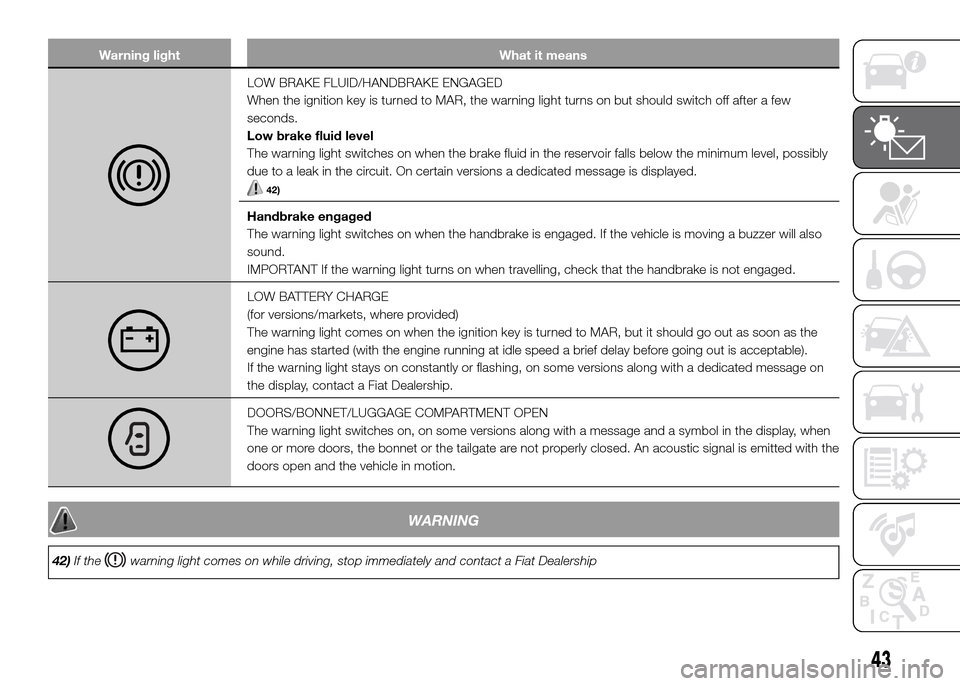
Warning light What it means
LOW BRAKE FLUID/HANDBRAKE ENGAGED
When the ignition key is turned to MAR, the warning light turns on but should switch off after a few
seconds.
Low brake fluid level
The warning light switches on when the brake fluid in the reservoir falls below the minimum level, possibly
due to a leak in the circuit. On certain versions a dedicated message is displayed.
42)
Handbrake engaged
The warning light switches on when the handbrake is engaged. If the vehicle is moving a buzzer will also
sound.
IMPORTANT If the warning light turns on when travelling, check that the handbrake is not engaged.
LOW BATTERY CHARGE
(for versions/markets, where provided)
The warning light comes on when the ignition key is turned to MAR, but it should go out as soon as the
engine has started (with the engine running at idle speed a brief delay before going out is acceptable).
If the warning light stays on constantly or flashing, on some versions along with a dedicated message on
the display, contact a Fiat Dealership.
DOORS/BONNET/LUGGAGE COMPARTMENT OPEN
The warning light switches on, on some versions along with a message and a symbol in the display, when
one or more doors, the bonnet or the tailgate are not properly closed. An acoustic signal is emitted with the
doors open and the vehicle in motion.
WARNING
42)If thewarning light comes on while driving, stop immediately and contact a Fiat Dealership
43
Page 74 of 204

IMPORTANT When putting the back
seat to its normal position, make sure
the seat belts are positioned so they are
ready to use.
ADJUSTING THE SEAT
BELT HEIGHT
(for versions/markets, where provided)
85) 86)
Four different adjustments in height are
provided. To adjust, press button A
fig. 58 and raise or lower handle B.
Always adjust the height of the seat belt
to fit the person wearing it: this
precaution could greatly reduce the risk
of injury in the case of collision.
Correct adjustment is obtained when
the belt passes approximately half way
between the shoulder and the neck.
For some versions, front seat belts have
just one fixed anchor point located on
the door pillar.
WARNING
81)Never press button C fig. 55 when
travelling.
82)Remember that in the event of an
accident, the rear seat passengers not
wearing seat belts are exposed to a very
serious risk and also represent a serious
danger for the front seat occupants.
83)The rear central seat belt (for
versions/markets, where provided) is
provided with a service buckle. Do not use
the seat belt with the service buckle not
fastened. In this case there is a high risk of
injury or death in the event of an accident.
Before using the belt, always make sure
that the service buckle is correctly
fastened.
84)The rear left and right side belts are
provided with an adjustment device for the
metal tongue position (metal hook). Adjust
the tongue position with respect to the seat
belt to improve comfort and reduce noise
inside the passenger compartment.
85)Stop the vehicle to adjust the seat belt
height.
86)After height adjustment, make sure that
the cursor to which the ring is secured is
blocked in one of the preset positions.
To do this, with button A fig. 58 released,
exert further pressure downwards to allow
the locking device to click if the grip has
not been released in one of the possible
positions.
SBR (Seat Belt
Reminder) SYSTEM
The SBR system warns the passengers
of the front and rear (for versions/
markets, where provided) seats if their
seat belt is not fastened.
The system signals unfastened seat
belts with visual warnings (warning
lights on in the instrument panel and
icons on the display) and an acoustic
signal (see the following paragraphs).
Contact a Fiat Dealership to deactivate
this acoustic warning permanently.
The acoustic warning can be
reactivated at any time through the
display Setup Menu.
58F1D0053
72
SAFETY
Page 91 of 204

Pretensioners and airbags are deployed
in different ways on the basis of the
type of collision. Failure to deploy
of one of the devices does not
necessarily indicate a system
malfunction.
WARNING
102)Do not apply stickers or other objects
on the steering wheel, on the dashboard
in the passenger side airbag area, on
the side cover on the roof and on
the seats. Never put objects (e.g. mobile
phones) on the passenger's side
dashboard since they could interfere with
correct inflation of the airbag and also
cause serious injury to the passengers.
103)Always drive keeping your hands on
the steering wheel rim so that the airbag
can inflate freely if necessary. Do not drive
with your body bent forward. Keep your
back straight against the backrest.104)When an active passenger airbag is
fitted, DO NOT install rearward facing child
restraint systems on the front seat.
Deployment of the airbag in an accident
could cause fatal injuries to the child
regardless of the severity of the impact.
Therefore, always deactivate the passenger
side airbag when a rearward facing child
restraint system is installed on the front
passenger seat. The front passenger seat
must also be positioned back as far as
possible in order to prevent the child
restraint system from coming into contact
with the dashboard. Immediately reactivate
the passenger airbag as soon as the child
restraint system has been removed.
105)Do not affix rigid objects to the coat
hooks or support handles.
106)Do not rest the head, arms or elbows
on the door, windows and window bag
area to avoid possible injuries during
inflation.
107)Never lean your head, arms and
elbows out of the window.
108)If the
warning light stays on whilst
driving, a fault may have occurred in the
restraint systems. In this case the airbags
or pretensioners may not be deployed
in an impact or, in a lower number of
cases, they may be deployed accidentally.
Before continuing, contact a Fiat
Dealership immediately to have the system
checked.109)In the event of “yellow”
warning
light failure, the “red”warning light
switches on and, for versions/markets
where provided, the explosive charges of
the passenger airbag and the side bags
are deactivated. When the "red" warning
light is on, before proceeding contact a Fiat
Dealership to have the system immediately
checked (see previous warning).
110)On vehicles with side bags, do not
cover the front seat backrests with extra
covers.
111)Do not travel carrying objects in your
lap, in front of your chest or between
your lips (pipe, pencils, etc.). They could
cause severe injury if the airbag is
deployed.
112)If the vehicle has been stolen or in the
case of attempt to steal it, if it has been
subjected to vandalism or floods, have the
airbag system checked by a Fiat
Dealership.
89
Page 94 of 204

STARTING THE
ENGINE
118) 119)
36) 37) 38) 39)
Before starting the engine, adjust the
seat, the interior rear view mirrors,
the door mirrors and fasten the seat
belt correctly.
Never press the accelerator pedal for
starting the engine.
VERSIONS WITH MANUAL
GEARBOX
Petrol versions
Proceed as follows:
❒engage the handbrake and place the
gear lever in neutral.For 0.9 TwinAir
and 0.9 TwinAir Turbo versions
engage the handbrake and place the
gear lever in neutral or fully press the
clutch pedal if a gear other than neutral
is engaged;
❒for all versions (except 0.9
TwinAir Turbo)fully depress the clutch
pedal, without pressing the accelerator;
❒turn the ignition key to AVV and
release it as soon as the engine starts.
Diesel versions
Proceed as follows:
❒engage the handbrake, put the gear
lever into neutral and turn the ignition
key to MAR: the warning lights
andon the instrument panel
will turn on;❒wait for the warning lights
and
to turn off and then fully depress
the clutch pedal without pressing the
accelerator;
❒turn the ignition key to AVV as soon
as warning light
switches off.
Release the ignition key as soon as the
engine starts.
IMPORTANT If the engine does not
start at the first attempt, return the
ignition key to STOP before repeating
the procedure. If, with the ignition
key at MAR, the warning lights
and
(only for petrol versions) stay on
in the instrument panel, the ignition key
must be brought back to STOP and
then to MAR again. If the
warning
light stays on, retry with the other
keys provided. Contact a Fiat
Dealership if you still cannot start the
engine.
VERSIONS WITH
DUALOGIC GEARBOX
120)Engine starting is allowed both with a
gear engaged and with the gearbox
in neutral (N).
However, the brake pedal must always
be pressed first if neutral is not
engaged. It is therefore advisable to
place the gear lever in neutral (N) before
starting the engine.LPG AND NATURAL
POWER VERSIONS
The engine always starts up on petrol
independently of the mode previously
selected.
40)
STOPPING THE ENGINE
41)Turn the ignition key to STOP while the
engine is idling.
IMPORTANT After a demanding drive,
before turning the engine off you should
allow it to idle to allow the temperature
in the engine compartment to
decrease.
92
STARTING AND DRIVING
WARNING
118)It is dangerous to run the engine in
enclosed areas. The engine takes in
oxygen and releases carbon dioxide,
carbon monoxide and other toxic gases.
119)Remember that the brake servo
and power steering are not operational until
the engine has been started, therefore
you need to apply much more force than
usual to the brake pedal and steering
wheel.
120)If the engine fails to start with a gear
engaged, the potentially dangerous
situation due to the fact that the gearbox is
automatically placed in neutral will be
signalled by an acoustic signal.
Page 101 of 204

99
TOWING TRAILERS
128) 129)
IMPORTANT
For towing motorhomes or trailers the
vehicle must be fitted with an approved
tow hook and an adequate electrical
system. Installation must be carried out
by a specialist.
Install any specific and/or additional
door mirrors as specified by the
Highway Code.
Remember that when towing a trailer,
steep hills are harder to climb, braking
distances increase and overtaking
takes longer depending on the overall
weight of the trailer.
Engage a low gear when driving
downhill, rather than constantly using
the brake.
The weight the trailer exerts on the
vehicle tow hook reduces the vehicle's
loading capacity by the same amount.
To make sure that the maximum
towable weight is not exceeded (given
in the vehicle registration document)
account should be taken of the fully
laden trailer, including accessories and
luggage.
Do not exceed the speed limits specific
to each country you are driving in, in
the case of vehicles towing trailers.
In any case, the top speed must not
exceed 100 km/h.An electric brake (or electric winch)
should be supplied directly by the
battery through a cable with a cross
section of no less than 2.5 mm2.
In addition to the electrical branches,
the vehicle electrical system can only
be connected to the supply cable for an
electric brake and to the cable for an
internal light for the trailer, not
exceeding 15 W. For connections, use
the preset control unit with a battery
cable with section not less than 2.5
mm2.
On Panda Cross and Panda 4x4
versions, in the event of prolonged
vehicle use at maximum tow capacity
on slopes, replacing engine oil more
frequently (every 10,000 km) is
advisable.
IMPORTANT The use of auxiliary loads
other than external lights (electric brake,
winch, etc.) must be used with engine
running.
IMPORTANT To install a tow hook
contact a Fiat Dealership.
WARNING
128)The ABS with which the vehicle is
equipped will not control the braking
system of the trailer. Particular caution is
required on slippery roads.
129)Never modify the braking system of
the vehicle to control the trailer brake.
The trailer braking system must be fully
independent of the vehicle’s hydraulic
system.
REFUELLING THE
VEHICLE
130) 131) 132)Always stop the engine before
refuelling.
PETROL ENGINES
Use unleaded petrol only, with an
octane number (R.O.N.) no lower than
95. Never introduce even the smallest
amount of leaded petrol, even in the
event of an emergency, in order to
prevent damage to the catalytic
converter.
DIESEL ENGINES
Only use Diesel for motor vehicles (EN
590 specification).
When using or parking the car for a
long time in the mountains or cold
areas, it is advisable to refuel using
locally available diesel. In this case, it is
also advisable to keep the tank over
50% full.