2016 FIAT FULLBACK Wheel
[x] Cancel search: WheelPage 229 of 312

Thousand of miles9 182736455463728190
Thousand of kilometers15 30 45 60 75 90 105 120 135 150
Years12345678910
Visually inspect conditions and wear of front
disc brake pads and operation of pad wear
indicator
●●●●●●●●●●
Visually inspect condition and wear of the
rear drum brake lining●●●●●●●●●●
Check the front and rear wheel bearing
clearances●●●
Visually check for any fluid leaks from the
automatic transmission (if leaks are found,
check the oil level)
●●●●● ●●●●
Change the automatic transmission oil (4)●
Visually check for any fluid leaks from the
manual transmission (if leaks are found,
check the oil level)
●●●●● ●●●●
Change the manual transmission oil (8)●
Visually inspect the integrity of the
suspension system components and their
fixings
●●●●●●●●●●
Check handbrake lever travel and adjust, if
necessary●●●●●●●●●●
(4) To be done only in case of heavy use, only on a mileage basis, every 100,000 km.
(8)To be done only on a mileage basis.
227
Page 234 of 312

Thousands of miles6 121825313743505662
Thousands of kilometers or10 20 30 40 50 60 70 80 90 100
Years12345678910
Check cleanliness of bonnet and luggage
compartment locks, cleanliness and
lubrication of linkage
●●●●●
Visually inspect conditions and wear of front
disc brake pads and operation of pad wear
indicator
●●●●●●●●●●
Visually inspect condition and wear of the
rear drum brake lining●●●●●●●●●●
Check the front and rear wheel bearing
clearances●●●
Visually check for any fluid leaks from the
automatic transmission (if leaks are found,
check the oil level)
●●●●●●●●●
Change the automatic transmission oil (14)●
Visually check for any fluid leaks from the
manual transmission (if leaks are found,
check the oil level)
●●●●●●●●●
Change the manual transmission oil (8)●
Visually inspect the integrity of the
suspension system components and their
fixings
●●●●●●●●●●
(14) To be done only in case of heavy use, only on a mileage basis.
(8) to be done only on a mileage basis, independently of the time.
232
SERVICING AND MAINTENANCE
Page 239 of 312

Thousands of miles6 121825313743505662
Thousands of kilometers or10 20 30 40 50 60 70 80 90 100
Years12345678910
Check operation of the windscreen
wiper/washer system and adjust jets, if
necessary
●●●●●
Check cleanliness of bonnet and luggage
compartment locks, cleanliness and
lubrication of linkage
●●●●●
Visually inspect conditions and wear of front
disc brake pads and operation of pad wear
indicator
●●●●●●●●●●
Visually inspect condition and wear of the
rear drum brake lining●●●●●●●●●●
Check the front and rear wheel bearing
clearances●●●
Visually check for any fluid leaks from the
automatic transmission (if leaks are found,
check the oil level)
●●●●●●●●●
Change the automatic transmission oil (14)●
Visually check for any fluid leaks from the
manual transmission (if leaks are found,
check the oil level)
●●●●●●●●●
Change the manual transmission oil (8)●
(14) To be done only in case of heavy use, only on a mileage basis.
(8) to be done only on a mileage basis, independently of the time.
237
Page 259 of 312

CLEANING THE
EXTERIOR OF YOUR
VEHICLE
If the following is left on your vehicle, it
may cause corrosion, discolouration
and stains, wash the vehicle as soon as
possible.
Seawater, road deicing products.
Soot and dust, iron powder from
factories, chemical substance (acids,
alkalis, coaltar, etc.).
Droppings from birds, carcasses of
insects, tree sap, etc.
Washing
Chemicals contained in the dirt and
dust picked up from the road surface
can damage the paint coat and body of
your vehicle if left in prolonged contact.
Frequent washing and waxing is the
best way to protect your vehicle from
this damage. This will also be effective
in protecting it from environmental
elements such as rain, snow, salt air,
etc.
Do not wash the vehicle in direct
sunlight. Park the vehicle in the shade
and spray it with water to remove dust.
Next, using an ample amount of clean
water and a car washing brush or
sponge, wash the vehicle from top to
bottom.
Use a mild car washing soap if
necessary. Rinse thoroughly and wipe
dry with a soft cloth. After washing thevehicle, carefully clean the joints and
flanges of the doors, bonnet and other
sections where dirt is likely to remain.
163) 164) 165) 166) 167) 168) 169) 170)
6)
During cold weather
The salt and other chemicals spread on
the roads in some areas in winter can
have a harmful effect on the vehicle
body. You should therefore wash the
vehicle as often as possible in
accordance with our care-instructions.
It is recommended to have a
preservative applied and the underfloor
protection checked before and after the
cold weather season.
After washing your vehicle, wipe off all
waterdrops from the rubber parts
around the doors to prevent the doors
from freezing.
Waxing
Waxing the vehicle will help prevent the
adherence of dust and road chemicals
to the paintwork. Apply a wax solution
after washing the vehicle, or at least
once every three months to assist
displacing of water.
Do not wax your vehicle in direct
sunlight. You should wax after the
surfaces have cooled.
For information on how to use wax refer
to the instruction manual of the wax.
171)
Polishing
The vehicle should only be polished if
the paintwork has become stained or
lost its lustre. Do not polish parts with a
mat coating and the plastic bumpers.
Doing so could cause stains or damage
the finish.
Cleaning plastic parts
Use a sponge or chamois leather. If a
car wax adheres on a grey or black
rough surface of the bumper, moulding
or lamps, the surface becomes white.
In such a case, wipe it off using
lukewarm water and soft cloth or
chamois leather.
172) 173)
Chrome parts
In order to prevent spots and corrosion
of chrome parts, wash with water, dry
thoroughly, and apply a special
protective coating. This should be done
more frequently in winter.
Aluminium wheels
*
Remove dirt using a sponge while
sprinkling water on the wheel.Use
neutral detergent on any dirt that
cannot be removed easily with
water. Rinse off the neutral
detergent after washing the
wheel.Dry the wheel thoroughly
using a chamois leather or a soft
cloth.
174) 175) 176) 177)
257
Page 260 of 312

Window glass
The window glass can normally be
cleaned using only a sponge and water.
Glass cleaner can be used to remove
oil, grease, insect carcasses, etc. After
washing the glass, wipe it dry with a
clean, dry, soft cloth. Never use a cloth
that is used for cleaning a painted
surface to clean a window. Wax from
the painted surface could get on the
glass and lower glass transparency and
visibility.
To clean the inside of the rear window,
always use a soft cloth and wipe the
window glass along the demister heater
element so as not to cause damage.
Wiper blades
Use a soft cloth and glass cleaner to
remove grease, insect carcasses, etc.,
from the wiper blades. Replace the
wiper blades when they no longer wipe
properly.
Engine compartment
Clean the engine compartment at the
beginning and end of winter. Pay
particular attention to flanges, crevices
and peripheral parts where dust
containing road chemicals and other
corrosive materials might collect.
If salt and other chemicals are used on
the roads in your area, clean the engine
compartment at least every three
months.Never spray or splash water on the
electrical components in the engine
compartment, as this may cause
damage.
Do not bring the nearby parts, the
plastic parts and so on into contact
with sulphuric acid (battery electrolyte)
which may crack, stain or discolour
them.
If they are in contact, wipe off with soft
cloth, chamois or the like and an
aqueous solution of neutral detergent
then immediately rinse the affected
parts with plenty of water.
IMPORTANT
163)Avoid washing with rollers and/or
brushes in washing stations. Wash the
vehicle only by hand using neutral pH
detergents; dry it with a wet chamois
leather. Abrasive products and/or polishes
should not be used for cleaning the car.
Bird droppings must be washed off
immediately and thoroughly as the acid
they contain is particularly aggressive.
Avoid (if at all possible) parking the vehicle
under trees; remove vegetable resins
immediately as, when dried, it may only be
possible to remove them with abrasive
products and/or polishes, which is highly
inadvisable as they could alter the typical
opaqueness of the paint. Do not use pure
windscreen washer fluid for cleaning the
front windscreen and rear window; dilute it
min. 50% with water. Only use pure screen
washer fluid when strictly necessary due to
outside temperature conditions.164)When washing the under side of your
vehicle or wheel, be careful not to injure
your hands.
165)If your vehicle has rain sensor wipers,
place the wiper switch lever in the “OFF”
position to deactivate the rain sensor
before washing the vehicle. Otherwise, the
wipers will operate in the presence of water
spray on the windscreen and may get
damaged as a result.
166)Refrain from excessively using a car
wash as its brushes may scratch the paint
surface, causing it to lose its gloss.
Scratches will be especially visible on
darker coloured vehicles.
167)Never spray or splash water on the
electrical components in the engine
compartment. Doing so could have an
adverse effect on the engine startability.
Exercise caution also when washing the
underbody; be careful not to spray water
into the engine compartment.
168)Some types of hot water washing
equipment apply high pressure and heat to
the vehicle. They may cause heat distortion
and damage to the vehicle resin parts and
may result in flooding of the vehicle interior.
Therefore maintain a good distance of
approx. 70 cm or more between the vehicle
body and the washing nozzle. Also, when
washing around the door glass, hold the
nozzle at a distance of more than 70 cm
and at right angles to the glass surface.
258
SERVICING AND MAINTENANCE
Page 261 of 312

169)After washing the vehicle, drive the
vehicle slowly while lightly depressing the
brake pedal several times in order to dry
out the brakes. Leaving the brakes wet
could result in reduced braking
performance. Also, there is a possibility that
they could freeze up or become inoperative
due to rust, rendering the vehicle unable to
move.
170)Using an automatic car wash, pay
attention to the following items, referring to
the operation manual or consulting a car
wash operator. If the following procedure is
not followed, it could result in damage to
your vehicle: 1 – the outside rear-view
mirrors are retracted. 2 – The antenna is
removed. 3 – The wiper arms are secured
in place with tape.4–Ifyour vehicle has
rain sensor wipers, place the wiper switch
lever in the “OFF” position to deactivate the
rain sensor.
171)Waxes containing high abrasive
compounds should not be used.
172)Do not use a scrubbing brush or other
hard tools as they may damage the plastic
part surface.
173)Do not bring the plastic parts into
contact with petrol, light oil, brake fluids,
engine oils, greases, paint thinners and
sulphuric acid (battery electrolyte) which
may crack, stain or discolour the plastic
parts. If they touch the plastic parts, wipe
them off with soft cloth, chamois or the like
and an aqueous solution of neutral
detergent then immediately rinse the
affected parts with water.
174)Do not use a brush or other hard
implement on the wheels. Doing so could
scratch the wheels.175)Do not use any cleaner that contains
an abrasive substance or is acidic or
alkaline. Doing so could cause the coating
on the wheels to peel or become
discoloured or stained.
176)Do not directly apply hot water using a
steam cleaner or by any other means.
177)Contact with seawater and road
deicer can cause corrosion. Rinse off such
substances as soon as possible.
IMPORTANT
6)Detergents pollute the environment. Only
wash your vehicle in areas equipped to
collect and treat wastewater from this type
of activity.
259
Page 264 of 312

Wheel condition
340) 341) 342)
178)
1. Location of the tread wear indicator
2. Tread wear indicator
Check the tyres for cuts, cracks and
other damage. Replace the tyres if
there are deep cuts or cracks. Also
check each tyre for pieces of metal or
pebbles.
The use of worn tyres can be very
dangerous because of the greater
chance of skidding or hydroplaning.
The tread depth of the tyres must
exceed 1.6 mm in order for the tyres to
meet the minimum requirement for use.
Tread wear indicators will appear on the
surface of the tyre as the tyre wears,
thereby indicating that the tyre no
longer meets the minimum requirement
for use. When these wear indicatorsappear, the tyres must be replaced with
new ones.
In the case of the 4-wheel drive
vehicles, when replacement of any of
the tyres is necessary, replace all of
them.
Replacing tyres and wheels
179) 180)
Tyre rotation
Tyre wear varies with vehicle conditions,
road surface conditions and individual
driver’s driving habits. To equalize the
wear and help extend tyre life, it is
recommended to rotate the tyres
immediately after discovery of abnormal
wear, or whenever the wear difference
between the front and rear tyres is
recognizable.
When rotating tyres, check for uneven
wear and damage. Abnormal wear is
usually caused by incorrect tyre
pressure, improper wheel alignment,
out of balance wheel, or severe braking.
Consult your authorised Fiat dealer to
determine the cause of irregular tread
wear.
181) 182)
1
2
409AA0002549
410AHE100140
262
SERVICING AND MAINTENANCE
Page 265 of 312
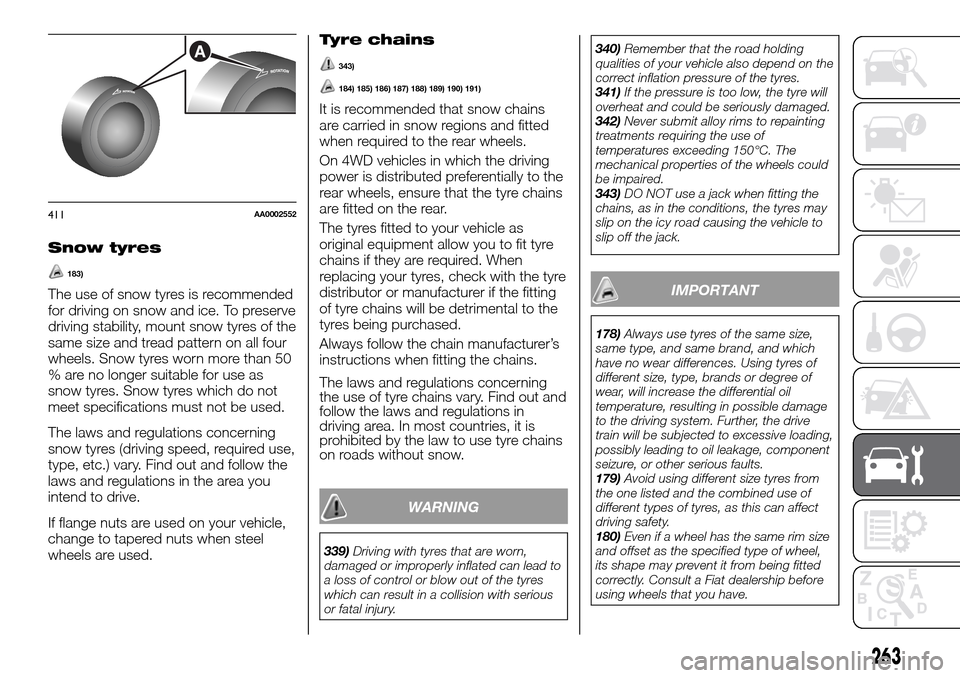
Snow tyres
183)
The use of snow tyres is recommended
for driving on snow and ice. To preserve
driving stability, mount snow tyres of the
same size and tread pattern on all four
wheels. Snow tyres worn more than 50
% are no longer suitable for use as
snow tyres. Snow tyres which do not
meet specifications must not be used.
The laws and regulations concerning
snow tyres (driving speed, required use,
type, etc.) vary. Find out and follow the
laws and regulations in the area you
intend to drive.
If flange nuts are used on your vehicle,
change to tapered nuts when steel
wheels are used.
Tyre chains
343)
184) 185) 186) 187) 188) 189) 190) 191)
It is recommended that snow chains
are carried in snow regions and fitted
when required to the rear wheels.
On 4WD vehicles in which the driving
power is distributed preferentially to the
rear wheels, ensure that the tyre chains
are fitted on the rear.
The tyres fitted to your vehicle as
original equipment allow you to fit tyre
chains if they are required. When
replacing your tyres, check with the tyre
distributor or manufacturer if the fitting
of tyre chains will be detrimental to the
tyres being purchased.
Always follow the chain manufacturer’s
instructions when fitting the chains.
The laws and regulations concerning
the use of tyre chains vary. Find out and
follow the laws and regulations in
driving area. In most countries, it is
prohibited by the law to use tyre chains
on roads without snow.
WARNING
339)Driving with tyres that are worn,
damaged or improperly inflated can lead to
a loss of control or blow out of the tyres
which can result in a collision with serious
or fatal injury.340)Remember that the road holding
qualities of your vehicle also depend on the
correct inflation pressure of the tyres.
341)If the pressure is too low, the tyre will
overheat and could be seriously damaged.
342)Never submit alloy rims to repainting
treatments requiring the use of
temperatures exceeding 150°C. The
mechanical properties of the wheels could
be impaired.
343)DO NOT use a jack when fitting the
chains, as in the conditions, the tyres may
slip on the icy road causing the vehicle to
slip off the jack.
IMPORTANT
178)Always use tyres of the same size,
same type, and same brand, and which
have no wear differences. Using tyres of
different size, type, brands or degree of
wear, will increase the differential oil
temperature, resulting in possible damage
to the driving system. Further, the drive
train will be subjected to excessive loading,
possibly leading to oil leakage, component
seizure, or other serious faults.
179)Avoid using different size tyres from
the one listed and the combined use of
different types of tyres, as this can affect
driving safety.
180)Even if a wheel has the same rim size
and offset as the specified type of wheel,
its shape may prevent it from being fitted
correctly. Consult a Fiat dealership before
using wheels that you have.
A
411AA0002552
263