2016 FIAT FULLBACK warning
[x] Cancel search: warningPage 150 of 312

Shift pointSpeed limit
Diesel-powered vehicles
4N15 4D56 without intercooler 4D56 with intercooler
2H, 4H 4L 2H, 4H 4L 2H, 4H 4L
1st gear 30 km/h 10 km/h 30 km/h 15 km/h 30 km/h 15 km/h
2nd gear 60 km/h 20 km/h 60 km/h 30 km/h 60 km/h 30 km/h
3rd gear 100 km/h 35 km/h 95 km/h 50 km/h 100 km/h 55 km/h
4th gear 140 km/h 55 km/h 130 km/h 65 km/h 150 km/h 75 km/h
5th gear 185 km/h 70 km/h — — — —
Vehicles with 5 M/T, use 5th gear whenever vehicle speed allows, for maximum fuel economy.
Vehicles with 6 M/T, use 6th gear whenever vehicle speed allows, for maximum fuel economy.
WARNING
205)Depress the clutch pedal fully to
change gear correctly. It is therefore
essential that there is nothing under the
pedals: make sure the mats are lying flat
and do not get in the way of the pedals.
IMPORTANT
87)Do not put the gearshift lever into the
reverse position while the vehicle is moving
forward. Doing so could damage the
transmission.
88)Do not rest your foot on the clutch
pedal while driving as this will cause
premature clutch wear or damage.89)Do not coast in the “N” (Neutral)
position.
90)Do not use the gearshift lever as a hand
rest, because this can result in premature
wear of the transmission shift forks.
91)Do not depress the gearshift lever
when moving it to any position other than
the “R” (Reverse) position. If you always
depress the gearshift lever when moving it,
you could unintentionally move the gearshift
lever to the “R” (Reverse) position and
cause an accident and/or a transmission
fault.
148
STARTING AND DRIVING
Page 154 of 312
perform a downshift when the selector
lever or the shift paddles is moved to
the “— (SHIFT DOWN)” position at
certain vehicle speeds.
Downward shifts are made
automatically when the vehicle slows
down. When the vehicle stops, 1st gear
is automatically selected.
When driving away on a slippery road,
push the selector lever forward into the
“+ (SHIFT UP)” position. This cause the
transmission to shift into the 2nd gear
which is better for smooth driving away
on a slippery road. Push the selector
lever to the “— (SHIFT DOWN)” side to
shift back to the 1st gear.
Sport mode indicator
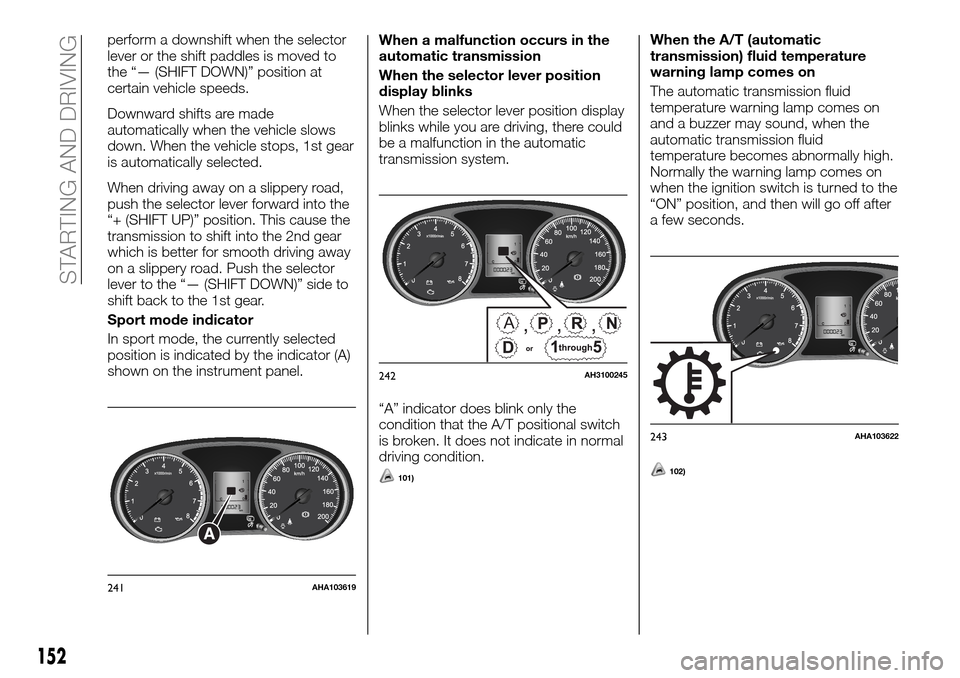
In sport mode, the currently selected
position is indicated by the indicator (A)
shown on the instrument panel.When a malfunction occurs in the
automatic transmission
When the selector lever position
display blinks
When the selector lever position display
blinks while you are driving, there could
be a malfunction in the automatic
transmission system.
“A” indicator does blink only the
condition that the A/T positional switch
is broken. It does not indicate in normal
driving condition.
101)
When the A/T (automatic
transmission) fluid temperature
warning lamp comes on
The automatic transmission fluid
temperature warning lamp comes on
and a buzzer may sound, when the
automatic transmission fluid
temperature becomes abnormally high.
Normally the warning lamp comes on
when the ignition switch is turned to the
“ON” position, and then will go off after
a few seconds.
102)
A
241AHA103619
,,,A
242AH3100245
243AHA103622
152
STARTING AND DRIVING
Page 156 of 312
100)For vehicles equipped with the shift
paddles, do not use the left- and right-hand
shift paddles at the same time. Doing so
could cause a shift of gear ratio that you do
not expect.
101)If the selector lever position display
blinks while you are driving, it is likely that a
safety device is operating because of a
malfunction in the automatic transmission.
Have the vehicle inspected by a Fiat
Dealership as soon as possible.
102)If the lamp comes on, reduce the
engine speed and stop the vehicle in a safe
area. Then set the selector lever to “P”
(PARK) position and idle the engine until the
warning lamp goes off. When the warning
lamp goes off, resume normal driving. If the
warning lamp does not go off, we
recommend you to have your vehicle
inspected.
103)Before selecting a gear with the
engine running and the vehicle stationary,
fully depress the brake pedal to prevent the
vehicle from creeping. The vehicle will begin
to move as soon as the gear is engaged,
especially when the engine speed is high,
at fast idle or with the air conditioner
operating, the brakes should only be
released when you are ready to drive away.
104)Depress the brake pedal with the right
foot at all times. Using the left foot could
cause driver movement delay in case of an
emergency.
105)To prevent sudden acceleration, never
race the engine when shifting from the “P”
(PARK) or “N” (NEUTRAL) position.
106)Operating the accelerator pedal while
the other foot is resting on the brake pedal
will affect braking efficiency and may cause
premature wear of brake pads.107)Use the selector lever in the correct
shift position in accordance with driving
conditions. Never coast downhill backward
with the selector lever in the {“D” (DRIVE) or
sports mode} or coast forward with the
selector lever in the “R” (REVERSE)
position. The engine may stop and the
unexpected increase in brake pedal effort
and steering wheel weight could lead to an
accident.
108)Do not race the engine with brake
pedal pressed when the vehicle is
stationary. This can damage the A/T. Also,
when you depress the accelerator pedal
while holding down the brake pedal with
the selector lever in the “P” (PARK), “N”
(NEUTRAL) or “D” (DRIVE) position, the
engine revolutions may not rise as high as
when performing the same operation with
the selector lever in the “N” (NEUTRAL)
position.
109)Never hold the vehicle stationary on a
hill using the accelerator pedal (without
using the brake pedal). Always apply the
parking brake and/or service brakes.EASY SELECT 4WD
(where provided)
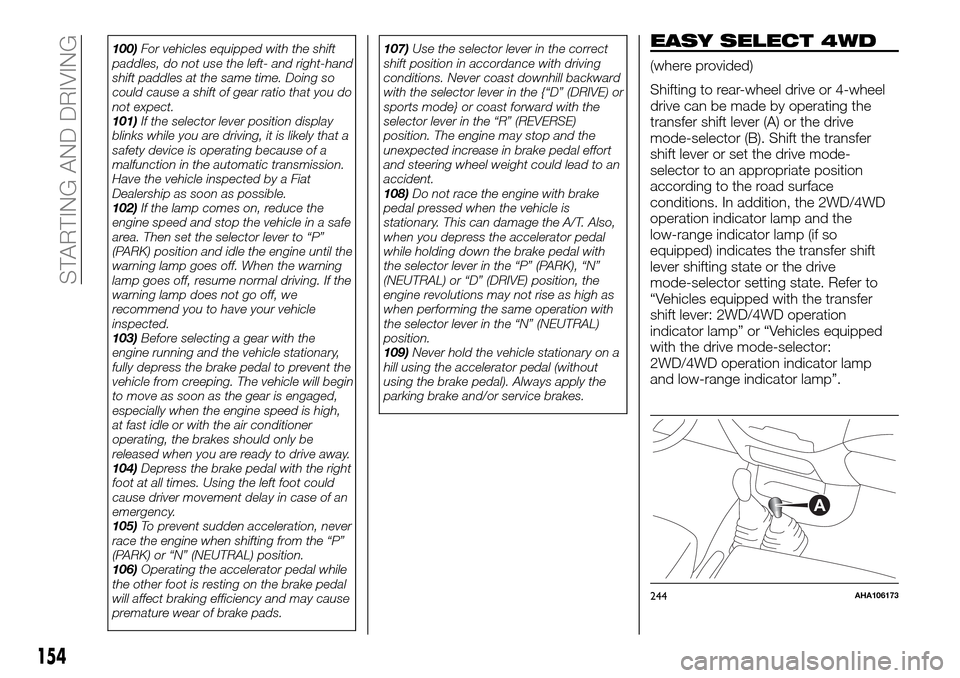
Shifting to rear-wheel drive or 4-wheel
drive can be made by operating the
transfer shift lever (A) or the drive
mode-selector (B). Shift the transfer
shift lever or set the drive mode-
selector to an appropriate position
according to the road surface
conditions. In addition, the 2WD/4WD
operation indicator lamp and the
low-range indicator lamp (if so
equipped) indicates the transfer shift
lever shifting state or the drive
mode-selector setting state. Refer to
“Vehicles equipped with the transfer
shift lever: 2WD/4WD operation
indicator lamp” or “Vehicles equipped
with the drive mode-selector:
2WD/4WD operation indicator lamp
and low-range indicator lamp”.
A
244AHA106173
154
STARTING AND DRIVING
Page 163 of 312
“4H” <-> “4L”
Selector
positionIndicator lamp
4H
and
and
and
Drive
mode
switching
in
progress
4L
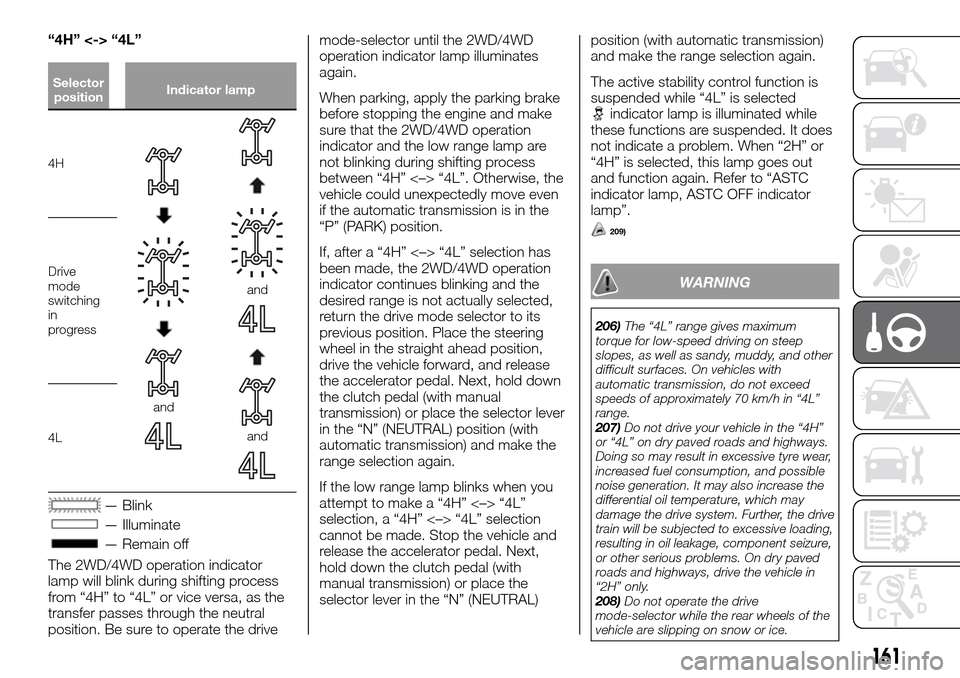
— Blink
— Illuminate
— Remain off
The 2WD/4WD operation indicator
lamp will blink during shifting process
from “4H” to “4L” or vice versa, as the
transfer passes through the neutral
position. Be sure to operate the drivemode-selector until the 2WD/4WD
operation indicator lamp illuminates
again.
When parking, apply the parking brake
before stopping the engine and make
sure that the 2WD/4WD operation
indicator and the low range lamp are
not blinking during shifting process
between “4H” <–> “4L”. Otherwise, the
vehicle could unexpectedly move even
if the automatic transmission is in the
“P” (PARK) position.
If, after a “4H” <–> “4L” selection has
been made, the 2WD/4WD operation
indicator continues blinking and the
desired range is not actually selected,
return the drive mode selector to its
previous position. Place the steering
wheel in the straight ahead position,
drive the vehicle forward, and release
the accelerator pedal. Next, hold down
the clutch pedal (with manual
transmission) or place the selector lever
in the “N” (NEUTRAL) position (with
automatic transmission) and make the
range selection again.
If the low range lamp blinks when you
attempt to make a “4H” <–> “4L”
selection, a “4H” <–> “4L” selection
cannot be made. Stop the vehicle and
release the accelerator pedal. Next,
hold down the clutch pedal (with
manual transmission) or place the
selector lever in the “N” (NEUTRAL)position (with automatic transmission)
and make the range selection again.
The active stability control function is
suspended while “4L” is selected
indicator lamp is illuminated while
these functions are suspended. It does
not indicate a problem. When “2H” or
“4H” is selected, this lamp goes out
and function again. Refer to “ASTC
indicator lamp, ASTC OFF indicator
lamp”.
209)
WARNING
206)The “4L” range gives maximum
torque for low-speed driving on steep
slopes, as well as sandy, muddy, and other
difficult surfaces. On vehicles with
automatic transmission, do not exceed
speeds of approximately 70 km/h in “4L”
range.
207)Do not drive your vehicle in the “4H”
or “4L” on dry paved roads and highways.
Doing so may result in excessive tyre wear,
increased fuel consumption, and possible
noise generation. It may also increase the
differential oil temperature, which may
damage the drive system. Further, the drive
train will be subjected to excessive loading,
resulting in oil leakage, component seizure,
or other serious problems. On dry paved
roads and highways, drive the vehicle in
“2H” only.
208)Do not operate the drive
mode-selector while the rear wheels of the
vehicle are slipping on snow or ice.
161
Page 168 of 312

WARNING
210)The “4LLc” range gives maximum
torque for low-speed driving on steep
slopes, as well as sandy, muddy, and other
difficult surfaces. On vehicles with
automatic transmission, do not exceed
speeds of approximately 70 km/h in “4LLc”
range.
211)Do not drive your vehicle in the
“4HLc” or “4LLc” position on dry paved
roads and highways. Doing so may result
in excessive tyre wear, increased fuel
consumption, and possible noise
generation. It may also increase the
differential oil temperature, which may
damage the drive system. Further, the drive
train will be subjected to excessive loading,
resulting in oil leakage, component seizure,
or other serious problems. On dry paved
roads and highways, drive the vehicle in
“2H” or “4H” only.212)Do not operate the drive
mode-selector while the rear wheels of the
vehicle are slipping on snow or ice.
213)If a problem is detected in the transfer
system, a safety device will activate. The
front and rear wheel lamps will go out, the
centre differential lock lamp will blink rapidly
(twice per second), and transfer shifting will
become impossible. Park your vehicle in a
safe place, turn off the engine for a few
moments. Restart the engine. The lamp
should resume normal operation. If the
lamps continue to blink, have the vehicle
checked by a Fiat Dealership as soon as
possible.
REAR DIFFERENTIAL
LOCK
(where provided)
If one wheel starts to spin freely and the
vehicle becomes stuck and cannot be
freed even using 4-wheel drive, the rear
differential lock switch (A) can be used
to activate the rear differential lock for
extra traction.
Operating the rear differential lock
1. Move the drive mode-selector to
“4L” or “4H” position (Easy select
4WD), “4LLc” or “4HLc” position (Super
select 4WD II).
2. To activate the rear differential lock,
press the rear differential lock switch (1).
3. To deactivate the rear differential
lock, press the rear differential lock
switch (2).
253AHZ101128
254AHA106069
166
STARTING AND DRIVING
Page 169 of 312

110)
The rear differential lock does not
operate when the drive mode-selector
is in “2H” position (Easy select 4WD),
“2H” or “4H” position (Super select
4WD II).
When the rear differential is locked with
the drive mode-selector in “4L” or “4H”
position (Easy select 4WD), “4LLc” or
“4HLc” position (Super select 4WD II)
changing the drive mode-selector to
“2H” position (Easy select 4WD), “2H”
or “4H” position (Super select 4WD II)
makes the rear differential unlock
automatically.Rear differential lock indicator lamp
When the ignition switch is turned to
the “ON” position or the operation
mode is put in ON, the rear differential
lock indicator lamp (A) in the meter
cluster illuminates for a few seconds
then indicates the rear differential lock’s
operating status (activated or
deactivated).
The 2WD/4WD operation indicator
lamp also illuminates for a few seconds
when the ignition switch is turned to the
“ON” position or the operation mode is
put in ON. Refer to “2WD/4WD
operation indicator lamp”. The status of
the rear differential lock (resulting from
depression of the rear differential lock
switch) is shown by blinking or steady
illumination of the rear differential lock
indicator lamp.
The operation state
of rear differential
lockRear differential
lock indicator
lamp
Easy select
4WD
Rear differential lock
deactivated
Switching in progress
Rear differential lock
activated
Blink
Illuminate
Remain off
The indicator lamp blinks while the rear
differential lock is being switched
between its activated and deactivated
conditions. When the switching
operation is complete, the indicator
lamp is either illuminated steadily or not
illuminated.
The ASTC and ABS functions are
suspended while the rear differential
lock is activated. ASTC indicator lamp,
ASTC OFF indicator lamp and ABS
warning lamp are illuminated while
these functions are suspended. It does
not indicate a problem. When the rear
255AHA106072R/D
LOCK
A
256AHA104980
167
Page 170 of 312

differential lock is disengaged, these
lamps go out and function again. Refer
to “ABS warning lamp”, “ASTC
indicator lamp, ASTC OFF indicator
lamp”.
If the indicator lamp continues blinking
after the switch has been pressed to
deactivate the rear differential lock, hold
the steering wheel in the straight ahead
position then slowly depress and
release the accelerator pedal several
times.
If the indicator lamp continues blinking
after the switch has been pressed to
activate the rear differential lock, bear in
mind the following instructions:
If the vehicle speed is 12 km/h or
higher, decelerate to a speed of
2.5 km/h or lower. The indicator lamp
will illuminate steadily and the rear
differential lock will be activated.
If the vehicle speed is 12 km/h or lower,
turn the steering wheel from side to
side until the indicator lamp illuminates
steadily. If the vehicle is stuck in soft
ground, make sure the area around the
vehicle is clear then repeatedly attempt
to drive forward and backward. The
indicator lamp will illuminate steadily
and the rear differential lock will be
activated.
111)
Examples of effective use of the
rear differential lock
112)
When one of the wheels has fallen
in a ditch
When driving on rocky roads
When the vehicle is unable to move
because one of the wheels is
suspended in the air.When getting out of snow
When the vehicle is unable to get going
because one of the wheels is on the
snow and the other on a paved road.
257AHA105206
258AHA105219
259AHA105222
168
STARTING AND DRIVING
Page 171 of 312

Examples of incorrect use of the
rear differential lock
214)
215)
216) 217)
WARNING
214)If the “4L” or “4H” position (Easy
select 4WD), “4LLc” or “4HLc” position
(Super select 4WD II) is selected along with
the rear differential lock, the following
phenomena appear and it is very
dangerous. Please be sure to release the
rear differential lock on normal roads. If the
rear differential lock is used by mistake
when driving on a paved road: With the
rear differential lock on, the power to drive
the vehicle straight ahead becomes very
strong, which may make it difficult to turn
the steering wheel.
215)If the rear differential lock is used by
mistake when turning a curve or making a
right or left turn at a crossing or the like:
The vehicle is unable to make a turn and
may go straight ahead.216)If the rear differential lock is used by
mistake except when making an
emergency escape on snow or frozen
road: It becomes difficult to make a steady
turn.
217)In the case where the condition of the
road is different for the right tyre to drive
from the left tyre (such as one tyre on a
paved road and the other on ice), direction
of the vehicle may change abruptly when
engine braking or accelerating. Do not use
the rear differential lock except when
making an emergency escape on a snow
or frozen road, but drive with 4WD.
IMPORTANT
110)Operate the rear differential switch
after the wheels are stopped. Operating the
switch with the wheels turning may cause
the vehicle to dart in unexpected directions.
111)If a problem is detected in the rear
differential lock system, a safety device will
activate. The rear differential lock indicator
lamp will blink rapidly (twice per second),
and the rear differential lock will deactivate.
Park your vehicle in a safe place, turn off
the engine for a few moments. Restart the
engine. It is safe to continue driving if the
lamps resume normal operation. If the rear
differential lock indicator lamp blinks when
the rear differential lock is reactivated, have
the vehicle checked by a Fiat Dealership as
soon as possible.
260AHA105235
261AHA105248
262AHA105251
169