2016 FIAT FULLBACK tow
[x] Cancel search: towPage 74 of 312

If the DPF warning lamp flashes
during vehicle operation
Flashing of the DPF warning lamp
indicates an abnormality in the DPF
system. Have the system inspected by
a Fiat Dealership.
WARNING
72)The diesel particulate filter (DPF)
reaches high temperatures during normal
operation. Do not park the vehicle on
flammable material (grass, dry leaves, pine
needles etc.): fire hazard.
IMPORTANT
22)Do not use any type of fuel or engine oil
that is not specified for your vehicle. Also,
do not use any moisture-removing agent or
other fuel additive. Such substances could
have a detrimental effect on the DPF. Refer
to “Fuel selection” and “Engine oil”.
23)Vehicle travel speed should always be
adapted to the traffic and weather
conditions, and must always comply with
traffic regulations. The engine can be
stopped even if the DPF symbol is on:
however, repeated interruptions of the
regeneration process could cause
premature deterioration of the engine oil.
For this reason it is always advisable to wait
for the symbol to go off before turning off
the engine, following the instructions
above. Do not complete the DPF
regeneration process when the vehicle is
stopped.24)Continuing to drive with the DPF
warning lamp flashing could result in engine
trouble and DPF damage.
ENGINE
COMPARTMENT
BONNET
To open
1. Pull the release lever towards you to
unlock the bonnet.
2. Raise the bonnet while pressing the
safety lock.
128AHA102609
129AHA102452
72
GETTING TO KNOW YOUR VEHICLE
Page 76 of 312

CARGO AREA
CARGO LOADS
77) 78)
Cargo loads precautions
When loading luggage, be careful to the
following.
Stow cargo and luggage in the cargo
area whenever possible.
Distribute cargo or luggage evenly
not to be unbalanced in weight of a
load.
Do not place cargo or luggage on
the instrument panel. Also, do not stack
up cargo or luggage on the front
passenger’s seat or the rear seat.
Having the driver’s vision blocked, and
your cargo being thrown inside the
cabin if you suddenly have to brake can
cause a serious accident or injury.
WARNING
77)If a vehicle is parked on a very steep
gradient or with a side gradient, opening
the rear door or side door could cause any
unsecured items to emerge suddenly.
78)If you wish to carry a reserve of petrol
in a can, observe the legal restrictions and
only use a can that is type-approved and
properly secured to the load anchorage
eyebolts. Anyway, by doing so, you
increase the risk of fire in the event of an
accident with your vehicle.
INTERIOR FEATURES
SUN VISORS
A — To eliminate front glare
B — To eliminate side glareCard holder
Cards can be slipped into the holder (A)
on the back of the sun visor.
AB
132AHA105958
A
133AHA106548
A
134AHA106551
74
GETTING TO KNOW YOUR VEHICLE
Page 99 of 312
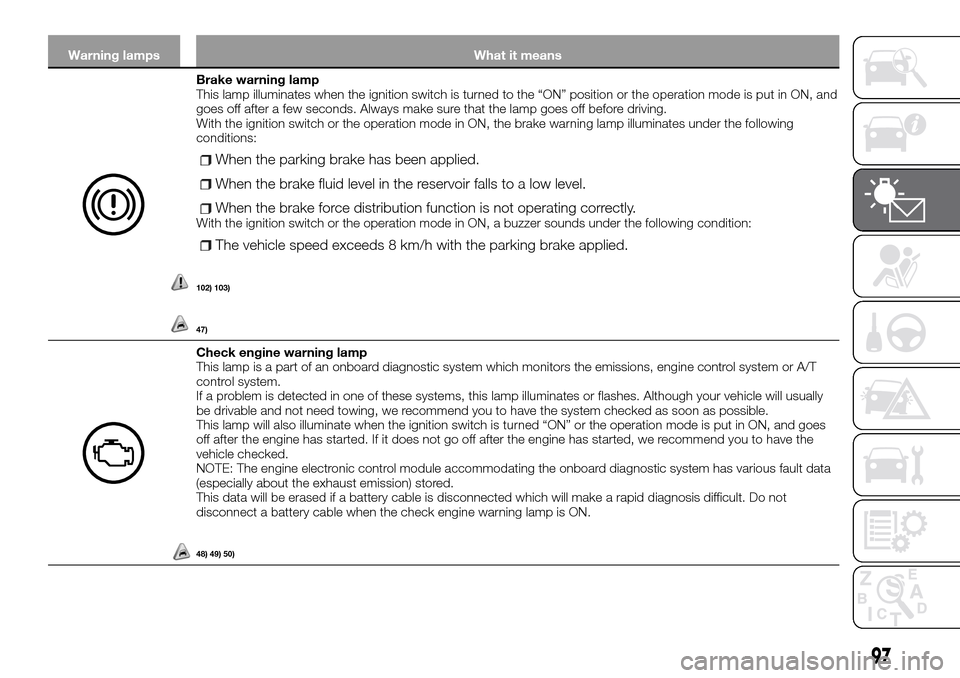
Warning lamps What it means
Brake warning lamp
This lamp illuminates when the ignition switch is turned to the “ON” position or the operation mode is put in ON, and
goes off after a few seconds. Always make sure that the lamp goes off before driving.
With the ignition switch or the operation mode in ON, the brake warning lamp illuminates under the following
conditions:
When the parking brake has been applied.
When the brake fluid level in the reservoir falls to a low level.
When the brake force distribution function is not operating correctly.With the ignition switch or the operation mode in ON, a buzzer sounds under the following condition:
The vehicle speed exceeds 8 km/h with the parking brake applied.
102) 103)
47)
Check engine warning lamp
This lamp is a part of an onboard diagnostic system which monitors the emissions, engine control system or A/T
control system.
If a problem is detected in one of these systems, this lamp illuminates or flashes. Although your vehicle will usually
be drivable and not need towing, we recommend you to have the system checked as soon as possible.
This lamp will also illuminate when the ignition switch is turned “ON” or the operation mode is put in ON, and goes
off after the engine has started. If it does not go off after the engine has started, we recommend you to have the
vehicle checked.
NOTE: The engine electronic control module accommodating the onboard diagnostic system has various fault data
(especially about the exhaust emission) stored.
This data will be erased if a battery cable is disconnected which will make a rapid diagnosis difficult. Do not
disconnect a battery cable when the check engine warning lamp is ON.
48) 49) 50)
97
Page 103 of 312

47)If the vehicle is towed with the ignition
switch in the “ON” position or the operation
mode in ON and only the front wheels or
only the rear wheels raised off the ground,
the ASTC may operate, resulting in an
accident. When towing the vehicle with the
front wheels raised, keep the ignition switch
in the “LOCK” or “ACC” position or the
operation mode in ACC or OFF. When
towing the vehicle with the rear wheels
raised, keep the ignition switch in the
“ACC” position or the operation mode in
ACC. Refer to “Towing”.
48)Prolonged driving with this lamp on
may cause further damage to the emission
control system. It could also affect fuel
economy and drivability.
49)If the lamp does not illuminate when the
ignition switch is turned to the “ON”
position or the operation mode is put in
ON, we recommend you to have the
system checked.
50)If the lamp illuminates while the engine
is running, avoid driving at high speeds and
have the system inspected by a Fiat
Dealership as soon as possible. Accelerator
pedal and brake pedal response may be
negatively influenced under these
conditions.
51)If it illuminates while the engine is
running, there is a problem in the charging
system. Immediately park your vehicle in a
safe place and we recommend you to have
it checked.
52)If this lamp illuminates when the engine
oil level is not low, have it inspected.
53)This warning lamp does not indicate
the amount of oil in the crankcase. This
must be determined by checking the oil
level on the dipstick, while the engine is
switched off.54)If you continue driving with low engine
oil level or with this warning lamp
illuminated, engine seizure may occur.
55)Before moving your vehicle, check that
the warning lamp is OFF.
56)If any of the following conditions occur,
there may be a problem with the SRS
airbags and/or seat belt pre-tensioners,
and they may not function properly in a
collision or may suddenly activate without a
collision: 1 – Even when the ignition switch
or the operation mode is in ON, the SRS
warning lamp does not come on or it
remains on. 2 – The SRS warning lamp
comes on while driving.
57)The SRS airbags and seat belt
pre-tensioners are designed to help reduce
the risk of serious injury or death in certain
collisions. If either of the above conditions
occurs, immediately have your vehicle
checked by a Fiat Dealership.
58)Any of the following indicates that the
ABS is not functioning and only the
standard brake system is working. (The
standard brake system is functioning
normally.) If this happens, take your vehicle
to a Fiat Dealership.
101
Page 105 of 312

SEAT BELTS
To protect you and your passengers in
the event of an accident, it is the most
important that the seat belts be worn
correctly while driving.
The driver’s and front passenger’s seat
belt equipped with an airbag each have
a pre-tensioner system and the rear
seat belts equipped with a dual stage
airbag system each have a
pre-tensioner system. These belts are
used the same way as a conventional
seat belt.
Refer to “Seat belt pre-tensioner
system and force limiter system”.
104) 105) 106) 107) 108) 109) 110) 111) 112) 113)
3-point type seat belt (with
emergency locking mechanism)
This type of belt requires no length
adjustment. Once worn, the belt
adjusts itself to the movement of
wearer, but in the event of a sudden or
strong shock, the belt automatically
locks to hold the wearer’s body.
NOTE You can check if the belt locks
by pulling it forward quickly.To fasten
1. Pull the seat belt out slowly while
holding the latch plate.
NOTE When the seat belts cannot be
pulled out in a locked condition, pull the
belts once forcefully and then return
them. After that, pull the belts out
slowly once again.
2. Insert the latch plate into the buckle
until a “click” is heard.
114)
59) 60)
To unfasten
Hold the latch plate and push the
button on the buckle.NOTE As the belt retracts
automatically, keep the latch plate held
while retracting so that the belt stows
slowly. Failure to do this could damage
the vehicle.
113)
SEAT BELT INSPECTION
Check the belts for cuts, worn or frayed
webbing and for cracked or deformed
metallic parts. Replace the belt
assembly if defective.
A dirty belt should be cleaned with
neutral detergent in warm water. After
rinsing in water, let it dry in the shade.
Do not attempt to bleach or re-dye the
belts because this affects their
characteristics.
115) 116) 117)
61) 62)
180AA0008466
181AA0008293
103
Page 117 of 312

Child restraint
anchorage points
(Double cab)
(where provided)
When fitting a child restraint, always
follow the manufacturer’s instructions
using the approved anchorage points
shown and install the child restraint
fitting package.
Anchorage locations
Two child restraint anchorage points are
built into the vehicle and are located on
the vertical panel behind the rear
seatback.
68)
Tether anchor strap installation
142)
1 — Remove the head restraint from
the location in which you wish to install
a child restraint.
2 — Drop the child restraint’s tether
strap (A) down the back of the rear
seatback.
3 — Tip the armrest forward. Open the
fastener (B) that’s located in the space
where the armrest was stowed.4 — Open the inner cover.
5 — Put your hand in the opening of
the fastener, attach the tether strap’s
hook (C) to the tether anchorage (D),
and securely tighten the tether strap.
189AHA104759
A
190AHA104762
B
191AHA104775
192AHA106157
115
Page 133 of 312

198)Do not turn the ignition switch to the
“LOCK” or “ACC” position or the operation
mode in ACC or OFF while the hill start
assist is operating. The hill start assist
could stop operating, which could result in
an accident.
IMPORTANT
69)Do not over-rely on the hill start assist
to prevent backwards movement of the
vehicle. Under certain circumstances, even
when hill start assist is activated, the
vehicle may move backwards if the brake
pedal is not sufficiently depressed, if the
vehicle is heavily loaded, if the road is very
steep or slippery or if the vehicle tows a
trailer, etc.
70)The hill start assist is not designed to
keep the vehicle stopped in place on uphill
slopes for more than 2 seconds.
71)If the warning is turn on, the hill start
assist will not operate. Start off carefully.
72)Park your vehicle in a safe place and
stop the engine. Restart the engine and
check whether the warning indicator went
out, in which case the hill start assist is
again working normally. If they warning
remains displayed or reappear frequently, it
is not necessary to stop the vehicle
immediately, but the vehicle should be
inspected by a Fiat Dealership.
73)Do not stop the engine while the
vehicle is moving. Stopping the engine
would make the steering wheel extremely
hard to turn, possibly resulting in an
accident.74)Do not leave the steering wheel turned
all the way in one direction. This can cause
damage to the power steering system.
131
Page 137 of 312

RUNNING-IN RECOMMENDATIONS
During the running-in period for the first 1,000 km, it is advisable to drive your new vehicle using the following precautions as a
guideline to aid long life as well as future economy and performance.
Do not race the engine at high speeds.
Avoid rapid starting, accelerating, braking and prolonged high-speed running.
Keep to the running-in speed limit shown below. Please note that the legal speed limits displayed must be adhered to.
Do not exceed loading limits.
Refrain from towing a trailer.
Vehicles with M/T
2WD Models
Shift point Speed limit
Petrol powered
vehiclesDiesel powered vehicles
4N15 4D56 Without intercooler 4D56 With intercooler
1st gear 25 km/h 20 km/h 20 km/h 20 km/h
2nd gear 50 km/h 40 km/h 40 km/h 40 km/h
3rd gear 75 km/h 65 km/h 65 km/h 65 km/h
4th gear 105 km/h 95 km/h 90 km/h 95 km/h
5th gear 125 km/h 120 km/h 105 km/h 120 km/h
6th gear — 145 km/h — —
135