2016 FIAT FULLBACK change wheel
[x] Cancel search: change wheelPage 199 of 312

8. Turn the wheel nuts clockwise by
hand to initially tighten them.
Type 1:On vehicles with steel
wheelsTemporarily tighten the wheel
nuts by hand until the tapered parts of
the wheel nuts make light contact with
the seats of the wheel holes and the
wheel is not loose.Type 2:On vehicles with aluminium
wheelsTemporarily tighten the wheel
nuts by hand until the flange parts of
the wheel nuts make light contact with
the wheel and the wheel is not loose.
135)
NOTE If all 4 aluminium wheels are
changed to steel wheels. e. g. when
fitting winter tyres, use tapered nuts.
9. Put the notch (K) provided on the
jack handle end on the valve (L) of the
jack. Using the jack handle, turn the
release valve anticlockwise slowly to
lower the vehicle until the tyre touches
the ground.
272)
10. Tighten the nuts crisscross in 2 or
3 steps until each nut has been
tightened securely.
Tightening torque
Steel wheel: 137 to 157 Nm Aluminium
wheel: 118 to 137 Nm
(Achieved by applying a force at the
end of the wheel nut wrench supplied
with the vehicle. Steel wheel: 510 to
580 N; Aluminium wheel: 440 to 500 N)
GHI
326AHA105772
J
327AHA105785
328AA0027931
329AHA102364
L
K
330AHA105798
197
Page 201 of 312

NOTE Confirm that the hanger disc is
securely fitted in the wheel disc hole
when the wheel is just lifted off the
ground.
3. After winding up the spare wheel
sufficiently, make sure it is not loose (the
tightening torque should be
approximately 40 Nm (achieved by
applying a force of 200 N at the end of
the wheel nut wrench) then withdraw
the jack handle, taking care not to turn
it in the reverse direction.
278) 279) 280)
4. Have your damaged tyre repaired as
soon as possible.
To store the tools, jack and jack
handle
Reverse the removing procedure when
storing the jack, jack handle and wheel
nut wrench (refer to “Tools, jack and
jack handle”).
WARNING
257)Use your hazard lights, warning
triangle, etc. to show that your vehicle is
stationary according to the regulations in
force. Passengers should get out of the
vehicle, particularly if it is heavily loaded,
and wait for the wheel to be changed away
from the traffic. Apply the handbrake. in the
event of a wheel change on a slope or on
unsurfaced roads, put any object as stop
under the wheels.
258)Be sure to apply chocks or blocks to
the correct tyre when jacking up the
vehicle. If the vehicle moves while jacked
up, the jack could slip out of position,
leading to an accident.
259)The pressure should be periodically
checked and maintained at the specified
pressure while the tyre is stowed. Driving
with an insufficient tyre pressure can lead
to an accident. If you have no choice but to
drive with an insufficient tyre pressure,
keep your speed down and inflate the tyre
to the correct pressure as soon as
possible. (Refer to “Tyre inflation
pressures”).
260)Set the jack only at the positions
shown here. If the jack is set at a wrong
position, it could dent your vehicle or the
jack might fall over and cause personal
injury.
261)Do not use the jack on a tilted or soft
surface. Otherwise, the jack might slip and
cause personal injury. Always use the jack
on a flat, hard surface. Before setting the
jack, make sure there are no sand or
pebbles under the jack base.262)Stop jacking up the vehicle as soon
as the tyre is raised off the ground. It is
dangerous to raise the vehicle any higher.
Do not get under your vehicle while using
the jack. Do not bump the raised vehicle or
leave it sitting on the jack for a long time.
Both are very dangerous. Do not use a jack
except the one that came with your
vehicle. The jack should not be used for
any purpose other than to change a tyre.
No one should be in your vehicle when
using the jack. Do not start or run the
engine while your vehicle is on the jack. Do
not turn the raised wheel. The tyres still on
the ground could turn and make your
vehicle fall off the jack.
263)Do not get under your vehicle while
using the jack.
264)Do not bump the raised vehicle or
leave it sitting on the jack for a long time.
Both are very dangerous.
265)Do not use a jack except the one that
came with your vehicle.
266)The jack should not be used for any
purpose other than to change a tyre.
267)No one should be in your vehicle
when using the jack.
268)Do not start or run the engine while
your vehicle is on the jack.
269)Do not turn the raised wheel. The
tyres still on the ground could turn and
make your vehicle fall off the jack.
270)Handle the wheel carefully when
changing the tyre, to avoid scratching the
wheel surface.
B
336AHA102319
199
Page 202 of 312

271)Mount the spare wheel with the valve
stem (J) facing outboard. If you cannot see
the valve stem (J), you have installed the
wheel backwards. Operating the vehicle
with the spare wheel installed backwards
can cause vehicle damage and result in an
accident.
272)Be sure to open the release valve
slowly. If it is opened quickly, the vehicle will
drop abruptly and the jack may come out
of position, causing a serious accident.
273)Never use your foot or a pipe
extension for extra force in the wheel nut
wrench. If you do so, you will tighten the
nut too much.
274)The tyre pressure should be
periodically checked and maintained at the
specified pressure while the tyre is stowed.
275)After changing the tyre and driving the
vehicle about 1,000 km, retighten the
wheel nuts to make sure that they have not
come loose.
276)If the steering wheel vibrates when
driving after changing the tyre, we
recommend you to have the tyres checked
for balance.
277)Do not mix one type of tyre with
another or use a different size from the one
listed. This would cause early wear and
poor handling.
278)The spare wheel should always be
securely in position. If a flat tyre is
changed, put the flat tyre in the spare
wheel mounting position with the wheel
outer surface upward, and use the wheel
nut wrench to secure it firmly.279)Never tamper with the inflation valve.
Never introduce tools of any kind between
rim and tyre. Check tyre and spare wheel
pressure regularly, referring to the values
shown in the "Technical specifications"
section.
280)The moving components of the jack
(screw and joints) can also cause injuries:
do not touch them. If you come into
contact with lubricating grease, clean
yourself thoroughly.
IMPORTANT
132)Avoid using different size tyres from
the one listed and the combined use of
different types of tyres, as this can affect
driving safety.
133)Even if a wheel has the same rim size
and offset as the specified type of wheel,
its shape may prevent it from being fitted
correctly. Consult an authorised Fiat
Dealership before using wheels that you
have.
134)When installing or removing the spare
wheel, please observe the followings. If you
do not follow them, it could result in break
the spare wheel carrier. Do not use the
power tool. Use the wheel nut wrench
stowed on the vehicle. Do not apply a force
of 400 N or more at the end of the wheel
nut wrench.
135)Never apply oil to either the wheel
bolts or the nuts or they will tighten too
much.
136)If the release valve is loosened too
much (2 or more turns) in the anticlockwise
direction, the jack’s oil will leak and the jack
cannot be used.137)Close the release valve slowly when
lowering the vehicle, or the valve may be
damaged.
200
IN CASE OF EMERGENCY
Page 229 of 312

Thousand of miles9 182736455463728190
Thousand of kilometers15 30 45 60 75 90 105 120 135 150
Years12345678910
Visually inspect conditions and wear of front
disc brake pads and operation of pad wear
indicator
●●●●●●●●●●
Visually inspect condition and wear of the
rear drum brake lining●●●●●●●●●●
Check the front and rear wheel bearing
clearances●●●
Visually check for any fluid leaks from the
automatic transmission (if leaks are found,
check the oil level)
●●●●● ●●●●
Change the automatic transmission oil (4)●
Visually check for any fluid leaks from the
manual transmission (if leaks are found,
check the oil level)
●●●●● ●●●●
Change the manual transmission oil (8)●
Visually inspect the integrity of the
suspension system components and their
fixings
●●●●●●●●●●
Check handbrake lever travel and adjust, if
necessary●●●●●●●●●●
(4) To be done only in case of heavy use, only on a mileage basis, every 100,000 km.
(8)To be done only on a mileage basis.
227
Page 234 of 312

Thousands of miles6 121825313743505662
Thousands of kilometers or10 20 30 40 50 60 70 80 90 100
Years12345678910
Check cleanliness of bonnet and luggage
compartment locks, cleanliness and
lubrication of linkage
●●●●●
Visually inspect conditions and wear of front
disc brake pads and operation of pad wear
indicator
●●●●●●●●●●
Visually inspect condition and wear of the
rear drum brake lining●●●●●●●●●●
Check the front and rear wheel bearing
clearances●●●
Visually check for any fluid leaks from the
automatic transmission (if leaks are found,
check the oil level)
●●●●●●●●●
Change the automatic transmission oil (14)●
Visually check for any fluid leaks from the
manual transmission (if leaks are found,
check the oil level)
●●●●●●●●●
Change the manual transmission oil (8)●
Visually inspect the integrity of the
suspension system components and their
fixings
●●●●●●●●●●
(14) To be done only in case of heavy use, only on a mileage basis.
(8) to be done only on a mileage basis, independently of the time.
232
SERVICING AND MAINTENANCE
Page 239 of 312

Thousands of miles6 121825313743505662
Thousands of kilometers or10 20 30 40 50 60 70 80 90 100
Years12345678910
Check operation of the windscreen
wiper/washer system and adjust jets, if
necessary
●●●●●
Check cleanliness of bonnet and luggage
compartment locks, cleanliness and
lubrication of linkage
●●●●●
Visually inspect conditions and wear of front
disc brake pads and operation of pad wear
indicator
●●●●●●●●●●
Visually inspect condition and wear of the
rear drum brake lining●●●●●●●●●●
Check the front and rear wheel bearing
clearances●●●
Visually check for any fluid leaks from the
automatic transmission (if leaks are found,
check the oil level)
●●●●●●●●●
Change the automatic transmission oil (14)●
Visually check for any fluid leaks from the
manual transmission (if leaks are found,
check the oil level)
●●●●●●●●●
Change the manual transmission oil (8)●
(14) To be done only in case of heavy use, only on a mileage basis.
(8) to be done only on a mileage basis, independently of the time.
237
Page 265 of 312
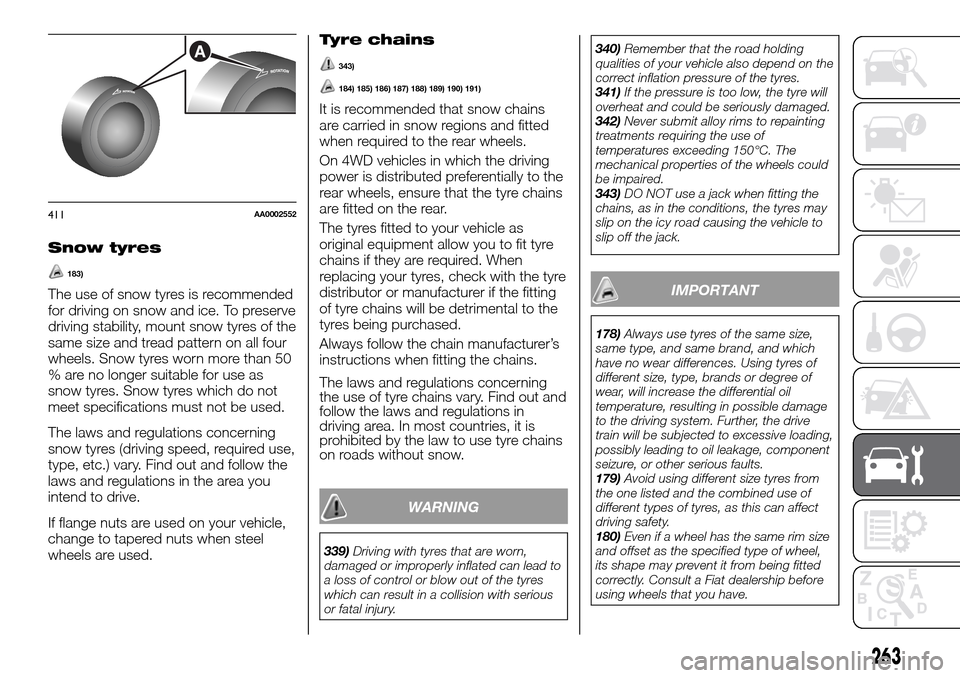
Snow tyres
183)
The use of snow tyres is recommended
for driving on snow and ice. To preserve
driving stability, mount snow tyres of the
same size and tread pattern on all four
wheels. Snow tyres worn more than 50
% are no longer suitable for use as
snow tyres. Snow tyres which do not
meet specifications must not be used.
The laws and regulations concerning
snow tyres (driving speed, required use,
type, etc.) vary. Find out and follow the
laws and regulations in the area you
intend to drive.
If flange nuts are used on your vehicle,
change to tapered nuts when steel
wheels are used.
Tyre chains
343)
184) 185) 186) 187) 188) 189) 190) 191)
It is recommended that snow chains
are carried in snow regions and fitted
when required to the rear wheels.
On 4WD vehicles in which the driving
power is distributed preferentially to the
rear wheels, ensure that the tyre chains
are fitted on the rear.
The tyres fitted to your vehicle as
original equipment allow you to fit tyre
chains if they are required. When
replacing your tyres, check with the tyre
distributor or manufacturer if the fitting
of tyre chains will be detrimental to the
tyres being purchased.
Always follow the chain manufacturer’s
instructions when fitting the chains.
The laws and regulations concerning
the use of tyre chains vary. Find out and
follow the laws and regulations in
driving area. In most countries, it is
prohibited by the law to use tyre chains
on roads without snow.
WARNING
339)Driving with tyres that are worn,
damaged or improperly inflated can lead to
a loss of control or blow out of the tyres
which can result in a collision with serious
or fatal injury.340)Remember that the road holding
qualities of your vehicle also depend on the
correct inflation pressure of the tyres.
341)If the pressure is too low, the tyre will
overheat and could be seriously damaged.
342)Never submit alloy rims to repainting
treatments requiring the use of
temperatures exceeding 150°C. The
mechanical properties of the wheels could
be impaired.
343)DO NOT use a jack when fitting the
chains, as in the conditions, the tyres may
slip on the icy road causing the vehicle to
slip off the jack.
IMPORTANT
178)Always use tyres of the same size,
same type, and same brand, and which
have no wear differences. Using tyres of
different size, type, brands or degree of
wear, will increase the differential oil
temperature, resulting in possible damage
to the driving system. Further, the drive
train will be subjected to excessive loading,
possibly leading to oil leakage, component
seizure, or other serious faults.
179)Avoid using different size tyres from
the one listed and the combined use of
different types of tyres, as this can affect
driving safety.
180)Even if a wheel has the same rim size
and offset as the specified type of wheel,
its shape may prevent it from being fitted
correctly. Consult a Fiat dealership before
using wheels that you have.
A
411AA0002552
263
Page 309 of 312

INDEX
4Wheel drive operation........170
Accessory socket............76
Active safety systems..........126
Air conditioning system.........52
Air purifier..................67
Ashtray....................75
Assist grip..................80
Automatic climate control air
conditioner................59
Automatic transmission.........149
Auxiliary driving system.........130
Battery..................252
Bleeding the fuel system........188
Bonnet....................72
Bottle holder................80
Brake fluid.................249
Cargo area.................74
Cargo loads.................74
Catalytic converter.........71,245
Central door locks.............28
Checking levels..............241
Child restraint...............107
Child restraint system..........110
Child-protection rear doors (Double
cab)....................29
Cigarette lighter..............76
.257.256
Clutch fluid................250
Coat hook..................80
Combination headlamps and
dipper switch..............40
Convenient hook.............80
Cooler Manual air conditioning.....55
Cruise control...............176
Cup holder.................79
Demanding vehicle use........240
Diesel particulate filter..........71
Digital clock.................77
Doors.....................26
Driving, alcohol and drugs.......134
Easy select 4WD............154
Economical driving...........133
Electric window control.........68
Electrical system.............289
Electronic immobilizer..........13
Emergency starting...........185
Engine compartment...........72
Engine coolant..............247
Engine oil.................245
Engine overheating...........187
Engine switch...............24
External Lights...............40
Fluids and Lubricants.........300Fog lamp switch..............44
Force limiter................106
Front seats.................31
Fuel selection................81
Fuses....................205
Fusible links................205
General maintenance.........255
Graphical index...............9
Handling of 4 wheel drive vehicles.173
Hazard warning flasher switch.....44
Head restraints...............34
Headlamp levelling switch........42
Heater Manual air conditioning.....55
How to change a tyre..........194
If the vehicle breaks down.......185
Ignition switch...............23
Important operation tips for the air
conditioning...............66
Inside rearview mirror...........37
Installing a child restraint system to
lower anchorage...........116
Instruments.................86
Interior features..............74
Interior lamps................47
ISOFIX positions.............110
Key number tag..............13
Keyless Entry System...........14
Keys.....................13
Cleaning the exterior of your vehicleCleaning the interior of your vehicle