2016 FIAT FREEMONT Media
[x] Cancel search: MediaPage 193 of 412

Compressed Audio Files (MP3, WMA AND
ACC)
The DVD player is capable of playing MP3 (MPEG-1
Audio Layer 3 with data bitrates from 32 to 320 kbit/s,
including variable bit rates), WMA (All Standard 8.x,
9.x Windows Media Audio) and ACC (MPEG-4 audio;
sampling frequencies 8 to 48 kHz; mono and stereo)
audio files with the from a CD Data disc (usually a
CD-R or CD-RW).
• The DVD player always uses the file extension todetermine the audio format, so MP3 files must always
end with the extension ".mp3" or ".MP3", WMA files
must always end with the extension ".wma" or
"WMA", and ACC files must end with the extensions
“.acc” or “.m4a”. To prevent incorrect playback, do
not use these extensions for any other types of files.
• For MP3 files, ID3 tag data v1, v1.1, v2 and v2.4 (such as artist name, track title, album, etc.) are supported.
• Any file that is copy protected (such as those down- loaded from many online music stores) will not play.
The DVD player will automatically skip the file and
begin playing the next available file.
• Other compression formats such as AAC, MP3 Pro, Ogg Vorbis, and ATRAC3 will not play. The DVD
player will automatically skip the file and begin playing
the next available file. •If you are creating your own files, the recommended
fixed bit rate for MP3 files is between 96 and 192Kbps
and the recommended fixed bit rate for WMA files is
between 64 and 192Kbps. Variable bit rates are also
supported. For both formats, the recommended
sample rate is either 44.1kHz or 48kHz.
• To change the current file, use the remote control’s
or DVD player’s ▴button to advance to the next file,
or the ▾button to return to the start of the current
or previous file.
• To change the current directory, use the remote control’s PROG UP and Down buttons or Rewind/
skip back and fast fwd/skip forward.
Disc Errors
If the DVD player is unable to read the disc, a "Disc
Error" message is displayed on the Radio display and
the disc is automatically ejected. A dirty, damaged, or
incompatible disc format are all potential causes for a
"Disc Error" message.
If a disc has a damaged track which results in audible or
visible errors that persists for 2.0 seconds, the DVD
player will attempt to continue playing the disc by
skipping forward 1.0 to 3.0 seconds at a time. If the end
of the disc is reached, the DVD player will return to the
beginning of the disc and attempt to play the start of
the first track.
187
KNOWING
YOUR
VEHICLE
SAFETY
STAR
TING
AND
DRIVING
WARNING
LIGHTS
AND
MESSAGES
IN AN
EMERGENCY
SERVICING
AND CARE
TECHNICAL
SPECIFICATIONS
CONTENTS
Page 201 of 412

WARNING! (Continued)
• In a collision, you and your passengers can
suffer much greater injuries if you are not prop-
erly buckled up.You can strike the interior of your
vehicle or other passengers, or you can be thrown
out of the vehicle. Always be sure you and others
in your vehicle are buckled up properly.
• It is dangerous to ride in a cargo area, inside or
outside of a vehicle. In a collision, people riding in
these areas are more likely to be seriously injured
or killed.
• Do not allow people to ride in any area of your
vehicle that is not equipped with seats and seat
belts.
• Be sure everyone in your vehicle is in a seat and
using a seat belt properly.
• Wearing your seat belt incorrectly could make
your injuries in a collision much worse.You might
suffer internal injuries, or you could even slide out
of the seat belt . Follow these instructions to wear
your seat belt safely and to keep your passengers
safe, too.
(Continued)WARNING! (Continued)
• Two people should never be belted into a single
seat belt . People belted together can crash into
one another in a collision, hurting one another
badly. Never use a lap/shoulder belt or a lap belt
for more than one person, no matter what their
size.
• A lap belt worn too high can increase the risk of
injury in a collision.The seat belt forces won’t be
at the strong hip and pelvic bones, but across
your abdomen. Always wear the lap part of your
seat belt as low as possible and keep it snug.
• A twisted seat belt may not protect you prop-
erly. In a collision, it could even cut into you. Be
sure the seat belt is flat against your body, with-
out twists. If you can’t straighten a seat belt in
your vehicle, take it to your authorized dealer
immediately and have it fixed.
• A seat belt that is buckled into the wrong
buckle will not protect you properly. The lap
portion could ride too high on your body, possibly
causing internal injuries. Always buckle your seat
belt into the buckle nearest you.
(Continued)
195
KNOWING
YOUR
VEHICLE
SAFETY
STARTING
AND
DRIVING
WARNING
LIGHTS
AND
MESSAGES
IN
AN
EMERGENCY
SERVICING
AND CARE
TECHNICAL
SPECIFICATIONS
CONTENTS
Page 202 of 412
WARNING! (Continued)
• A seat belt that is too loose will not protect you
properly. In a sudden stop, you could move too far
forward, increasing the possibility of injury.Wear
your seat belt snugly.
• A seat belt that is worn under your arm is
dangerous.Your body could strike the inside sur-
faces of the vehicle in a collision, increasing head
and neck injury. A seat belt worn under the arm
can cause internal injuries. Ribs aren’t as strong
as shoulder bones. Wear the seat belt over your
shoulder so that your strongest bones will take
the force in a collision.
• A shoulder belt placed behind you will not
protect you from injury during a collision.You are
more likely to hit your head in a collision if you do
not wear your shoulder belt .The lap and shoulder
belt are meant to be used together.
• A frayed or torn seat belt could rip apart in a
collision and leave you with no protection. In-
spect the seat belt system periodically, checking
for cuts, frays, or loose parts. Damaged parts
must be replaced immediately. Do not disas-
semble or modify the seat belt system. Seat belt
assemblies must be replaced after a collision. LAP/SHOULDER BELT OPERATING
INSTRUCTIONS
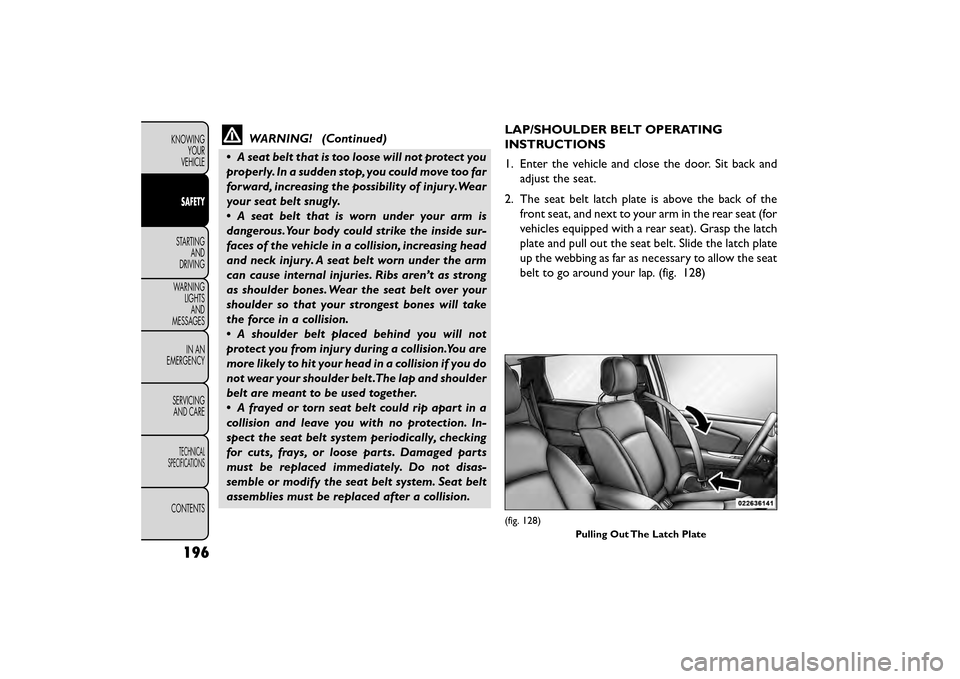
1. Enter the vehicle and close the door. Sit back and
adjust the seat.
2. The seat belt latch plate is above the back of the front seat, and next to your arm in the rear seat (for
vehicles equipped with a rear seat). Grasp the latch
plate and pull out the seat belt. Slide the latch plate
up the webbing as far as necessary to allow the seat
belt to go around your lap. (fig. 128)
(fig. 128)
Pulling Out The Latch Plate
196
KNOWINGYOUR
VEHICLE
SAFETY
STARTING AND
DRIVING
WARNING LIGHTSAND
MESSAGES
IN
AN
EMERGENCY
SERVICINGAND CARE
TECHNICAL
SPECIFICATIONS
CONTENTS
Page 203 of 412

3. When the seat belt is long enough to fit, insert thelatch plate into the buckle until you hear a “click.”
(fig. 129)
4. Position the lap belt so that it is snug and lies low across your hips, below your abdomen. To remove
slack in the lap belt portion, pull up on the shoulder
belt. To loosen the lap belt if it is too tight, tilt the
latch plate and pull on the lap belt. A snug seat belt
reduces the risk of sliding under the seat belt in a
collision. (fig. 130)
5. Position the shoulder belt across the shoulder and chest with minimal, if any slack so that it is comfort-
able and not resting on your neck. The retractor will
withdraw any slack in the shoulder belt. 6. To release the seat belt, push the red button on the
buckle. The seat belt will automatically retract to its
stowed position. If necessary, slide the latch plate
down the webbing to allow the seat belt to retract
fully.
LAP/SHOULDER BELT UNTWISTING
PROCEDURE
Use the following procedure to untwist a twisted
lap/shoulder belt.
1. Position the latch plate as close as possible to the anchor point.
2. At about 15 to 30 cm above the latch plate, grasp and twist the belt webbing 180° to create a fold that
begins immediately above the latch plate.
(fig. 129)
Inserting Latch Plate Into Buckle(fig. 130) Positioning The Lap Belt
197
KNOWING
YOUR
VEHICLE
SAFETY
STARTING
AND
DRIVING
WARNING
LIGHTS
AND
MESSAGES
IN
AN
EMERGENCY
SERVICING
AND CARE
TECHNICAL
SPECIFICATIONS
CONTENTS
Page 205 of 412

SEAT BELT PRETENSIONER
The front seat belt system is equipped with pretension-
ing devices that are designed to remove slack from the
seat belt in the event of a collision. These devices may
improve the performance of the seat belt by removing
slack from the seat belt early in a collision. Pretension-
ers work for all size occupants, including those in child
restraints.
NOTE:These devices are not a substitute for proper
seat belt placement by the occupant. The seat belt still
must be worn snugly and positioned properly.
The pretensioners are triggered by the Occupant Re-
straint Controller (ORC). Like the air bags, the preten-
sioners are single use items. A deployed pretensioner
or a deployed air bag must be replaced immediately.
ENERGY MANAGEMENT FEATURE
This vehicle has a seat belt system with an Energy
Management feature in the front seating positions that
may help further reduce the risk of injury in the event
of a collision. This seat belt system has a retractor
assembly that is designed to release webbing in a
controlled manner. SUPPLEMENTAL ACTIVE HEAD
RESTRAINTS (AHR)
These head restraints are passive, deployable compo-
nents, and vehicles with this equipment cannot be
readily identified by any markings, only through visual
inspection of the head restraint. The head restraint will
be split in two halves, with the front half being soft
foam and trim, the back half being decorative plastic.
How The Active Head Restraints (AHR) Work
The Occupant Restraint Controller (ORC) determines
whether the severity, or type of rear impact will require
the Active Head Restraints (AHR) to deploy. If a rear
impact requires deployment, both the driver and front
passenger seat AHRs will be deployed.
When AHRs deploy during a rear impact, the front half
of the head restraint extends forward to minimize the
gap between the back of the occupant’s head and the
AHR. This system is designed to help prevent or
reduce the extent of injuries to the driver and front
passenger in certain types of rear impacts.
199
KNOWING
YOUR
VEHICLE
SAFETY
STARTING
AND
DRIVING
WARNING
LIGHTS
AND
MESSAGES
IN
AN
EMERGENCY
SERVICING
AND CARE
TECHNICAL
SPECIFICATIONS
CONTENTS
Page 209 of 412

SERVICE ACTIVE HOOD SYSTEM
If the system has deployed the Active Hood, or if it
detects a malfunction in any part of the system, it turns
on the Air Bag Warning Light and it will display the
“SERVICE ACTIVE HOOD” message in the Electronic
Vehicle Information Center (EVIC), if equipped. A
single chime will sound if the Air Bag Warning Light
comes on again after initial startup. It also includes
diagnostics that will illuminate the Air Bag Warning
Light if a malfunction is noted that could affect the
Active Hood system. The diagnostics also record the
nature of the malfunction. If the Air Bag Warning Light
is illuminated, or if “SERVICE ACTIVE HOOD” ap-
pears in the EVIC, if equipped, see your authorized
dealer.
In the event of an Active Hood deployment, the vehicle
should be serviced by an authorized dealer. The hood
hinges must be serviced and the actuator assemblies
replaced to restore system functionality. Following an
Active Hood deployment, the hood position can be
temporarily reset by pushing down at the rear edge
over the hood hinges as the internal pressure of each
actuator is relieved. The temporary hood reset posi-
tion is intended to improve forward driving visibility
over the hood until the vehicle can be serviced.The temporary hood reset position will leave the hood
approximately 5 mm above the fender surface. The
front bumper assembly may affect proper operation of
the Active Hood system. The front bumper compo-
nents should be inspected for damage and replaced if
necessary in the event of a frontal impact, even if it
occurs at a low rate of speed.
NOTE:
After any Active Hood deployment, the ve-
hicle should be taken to an authorized dealer
immediately.
(fig. 137)
(fig. 137)
Service Active Hood
203
KNOWING
YOUR
VEHICLE
SAFETY
STARTING
AND
DRIVING
WARNING
LIGHTS
AND
MESSAGES
IN
AN
EMERGENCY
SERVICING
AND CARE
TECHNICAL
SPECIFICATIONS
CONTENTS
Page 212 of 412

WARNING!
• Being too close to the steering wheel
or ins
trument panel during Advanced
Front Air Bag deployment could cause serious
injury, including death. Air bags need room to
inflate. Sit back, comfortably extending your
arms to reach the steering wheel or instrument
panel.
• Never place a rear-facing child restraint in
front of an air bag. A deploying Passenger Ad-
vanced Front Air Bag can cause death or serious
injury to a child 12 years or younger, including a
child in a rear-facing child restraint .
• Only use a rear-facing child restraint in a ve-
hicle with a rear seat .
ADVANCED FRONT AIR BAG FEATURES
The Advanced Front Air Bag system has multistage
driver and front passenger air bags. This system pro-
vides output appropriate to the severity and type of
collision as determined by the Occupant Restraint
Controller (ORC), which may receive information
from the front impact sensors or other system com-
ponents.
The first stage inflator is triggered immediately during
an impact that requires air bag deployment. A low energy output is used in less severe collisions. A higher
energy output is used for more severe collisions.
This vehicle may be equipped with a driver and/or front
passenger seat belt buckle switch that detects whether
the driver or front passenger seat belt is buckled. The
seat belt buckle switch may adjust the inflation rate of
the Advanced Front Air Bags.
WARNING!
• No objects should be placed over or
n ear
the air bag on the instrument panel
or steering wheel, because any such objects could
cause harm if the vehicle is in a collision severe
enough to cause the air bags to inflate.
• Do not put anything on or around the air bag
covers or attempt to open them manually. You
may damage the air bags and you could be
injured because the air bags may no longer be
functional. The protective covers for the air bag
cushions are designed to open only when the air
bags are inflating.
• Relying on the air bags alone could lead to
more severe injuries in a collision. The air bags
work with your seat belt to restrain you properly.
In some collisions, air bags won’t deploy at all.
Always wear your seat belts even though you
have air bags.
206
KNOWING YOUR
VEHICLE
SAFETY
STARTING AND
DRIVING
WARNING LIGHTSAND
MESSAGES
IN
AN
EMERGENCY
SERVICINGAND CARE
TECHNICAL
SPECIFICATIONS
CONTENTS
Page 217 of 412

The Side Air Bags will not deploy in all side collisions,
including some collisions at certain angles, or some
side collisions that do not impact the area of the
passenger compartment. The Side Air Bags may deploy
during angled or offset frontal collisions where the
Advanced Front Air Bags deploy.
Rollover Events
Side Air Bags are designed to activate in certain roll-
over events. The ORC determines whether the de-
ployment of the Side Air Bags in a particular rollover
event is appropriate, based on the severity and type of
collision. Vehicle damage by itself is not a good indica-
tor of whether or not Side Air Bags should have
deployed.
The Side Air Bags will not deploy in all rollover events.
The rollover sensing-system determines if a rollover
event may be in progress and whether deployment is
appropriate. A slower-developing event may deploy the
seat belt pretensioners on both sides of the vehicle. A
faster-developing event may deploy the seat belt pre-
tensioners as well as the SABs and SABICs on both
sides of the vehicle. The rollover sensing-system may
also deploy the seat belt pretensioners, with or with-
out the SABs and SABICs, on both sides of the vehicle
if the vehicle experiences a near rollover event.IF A DEPLOYMENT OCCURS
The Advanced Front Air Bags are designed to deflate
immediately after deployment.
NOTE:
Front and/or side air bags will not deploy in all
collisions. This does not mean something is wrong with
the air bag system.
If you do have a collision, which deploys the air bags,
any or all of the following may occur:
• The air bag material may sometimes cause abrasions and/or skin reddening to the occupants as the air
bags deploy and unfold. The abrasions are similar to
friction rope burns or those you might get sliding
along a carpet or gymnasium floor. They are not
caused by contact with chemicals. They are not
permanent and normally heal quickly. However, if you
haven’t healed significantly within a few days, or if you
have any blistering, see your doctor immediately.
• As the air bags deflate, you may see some smoke-like particles. The particles are a normal by-product of
the process that generates the non-toxic gas used for
air bag inflation. These airborne particles may irritate
the skin, eyes, nose, or throat. If you have skin or eye
irritation, rinse the area with cool water. For nose or
throat irritation, move to fresh air. If the irritation
continues, see your doctor. If these particles settle
on your clothing, follow the garment manufacturer’s
instructions for cleaning.
211
KNOWING
YOUR
VEHICLE
SAFETY
STARTING
AND
DRIVING
WARNING
LIGHTS
AND
MESSAGES
IN
AN
EMERGENCY
SERVICING
AND CARE
TECHNICAL
SPECIFICATIONS
CONTENTS