Page 125 of 296

Reduced sensor sensitivity and a
reduction in the parking assistance
system performance could be due to
the presence on the surface of the
sensor of: ice, snow, mud, thick paint.
The sensor may detect a non-
existent obstacle (echo noise) due to
mechanical noises, for example when
washing the vehicle, in case of rain,
strong wind, hail.
The warnings sent by the sensor
can also be altered by the presence of
ultrasonic systems (e.g. pneumatic
brakes of trucks or pneumatic drills)
near the car.
The performance of the parking
assistance system may also be affected
by the position of the sensors. For
example by a change in the ride setting
(caused by the wear of the shock
absorbers, suspension), changing the
tyres, overloading the vehicle and
carrying out specific tuning operations
that require the vehicle to be lowered.
Detection of obstacles in the upper
part of the vehicle (particularly in the
case of vans or chassis cabs) may not
be guaranteed because the system
detects obstacles that could strike the
lower part of the vehicle.
WARNING
122)The driver is always responsible for
parking and other dangerous manoeuvres.
While carrying out these manoeuvres,
always make sure that no people
(especially children) or animals are in the
area concerned. The parking sensors
are used to assist the driver, who must
never allow his attention to lapse during
potentially dangerous manoeuvres, even
those executed at low speeds.
WARNING
25)For correct operation of the system,
sensors must always be clean from mud,
dirt, snow or ice. Be careful not to scratch
or damage the sensors while cleaning
them. Avoid using dry, rough or hard
cloths. The sensors must be washed using
clean water, with the addition of vehicle
shampoo if necessary.
REAR CAMERA
(PARKVIEW® REAR
BACK UP CAMERA)
(for versions/markets, where provided)
123)
26)
The vehicle may be equipped with a
ParkView® Rear Back Up Camera,
which allows the driver to see the
surrounding area behind the vehicle on
the display when reverse is engaged
or the tailgate is opened fig. 114.
SYMBOLS AND
MESSAGES ON THE
DISPLAY
When displayed, the static line grid
shows the width of the vehicle.
The grid shows separate areas,
allowing you to see the distance from
the rear of the vehicle.
The table below shows the
approximate distances for each area:
Area (reference
fig. 114)Distance from the
rear of the vehicle
Red (A) 0–30 cm
Yellow (B) 30–100 cm
Green (C) 1 m or more
123
Page 138 of 296

In addition to the electrical branches,
the vehicle's electric system can only
be connected to the supply cable for an
electric brake and to the cable for an
internal light, though not above 15
W. For connections use the preset
control unit with battery cable no less
than 2.5 mm
2.
IMPORTANT The trailer tow hook
contributes to the length of the vehicle.
When installing on long wheelbase
versions, it is only possible to install
removable tow hooks because the total
vehicle length limit of 6 metres is
exceeded.
If no trailer is fitted, the hook must be
removed from the attachment base and
it must not exceed the vehicle's
original length.
IMPORTANT If you wish to leave the
tow hook fitted without towing a trailer,
it is advisable to contact a Fiat
Dealership for the relevant system
update operations because the tow
hook could be detected as an obstacle
by the central sensors.Installation diagram for Van
versions fig. 121
The tow hook structure must be
fastened in the points shown by the
symbol Ø using a total of 6 M10x1.25
screws and 4 M12 screws.
The internal back plates must be at
least 5 mm thick. MAX LOAD ON
BALL: 100/120 kg depending on the
payload (see the “Weights” table in the
“Technical Data” chapter).
138)
To install a tow hook, the bumpers
must be trimmed as described in the
supplier's installation kit.
Installation diagram for Truck and
Chassis Cab versions fig. 122
Another tow hook specific to Truck and
Chassis Cab versions is shown in fig.
122.
The structure Ø must be fixed in the
points indicated using a total of 6
M10x1.25 screws and 4 M12 screws.MAX LOAD ON BALL: 100/120 kg
depending on the payload (see the
“Weights” table in the “Technical Data”
chapter).
WARNING
136)The ABS with which the vehicle may
be equipped will not control the braking
system of the trailer. Particular caution
is required on slippery roads.
137)Never modify the braking system of
the vehicle to control the trailer brake. The
trailer braking system must be fully
independent from the hydraulic system of
the vehicle.
138)After fitting, screw holes must be
sealed to prevent a exhaust gas inlet.
.
136
STARTING AND DRIVING
Page 151 of 296
undo the 7 fixing screws A of the
plastic cover;
undo the two fixing screws B;
extract the unit outwards and
disconnect the electrical connector;
unscrew the screws C using the
screwdriver provided and remove the
bulb holder;
remove the bulb D, E, F pushing it
gently and turning it anticlockwise
(“bayonet” locking), then replace it;
remove the bulb G, H pulling outwards;
refit the bulb holder and tighten the
screws C;
reconnect the electrical connector,
correctly reposition the unit on the body
of the vehicle and then tighten the
fixing screws B;
refit the plastic cover fastening it
with the 7 fixing screws A.For truck and chassis cab versions:
Undo the four screws H fig. 140 and
replace the bulbs:
I bulb for rear fog light
L bulb for reversing light
M bulb for side light
N bulb for brake light
O bulb for side light.
138F1A0319139F1A0320
140F1A0200
149
Page 152 of 296
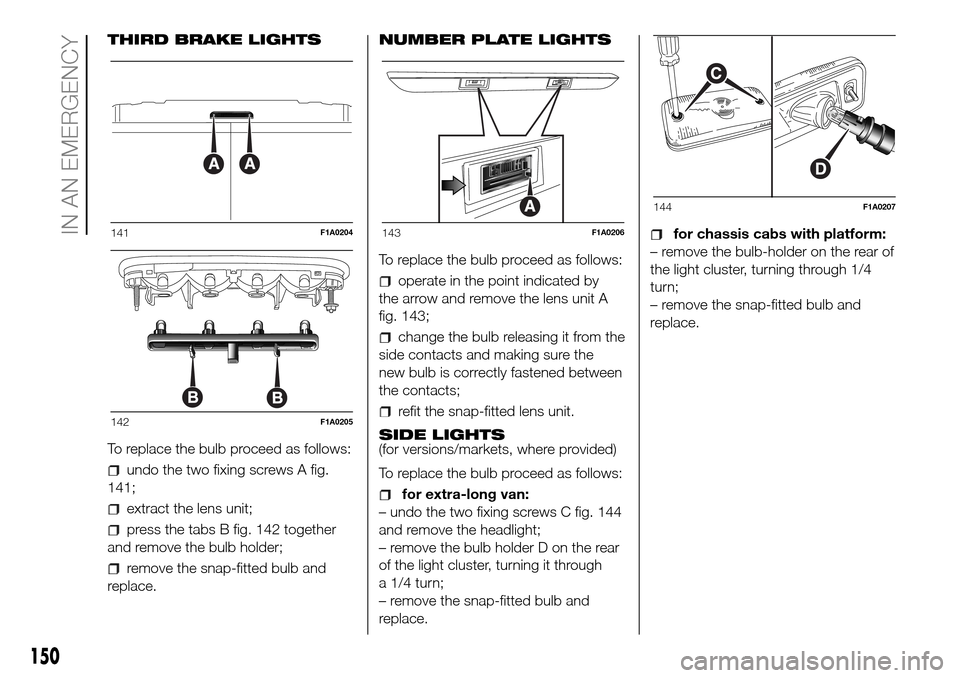
THIRD BRAKE LIGHTS
To replace the bulb proceed as follows:
undo the two fixing screws A fig.
141;
extract the lens unit;
press the tabs B fig. 142 together
and remove the bulb holder;
remove the snap-fitted bulb and
replace.NUMBER PLATE LIGHTS
To replace the bulb proceed as follows:
operate in the point indicated by
the arrow and remove the lens unit A
fig. 143;
change the bulb releasing it from the
side contacts and making sure the
new bulb is correctly fastened between
the contacts;
refit the snap-fitted lens unit.
SIDE LIGHTS
(for versions/markets, where provided)
To replace the bulb proceed as follows:
for extra-long van:
– undo the two fixing screws C fig. 144
and remove the headlight;
– remove the bulb holder D on the rear
of the light cluster, turning it through
a 1/4 turn;
– remove the snap-fitted bulb and
replace.
for chassis cabs with platform:
– remove the bulb-holder on the rear of
the light cluster, turning through 1/4
turn;
– remove the snap-fitted bulb and
replace.141F1A0204
142F1A0205
143F1A0206
144F1A0207
150
IN AN EMERGENCY
Page 211 of 296
IDENTIFICATION
DATA
It is advisable to take note of the
identification codes. Identification codes
are printed and shown on the plates
as indicated below, together with the
positions:
VIN plate.
Chassis marking.
Bodywork paint identification plate.
Engine marking.
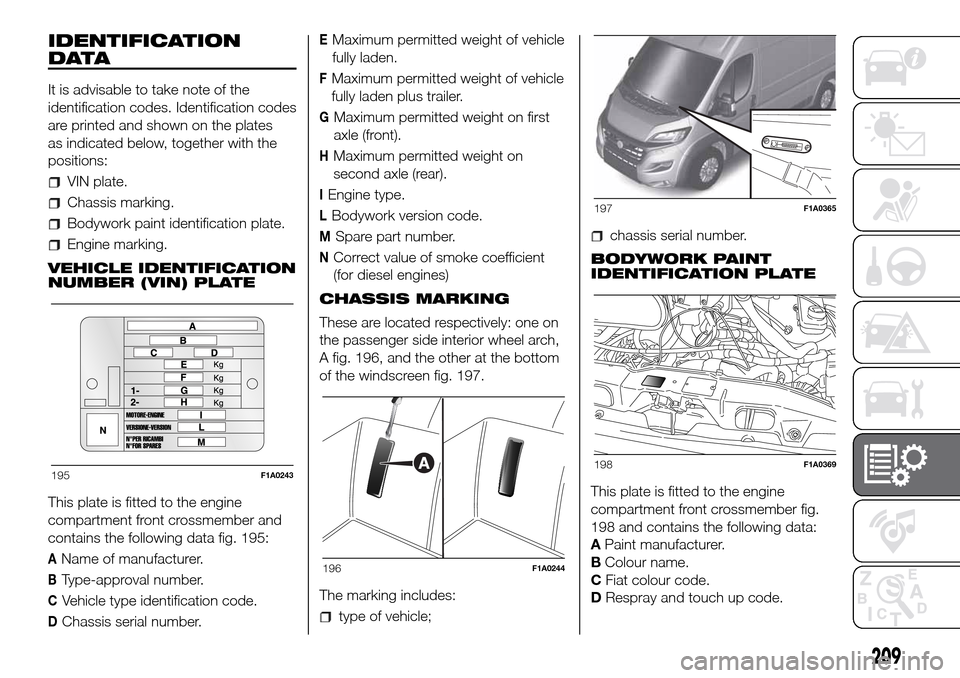
VEHICLE IDENTIFICATION
NUMBER (VIN) PLATE
This plate is fitted to the engine
compartment front crossmember and
contains the following data fig. 195:
AName of manufacturer.
BType-approval number.
CVehicle type identification code.
DChassis serial number.
EMaximum permitted weight of vehicle
fully laden.
FMaximum permitted weight of vehicle
fully laden plus trailer.
GMaximum permitted weight on first
axle (front).
HMaximum permitted weight on
second axle (rear).
IEngine type.
LBodywork version code.
MSpare part number.
NCorrect value of smoke coefficient
(for diesel engines)
CHASSIS MARKING
These are located respectively: one on
the passenger side interior wheel arch,
A fig. 196, and the other at the bottom
of the windscreen fig. 197.
The marking includes:
type of vehicle;
chassis serial number.
BODYWORK PAINT
IDENTIFICATION PLATE
This plate is fitted to the engine
compartment front crossmember fig.
198 and contains the following data:
APaint manufacturer.
BColour name.
CFiat colour code.
DRespray and touch up code.
195F1A0243
196F1A0244
197F1A0365
198F1A0369
209
Page 214 of 296
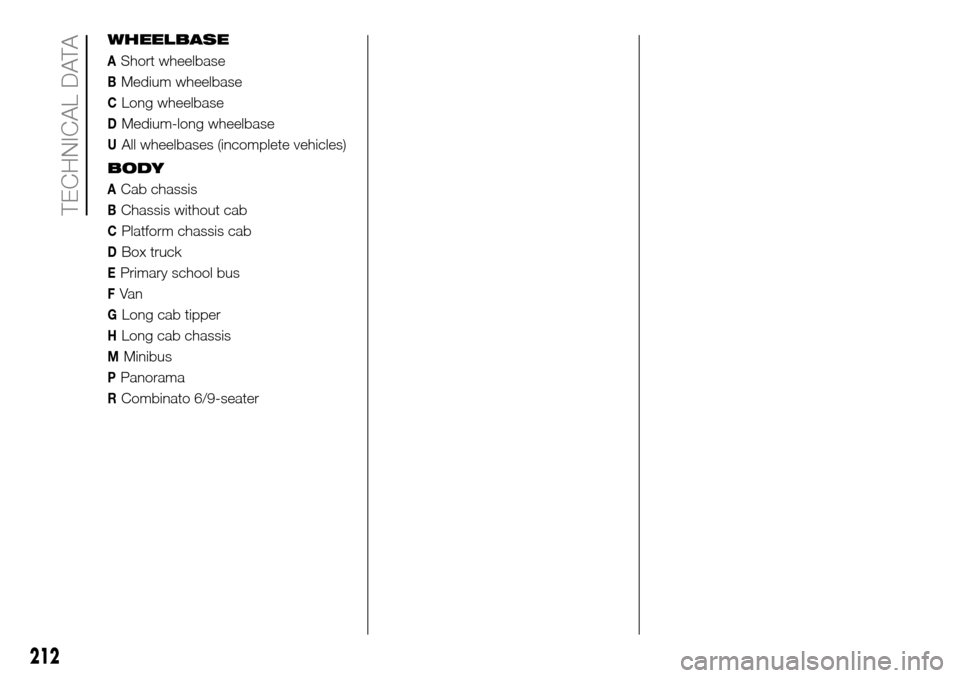
WHEELBASE
AShort wheelbase
BMedium wheelbase
CLong wheelbase
DMedium-long wheelbase
UAll wheelbases (incomplete vehicles)
BODY
ACab chassis
BChassis without cab
CPlatform chassis cab
DBox truck
EPrimary school bus
FVa n
GLong cab tipper
HLong cab chassis
MMinibus
PPanorama
RCombinato 6/9-seater
212
TECHNICAL DATA
Page 229 of 296
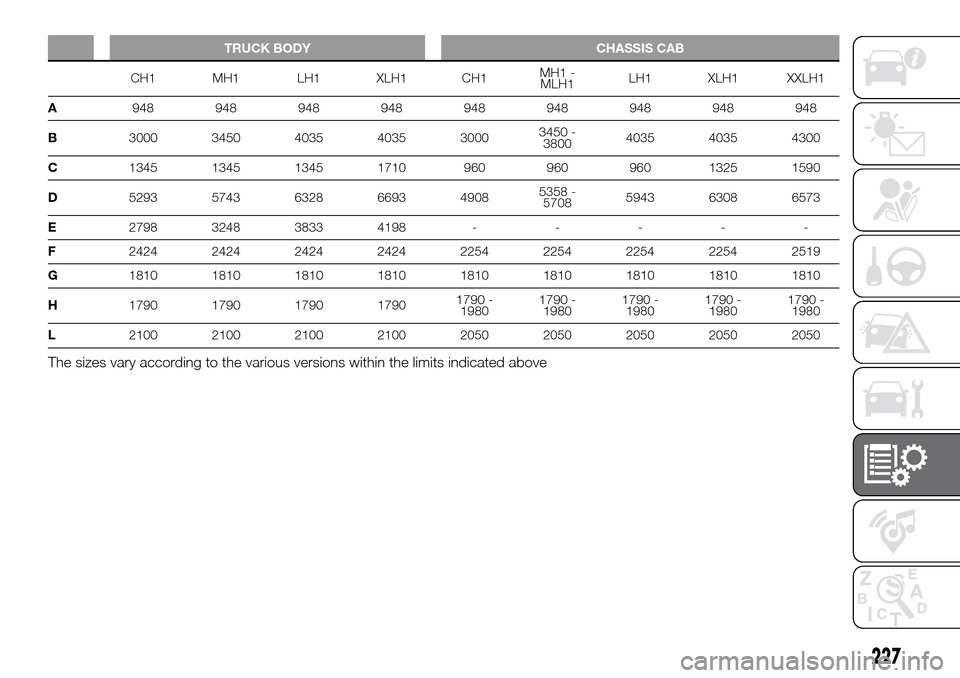
TRUCK BODY CHASSIS CAB
CH1 MH1 LH1 XLH1 CH1MH1 -
MLH1LH1 XLH1 XXLH1
A948 948 948 948 948 948 948 948 948
B3000 3450 4035 4035 30003450 -
38004035 4035 4300
C1345 1345 1345 1710 960 960 960 1325 1590
D5293 5743 6328 6693 49085358 -
57085943 6308 6573
E2798 3248 3833 4198-----
F2424 2424 2424 2424 2254 2254 2254 2254 2519
G1810 1810 1810 1810 1810 1810 1810 1810 1810
H1790 1790 1790 17901790 -
19801790 -
19801790 -
19801790 -
19801790 -
1980
L2100 2100 2100 2100 2050 2050 2050 2050 2050
The sizes vary according to the various versions within the limits indicated above
227
Page 230 of 296
CHASSIS COWL SPECIAL CAB VAN
CH1MH1 -
MLH1LH1 XLH1 XXLH1 CH1MH1 -
MLH1LH1 XLH1 XXLH1
A925 925 925 925 925 948 948 948 948 948
B30003450 -
38004035 4035 4300 30003450 -
38004035 4035 4300
C860 860 860 1225 1490 880 880 880 1245 1510
D47855235 -
55855820 6125 6390 48285278 -
56285863 6228 6493
E----------
F-----2254 2254 2254 2254 2254
G1810 1810 1810 1810 1810 1810 1810 1810 1810 1810
H1790 -
19801790 -
19801790 -
19801790 -
19801790 -
19801790 -
19801790 -
19801790 -
19801790 -
19801790 -
1980
L2050 2050 2050 2050 2050 2050 2050 2050 2050 2050
The sizes vary according to the various versions within the limits indicated above
228
TECHNICAL DATA