2016 FIAT DOBLO PANORAMA check oil
[x] Cancel search: check oilPage 9 of 323
VEHICLE MODIFICATIONS / ALTERATIONS
IMPORTANT
Any change or alteration of the vehicle might seriously affect its safety and road holding, thus causing accidents, in which the
occupants could even be fatally injured.
ACCESSORIES PURCHASED BY THE OWNER
If after buying the vehicle, you decide to install electrical accessories that require a permanent electrical supply (e.g. radio,
satellite anti-theft system, etc.) or accessories that in any case burden the electrical supply, contact a Fiat Dealership, whose
personnel will check whether the vehicles's electrical system is able to withstand the load required, or whether it needs to
be integrated with a more powerful battery.
IMPORTANT Take care when fitting additional spoilers, alloy wheels or non-standard wheel hubs: they could reduce the
ventilation of the brakes and affect efficiency under sharp, repeated braking or on long descents. Make sure that nothing
obstructs the pedal stroke (mats, etc.).
INSTALLING ELECTRICAL/ELECTRONIC DEVICES
Electrical and electronic devices installed after buying the vehicle and available as after-sales must carry the following label
.
Fiat authorises the installation of transceivers provided that installation is carried out at a specialised centre, in a workmanlike
fashion and in compliance with manufacturer's specifications.
IMPORTANT Traffic authorities may not allow the vehicle on the road if devices are fitted that involve modifications to the
features of the vehicle. This may also cause lapse of the warranty in relation to faults caused by the change or either directly or
indirectly related to it.
Fiat shall not be liable for damage caused by the installation of accessories either not supplied or recommended by Fiat and/or
not installed in compliance with the provided instructions.
RADIO TRANSMITTERS AND MOBILE PHONES
Radio transmitters (car phones, CB radios etc.) cannot be used inside the vehicle unless a separate aerial is mounted
externally.
Transmission and reception of these devices may be affected by the shielding effect of the vehicle body. As far as the use of
EC-approved mobile phones is concerned (GSM, GPRS, UMTS, LTE), follow the usage instructions provided by the mobile
phone Manufacturer.
Page 97 of 323

Warning lights on
panelWhat it means What to do
redLOW ENGINE OIL LEVEL
When turning the ignition key to MAR, the warning light turns on but it
should go off after a few seconds.
This warning light appears on the panel when the engine oil level falls
below the minimum recommended value.
On certain versions a dedicated message is displayed.Restore the correct
engine oil level (see
“Checking fluid levels” in
the "Servicing and
maintenance" section).
redINCOMPLETE DOOR LOCKING
On certain versions, the warning light turns on when one or more doors
or the boot are not properly closed.
A buzzer will sound when doors/tailgate are open and the vehicle is
moving.
WARNING
48) If thewarning light does not switch on when the key is turned to MAR or if it stays on when driving (together with
the message on the display), there may be a fault in the restraint systems; in this case, the airbags or pretensioners
may not deploy in the event of an accident or, in a lower number of cases, they could deploy erroneously. Before
continuing, contact a Fiat Dealership to have the system checked immediately.
49) Failure of the
warning light is indicated by thewarning light coming on. In this case, thewarning light may
not indicate a fault in the restraint systems. Before continuing, contact a Fiat Dealership to have the system checked
immediately.
50) Deteriorated engine oil must be replaced as soon as possible after the
warning light comes on, and never more
than 500 km after it first switches on. Failure to observe the above indications may result in severe damage to the
engine and invalidate the warranty. Remember that when this warning light comes on, it does not mean that the level
of engine oil is low, so if it flashes you do not need to top up the engine oil.
51) If the
warning light flashes when driving, contact a Fiat Dealership.
93
Page 189 of 323

Thousands of miles 18 36 54 72 90 108
Thousands of kilometres 30 60 90 120 150 180
Months 24 48 72 96 120 144
Check handbrake lever travel and adjust, if necessary●●●●●●
Visually inspect conditions of the accessory drive belt(s)●●
Check exhaust emissions/smokiness●●●●●●
Check engine management system operation (through the
diagnosis socket)●●●●●●
Check cleanliness of sliding side door lower guides (or every 6
months)●●●●●●
Replace accessory drive belt(s)●
Replace toothed timing drive belt (1.6 MultiJet version) (*)●
Replace fuel filter●●●
Replace the air cleaner cartridge●●●●●●
Change engine oil and replace oil filter (or every 24 months)●●●●●●
Change brake fluid (or every 24 months)●●●
Replace pollen filter (or every 24 months)●●●●●●
(*) Irrespective of the mileage, the timing drive belt must be changed every 4 years for heavy-duty use (cold climates, town use, long periods of idling) or at least every 5 years.
185
Page 191 of 323
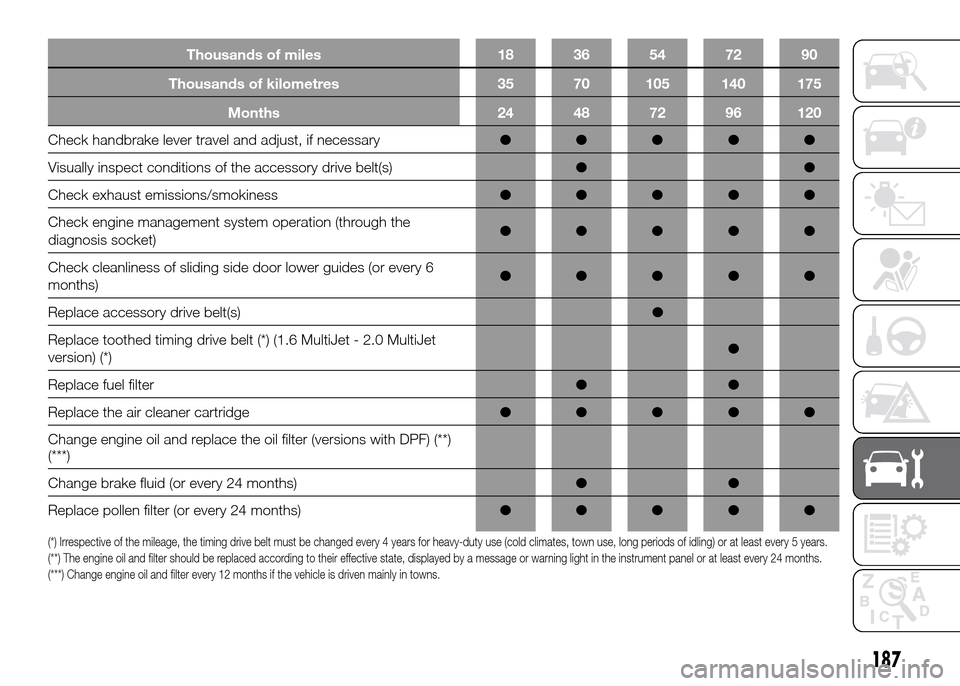
Thousands of miles 18 36 54 72 90
Thousands of kilometres 35 70 105 140 175
Months 24 48 72 96 120
Check handbrake lever travel and adjust, if necessary●●●●●
Visually inspect conditions of the accessory drive belt(s)●●
Check exhaust emissions/smokiness●●●●●
Check engine management system operation (through the
diagnosis socket)●●●●●
Check cleanliness of sliding side door lower guides (or every 6
months)●●●●●
Replace accessory drive belt(s)●
Replace toothed timing drive belt (*) (1.6 MultiJet - 2.0 MultiJet
version) (*)●
Replace fuel filter●●
Replace the air cleaner cartridge●●●●●
Change engine oil and replace the oil filter (versions with DPF) (**)
(***)
Change brake fluid (or every 24 months)●●
Replace pollen filter (or every 24 months)●●●●●
(*) Irrespective of the mileage, the timing drive belt must be changed every 4 years for heavy-duty use (cold climates, town use, long periods of idling) or at least every 5 years.
(**) The engine oil and filter should be replaced according to their effective state, displayed by a message or warning light in the instrument panel orat least every 24 months.
(***) Change engine oil and filter every 12 months if the vehicle is driven mainly in towns.
187
Page 192 of 323

PERIODIC CHECKS
Every 1,000 km or before long
journeys, check and, if necessary, top
up the following:
❒engine coolant level;
❒brake fluid level;
❒windscreen washer fluid level;
❒tyre inflation pressure and condition;
❒operation of lighting system
(headlights, direction indicators,
hazard warning lights, etc.);
❒operation of screen washer/wiper
system and positioning/wear of
windscreen/rear screen wiper blades
(for versions/markets where
provided);
Every 3,000 km check and top up if
required: engine oil level.
DEMANDING
VEHICLE USE
If the vehicle is mostly used in one of
the following conditions:
❒towing a trailer or motorhome;
❒dusty roads;
❒short, repeated journeys (less than
7-8 km) at sub-zero outside
temperatures;
❒engine often idling or driving long
distances at low speeds or long
periods of inactivity;
the following checks must be carried
out more often than indicated in the
Scheduled Servicing Plan:
❒check front disc brake pad condition
and wear;
❒check cleanliness of bonnet and
luggage compartment locks,
cleanliness and lubrication of linkage;
❒visually inspect condition of: engine,
gearbox, transmission, pipes and
hoses (exhaust - fuel system -
brakes) and rubber elements (boots -
sleeves - bushes - etc.);
❒check battery charge and battery
fluid level (electrolyte);
❒visually inspect conditions of the
auxiliary drive belts;❒check and, if necessary, change
engine oil and replace oil filter;
❒check and, if necessary, replace
pollen filter;
❒replacement of air cleaner cartridge
every 15,000 km.
188
SERVICING AND MAINTENANCE
Page 200 of 323
196
SERVICING AND MAINTENANCE
ENGINE OIL
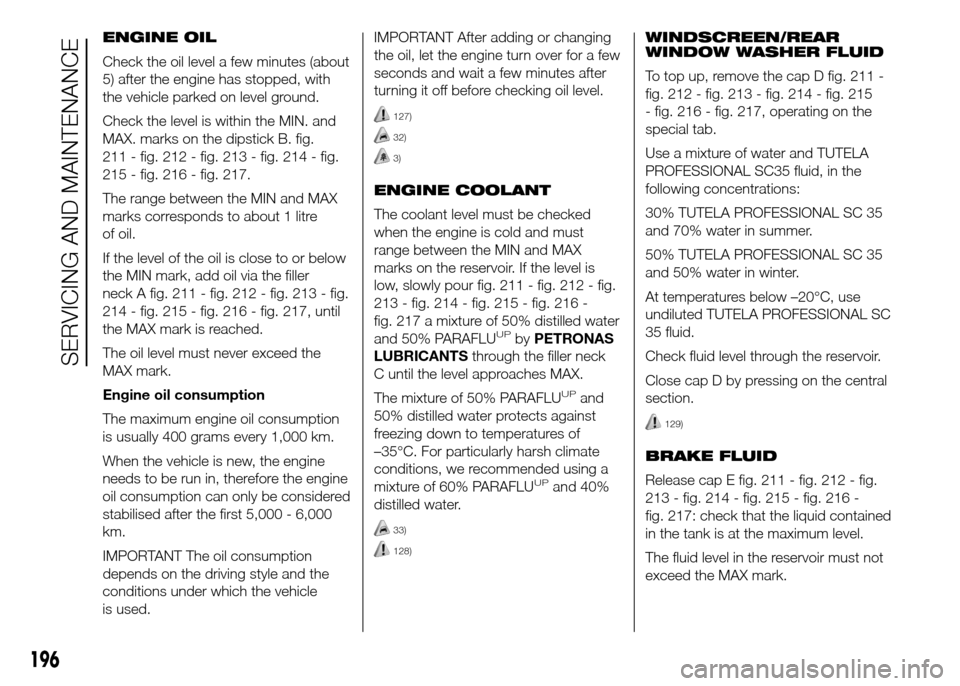
Check the oil level a few minutes (about
5) after the engine has stopped, with
the vehicle parked on level ground.
Check the level is within the MIN. and
MAX. marks on the dipstick B. fig.
211 - fig. 212 - fig. 213 - fig. 214 - fig.
215 - fig. 216 - fig. 217.
The range between the MIN and MAX
marks corresponds to about 1 litre
of oil.
If the level of the oil is close to or below
the MIN mark, add oil via the filler
neck A fig. 211 - fig. 212 - fig. 213 - fig.
214 - fig. 215 - fig. 216 - fig. 217, until
the MAX mark is reached.
The oil level must never exceed the
MAX mark.
Engine oil consumption
The maximum engine oil consumption
is usually 400 grams every 1,000 km.
When the vehicle is new, the engine
needs to be run in, therefore the engine
oil consumption can only be considered
stabilised after the first 5,000 - 6,000
km.
IMPORTANT The oil consumption
depends on the driving style and the
conditions under which the vehicle
is used.IMPORTANT After adding or changing
the oil, let the engine turn over for a few
seconds and wait a few minutes after
turning it off before checking oil level.
127)
32)
3)
ENGINE COOLANT
The coolant level must be checked
when the engine is cold and must
range between the MIN and MAX
marks on the reservoir. If the level is
low, slowly pour fig. 211 - fig. 212 - fig.
213 - fig. 214 - fig. 215 - fig. 216 -
fig. 217 a mixture of 50% distilled water
and 50% PARAFLU
UPbyPETRONAS
LUBRICANTSthrough the filler neck
C until the level approaches MAX.
The mixture of 50% PARAFLU
UPand
50% distilled water protects against
freezing down to temperatures of
–35°C. For particularly harsh climate
conditions, we recommended using a
mixture of 60% PARAFLU
UPand 40%
distilled water.
33)
128)
WINDSCREEN/REAR
WINDOW WASHER FLUID
To top up, remove the cap D fig. 211 -
fig. 212 - fig. 213 - fig. 214 - fig. 215
- fig. 216 - fig. 217, operating on the
special tab.
Use a mixture of water and TUTELA
PROFESSIONAL SC35 fluid, in the
following concentrations:
30% TUTELA PROFESSIONAL SC 35
and 70% water in summer.
50% TUTELA PROFESSIONAL SC 35
and 50% water in winter.
At temperatures below –20°C, use
undiluted TUTELA PROFESSIONAL SC
35 fluid.
Check fluid level through the reservoir.
Close cap D by pressing on the central
section.
129)
BRAKE FLUID
Release cap E fig. 211 - fig. 212 - fig.
213 - fig. 214 - fig. 215 - fig. 216 -
fig. 217: check that the liquid contained
in the tank is at the maximum level.
The fluid level in the reservoir must not
exceed the MAX mark.
Page 201 of 323

The level may exceed the MAX mark
when the oil is hot.
If topping up is required, make sure the
oil you use has the same specifications
as that already in the system.
132)
4)
35)
WARNING
126) Never smoke while working in
the engine compartment: gas
and flammable vapours may be
present, with the risk of fire.
127) When the engine is hot, take
care when working inside the
engine compartment to avoid
burns. Remember that when the
engine is hot, the fan may
operate: danger of injury. Scarves,
ties and other loose clothing may
be pulled by moving parts.128) The cooling system is
pressurised. If necessary, only
replace the cap with another
original one or the operation of
the system may be adversely
affected. Do not remove the cap
from the reservoir when the
engine is hot: danger of scalding.
129) Do not travel with the
windscreen washer fluid reservoir
empty: the windscreen washer
is essential for improving visibility.
Some commercial windscreen
washer additives are flammable.
The engine compartment contains
hot parts which could cause a
fire if they come into contact with
these additives.
130) Brake fluid is poisonous and
highly corrosive. In the event of
accidental contact, immediately
wash the affected parts with
water and mild soap. Then rinse
thoroughly. Consult a doctor
immediately if you swallow the
fluid.
131) The symbol
on the container
indicates a synthetic brake fluid,
which is different from a mineral
fluid. Using a mineral-type fluid
will damage the special rubber
seals of the braking system
beyond repair.
197
Use the brake fluid shown in the "Fluids
and lubricants" table (see "Technical
Specifications").
NB Carefully clean the reservoir cap E
and surrounding surfaces.
Take great care to ensure that
impurities do not enter the reservoir
when the cap is opened.
For topping-up, always use a funnel
with integrated filter with mesh equal to
or lower than 0.12 mm.
IMPORTANT Brake fluid absorbs
moisture. For this reason, if the vehicle
is mainly used in areas with a high
degree of atmospheric humidity, the
fluid should be replaced at more
frequent intervals than specified in the
“Scheduled Servicing Plan”.
34)
130) 131)
POWER STEERING FLUID
Check that the oil level with the vehicle
on flat ground and the engine cold is
between the MIN and MAX marks
on the reservoir body G fig. 211 - fig.
212 - fig. 213 - fig. 214 - fig. 215 - fig.
216 - fig. 217.
Page 202 of 323

132) Prevent power steering fluid
from coming into contact with
hot engine parts: it is flammable.
IMPORTANT
31) When topping up, take care not
to mix up the various types of
fluids: they are not compatible
with each other and could
seriously damage the vehicle.
32) Do not add oil with specifications
other than those of the oil already
in the engine.
33) PARAFLU
UPanti-freeze is used
in the engine cooling system. Use
the same fluid as in the cooling
system when topping up.
PARAFLU
UPcannot be mixed with
any other type of fluid. If this
happens, do not start the engine
and contact a Fiat Dealership.
34) Avoid allowing brake fluid, which
is extremely corrosive, to come
into contact with painted areas.
Should it happen, wash
immediately with water.35) Do not press the power steering
end of travel lock for longer than 8
consecutive seconds with the
engine running because it will
cause noise and risk damaging
the system.
IMPORTANT
3) Used engine oil and oil filters
contain substances which are
harmful to the environment. It is
advisable to have oil and filters
changed by a Fiat Dealership,
where they will be disposed of
properly and in accordance with
the law.
4) Power steering fluid consumption
is extremely low; if another top-up
is required after only a short
period of time, have the system
checked for leaks at a Fiat
Dealership.
AIR CLEANER/
POLLEN FILTER
Have the air cleaner or the pollen filter
replaced by a Fiat Dealership.
198
SERVICING AND MAINTENANCE