2016 FIAT DOBLO PANORAMA Part
[x] Cancel search: PartPage 142 of 323

TPMS (Tyre
Pressure
Monitoring System)
(for versions/markets, where provided)
86) 87) 88) 89) 90) 91) 92) 93) 94)
DESCRIPTION
The tyre pressure monitoring system
(TPMS) warns the driver of low tyre
pressure on the basis of the cold
inflation pressure prescribed for the
vehicle.
Changes in outside temperature may
cause tyre pressure to vary. This means
that a decrease in the outside
temperature corresponds to a decrease
in the tyre pressure.
Tyre pressure must always be adjusted
according to the cold inflation pressure.
Cold tyre inflation pressure is the tyre
pressure after letting the vehicle stand
for at least three hours or a travel
shorter than 1.6 km after an interval of
three hours.
The cold tyre inflation pressure must
not exceed the maximum inflation
pressure value printed on the side of
the tyre.The tyre pressure also increases while
driving the vehicle: this is a normal
condition and does not require any
adjustment of the pressure.
NOTE
❒The TPMS does not replace the
normal tyre maintenance service and
does not indicate any fault in a tyre.
❒Therefore, the TPMS should not be
used as pressure switch while
adjusting the tyre inflation pressure.
❒Driving with insufficient tyre pressure
causes their overheating and can
result in tyre failure. The low inflation
pressure reduces fuel efficiency
and tyre tread life and may also affect
handling and braking performance
of the vehicle.
❒The TPMS does not replace the
correct tyre maintenance. It is up to
the driver to maintain the correct tyre
pressure level measuring it with a
suitable pressure switch. This is
necessary even if the decrease in the
inflation pressure value does not
cause the tyre pressure control
warning light to switch on.❒The TPMS warns the driver of any
condition of insufficient tyre pressure
If this drops below the insufficient
pressure limit for any reason including
low temperature and normal
pressure loss of the tyre.
❒The seasonal temperature changes
affect tyre pressure.
The TPMS uses wireless devices with
electronic sensors mounted on the
wheel rims to constantly monitor the
value of tyre pressure. The sensors
mounted on each wheel as part of the
valve stem transmit various information
of the tyres to the receiver module, in
order to calculate the pressure.
IMPORTANT Monitoring and
maintaining the correct pressure in all
four tyres are particularly important.
Tyre pressure
monitoring system low
pressure warning
The system warns the driver if one or
more tyres are flat by switching on
the warning light
on the instrument
panel (together with a warning message
and an acoustic signal).
138
STARTING AND DRIVING
Page 149 of 323

The following conditions may influence
the performance of the parking
assistance system:
❒Reduced sensor sensitivity and a
reduction in the parking assistance
system performance could be due to
the presence on the surface of the
sensor of: ice, snow, mud, thick
paint.
❒The sensor may detect a non-
existent obstacle (echo noise) due to
mechanical noises, for example
when washing the vehicle, in case of
rain, strong wind, hail.
❒The signals sent out by the sensors
can be altered by dirt, snow or ice
deposited on the sensors or by
ultrasound systems (e.g. truck
pneumatic brakes or pneumatic drills)
near the vehicle.
❒The performance of the parking
assistance system may also be
affected by the position of the
sensors. For example by a change in
the ride setting (caused by the wear
of the shock absorbers, suspension),
changing the tyres, overloading the
vehicle and carrying out specific
tuning operations that require the
vehicle to be lowered.❒Detection of obstacles in the upper
part of the vehicle (particularly in the
case of vans or chassis cabs) may
not be guaranteed because the
system detects obstacles that could
strike the lower part of the vehicle.
❒The parking sensors work properly
with the swing doors closed.
❒If they are open, they can cause the
system to send false signals: always
close the rear doors.
❒Do not apply stickers to the sensors.
WARNING
97) The sensors must be clean of
mud, dirt, snow and ice in order
for the system to work. Be careful
not to scratch or damage the
sensors while cleaning them.
Avoid using dry, rough or hard
cloths. The sensors must be
washed using clean water, with
the addition of car shampoo if
necessary. When using special
washing equipment such as high
pressure jets or steam cleaning,
clean the sensors very quickly
keeping the jet more than 10 cm
away.98) Parking manoeuvres, however,
are always the driver’s
responsibility. While carrying out
these manoeuvres, always make
sure that no people (especially
children) or animals are in the
area concerned. The parking
sensor is designed to assist
drivers, who must still never allow
their attention to lapse during
potentially dangerous
manoeuvres even if performed at
low speed.
145
Page 151 of 323

23)
IMPORTANT
22) For diesel engines, use only
diesel fuel for motor vehicles
in accordance with EN590
European specifications. The use
of other products or mixtures
may damage the engine beyond
repair and consequently invalidate
the warranty, due to the damage
caused. If you accidentally refuel
with another type of fuel, do not
start the engine, and drain the
tank. If the engine has run, even
for a very short time, you will need
to have the entire fuel supply
system emptied in addition to the
tank.
23) Do not bring naked flames or lit
cigarettes near the fuel tank filler:
fire risk. Keep your face away
from the fuel filler to prevent
breathing in harmful vapours.
SAVING FUEL
Some useful tips are given below for
fuel saving and reducing harmful
emissions of CO2 and other pollutants
(nitrogen oxides, unburnt
hydrocarbons, Particulate Matter (PM),
etc.).
PRACTICAL ADVICE FOR
REDUCING FUEL
CONSUMPTION AND
HARMFUL EMISSIONS
Vehicle conditions
❒Have checks and adjustments for
vehicle maintenancecarried out
in accordance with the “Scheduled
servicing plan”.
❒Checktyrepressure regularly, at
least once every four weeks.
Excessively low pressures will
increase consumption because
rolling resistance will be higher. In
addition, this wears the tyre more
quickly and impairs performance.
❒Only usesnow tyreswhen
the weather conditions make them
absolutely necessary. They increase
consumption and noise.❒Do not travel witha heavy load: the
weight of the vehicle (especially when
driving in town) and its geometry
greatly affect fuel consumption and
stability.
❒Removeroof racks or ski racks
after use. These accessories reduce
the vehicle's aerodynamic
penetration and have a negative
effect on fuel consumption.
❒When transporting particularly large
objects, use atrailerif possible.
❒Use the vehicle's air vents if possible:
travelling with the windows open
impairs aerodynamics.
❒Use electrical devices only for the
amount of time needed. The vehicle’s
heated rear window, additional
headlights, screen wipers and heater
fan require a considerable amount
of energy; this increases fuel
consumption (by up to +25% in an
urban cycle).
❒Air conditioning leads to higher fuel
consumption (on average up to
+30%). If the temperature outside is
not too extreme, try and use the
air vents.
147
Page 153 of 323

TOWING TRAILERS
IMPORTANT
The vehicle must be equipped with a
type-approved tow hook and adequate
electrical system to tow trailers.
Installation should be carried out by
specialised personnel who will issue the
required papers for travelling on roads.
Install any specific and/or additional
door mirrors as specified by the
Highway Code.
Remember that when towing a trailer,
steep hills are harder to climb, braking
spaces increase and overtaking takes
longer depending on the overall weight.
Engage a low gear when driving
downhill, rather than constantly using
the brake.
The weight of the trailer on the vehicle
tow hook will reduce the loading
capacity of the vehicle by the same
amount.
To make sure that the maximum
towable weight is not exceeded (given
in the vehicle registration document)
account should be taken of the fully
laden trailer, including accessories and
luggage.Do not exceed the speed limits specific
to each country you are driving in, in
the case of vehicles towing trailers.
In any case, the top speed must not
exceed 80 km/h.
99) 100)
WARNING
99) The ABS device with which the
vehicle is equipped will not
control the braking system of the
trailer. Particular caution is
required on slippery roads.
100) Never modify the braking
system of the vehicle to control
the trailer brake. The trailer
braking system must be fully
independent from the hydraulic
system of the vehicle.
SNOW TYRES
Fiat Dealerships will be happy to
provide advice concerning the most
suitable type of tyres for the customer's
requirements.
For the type of tyre to be used, inflation
pressures and the specifications of
snow tyres, follow the instructions given
in the "Wheels" paragraph of the
"Technical specifications" section.
The winter features of these tyres are
reduced considerably when the tread
depth is below 4 mm. Replace them in
this case.
Due to snow tyre characteristics, under
normal conditions of use or on long
motorway journeys, the performance of
these tyres is lower than that of
standard tyres. Limit performance
according to the use for which they
were approved.
IMPORTANT When using snow tyres
with a maximum speed index below the
one that can be reached by the vehicle
(increased by 5%), place a notice in
the passenger compartment, plainly in
view, which states the maximum speed
allowed by the snow tyres (as per EC
Directive).
149
Page 157 of 323

TYPES OF BULBS
Various types of bulbs are fitted to your
vehicle fig. 155:
AGlass bulbs: they are press-fitted.
Pull to extract.
BBayonet type bulbs: to remove from
its holder, press the bulb, turn it
anticlockwise, then remove.
CTubular bulbs: release them from their
contacts to remove.
DHalogen bulbs: to remove the bulb,
release the clip holding the bulb in
place.
EHalogen bulbs: to remove the bulb,
release the clip holding the bulb in
place.
WARNING
103) Modifications or repairs to the
electric system that are not
carried out properly or do not take
the system technical
specifications into account can
cause malfunctions leading to the
risk of fire.
104) Halogen bulbs contain
pressurised gas; in the case of
breakage they may burst.
IMPORTANT
24) Halogen bulbs must be handled
by holding the metallic part only.
If the transparent bulb is touched
with the fingers, its lighting
intensity is reduced and life of the
bulb may be compromised. In
the case of accidental contact,
rub the lamp with a cloth and
alcohol and leave to dry.
25) Where possible, it is advisable to
have bulbs changed at a Fiat
Dealership. Proper operation and
direction of the external lights
are essential for driving in safety
and comply with law.
155F0V0027
153
Page 159 of 323
REPLACING AN
EXTERIOR BULB
For the type of bulb and relevant power
rating, see “Changing a bulb”.
FRONT LIGHT CLUSTERS
The front light clusters contain side
light, daytime running light, dipped,
main beam and direction indicator
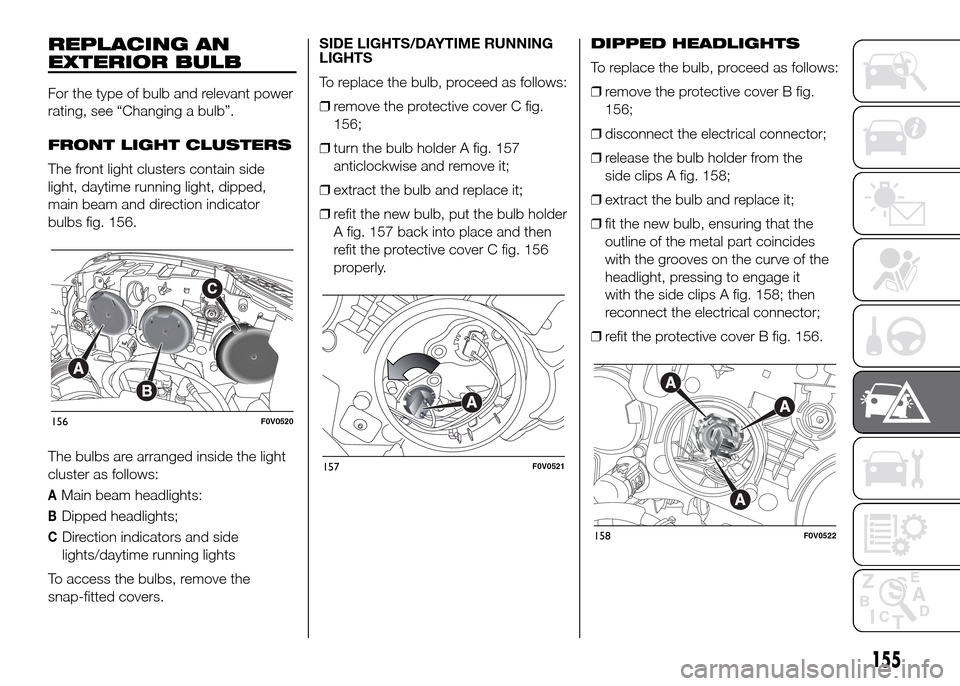
bulbs fig. 156.
The bulbs are arranged inside the light
cluster as follows:
AMain beam headlights:
BDipped headlights;
CDirection indicators and side
lights/daytime running lights
To access the bulbs, remove the
snap-fitted covers.SIDE LIGHTS/DAYTIME RUNNING
LIGHTS
To replace the bulb, proceed as follows:
❒remove the protective cover C fig.
156;
❒turn the bulb holder A fig. 157
anticlockwise and remove it;
❒extract the bulb and replace it;
❒refit the new bulb, put the bulb holder
A fig. 157 back into place and then
refit the protective cover C fig. 156
properly.DIPPED HEADLIGHTS
To replace the bulb, proceed as follows:
❒remove the protective cover B fig.
156;
❒disconnect the electrical connector;
❒release the bulb holder from the
side clips A fig. 158;
❒extract the bulb and replace it;
❒fit the new bulb, ensuring that the
outline of the metal part coincides
with the grooves on the curve of the
headlight, pressing to engage it
with the side clips A fig. 158; then
reconnect the electrical connector;
❒refit the protective cover B fig. 156.
156F0V0520
157F0V0521
158F0V0522
155
Page 160 of 323
DIRECTION INDICATORS
Front
To replace the bulb, proceed as follows:
❒remove the protective cover C fig.
156;
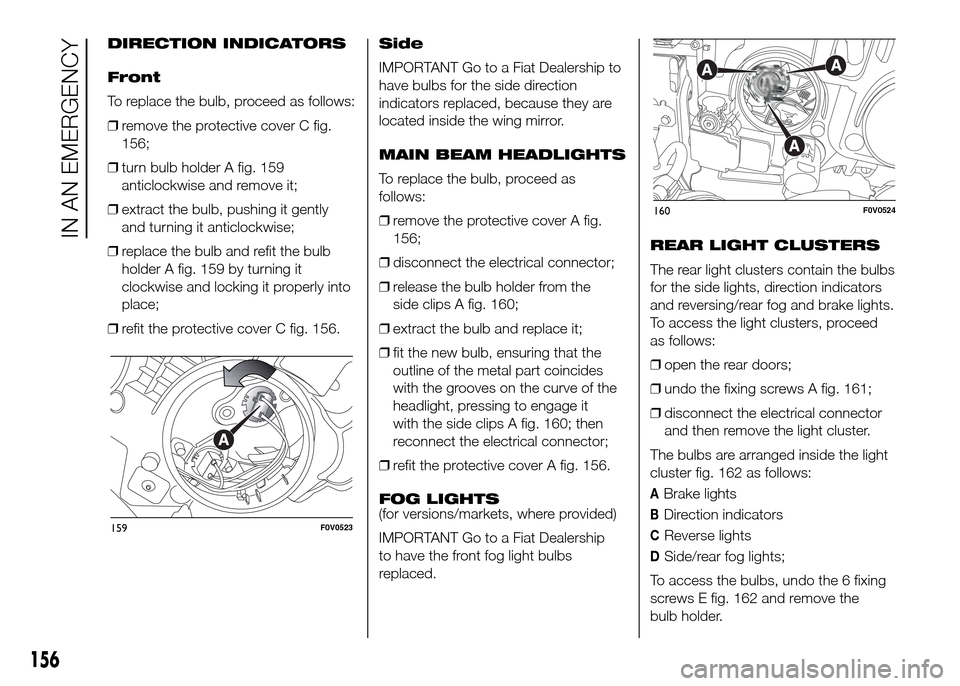
❒turn bulb holder A fig. 159
anticlockwise and remove it;
❒extract the bulb, pushing it gently
and turning it anticlockwise;
❒replace the bulb and refit the bulb
holder A fig. 159 by turning it
clockwise and locking it properly into
place;
❒refit the protective cover C fig. 156.Side
IMPORTANT Go to a Fiat Dealership to
have bulbs for the side direction
indicators replaced, because they are
located inside the wing mirror.
MAIN BEAM HEADLIGHTS
To replace the bulb, proceed as
follows:
❒remove the protective cover A fig.
156;
❒disconnect the electrical connector;
❒release the bulb holder from the
side clips A fig. 160;
❒extract the bulb and replace it;
❒fit the new bulb, ensuring that the
outline of the metal part coincides
with the grooves on the curve of the
headlight, pressing to engage it
with the side clips A fig. 160; then
reconnect the electrical connector;
❒refit the protective cover A fig. 156.
FOG LIGHTS
(for versions/markets, where provided)
IMPORTANT Go to a Fiat Dealership
to have the front fog light bulbs
replaced.REAR LIGHT CLUSTERS
The rear light clusters contain the bulbs
for the side lights, direction indicators
and reversing/rear fog and brake lights.
To access the light clusters, proceed
as follows:
❒open the rear doors;
❒undo the fixing screws A fig. 161;
❒disconnect the electrical connector
and then remove the light cluster.
The bulbs are arranged inside the light
cluster fig. 162 as follows:
ABrake lights
BDirection indicators
CReverse lights
DSide/rear fog lights;
To access the bulbs, undo the 6 fixing
screws E fig. 162 and remove the
bulb holder.
159F0V0523
160F0V0524
156
IN AN EMERGENCY
Page 165 of 323

105) 106) 107)
To identify the protective fuse, see the
tables on the following pages.
ENGINE COMPARTMENT
FUSE BOX
The fuse box fig. 181 is located on the
right-hand side of the engine, next to
the battery. To remove the protective
cover A fig. 180 and access the fuse
box, undo the two fixing screws B.
27)
180F0V0081
181F0V0089
161