Page 354 of 587
NOTE:You must ensure that the Auto Park Brake feature
is disabled before towing this vehicle, to avoid inadver-
tent Electric Park Brake engagement. The Auto Park
Brake feature is enabled or disabled via the Customer
Programmable Features in the Uconnect Settings.
Recreational Towing
Front-Wheel Drive (FWD) Models
Recreational towing is allowed ONLY if the front wheels
are OFF the ground. This may be accomplished using a
tow dolly (front wheels off the ground) or vehicle trailer
(all four wheels off the ground). If using a tow dolly,
follow this procedure:
• Properly secure the dolly to the tow vehicle, following
the dolly manufacturer’s instructions.
• Drive the front wheels onto the tow dolly. •
Apply the Electric Park Brake (EPB). Place the trans-
mission in PARK. Turn the engine OFF.
• Properly secure the front wheels to the dolly, following
the dolly manufacturer’s instructions.
• Turn the ignition to the MAR/RUN position, but do
not start the engine.
• Press and hold the brake pedal.
• Release the Electric Park Brake (EPB).
• Turn the engine OFF, remove the key or fob, and
release the brake pedal.
352 STARTING AND OPERATING
Page 355 of 587
CAUTION!
•DO NOT flat tow this vehicle. Damage to the
drivetrain will result. If this vehicle requires tow-
ing, make sure the drive wheels are OFF the
ground.
• Ensure that the Electric Park Brake is released, and
remains released, while being towed.
• Towing this vehicle in violation of the above re-
quirements can cause severe transmission damage.
Damage from improper towing is not covered un-
der the New Vehicle Limited Warranty. All-Wheel Drive (AWD) Models
Recreational towing (with all four wheels on the ground,
or using a towing dolly) is NOT ALLOWED. This vehicle
may be towed on a flatbed or vehicle trailer provided all
four wheels are OFF the ground.
CAUTION!
Towing this vehicle with ANY of its wheels on the
ground can cause severe transmission and/or power
transfer unit damage. Damage from improper towing
is not covered under the New Vehicle Limited War-
ranty.
7
STARTING AND OPERATING 353
Page 358 of 587
�JUMP STARTING ..................... .406
▫ Preparations For Jump Start ..............406
▫ Jump Starting Procedure ................408
� ENHANCED ACCIDENT RESPONSE SYSTEM . .410
▫ ENHANCED ACCIDENT RESPONSE SYSTEM
RESET PROCEDURE ...................411
� REFUELING IN EMERGENCY .............412
� IF YOUR ENGINE OVERHEATS ............412
� SHIFT LEVER OVERRIDE ................413�
IGNITION KEY REMOVAL OVERRIDE .......415
� FREEING A STUCK VEHICLE .............418
� TOWING A DISABLED VEHICLE ...........419
▫ Front Wheel Drive (FWD) Models ..........421
▫ All Wheel Drive (AWD) Models ...........422
� TOW EYE USAGE — IF EQUIPPED ..........422
▫ Front Tow Eye Installation ...............425
▫ Rear Tow Eye Installation ................426
356 IN CASE OF EMERGENCY
Page 421 of 587
CAUTION!(Continued)
reduce the risk of clutch or transmission failure
during prolonged efforts to free a stuck vehicle.
• When “rocking” a stuck vehicle by shifting be-
tween DRIVE/2nd gear and REVERSE, do not spin
the wheels faster than 15 mph (24 km/h), or drive-
train damage may result.
• Revving the engine or spinning the wheels too fast
may lead to transmission overheating and failure.
It can also damage the tires. Do not spin the wheels
above 30 mph (48 km/h) while in gear (no trans-
mission shifting occurring).
WARNING!
Fast spinning tires can be dangerous. Forces gener-
ated by excessive wheel speeds may cause damage, or
even failure, of the axle and tires. A tire could
explode and injure someone. Do not spin your vehi-
cle’s wheels faster than 30 mph (48 km/h) or for
longer than 30 seconds continuously without stop-
ping when you are stuck and do not let anyone near
a spinning wheel, no matter what the speed.
TOWING A DISABLED VEHICLE
This section describes procedures for towing a disabled
vehicle using a commercial towing service.8
IN CASE OF EMERGENCY 419
Page 422 of 587
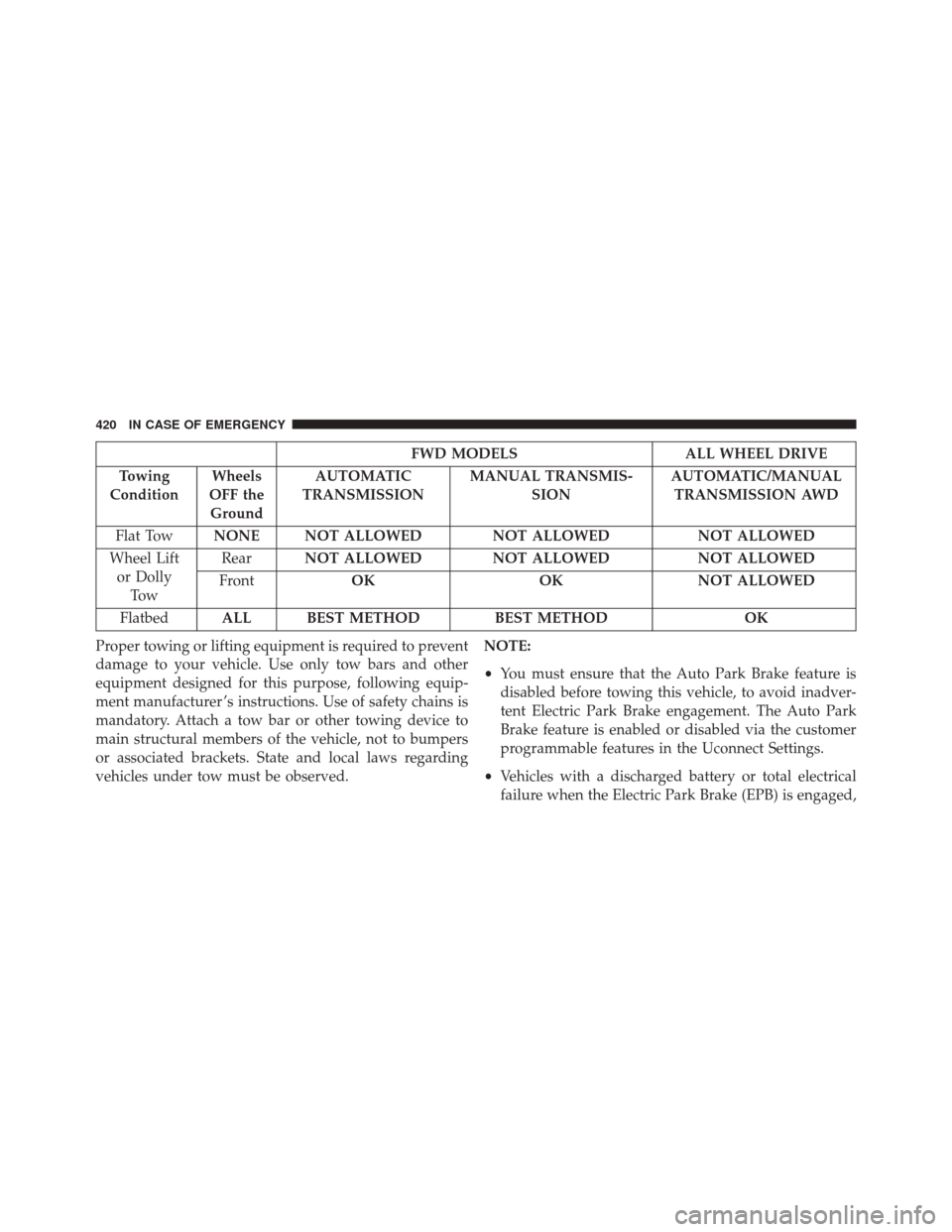
FWD MODELSALL WHEEL DRIVE
Towing
Condition Wheels
OFF the Ground AUTOMATIC
TRANSMISSION MANUAL TRANSMIS-
SION AUTOMATIC/MANUAL
TRANSMISSION AWD
Flat Tow NONE NOT ALLOWED NOT ALLOWED NOT ALLOWED
Wheel Lift or Dolly To w Rear
NOT ALLOWED NOT ALLOWED NOT ALLOWED
Front OK OKNOT ALLOWED
Flatbed ALL BEST METHOD BEST METHODOK
Proper towing or lifting equipment is required to prevent
damage to your vehicle. Use only tow bars and other
equipment designed for this purpose, following equip-
ment manufacturer ’s instructions. Use of safety chains is
mandatory. Attach a tow bar or other towing device to
main structural members of the vehicle, not to bumpers
or associated brackets. State and local laws regarding
vehicles under tow must be observed. NOTE:
•
You must ensure that the Auto Park Brake feature is
disabled before towing this vehicle, to avoid inadver-
tent Electric Park Brake engagement. The Auto Park
Brake feature is enabled or disabled via the customer
programmable features in the Uconnect Settings.
• Vehicles with a discharged battery or total electrical
failure when the Electric Park Brake (EPB) is engaged,
420 IN CASE OF EMERGENCY
Page 423 of 587
will need a wheel dolly or jack to raise the rear wheels
off the ground when moving the vehicle onto a flatbed.
If you must use the accessories (wipers, defrosters, etc.)
while being towed, the ignition must be in the MAR/
RUN position.
NOTE: The Safehold feature will engage the Electric Park
Brake whenever the driver’s door is opened (if the
ignition is ON, transmission is not in PARK, and brake
pedal is released). If you are towing this vehicle with the
ignition in the MAR/RUN position, you must manually
disable the Electric Park Brake each time the driver’s
door is opened, by pressing the brake pedal and then
releasing the EPB.
If the key fob is unavailable, or the vehicle’s battery is
discharged, refer to “Shift Lever Override” in this section
for instructions on shifting the transmission out of PARK
so that the vehicle can be moved.CAUTION!
• Do not use sling type equipment when towing.
Vehicle damage may occur.
• When securing the vehicle to a flat bed truck, do
not attach to front or rear suspension components.
Damage to your vehicle may result from improper
towing.
Front Wheel Drive (FWD) Models
The manufacturer recommends towing your vehicle with
all four wheels OFF the ground on a flatbed.
If flatbed equipment is not available, this vehicle must
towed with the front wheels OFF the ground (using a
towing dolly, or wheel lift equipment with the front
wheels raised).
8
IN CASE OF EMERGENCY 421
Page 424 of 587
NOTE:Ensure that the Electric Park Brake is released,
and remains released, while being towed.
CAUTION!
Towing this vehicle in violation of the above require-
ments can cause severe transmission damage. Dam-
age from improper towing is not covered under the
New Vehicle Limited Warranty.
All Wheel Drive (AWD) Models
The manufacturer requires towing with all four wheels
OFF the ground. Acceptable methods are to tow the
vehicle on a flatbed, or with one end of the vehicle raised
and the opposite end on a towing dolly.
CAUTION!
• DO NOT tow this vehicle with ANY of its wheels
on the ground. Damage to the drivetrain will result.
• Front or rear wheel lifts must not be used. Internal
damage to the transmission or power transfer unit
will occur if a front or rear wheel lift is used when
towing.
• Towing this vehicle in violation of the above re-
quirements can cause severe transmission and/or
power transfer unit damage. Damage from im-
proper towing is not covered under the New Ve-
hicle Limited Warranty.
TOW EYE USAGE — IF EQUIPPED
Your vehicle is equipped with a tow eye that can be used
to tow a disabled vehicle.
422 IN CASE OF EMERGENCY
Page 425 of 587
When using a tow eye be sure to follow the “Tow Eye
Usage Precautions” and the “Towing A Disabled Vehicle”
instructions in this section.Tow Eye Usage Precautions
NOTE:
•
Ensure that the tow eye is properly seated and secure
in the mounting receptacle.
• The tow eye is recommended for use with an approved
tow bar and or rope.
• Do not use the tow eye to pull the vehicle onto a
flatbed truck.
• Do not use the tow eye to free a stuck vehicle. Refer to
“Freeing A Stuck Vehicle” in this section for further
information.
Tow Eye
8
IN CASE OF EMERGENCY 423