Page 267 of 587
not lit during starting, see your authorized dealer. If the
light stays on, flickers, or comes on while driving, have
the system checked by an authorized dealer.
Defroster
Check operation by selecting the defrost mode and place
the blower control on high speed. You should be able to
feel the air directed against the windshield. See your
authorized dealer for service if your defroster is inoper-
able.
Floor Mat Safety Information
Always use floor mats designed to fit the footwell of your
vehicle. Use only floor mats that leave the pedal area
unobstructed and that are firmly secured so that they
cannot slip out of position and interfere with the pedals
or impair safe operation of your vehicle in other ways.
WARNING!
Pedals that cannot move freely can cause loss of
vehicle control and increase the risk of serious per-
sonal injury.
•Always make sure that floor mats are properly
attached to the floor mat fasteners.
• Never place or install floor mats or other floor
coverings in the vehicle that cannot be properly
secured to prevent them from moving and interfer-
ing with the pedals or the ability to control the
vehicle.
• Never put floor mats or other floor coverings on top
of already installed floor mats. Additional floor
mats and other coverings will reduce the size of the
pedal area and interfere with the pedals.
(Continued)
6
SAFETY 265
Page 269 of 587
Lights
Have someone observe the operation of brake lights and
exterior lights while you work the controls. Check turn
signal and high beam indicator lights on the instrument
panel.
Door Latches
Check for proper closing, latching, and locking.
Fluid Leaks
Check area under vehicle after overnight parking for fuel,
engine coolant, oil, or other fluid leaks. Also, if gasoline
fumes are detected, or if fuel or brake fluid leaks are
suspected, the cause should be located and corrected
immediately.
6
SAFETY 267
Page 282 of 587
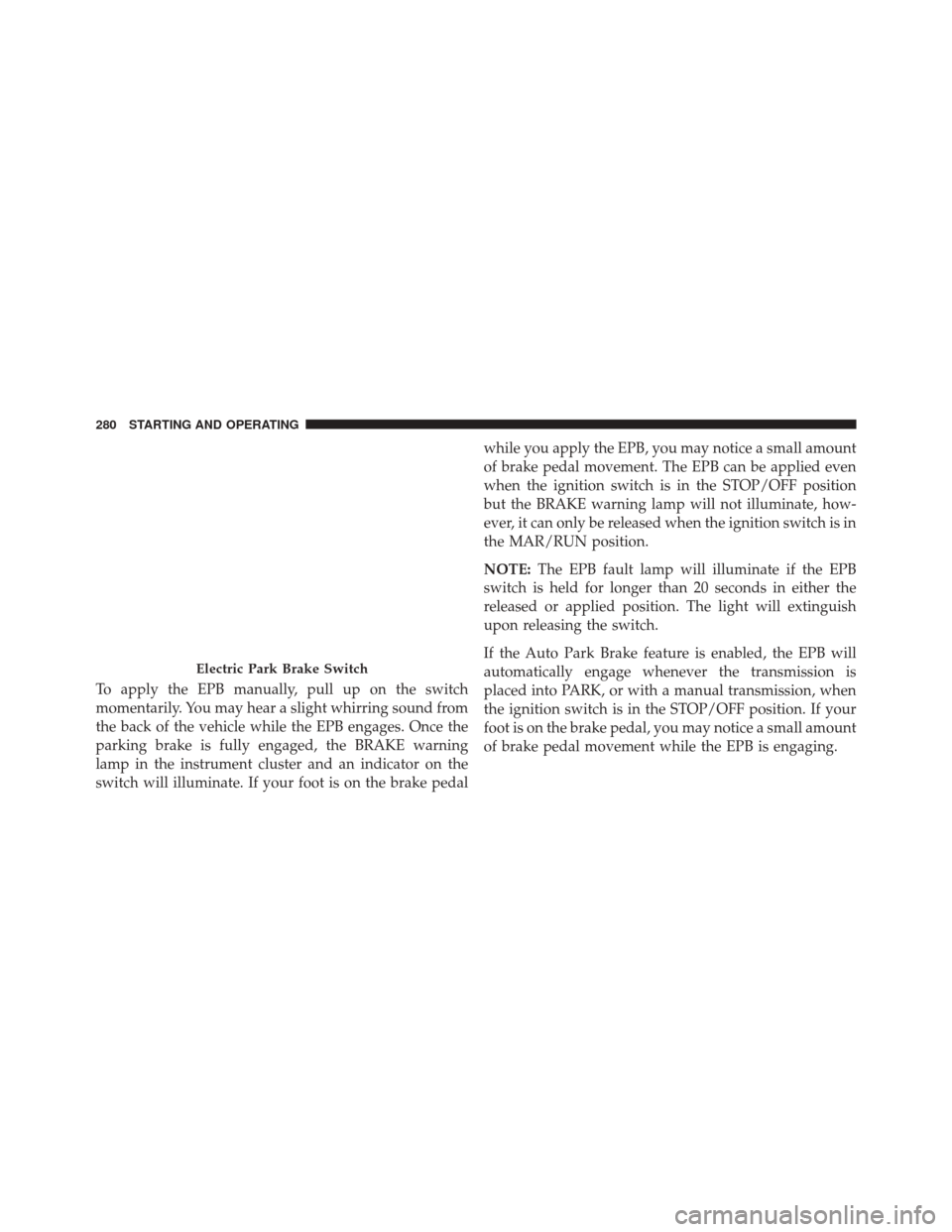
To apply the EPB manually, pull up on the switch
momentarily. You may hear a slight whirring sound from
the back of the vehicle while the EPB engages. Once the
parking brake is fully engaged, the BRAKE warning
lamp in the instrument cluster and an indicator on the
switch will illuminate. If your foot is on the brake pedalwhile you apply the EPB, you may notice a small amount
of brake pedal movement. The EPB can be applied even
when the ignition switch is in the STOP/OFF position
but the BRAKE warning lamp will not illuminate, how-
ever, it can only be released when the ignition switch is in
the MAR/RUN position.
NOTE:
The EPB fault lamp will illuminate if the EPB
switch is held for longer than 20 seconds in either the
released or applied position. The light will extinguish
upon releasing the switch.
If the Auto Park Brake feature is enabled, the EPB will
automatically engage whenever the transmission is
placed into PARK, or with a manual transmission, when
the ignition switch is in the STOP/OFF position. If your
foot is on the brake pedal, you may notice a small amount
of brake pedal movement while the EPB is engaging.
Electric Park Brake Switch
280 STARTING AND OPERATING
Page 283 of 587
The EPB will be automatically released if the driver ’s seat
belt is buckled and driver’s intention to start (in forward
or reverse direction) is recognized by the system
To release the EPB manually, the ignition switch must be
in the MAR/RUN position. Put your foot on the brake
pedal, then push the EPB switch down momentarily. You
may hear a slight whirring sound from the back of the
vehicle while the parking brake disengages. You may
also notice a small amount of movement in the brake
pedal. Once the EPB is fully disengaged, The BRAKE
warning lamp in the instrument cluster and the LED
indicator on the switch will extinguish.NOTE:
•
When parking on a hill, it is important to turn the front
wheels toward the curb on a downhill grade and away
from the curb on an uphill grade. Apply the EPB
before placing the shift lever in PARK, otherwise the
load on the transmission locking mechanism may
make it difficult to move the shift lever out of PARK.
The EPB should always be applied whenever the
driver is not in the vehicle.
• If the clutch pedal is released at the same time the gas
pedal is pressed, the EPB will be automatically re-
leased (manual transmissions only).
WARNING!
• Never use the PARK position as a substitute for the
parking brake. Always apply the parking brake
(Continued)
7
STARTING AND OPERATING 281
Page 285 of 587
CAUTION!
If the Brake System Warning Light remains on with
the parking brake released, a brake system malfunc-
tion is indicated. Have the brake system serviced by
an authorized dealer immediately.
If exceptional circumstances should make it necessary to
engage the EPB while the vehicle is in motion, maintain
upward pressure on the EPB switch for as long as
engagement is desired. The brake warning lamp could
illuminate in case of the hydraulic system is not available.
The rear stop lamps will also be illuminated automati-
cally while the vehicle remains in motion.
To disengage the EPB while the vehicle is in motion,
release the switch. If the vehicle is brought to a complete
stop using the EPB, when the vehicle reaches approxi-
mately 1.9 mph (3 km/h) the EPB will remain engaged.
WARNING!
Driving the vehicle with the parking brake engaged,
or repeated use of the parking brake to slow the
vehicle may cause serious damage to the brake sys-
tem; failure to do so can lead to brake failure and a
collision.
In the unlikely event of a malfunction of the EPB system,
a yellow EPB fault lamp will illuminate. This may be
accompanied by the Brake warning lamp flashing. In this
status some EPB functionalities may be deactivated. In
this event, urgent service of the EPB system is required.
Do not rely on the EPB to hold the vehicle stationary.
Auto Park Brake
The EPB can be programmed to be applied automatically
whenever the vehicle speed is below 1.9 mph (3 km/h)
and the automatic transmission is placed in PARK, or
with a manual transmission, whenever the ignition
7
STARTING AND OPERATING 283
Page 289 of 587
To shift the gears, press the clutch pedal to the floor and
put the shift lever to the desired position (the diagram for
the engagement of the gears is displayed on the handle of
the lever).To engage REVERSE gear from the NEUTRAL position
lift the REVERSE ring, located below the knob and
simultaneously move the lever to the left and then
forward.
Shifting
Fully press the clutch pedal before shifting gears. As you
release the clutch pedal, lightly press the accelerator
pedal.
You should always use first gear when starting from a
standing position.
Recommended Vehicle Shift Speeds
To utilize your manual transmission efficiently for fuel
economy and performance, it should be upshifted as
listed in the recommended shift speed chart. Shift at the
vehicle speeds listed for acceleration. When heavily
loaded or pulling a trailer, these recommended up-shift
speeds may not apply.
REVERSE Ring
7
STARTING AND OPERATING 287
Page 300 of 587
If the transmission becomes extremely hot, the “Trans-
mission Temperature Warning Light” may illuminate and
the transmission may operate differently until the trans-
mission cools down.
During cold temperatures, transmission operation may
be modified depending on engine and transmission
temperature as well as vehicle speed. This feature im-
proves warm up time of the engine and transmission to
achieve maximum efficiency. Engagement of the torque
converter clutch, and shifts into 8th or 9th gear, are
inhibited until the transmission fluid is warm. Normal
operation will resume once the transmission temperature
has risen to a suitable level.
AutoStick
AutoStick is a driver-interactive transmission feature
providing manual shift control, giving you more control
of the vehicle. AutoStick allows you to maximize engine
braking, eliminate undesirable upshifts and downshifts,and improve overall vehicle performance. This system
can also provide you with more control during passing,
city driving, cold slippery conditions, mountain driving,
and many other situations.
Operation
When the shift lever is in the AutoStick position (beside
the DRIVE position), it can be moved forward and
rearward. This allows the driver to manually select the
transmission gear being used. Moving the shift lever
forward (-) triggers a downshift, and rearward (+) an
upshift. The current gear is displayed in the instrument
cluster.
NOTE:
In AutoStick mode, the transmission will only
shift up or down when the driver moves the shift lever
rearward (+) or forward (-), except as described below.
• The transmission will automatically upshift when nec-
essary to prevent engine over-speed.
298 STARTING AND OPERATING
Page 302 of 587
Transmission Limp Home Mode
Transmission function is electronically monitored for
abnormal conditions. If a condition is detected that could
result in transmission damage, Transmission Limp Home
Mode is activated. In this mode, the transmission remains
in fourth gear regardless of which forward gear is
selected. PARK, REVERSE, and NEUTRAL will continue
to operate. The Malfunction Indicator Light (MIL) may be
illuminated. Limp Home Mode allows the vehicle to be
driven to an authorized dealer for service without dam-
aging the transmission.
In the event of a momentary problem, the transmission
can be reset to regain all forward gears by performing the
following steps:
1. Stop the vehicle.
2. Shift the transmission into PARK.
3. Turn the ignition switch to the STOP/OFF position.4. Wait approximately 10 seconds.
5. Restart the engine.
6. Shift into the desired gear range. If the problem is no
longer detected, the transmission will return to normal
operation.
NOTE: Even if the transmission can be reset, we recom-
mend that you visit your authorized dealer at your
earliest possible convenience. Your authorized dealer has
diagnostic equipment to determine if the problem could
recur. If the transmission cannot be reset, authorized
dealer service is required.
Key Ignition Park Interlock
Vehicles Equipped With Keyless Enter-N-Go:
This vehicle is equipped with a Key Ignition Park Inter-
lock which requires the transmission to be in PARK
before the ignition can be turned to the STOP/OFF
300 STARTING AND OPERATING