Page 317 of 476
4. Cold tire inflation pressures for the front, rear, andspare tires.
Loading
The vehicle maximum load on the tire must not exceed
the load carrying capacity of the tire on your vehicle. You
will not exceed the tire’s load carrying capacity if you
adhere to the loading conditions, tire size, and cold tire
inflation pressures specified on the Tire and Loading
Information placard in “Vehicle Loading” in the “Starting
And Operating” section of this manual.
NOTE: Under a maximum loaded vehicle condition,
gross axle weight ratings (GAWRs) for the front and rear
axles must not be exceeded. For further information on
GAWRs, vehicle loading, and trailer towing, refer to
“Vehicle Loading” in the “Starting And Operating” sec-
tion of this manual. To determine the maximum loading conditions of your
vehicle, locate the statement “The combined weight of
occupants and cargo should never exceed XXX lbs or
XXX kg” on the Tire and Loading Information placard.
The combined weight of occupants, cargo/luggage and
trailer tongue weight (if applicable) should never exceed
the weight referenced here.
Steps For Determining Correct Load Limit
1. Locate the statement “The combined weight of occu-
pants and cargo should never exceed XXX lbs or
XXX kg” on your vehicle’s placard.
2. Determine the combined weight of the driver and passengers that will be riding in your vehicle.
3. Subtract the combined weight of the driver and pas- sengers from XXX lbs or XXX kg.
4. The resulting figure equals the available amount of cargo and luggage load capacity. For example, if
5
STARTING AND OPERATING 315
Page 318 of 476
“XXX” amount equals 1,400 lbs (635 kg) and there will
be five 150 lb (68 kg) passengers in your vehicle, the
amount of available cargo and luggage load capacity
is 650 lbs (295 kg) (since 5 x 150 lbs (68 kg) = 750 lbs
(340 kg), and 1400 lbs (635 kg) – 750 lbs (340 kg) =
650 lbs [295 kg]).
5. Determine the combined weight of luggage and cargo being loaded on the vehicle. That weight may not
safely exceed the available cargo and luggage load
capacity calculated in step 4. NOTE:
•
If your vehicle will be towing a trailer, load from your
trailer will be transferred to your vehicle. The follow-
ing table shows examples on how to calculate total
load, cargo/luggage, and towing capacities of your
vehicle with varying seating configurations and num-
ber and size of occupants. This table is for illustration
purposes only and may not be accurate for the seating
and load carry capacity of your vehicle.
• For the following example, the combined weight of
occupants and cargo should never exceed 865 lbs
(392 kg).
316 STARTING AND OPERATING
Page 346 of 476
CAUTION!
To avoid fuel spillage and overfilling, do not “top
off” the fuel tank after filling.
WARNING!
•Never have any smoking materials lit in or near the
vehicle when the fuel door is open or the tank is
being filled.
• Never add fuel when the engine is running. This is
in violation of most state and federal fire regula-
tions and may cause the “Malfunction Indicator
Light” to turn on.
• A fire may result if fuel is pumped into a portable
container that is inside of a vehicle. You could be
burned. Always place fuel containers on the
ground while filling.
TRAILER TOWING
Trailer towing with this vehicle is not recommended.
Emergency Fuel Filling Procedure
344 STARTING AND OPERATING
Page 347 of 476
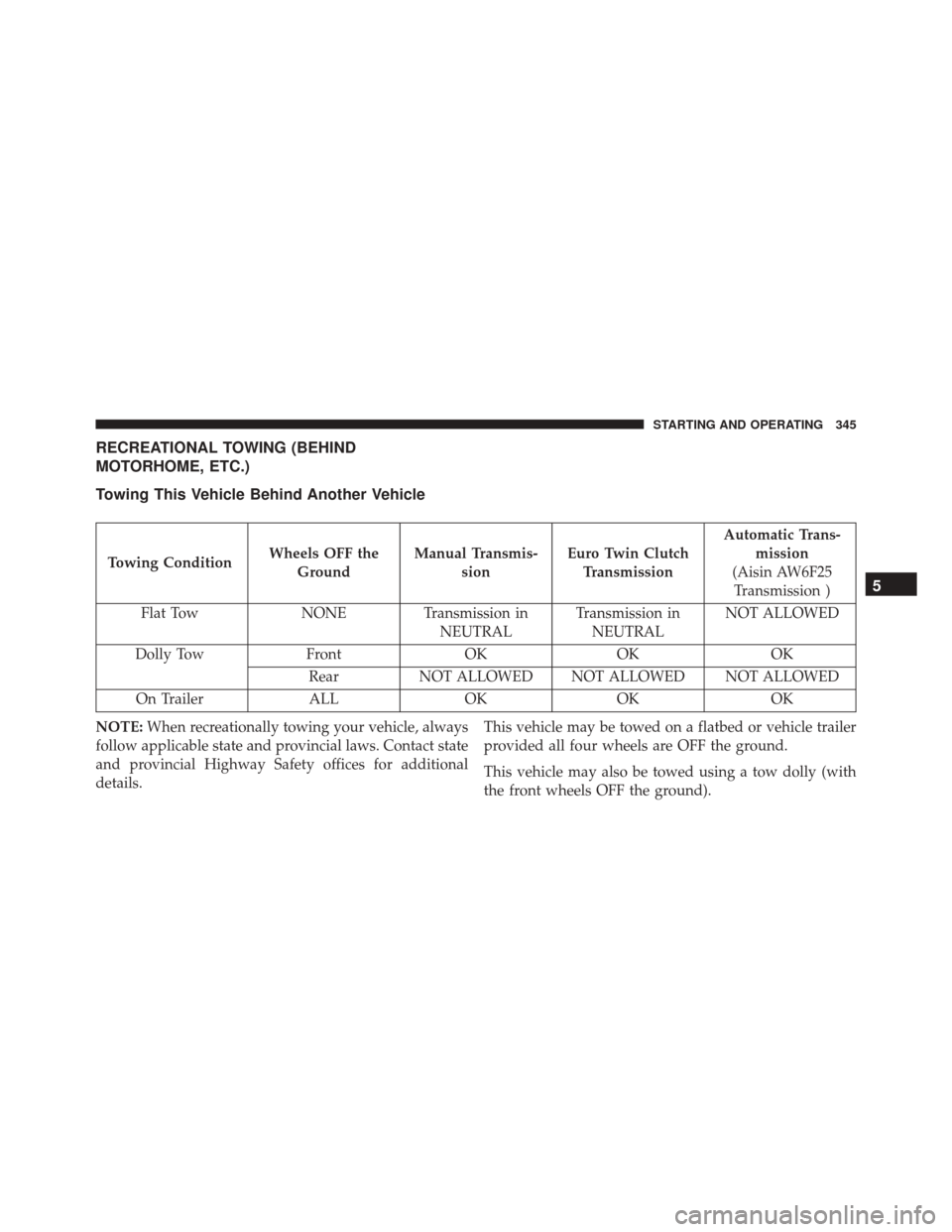
RECREATIONAL TOWING (BEHIND
MOTORHOME, ETC.)
Towing This Vehicle Behind Another Vehicle
Towing ConditionWheels OFF the
Ground Manual Transmis-
sion Euro Twin Clutch
Transmission Automatic Trans-
mission
(Aisin AW6F25 Transmission )
Flat Tow NONETransmission in
NEUTRAL Transmission in
NEUTRAL NOT ALLOWED
Dolly Tow FrontOKOK OK
Rear NOT ALLOWED NOT ALLOWED NOT ALLOWED
On Trailer ALLOKOK OK
NOTE: When recreationally towing your vehicle, always
follow applicable state and provincial laws. Contact state
and provincial Highway Safety offices for additional
details. This vehicle may be towed on a flatbed or vehicle trailer
provided all four wheels are OFF the ground.
This vehicle may also be towed using a tow dolly (with
the front wheels OFF the ground).
5
STARTING AND OPERATING 345
Page 348 of 476
Vehicles equipped with a manual transmission, or a Euro
Twin Clutch transmission, may be flat towed (with all
four wheels on the ground) at any legal highway speed,
for any distance, if the transmission is in NEUTRAL.
To place the Euro Twin Clutch transmission in NEU-
TRAL, follow the procedure below:
1. Turn the key to the ON/RUN position, without start-ing the engine.
2. Press the brake pedal and shift the transmission to NEUTRAL.
3. Turn the key to the OFF position. The key will remain in the ignition switch (it cannot be removed, since the
transmission is not in PARK). Leave the key in the OFF
position while being towed. 4. Release the brake pedal only when the parking brake
is applied, or the vehicle is securely connected to a tow
vehicle.
CAUTION!
•DO NOT flat tow any vehicle equipped with a
conventional automatic transmission. Damage to
the drivetrain will result. If these vehicles require
towing, make sure all drive wheels are OFF the
ground.
• Towing this vehicle in violation of the above re-
quirements can cause severe transmission damage.
Damage from improper towing is not covered un-
der the New Vehicle Limited Warranty.
(Continued)
346 STARTING AND OPERATING
Page 349 of 476
WHAT TO DO IN EMERGENCIES
CONTENTS
�HAZARD WARNING FLASHERS ...........349
� IF YOUR ENGINE OVERHEATS ............349
� WHEEL AND TIRE TORQUE
SPECIFICATIONS ..................... .350
▫ Torque Specifications ...................351
� TIRE SERVICE KIT ..................... .352
� JACKING AND TIRE CHANGING — IF
EQUIPPED .......................... .357
▫ Jack Location ....................... .358
▫ Spare Tire Removal ....................359 ▫
Preparations For Jacking ................360
▫ Jacking Instructions ...................360
▫ Spare Tire Stowage ....................364
� JUMP-STARTING PROCEDURE ............365
▫ Preparations For Jump-Start ..............366
▫ Jump-Starting Procedure ................367
� FREEING A STUCK VEHICLE .............370
� SHIFT LEVER OVERRIDE ................371
� TOWING A DISABLED VEHICLE ...........373
▫ Manual Transmission ...................374
6
Page 375 of 476
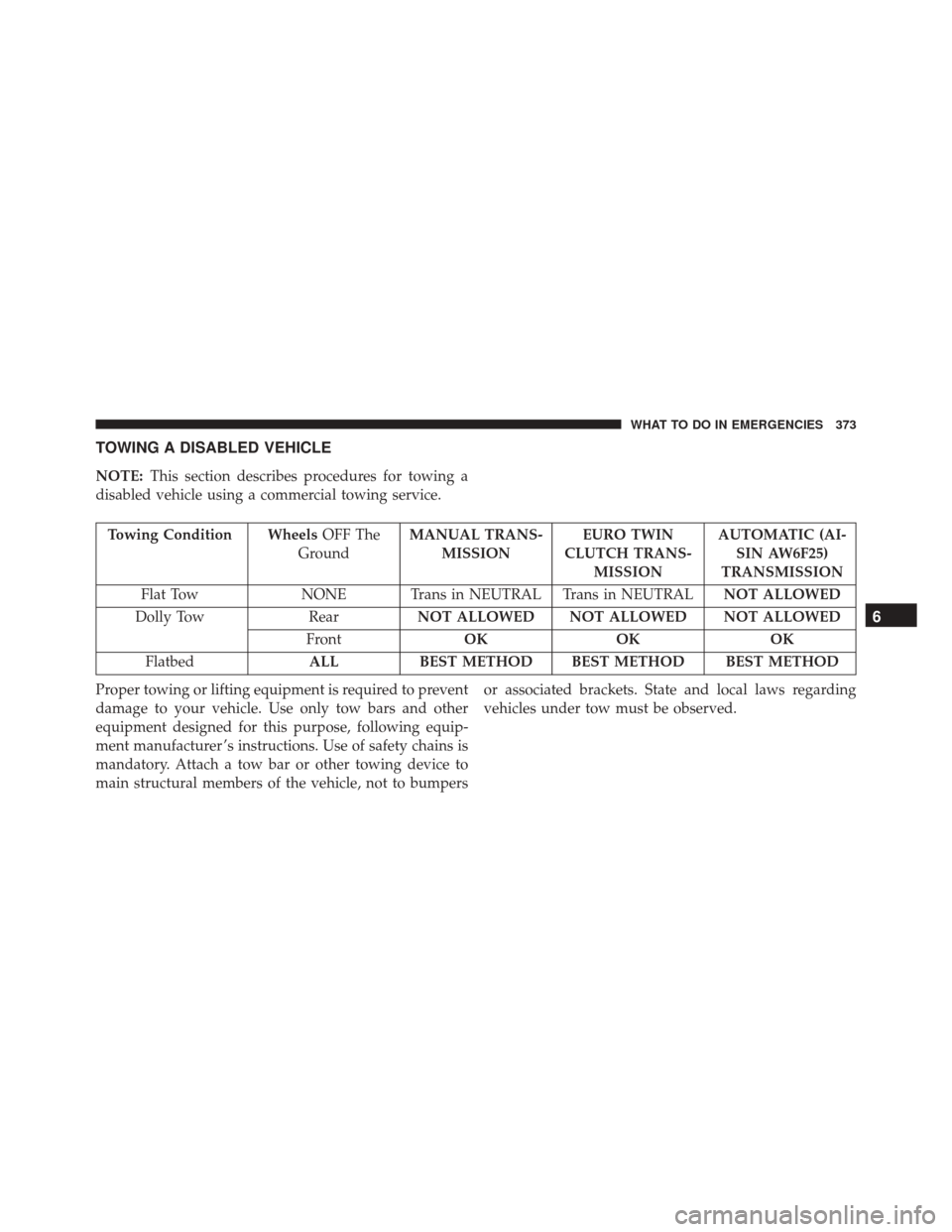
TOWING A DISABLED VEHICLE
NOTE:This section describes procedures for towing a
disabled vehicle using a commercial towing service.
Towing Condition Wheels OFF The
Ground MANUAL TRANS-
MISSION EURO TWIN
CLUTCH TRANS- MISSION AUTOMATIC (AI-
SIN AW6F25)
TRANSMISSION
Flat Tow NONE Trans in NEUTRAL Trans in NEUTRAL NOT ALLOWED
Dolly Tow RearNOT ALLOWED NOT ALLOWED NOT ALLOWED
Front OKOK OK
Flatbed ALLBEST METHOD BEST METHOD BEST METHOD
Proper towing or lifting equipment is required to prevent
damage to your vehicle. Use only tow bars and other
equipment designed for this purpose, following equip-
ment manufacturer ’s instructions. Use of safety chains is
mandatory. Attach a tow bar or other towing device to
main structural members of the vehicle, not to bumpers or associated brackets. State and local laws regarding
vehicles under tow must be observed.
6
WHAT TO DO IN EMERGENCIES 373
Page 376 of 476
CAUTION!
•Do not use sling-type equipment when towing.
Vehicle damage may occur.
• When securing the vehicle to a flatbed truck, do not
attach to front or rear suspension components.
Damage to your vehicle may result from improper
towing.
If you must use the accessories (wipers, defroster, etc.)
while being towed, the key must be in the ON/RUN
position.
Manual Transmission
• Vehicle can be flat towed (all four wheels on the
ground) with the transmission in NEUTRAL.
• Vehicle can be towed with the front wheels elevated. •
Vehicle can be towed on a flatbed truck (all wheels off
the ground).
CAUTION!
Towing this vehicle in violation of the above require-
ments can cause severe engine and/or transmission
damage. Damage from improper towing is not cov-
ered under the New Vehicle Limited Warranty.
Euro Twin Clutch Transmission
• Vehicle can be flat towed (all four wheels on the
ground) with the transmission in NEUTRAL.
• Vehicle can be towed with the front wheels elevated.
• Vehicle can be towed on a flatbed truck (all wheels off
the ground).
If the ignition key is unavailable, or the vehicle’s battery
is discharged, refer to �Shift Lever Override�in this
374 WHAT TO DO IN EMERGENCIES