Page 236 of 476
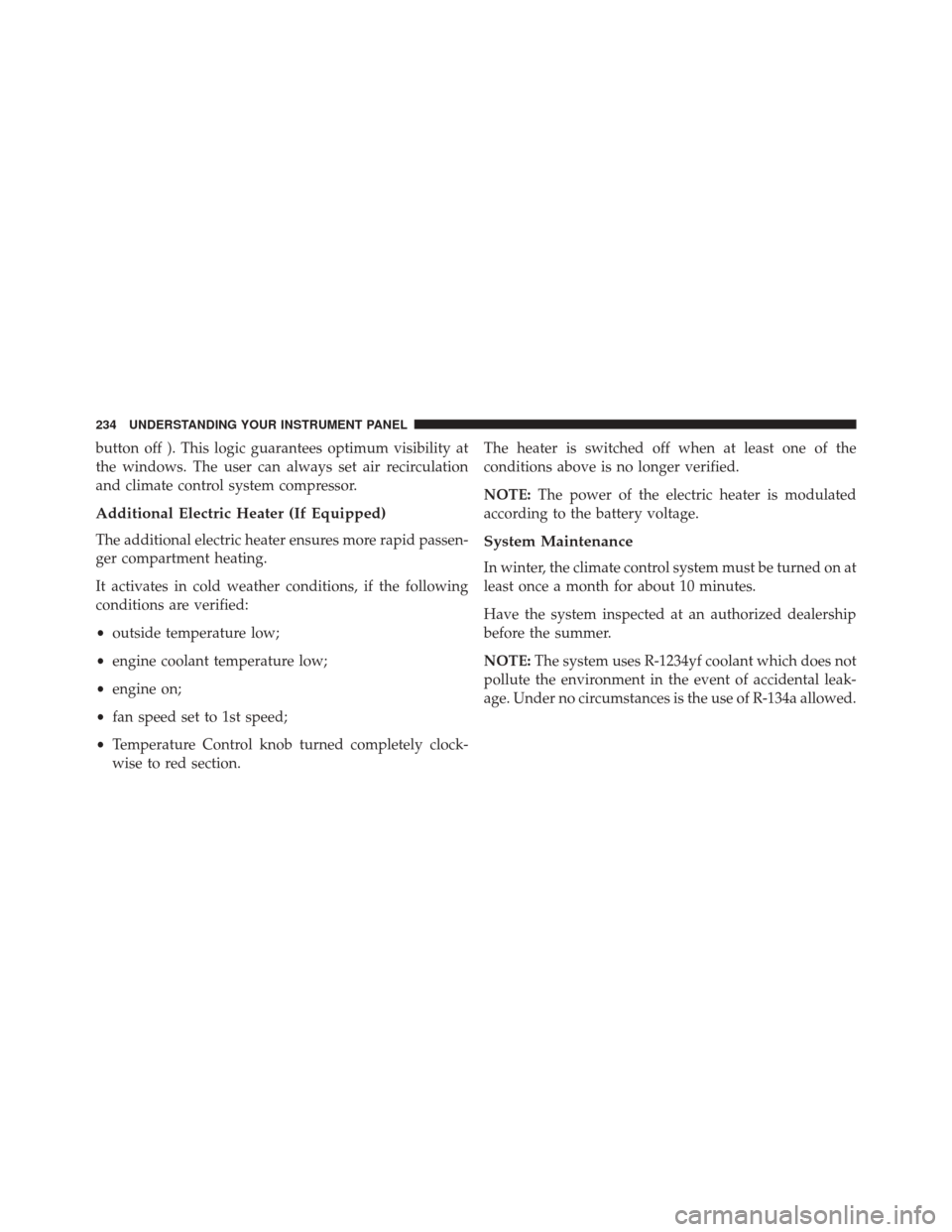
button off ). This logic guarantees optimum visibility at
the windows. The user can always set air recirculation
and climate control system compressor.
Additional Electric Heater (If Equipped)
The additional electric heater ensures more rapid passen-
ger compartment heating.
It activates in cold weather conditions, if the following
conditions are verified:
•outside temperature low;
• engine coolant temperature low;
• engine on;
• fan speed set to 1st speed;
• Temperature Control knob turned completely clock-
wise to red section. The heater is switched off when at least one of the
conditions above is no longer verified.
NOTE:
The power of the electric heater is modulated
according to the battery voltage.System Maintenance
In winter, the climate control system must be turned on at
least once a month for about 10 minutes.
Have the system inspected at an authorized dealership
before the summer.
NOTE: The system uses R-1234yf coolant which does not
pollute the environment in the event of accidental leak-
age. Under no circumstances is the use of R-134a allowed.
234 UNDERSTANDING YOUR INSTRUMENT PANEL
Page 242 of 476

During automatic operation, you can change the set
temperatures, air distribution and fan speed at any time
by using the relevant buttons or knobs: the system will
automatically change the settings to adjust to the new
requirements.
During completely automatic operation (AUTO), varying
the air flow and/or distribution (which are not dis-
played) causes the AUTO function LED to disappear and
the system to operate in MANUAL mode (displaying
both the flow and distribution requested).
When the compressor is deactivated, the AUTO opera-
tion remains active only if the system can guarantee
in-car comfort. Otherwise, the system switches to
MANUAL mode (the set temperatures will flash on the
display). The fan speed is the same in all the zones of the
passenger compartment.Adjusting The Air Temperature
Rotate the Driver Temperature Control, or the Passenger
Temperature Control, dial clockwise or anti clockwise, to
adjust the air temperature in the front left (Driver Tem-
perature Control) or right (Passenger Temperature Con-
trol) zone of the passenger compartment.
The set temperatures are shown on the displays.
Push the SYNC button to align the air temperature
between the two zones.
Turn the Passenger Temperature Control knob to return
to the separate management of air temperatures in the
two zones.
Turning the control knobs completely in one direction or
the other activates the�HI�(maximum heating) or �LO�
(maximum cooling) functions respectively.
240 UNDERSTANDING YOUR INSTRUMENT PANEL
Page 246 of 476
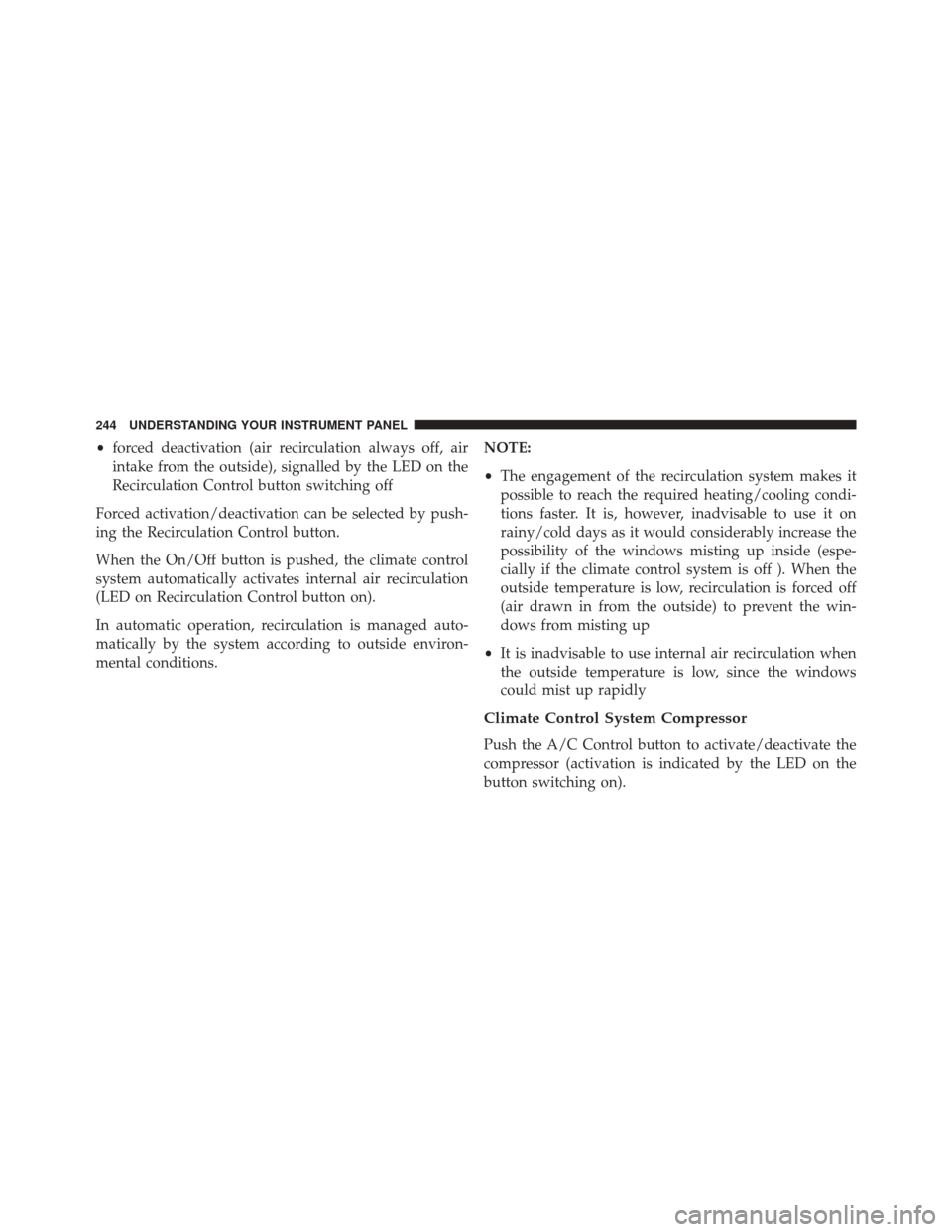
•forced deactivation (air recirculation always off, air
intake from the outside), signalled by the LED on the
Recirculation Control button switching off
Forced activation/deactivation can be selected by push-
ing the Recirculation Control button.
When the On/Off button is pushed, the climate control
system automatically activates internal air recirculation
(LED on Recirculation Control button on).
In automatic operation, recirculation is managed auto-
matically by the system according to outside environ-
mental conditions. NOTE:
•
The engagement of the recirculation system makes it
possible to reach the required heating/cooling condi-
tions faster. It is, however, inadvisable to use it on
rainy/cold days as it would considerably increase the
possibility of the windows misting up inside (espe-
cially if the climate control system is off ). When the
outside temperature is low, recirculation is forced off
(air drawn in from the outside) to prevent the win-
dows from misting up
• It is inadvisable to use internal air recirculation when
the outside temperature is low, since the windows
could mist up rapidly
Climate Control System Compressor
Push the A/C Control button to activate/deactivate the
compressor (activation is indicated by the LED on the
button switching on).
244 UNDERSTANDING YOUR INSTRUMENT PANEL
Page 249 of 476
NOTE:Do not affix stickers to the inside of the heated
rear window over the heating filaments, to avoid damage
that might cause them to stop working properly.
Switching Off The Climate Control System
Push the On/Off button.
With climate control system off:
• air recirculation is on, thus isolating the passenger
compartment from the outside;
• the compressor is off;
• the fan is off;
• the heated rear window can be activated / deacti-
vated. NOTE:
The climate control system control unit stores the
temperatures set before the system was switched off and
restores them when any button of the system is pushed
(except for the A/C Control button).
To restart the climate control system in fully automatic
mode push the AUTO button.
Additional Heater (If Equipped)
This allows the passenger compartment to be heated
more quickly in cold weather conditions.
The heater switches off automatically when the required
comfort conditions are achieved.
The additional heater activates automatically depending
on the environmental conditions and with engine started.
NOTE: The heater only operates if the outside tempera-
ture and engine coolant temperature are low. The heater
will not activate if the battery voltage is too low.
4
UNDERSTANDING YOUR INSTRUMENT PANEL 247
Page 282 of 476
MESSAGEDESCRIPTION
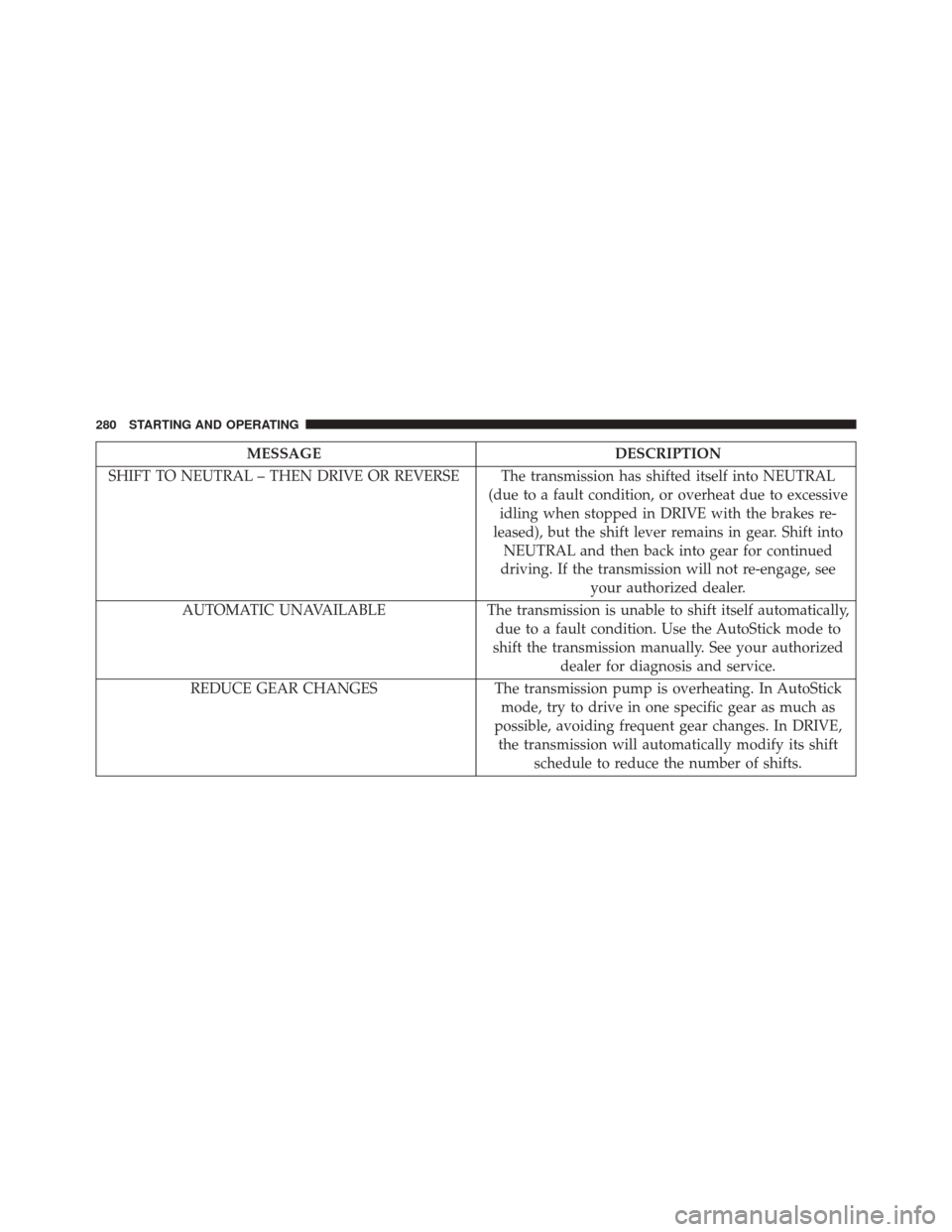
SHIFT TO NEUTRAL – THEN DRIVE OR REVERSE The transmission has shifted itself into NEUTRAL (due to a fault condition, or overheat due to excessiveidling when stopped in DRIVE with the brakes re-
leased), but the shift lever remains in gear. Shift into NEUTRAL and then back into gear for continued
driving. If the transmission will not re-engage, see your authorized dealer.
AUTOMATIC UNAVAILABLE The transmission is unable to shift itself automatically,
due to a fault condition. Use the AutoStick mode to
shift the transmission manually. See your authorized dealer for diagnosis and service.
REDUCE GEAR CHANGES The transmission pump is overheating. In AutoStick
mode, try to drive in one specific gear as much as
possible, avoiding frequent gear changes. In DRIVE, the transmission will automatically modify its shift schedule to reduce the number of shifts.
280 STARTING AND OPERATING
Page 283 of 476
MESSAGEDESCRIPTION
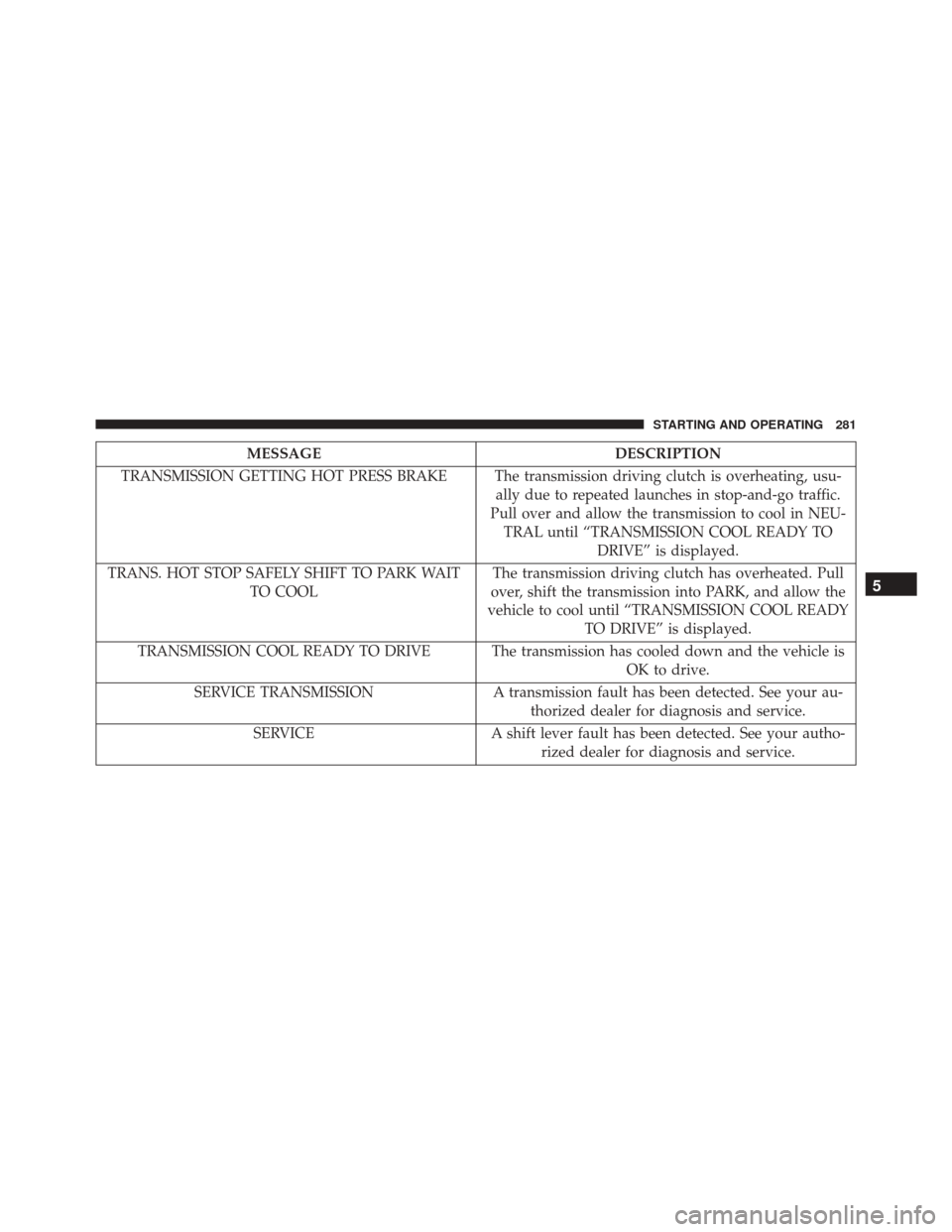
TRANSMISSION GETTING HOT PRESS BRAKE The transmission driving clutch is overheating, usu- ally due to repeated launches in stop-and-go traffic.
Pull over and allow the transmission to cool in NEU- TRAL until “TRANSMISSION COOL READY TO DRIVE” is displayed.
TRANS. HOT STOP SAFELY SHIFT TO PARK WAIT TO COOL The transmission driving clutch has overheated. Pull
over, shift the transmission into PARK, and allow the
vehicle to cool until “TRANSMISSION COOL READY TO DRIVE” is displayed.
TRANSMISSION COOL READY TO DRIVE The transmission has cooled down and the vehicle is OK to drive.
SERVICE TRANSMISSION A transmission fault has been detected. See your au-
thorized dealer for diagnosis and service.
SERVICE A shift lever fault has been detected. See your autho-
rized dealer for diagnosis and service.
5
STARTING AND OPERATING 281
Page 320 of 476
WARNING!
Overloading of your tires is dangerous. Overloading
can cause tire failure, affect vehicle handling, and
increase your stopping distance. Use tires of the
recommended load capacity for your vehicle. Never
overload them.
TIRES — GENERAL INFORMATION
Tire Pressure
Proper tire inflation pressure is essential to the safe and
satisfactory operation of your vehicle. Four primary areas
are affected by improper tire pressure:
•Safety and Vehicle Stability
• Economy
• Tread Wear
• Ride Comfort
Safety
WARNING!
•Improperly inflated tires are dangerous and can
cause collisions.
• Underinflation increases tire flexing and can result
in overheating and tire failure.
• Overinflation reduces a tire’s ability to cushion
shock. Objects on the road and chuckholes can
cause damage that result in tire failure.
• Overinflated or underinflated tires can affect ve-
hicle handling and can fail suddenly, resulting in
loss of vehicle control.
• Unequal tire pressures can cause steering prob-
lems. You could lose control of your vehicle.
• Unequal tire pressures from one side of the vehicle
to the other can cause the vehicle to drift to the
right or left.
(Continued)
318 STARTING AND OPERATING
Page 351 of 476
HAZARD WARNING FLASHERS
The Hazard Warning flasher switch is located on the
instrument panel below the radio.Push the switch to turn on the Hazard Warning
flashers. When the switch is activated, all direc-
tional turn signals will flash on and off to warn oncoming
traffic of an emergency. Push the switch a second time to
turn off the Hazard Warning flashers.
Do not use this emergency warning system when the
vehicle is in motion. Use it when your vehicle is disabled
and it is creating a safety hazard for other motorists.
If it is necessary to leave the vehicle to go for service, the
Hazard Warning flashers will continue to operate with
the ignition key removed and the vehicle locked.
NOTE: With extended use, the Hazard Warning flashers
may wear down your battery.
IF YOUR ENGINE OVERHEATS
In any of the following situations, you can reduce the
potential for overheating by taking the appropriate ac-
tion.
• On the highways — slow down.
• In city traffic — while stopped, place the transmission
in NEUTRAL, but do not increase engine idle speed.
NOTE: There are steps that you can take to slow down
an impending overheat condition:
• If your air conditioner (A/C) is on, turn it off. The A/C
system adds heat to the engine cooling system and
turning the A/C off can help remove this heat.
• You can also turn the temperature control to maximum
heat, the mode control to floor and the blower control
to high. This allows the heater core to act as a
6
WHAT TO DO IN EMERGENCIES 349