Page 285 of 362

CAUTION!
•When “rocking” a stuck vehicle by shifting be-
tween DRIVE and REVERSE, do not spin the
wheels faster than 15 mph (24 km/h), or drivetrain
damage may result.
• Spinning the wheels too fast may lead to transmis-
sion overheating and failure. It can also damage the
tires. Do not spin the wheels above 30 mph
(48 km/h) while in gear.
WARNING!
Fast spinning tires can be dangerous. Forces gener-
ated by excessive wheel speeds may cause damage, or
even failure, of the axle and tires. A tire could
explode and injure someone. Do not spin your vehi-
cle’s wheels faster than 30 mph (48 km/h) or for
(Continued)
WARNING! (Continued)
longer than 30 seconds continuously without stop-
ping when you are stuck and do not let anyone near
a spinning wheel, no matter what the speed.
MANUAL PARK RELEASE
WARNING!
Always secure your vehicle by fully applying the
parking brake, before activating the Manual Park
Release. Activating the Manual Park Release will
allow your vehicle to roll away if it is not secured by
the parking brake or other means. Activating the
Manual Park Release on an unsecured vehicle could
lead to serious injury or death for those in or around
the vehicle.6
WHAT TO DO IN EMERGENCIES 283
Page 287 of 362
TOWING A DISABLED VEHICLE
This section describes procedures for towing a disabled
vehicle using a commercial towing service.
Towing ConditionWheels OFF The Ground SINGLE-SPEED TRANSMISSION
Flat Tow NONENOT ALLOWED
Wheel Lift RearNOT ALLOWED
Front OK
Flatbed ALLOK
This vehicle must be towed with the front wheels OFF the
ground.
If you must use the accessories (wipers, defrosters, etc.)
while being towed, the ignition must be in the ON/RUN
position. If the ignition key is unavailable, or the battery is
discharged, see “Manual Park Release” in “What To Do
In Emergencies” for instructions on shifting the transmis-
sion out of PARK in order to move the vehicle.
6
WHAT TO DO IN EMERGENCIES 285
Page 310 of 362

CAUTION!
•Do not use abrasive or strong cleaning materials
such as steel wool or scouring powder that will
scratch metal and painted surfaces.
• Use of power washers exceeding 1,200 psi (8 274
kPa) can result in damage or removal of paint and
decals.
Special Care
• If you drive on salted or dusty roads or if you drive
near the ocean, hose off the undercarriage at least once
a month.
• It is important that the drain holes in the lower edges
of the doors, rocker panels, and trunk be kept clear and
open. •
If you detect any stone chips or scratches in the paint,
touch them up immediately. The cost of such repairs is
considered the responsibility of the owner.
• If your vehicle is damaged due to a collision or similar
cause that destroys the paint and protective coating,
have your vehicle repaired as soon as possible. The
cost of such repairs is considered the responsibility of
the owner.
• If you carry special cargo such as chemicals, fertilizers,
de-icer salt, etc., be sure that such materials are well
packaged and sealed.
• If a lot of driving is done on gravel roads, consider
mud or stone shields behind each wheel.
• Use MOPAR Touch Up Paint on scratches as soon as
possible. Your authorized dealer has touch up paint to
match the color of your vehicle.
308 MAINTAINING YOUR VEHICLE
Page 311 of 362

Wheel And Wheel Trim Care
•All wheels and wheel trim, especially aluminum and
chrome plated wheels, should be cleaned regularly
with a mild soap and water to prevent corrosion.
• To remove heavy soil and/or excessive brake dust, use
MOPAR Wheel Cleaner.
NOTE: If your vehicle is equipped with Dark Vapor or
Black Satin Chrome wheels DO NOT USE wheel cleaners,
abrasives or polishing compounds. They will perma-
nently damage this finish and such damage is not cov-
ered by the New Vehicle Limited Warranty. USE ONLY
MILD SOAP AND WATER WITH A SOFT CLOTH. Used
on a regular basis this is all that is required to maintain
this finish.
CAUTION!
Do not use scouring pads, steel wool, a bristle brush,
or metal polishes. Do not use oven cleaner. These
products may damage the wheel’s protective finish.
Avoid automatic car washes that use acidic solutions
or harsh brushes that may damage the wheel’s pro-
tective finish. Only MOPAR Wheel Cleaner or
equivalent is recommended.
Stain Repel Fabric Cleaning Procedure — If
Equipped
Stain Repel seats may be cleaned in the following man-
ner:
• Remove as much of the stain as possible by blotting
with a clean, dry towel.
• Blot any remaining stain with a clean, damp towel.
7
MAINTAINING YOUR VEHICLE 309
Page 327 of 362
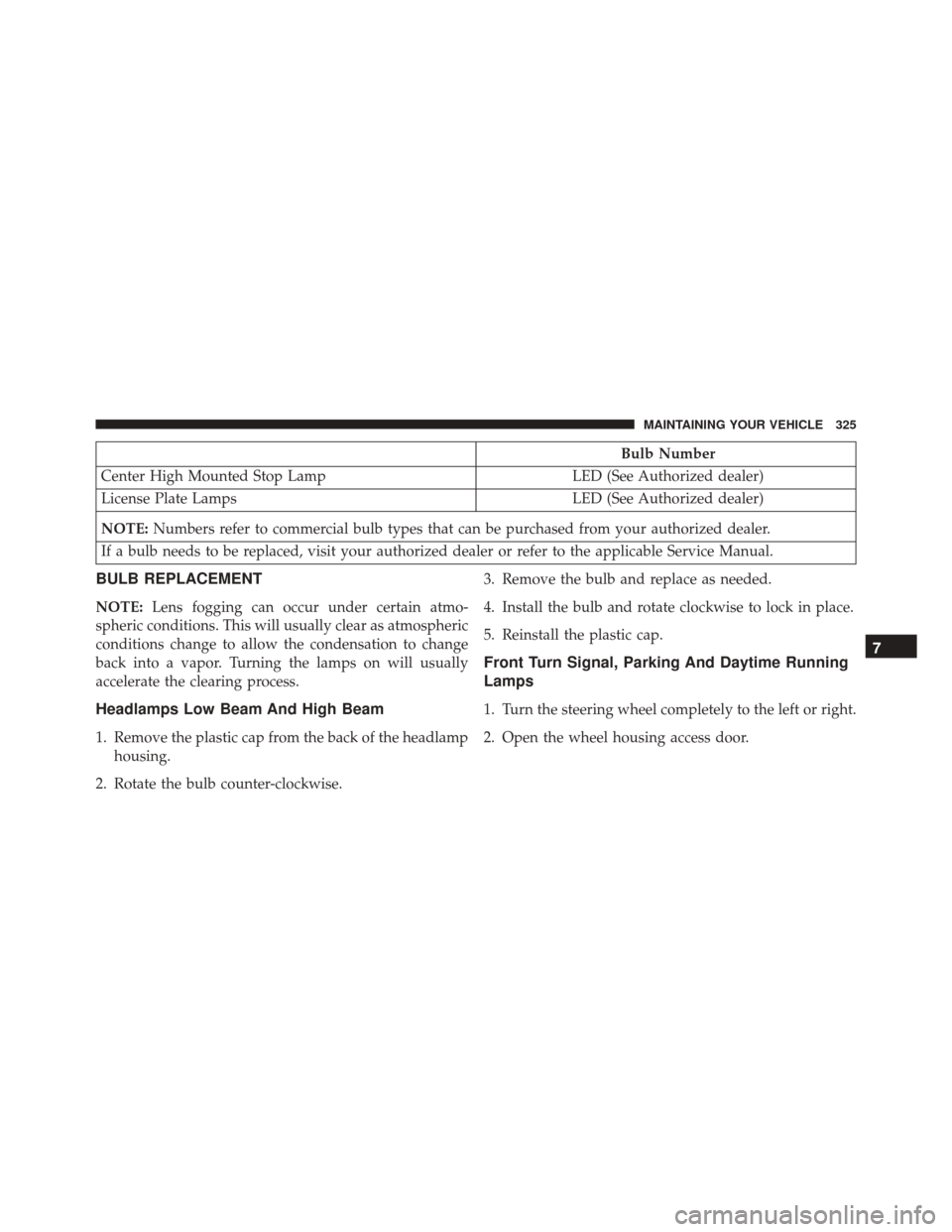
Bulb Number
Center High Mounted Stop Lamp LED (See Authorized dealer)
License Plate Lamps LED (See Authorized dealer)
NOTE: Numbers refer to commercial bulb types that can be purchased from your authorized dealer.
If a bulb needs to be replaced, visit your authorized dealer or refer to the applicable Service Manual.
BULB REPLACEMENT
NOTE: Lens fogging can occur under certain atmo-
spheric conditions. This will usually clear as atmospheric
conditions change to allow the condensation to change
back into a vapor. Turning the lamps on will usually
accelerate the clearing process.
Headlamps Low Beam And High Beam
1. Remove the plastic cap from the back of the headlamp housing.
2. Rotate the bulb counter-clockwise. 3. Remove the bulb and replace as needed.
4. Install the bulb and rotate clockwise to lock in place.
5. Reinstall the plastic cap.
Front Turn Signal, Parking And Daytime Running
Lamps
1. Turn the steering wheel completely to the left or right.
2. Open the wheel housing access door.
7
MAINTAINING YOUR VEHICLE 325
Page 328 of 362
3. Remove the plastic cap from the back of the lamphousing.
4. Rotate bulb/socket counter-clockwise.
5. Remove the bulb and replace as needed. 6. Install the bulb into socket, and rotate bulb/socket
clockwise into lamp locking it in place.
7. Reinstall the plastic cap.
Front Fog Lamps
To replace the front fog lights, see your authorized dealer.
Front/Rear Side Marker Lamps
1. Remove portion of the wheel liner to allow hand access to side marker lamp.
2. Rotate the bulb socket counterclockwise, and remove the bulb and socket assembly from the housing.
3. Pull the bulb from the socket and insert the replace- ment bulb.
4. Install the bulb and socket assembly into the housing, and rotate the socket clockwise to lock it in place.
5. Reinstall the wheel liner.
Wheel Housing Access Door
326 MAINTAINING YOUR VEHICLE
Page 348 of 362

WARNING!
The traction grade assigned to this tire is based on
straight-ahead braking traction tests, and does not
include acceleration, cornering, hydroplaning, or
peak traction characteristics.
Temperature Grades
The temperature grades are A (the highest), B, and C,
representing the tire’s resistance to the generation of heat
and its ability to dissipate heat, when tested under
controlled conditions on a specified indoor laboratory
test wheel. Sustained high temperature can cause the
material of the tire to degenerate and reduce tire life, and
excessive temperature can lead to sudden tire failure. The
grade C corresponds to a level of performance, which all
passenger vehicle tires must meet under the Federal
Motor Vehicle Safety Standard No. 109. Grades B and Arepresent higher levels of performance on the laboratory
test wheel, than the minimum required by law.
WARNING!
The temperature grade for this tire is established for
a tire that is properly inflated and not overloaded.
Excessive speed, under-inflation, or excessive load-
ing, either separately or in combination, can cause
heat buildup and possible tire failure.
346 IF YOU NEED CONSUMER ASSISTANCE
Page 351 of 362

Body Mechanism Lubrication.................301
B-Pillar Location ......................... .234
Brake Assist System ...................... .222
Brake Fluid ............................ .328
Brake, Parking .......................... .218
Brakes ................................ .304
Brake System ........................... .304
Anti-Lock (ABS) ....................... .220
Master Cylinder ....................... .305
Parking ............................. .218
Warning Light ........................ .148
Bulb Replacement ..................... .323, 325
Bulbs, Light .......................... .95, 323
Capacities, Fluid ......................... .328
Cargo Area Features ...................... .138
Car Washes ............................ .307
Cellular Phone .......................... .194
Chart, Tire Sizing ........................ .229Checking Your Vehicle For Safety
...............92
Checks, Safety ............................92
Child Restraint ............................73
Child Restraints Booster Seats ...........................78
Child Restraints .........................73
Child Seat Installation .....................89
How To Stow An Unused ALR Seat Belt ........86
Infants And Child Restraints ................76
Install A LATCH-Compatible Child Restraint ....85
Installing Child Restraints Using The Vehicle Seat
Belt ..................................87
Lower Anchors And Tethers For Children .......80
Older Children And Child Restraints ..........76
Seating Positions ........................79
Cleaning Wheels .............................. .309
Climate Control ......................... .195
Clutch ................................ .305
10
INDEX 349

