Page 307 of 432
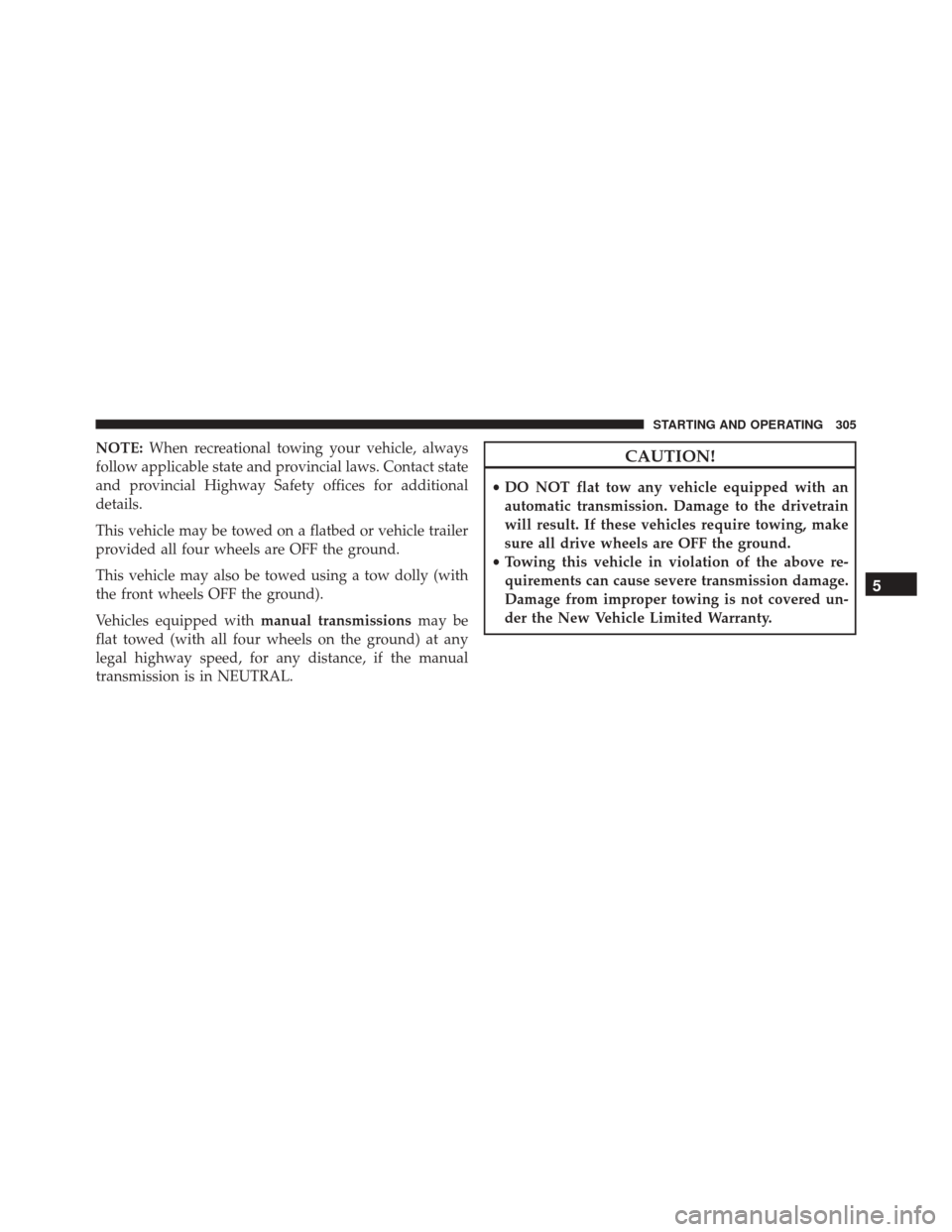
NOTE:When recreational towing your vehicle, always
follow applicable state and provincial laws. Contact state
and provincial Highway Safety offices for additional
details.
This vehicle may be towed on a flatbed or vehicle trailer
provided all four wheels are OFF the ground.
This vehicle may also be towed using a tow dolly (with
the front wheels OFF the ground).
Vehicles equipped with manual transmissionsmay be
flat towed (with all four wheels on the ground) at any
legal highway speed, for any distance, if the manual
transmission is in NEUTRAL.CAUTION!
• DO NOT flat tow any vehicle equipped with an
automatic transmission. Damage to the drivetrain
will result. If these vehicles require towing, make
sure all drive wheels are OFF the ground.
• Towing this vehicle in violation of the above re-
quirements can cause severe transmission damage.
Damage from improper towing is not covered un-
der the New Vehicle Limited Warranty.
5
STARTING AND OPERATING 305
Page 310 of 432
�TOWING A DISABLED VEHICLE ...........338
▫ Automatic Transmission .................339 ▫
Manual Transmission ...................340
308 WHAT TO DO IN EMERGENCIES
Page 340 of 432
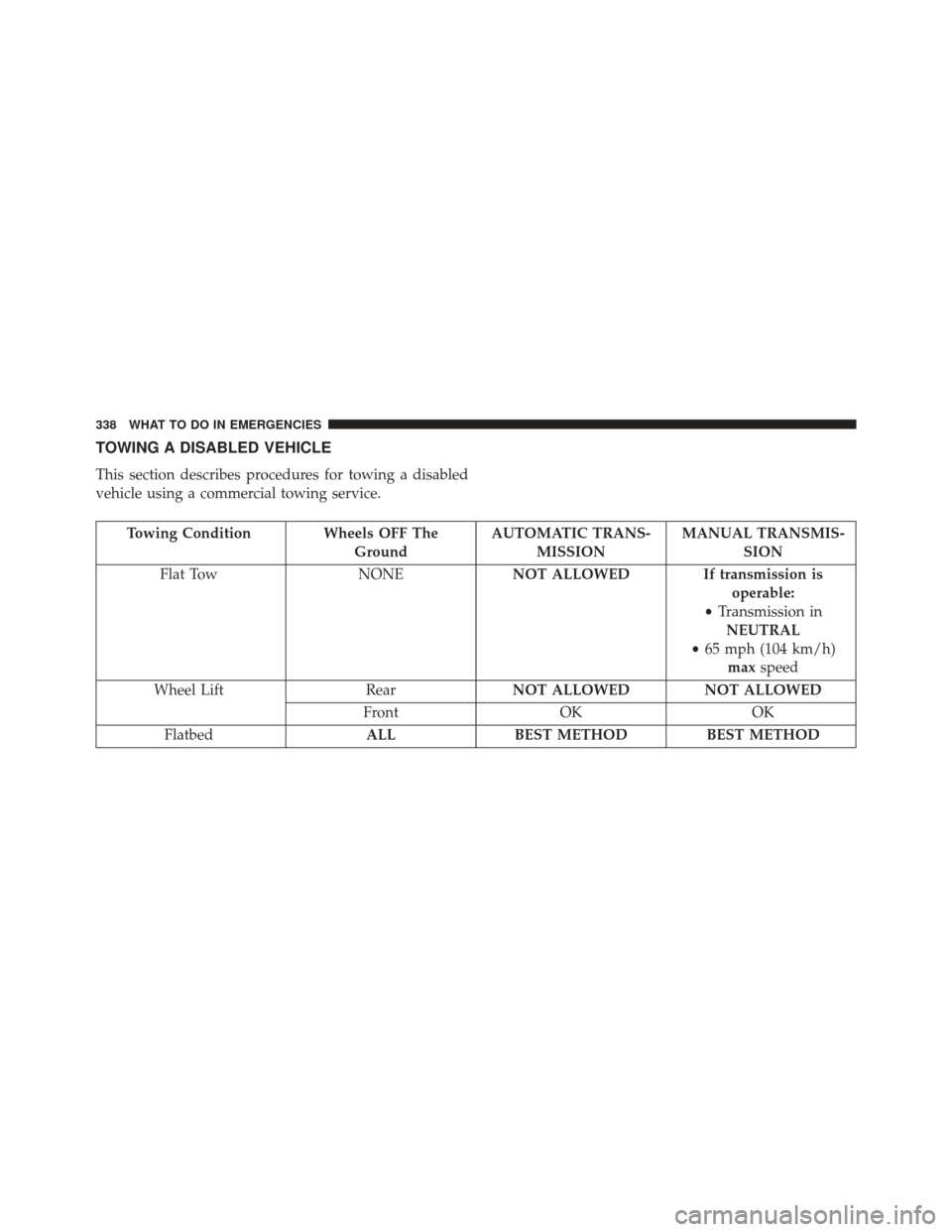
TOWING A DISABLED VEHICLE
This section describes procedures for towing a disabled
vehicle using a commercial towing service.
Towing Condition Wheels OFF TheGroundAUTOMATIC TRANS-
MISSION MANUAL TRANSMIS-
SION
Flat Tow NONENOT ALLOWED If transmission is
operable:
• Transmission in
NEUTRAL
• 65 mph (104 km/h)
max speed
Wheel Lift RearNOT ALLOWED NOT ALLOWED
Front OKOK
Flatbed ALLBEST METHOD BEST METHOD
338 WHAT TO DO IN EMERGENCIES
Page 341 of 432

Proper towing or lifting equipment is required to prevent
damage to your vehicle. Use only tow bars and other
equipment designed for this purpose, following equip-
ment manufacturer ’s instructions. Use of safety chains is
mandatory. Attach a tow bar or other towing device to
main structural members of the vehicle, not to bumpers
or associated brackets. State and local laws regarding
vehicles under tow must be observed.
If you must use the accessories (wipers, defrosters, etc.)
while being towed, the ignition must be in the ON/RUN
position.
CAUTION!
•Do not use sling-type equipment when towing.
Vehicle damage may occur.
(Continued)
CAUTION! (Continued)
•When securing the vehicle to a flatbed truck, do not
attach to front or rear suspension components.
Damage to your vehicle may result from improper
towing.
Automatic Transmission
• Vehicle can be towed with the front wheels elevated.
• Vehicle can be towed on a flatbed truck (all wheels off
the ground).
If the ignition key is unavailable, or the battery is
discharged, refer to “Gear Selector Override” in this
section for instructions on shifting the transmission out of
PARK in order to move the vehicle.
6
WHAT TO DO IN EMERGENCIES 339
Page 342 of 432
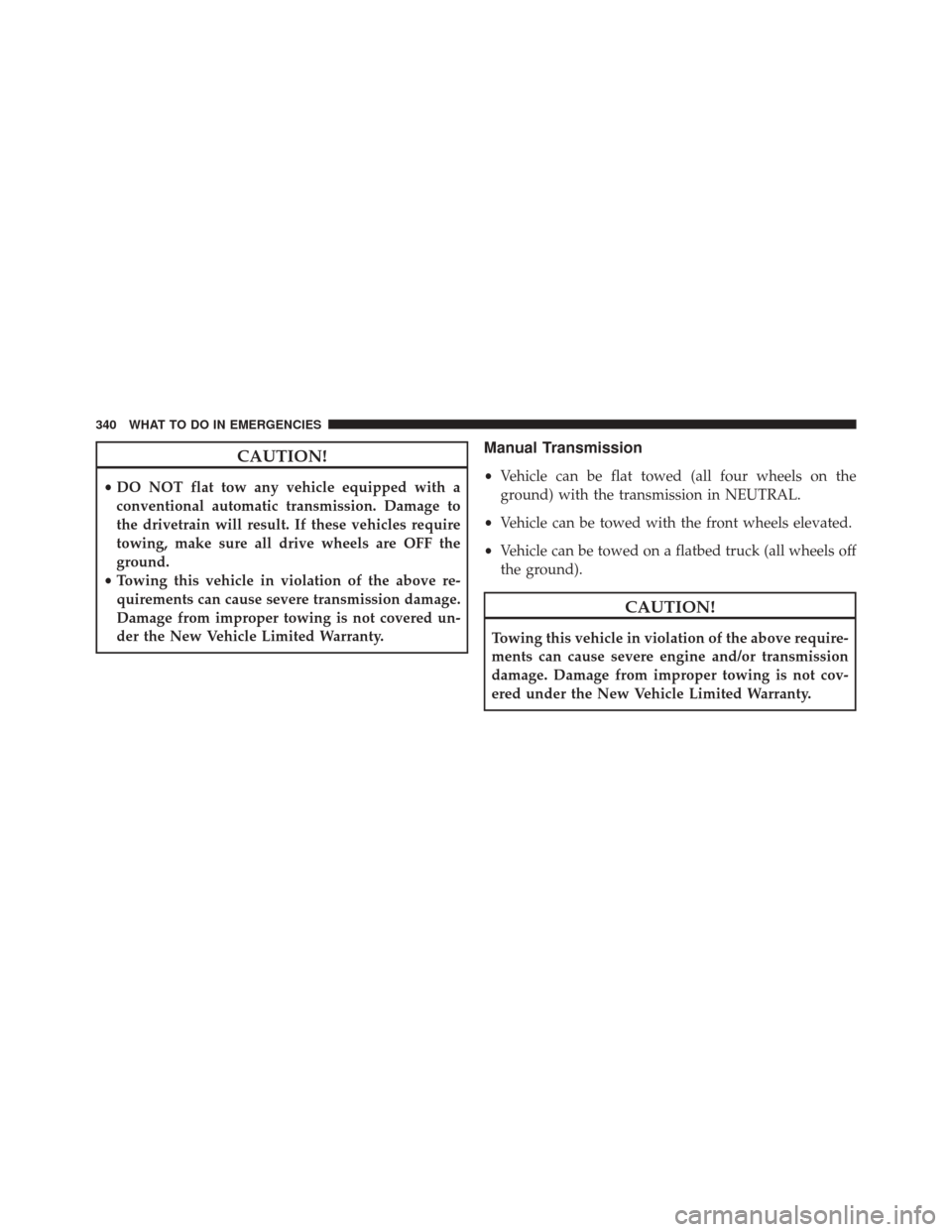
CAUTION!
•DO NOT flat tow any vehicle equipped with a
conventional automatic transmission. Damage to
the drivetrain will result. If these vehicles require
towing, make sure all drive wheels are OFF the
ground.
• Towing this vehicle in violation of the above re-
quirements can cause severe transmission damage.
Damage from improper towing is not covered un-
der the New Vehicle Limited Warranty.
Manual Transmission
• Vehicle can be flat towed (all four wheels on the
ground) with the transmission in NEUTRAL.
• Vehicle can be towed with the front wheels elevated.
• Vehicle can be towed on a flatbed truck (all wheels off
the ground).
CAUTION!
Towing this vehicle in violation of the above require-
ments can cause severe engine and/or transmission
damage. Damage from improper towing is not cov-
ered under the New Vehicle Limited Warranty.
340 WHAT TO DO IN EMERGENCIES
Page 346 of 432

ONBOARD DIAGNOSTIC SYSTEM — OBD II
Your vehicle is equipped with a sophisticated Onboard
Diagnostic system called OBD II. This system monitors
the performance of the emissions, engine, and automatic
transmission control systems. When these systems are
operating properly, your vehicle will provide excellent
performance and fuel economy, as well as engine emis-
sions well within current government regulations.
If any of these systems require service, the OBD II system
will turn on the Malfunction Indicator Light (MIL). It will
also store diagnostic codes and other information to
assist your service technician in making repairs. Al-
though your vehicle will usually be drivable and not
need towing, see your authorized dealer for service as
soon as possible.
CAUTION!
•Prolonged driving with the MIL on could cause
further damage to the emission control system. It
could also affect fuel economy and driveability.
The vehicle must be serviced before any emissions
tests can be performed.
• If the MIL is flashing while the engine is running,
severe catalytic converter damage and power loss
will soon occur. Immediate service is required.
Onboard Diagnostic System (OBD II)
Cybersecurity
Your vehicle is required to have an Onboard Diagnostic
system (OBD II) and a connection port to allow access to
information related to the performance of your emissions
controls. Authorized service technicians may need to
344 MAINTAINING YOUR VEHICLE
Page 364 of 432

Under normal operating conditions, the catalytic con-
verter will not require maintenance. However, it is im-
portant to keep the engine properly tuned to assure
proper catalyst operation and prevent possible catalyst
damage.
NOTE:Intentional tampering with emissions control
systems can result in civil penalties being assessed
against you.
In unusual situations involving grossly malfunctioning
engine operation, a scorching odor may suggest severe
and abnormal catalyst overheating. If this occurs, stop
the vehicle, turn off the engine and allow it to cool.
Service, including a tune-up to manufacturer’s specifica-
tions, should be obtained immediately. To minimize the possibility of catalytic converter dam-
age:
•
Do not shut off the engine or interrupt the ignition,
when the transmission is in gear and the vehicle is in
motion.
• Do not try to start the engine by pushing or towing the
vehicle.
• Do not idle the engine with any spark plug wires
disconnected or removed, such as when diagnostic
testing, or for prolonged periods during very rough
idle or malfunctioning operating conditions.
362 MAINTAINING YOUR VEHICLE
Page 420 of 432

Electronic Speed Control (Cruise Control)........110
Electronic Stability Control (ESC) ..............257
Electronic Throttle Control Warning Light ........156
Electronic Vehicle Information Center (EVIC) ......178
Exit Trip ............................. .182
NewTrip ............................ .182
Start Of Trip Procedure ...................182
Trip Computer ........................ .181
Trip Functions ........................ .183
Emergency, In Case Of Hazard Warning Flasher ..................309
Jacking .............................. .323
Jump Starting ......................... .331
Towing ............................. .338
Emission Control System Maintenance ..........345
Engine Air Cleaner .......................... .351
Break-In Recommendations .................74
Checking Oil Level ..................... .348Compartment
......................... .343
Cooling ............................. .363
Exhaust Gas Caution ..................76, 301
Fails To Start ......................... .231
Flooded, Starting ...................... .231
Fuel Requirements ..................... .297
Oil ............................. .348, 393
Oil Filler Cap ......................... .350
Oil Filter ............................ .350
Oil Selection ...................... .349, 394
Overheating .......................... .309
Starting ............................. .229
Enhanced Accident Response Feature ............50
Ethanol ............................... .298
Euro Twin Clutch Transmission Fluid Type ........................... .371
Event Data Recorder ........................54
Exhaust Gas Caution ....................76, 301
Exhaust System ....................... .76, 360
418 INDEX