Page 299 of 423

CORAX3
TRA
REGISTERED No: ER37066/15
DEALER No: DA0047074/10
FUEL REQUIREMENTS
8.4L Engine
The 8.4L engine is designed to meet all
emissions regulations, provide optimal
fuel economy and performance when us-
ing high-quality unleaded “Premium”
gasoline having a posted octane number of
91 as specified by the (R+M)/2 method. The use of 91 or
higher octane “Premium” gasoline is required for in this
engine. While operating on gasoline with the required octane
number, hearing a light knocking sound from the engine
is not a cause for concern. However, if the engine is heard
making a heavy knocking sound, see your dealer imme-
diately. Use of gasoline with a lower than recommended
octane number can cause engine failure and may void or
not be covered by the New Vehicle Limited Warranty.
Poor quality gasoline can cause problems such as hard
starting, stalling, and hesitations. If you experience these
symptoms, try another brand of gasoline before consid-
ering service for the vehicle.
Reformulated Gasoline
Many areas of the country require the use of cleaner
burning gasoline referred to as “Reformulated Gasoline”.
Reformulated gasoline contains oxygenates and are spe-
cifically blended to reduce vehicle emissions and im-
prove air quality.
5
STARTING AND OPERATING 297
Page 302 of 423

Fuel System Cautions
CAUTION!
Follow these guidelines to maintain your vehicle’s
performance:
•The use of leaded gasoline is prohibited by Federal
law. Using leaded gasoline can impair engine per-
formance and damage the emissions control sys-
tem.
• An out-of-tune engine or certain fuel or ignition
malfunctions can cause the catalytic converter to
overheat. If you notice a pungent burning odor or
some light smoke, your engine may be out of tune
or malfunctioning and may require immediate ser-
vice. Contact your authorized dealer for service
assistance.
(Continued)
CAUTION! (Continued)
•The use of fuel additives, which are now being
sold as octane enhancers, is not recommended.
Most of these products contain high concentrations
of methanol. Fuel system damage or vehicle perfor-
mance problems resulting from the use of such
fuels or additives is not the responsibility of the
manufacturer and may void or not be covered
under the New Vehicle Limited Warranty.
NOTE: Intentional tampering with the emissions control
system can result in civil penalties being assessed against
you.
300 STARTING AND OPERATING
Page 311 of 423
WHAT TO DO IN EMERGENCIES
CONTENTS
�HAZARD WARNING FLASHER ...........310
� IF YOUR ENGINE OVERHEATS ............310
� WHEEL AND TIRE TORQUE
SPECIFICATIONS ......................311
▫ Torque Specifications ...................311
� TIRE SERVICE KIT — IF EQUIPPED .........313
▫ Tire Service Kit Storage .................313
▫ Tire Service Kit Components And Operation . .314 ▫
Tire Service Kit Usage Precautions ..........315
▫ Sealing A Tire With Tire Service Kit .........317
� JUMP-STARTING PROCEDURES ...........323
� FREEING A STUCK VEHICLE .............327
� TOWING A DISABLED VEHICLE ...........329
6
Page 315 of 423
WARNING!
To avoid the risk of forcing the vehicle off the jack,
do not tighten the lug nuts fully until the vehicle has
been lowered. Failure to follow this warning may
result in personal injury.
TIRE SERVICE KIT — IF EQUIPPED
Small punctures up to 1/4 inch (6 mm) in the tire tread
can be sealed with Tire Service Kit. Foreign objects (e.g.,
screws or nails) should not be removed from the tire. Tire
Service Kit can be used in outside temperatures down to
approximately -4°F (-20°C).
This kit will provide a temporary tire seal, allowing you
to drive your vehicle up to 100 miles (160 km) with a
maximum speed of 55 mph (90 km/h).
Tire Service Kit Storage
The Tire Service Kit is located in the left side of the trunk.
Tire Service Kit Location
6
WHAT TO DO IN EMERGENCIES 313
Page 316 of 423
Tire Service Kit Components And OperationUsing The Mode Select Knob And Hoses
Your Tire Service Kit is equipped with the following
symbols to indicate the air or sealant mode.
Selecting Air Mode
Push in the Mode Select Knob (5) and turn to
this position for air pump operation only. Use
the Black Air Pump Hose (7) when selecting
this mode.
Selecting Sealant Mode
Push in the Mode Select Knob (5) and
turn to this position to inject the Tire
Service Kit Sealant and to inflate the
tire. Use the Sealant Hose (clear hose)
(6) when selecting this mode.
Tire Service Kit Components
1 — Sealant Bottle 5 — Mode Select Knob
2 — Deflation Button 6 — Sealant Hose (Clear)
3 — Pressure Gauge 7 — Air Pump Hose (Black)
4 — Power Button 8 — Power Plug (located on the bot- tom side of the Tire Service Kit)
314 WHAT TO DO IN EMERGENCIES
Page 317 of 423
Using The Power ButtonPush and release the Power Button (4) once to
turn On the Tire Service Kit. Push and release
the Power Button (4) again to turn Off the Tire
Service Kit.
Using The Deflation Button
Push the Deflation Button (2) to reduce the air
pressure in the tire if it becomes over-inflated.
Tire Service Kit Usage Precautions
•Replace the Tire Service Kit Sealant Bottle (1) and
Sealant Hose (6) prior to the expiration date (printed at
the lower right hand corner on the bottle label) to
assure optimum operation of the system. Refer to
“Sealing a Tire with Tire Service Kit” section (F)
“Sealant Bottle and Hose Replacement”. •
The Sealant Bottle (1) and Sealant Hose (6) are a one
tire application use and need to be replaced after each
use. Always replace these components immediately at
your original equipment vehicle dealer.
• When the Tire Service Kit sealant is in a liquid form,
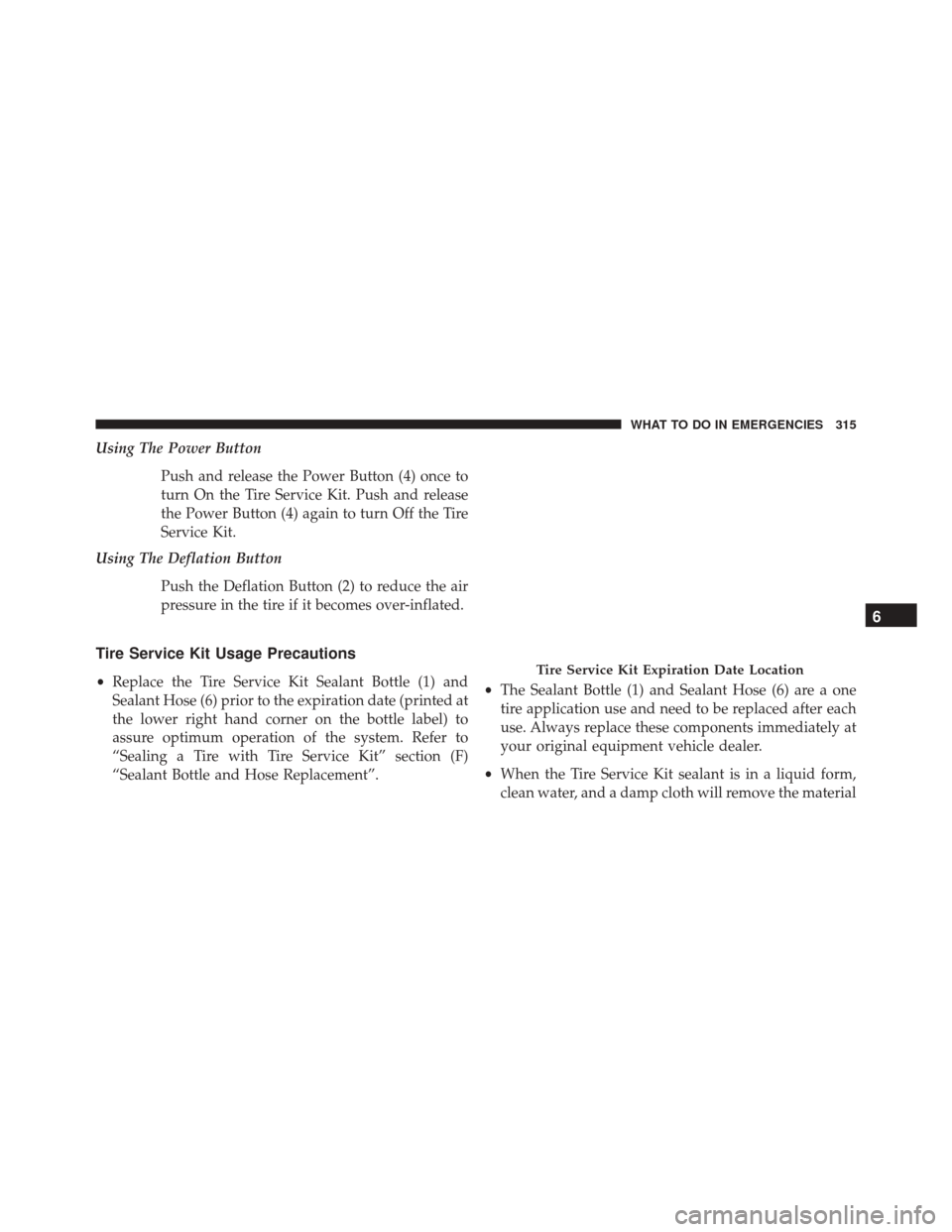
clean water, and a damp cloth will remove the materialTire Service Kit Expiration Date Location
6
WHAT TO DO IN EMERGENCIES 315
Page 318 of 423
from the vehicle or tire and wheel components. Once
the sealant dries, it can easily be peeled off and
properly discarded.
• For optimum performance, make sure the valve stem
on the wheel is free of debris before connecting the Tire
Service Kit.
• You can use the Tire Service Kit air pump to inflate
bicycle tires. The kit also comes with two needles,
located in the Accessory Storage Compartment (on the
bottom of the air pump) for inflating sport balls, rafts,
or similar inflatable items. However, use only the Air
Pump Hose (7) and make sure the Mode Select Knob
(5) is in the Air Mode when inflating such items to
avoid injecting sealant into them. The Tire Service Kit
Sealant is only intended to seal punctures less than 1/4
inch (6 mm) diameter in the tread of your vehicle.
• Do not lift or carry the Tire Service Kit by the hoses.WARNING!
•Do not attempt to seal a tire on the side of the
vehicle closest to traffic. Pull far enough off the
road to avoid the danger of being hit when using
the Tire Service Kit.
• Do not use Tire Service Kit or drive the vehicle
under the following circumstances:
– If the puncture in the tire tread is approximately 1/4 inch (6 mm) or larger.
– If the tire has any sidewall damage.
– If the tire has any damage from driving with extremely low tire pressure.
– If the tire has any damage from driving on a flat tire.
– If the wheel has any damage.
– If you are unsure of the condition of the tire or the wheel.
(Continued)
316 WHAT TO DO IN EMERGENCIES
Page 319 of 423
WARNING!(Continued)
•Keep Tire Service Kit away from open flames or
heat source.
• A loose Tire Service Kit thrown forward in a
collision or hard stop could endanger the occupants
of the vehicle. Always stow the Tire Service Kit in
the place provided. Failure to follow these warn-
ings can result in injuries that are serious or fatal to
you, your passengers, and others around you.
• Take care not to allow the contents of Tire Service
Kit to come in contact with hair, eyes, or clothing.
Tire Service Kit sealant is harmful if inhaled,
swallowed, or absorbed through the skin. It causes
skin, eye, and respiratory irritation. Flush immedi-
ately with plenty of water if there is any contact
with eyes or skin. Change clothing as soon as
possible, if there is any contact with clothing.
(Continued)
WARNING! (Continued)
•Tire Service Kit Sealant solution contains latex. In
case of an allergic reaction or rash, consult a phy-
sician immediately. Keep Tire Service Kit out of
reach of children. If swallowed, rinse mouth imme-
diately with plenty of water and drink plenty of
water. Do not induce vomiting! Consult a physician
immediately.
Sealing A Tire With Tire Service Kit
(A) Whenever You Stop To Use Tire Service Kit:
1. Pull over to a safe location and turn on the vehicle’s Hazard Warning flashers.
2. Verify that the valve stem (on the wheel with the deflated tire) is in a position that is near to the ground.
This will allow the Tire Service Kit Hoses (6) and (7) to
reach the valve stem and keep the Tire Service Kit flat
6
WHAT TO DO IN EMERGENCIES 317