Page 238 of 423
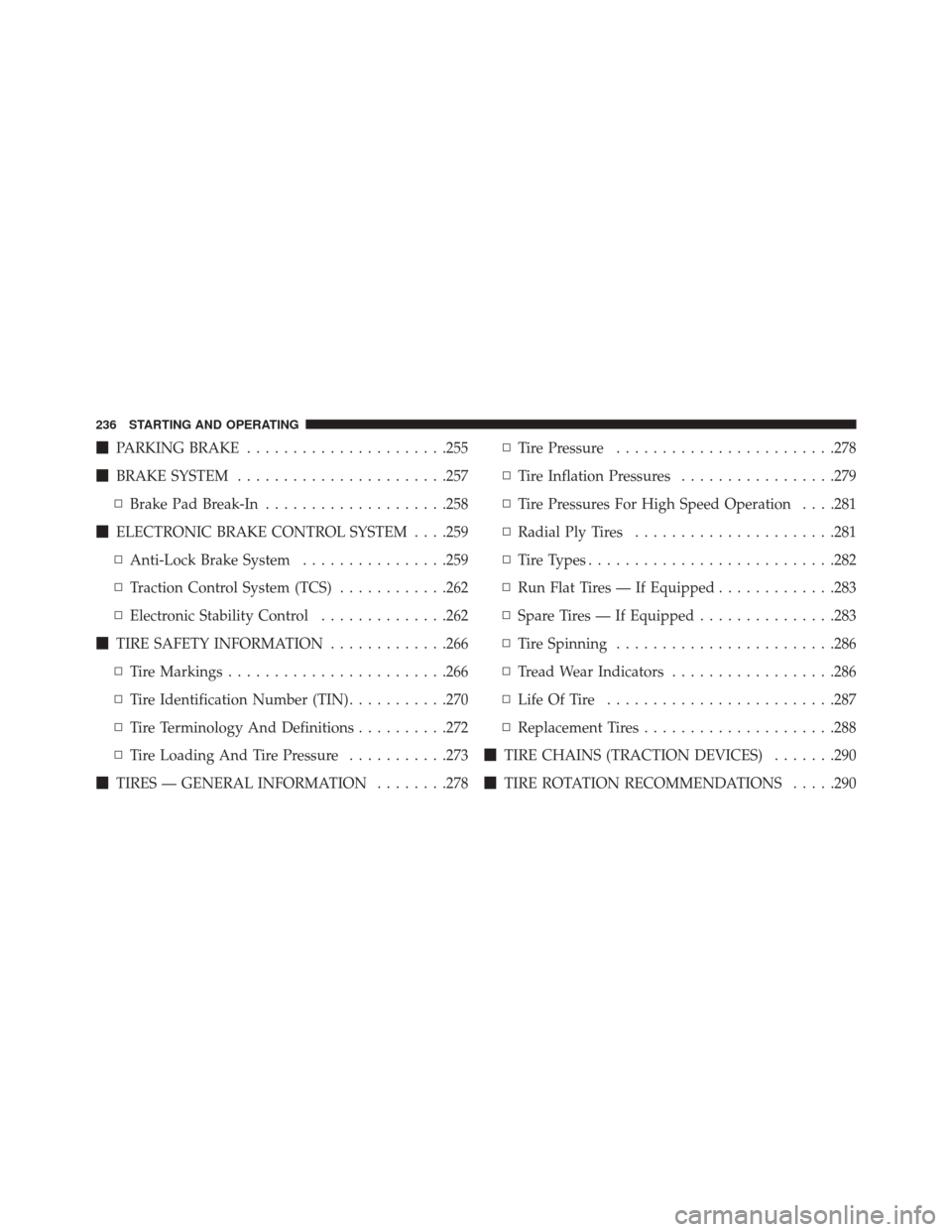
�PARKING BRAKE ..................... .255
� BRAKE SYSTEM ...................... .257
▫ Brake Pad Break-In ....................258
� ELECTRONIC BRAKE CONTROL SYSTEM . . . .259
▫ Anti-Lock Brake System ................259
▫ Traction Control System (TCS) ............262
▫ Electronic Stability Control ..............262
� TIRE SAFETY INFORMATION .............266
▫ Tire Markings ....................... .266
▫ Tire Identification Number (TIN) ...........270
▫ Tire Terminology And Definitions ..........272
▫ Tire Loading And Tire Pressure ...........273
� TIRES — GENERAL INFORMATION ........278▫
Tire Pressure ....................... .278
▫ Tire Inflation Pressures .................279
▫ Tire Pressures For High Speed Operation . . . .281
▫ Radial Ply Tires ..................... .281
▫ Tire Types .......................... .282
▫ Run Flat Tires — If Equipped .............283
▫ Spare Tires — If Equipped ...............283
▫ Tire Spinning ....................... .286
▫ Tread Wear Indicators ..................286
▫ Life Of Tire ........................ .287
▫ Replacement Tires .....................288
� TIRE CHAINS (TRACTION DEVICES) .......290
� TIRE ROTATION RECOMMENDATIONS .....290
236 STARTING AND OPERATING
Page 239 of 423
�TIRE PRESSURE MONITOR SYSTEM (TPMS) . .291
▫ Premium System ..................... .294
� FUEL REQUIREMENTS ..................297
▫ 8.4L Engine ......................... .297
▫ Reformulated Gasoline .................297
▫ Gasoline/Oxygenate Blends ..............298
▫ E-85 Usage In Non-Flex Fuel Vehicles .......298
▫ MMT In Gasoline .....................299
▫ Materials Added To Fuel ................299
▫ Fuel System Cautions ...................300 ▫
Carbon Monoxide Warnings .............301
� ADDING FUEL ....................... .301
▫ Emergency Fuel Filler Door Release .........303
� TRAILER TOWING .....................306
� RECREATIONAL TOWING (BEHIND
MOTORHOME, ETC.) ...................306
▫ Towing This Vehicle Behind Another Vehicle
(Flat Towing With All Four Wheels On The
Ground) .......................... .306
� GROUND CLEARANCE .................307
5
STARTING AND OPERATING 237
Page 251 of 423

TRACK USE
Guidelines For Track Use
NOTE:Because of the extreme conditions encountered
during track use, any damage or wear associated with
track use is not covered by warranty.
• It is recommended that the shocks be operated in
RACE mode, if equipped.
• ESC is track capable in all modes.
Prior To Each Track Event/Day
• Verify all fluids are at the correct levels. Refer to “Fluid
Capacities” in “Maintaining Your Vehicle” for further
information.
• Verify the front and rear brake pads have more than ½
pad thickness remaining. If the brake pads require
changing, please burnish prior to track outing at full
pace. •
Tire pressure:
– 35psi hot recommended. This typically can be achieved with cold pressures between 25 and 29 psi,
depending on driver, track, and ambient conditions.
Conclusion Of Each Track Event
• It is recommended that a brake bleed procedure is
performed to maintain the pedal feel and stopping
capability of your brake system.
• It is recommended that each track outing should end
with a minimum of 1 cool down lap using minimal
braking.
• Following each track session, tires should be inspected
for wear.
5
STARTING AND OPERATING 249
Page 261 of 423

WARNING!(Continued)
•Do not drive too fast for road conditions, especially
when roads are wet or slushy. A wedge of water can
build up between the tire tread and the road. This
hydroplaning action can cause loss of traction,
braking ability, and control.
• After going through deep water or a car wash,
brakes may become wet, resulting in decreased
performance and unpredictable braking action.
Dry the brakes by gentle, intermittent pedal action
while driving at very slow speeds.
ELECTRONIC BRAKE CONTROL SYSTEM
Your vehicle is equipped with an advanced electronic
brake control system that includes the Anti-Lock Brake
System (ABS), Traction Control System (TCS), and Elec-
tronic Stability Control (ESC). All of these systems work
together to enhance vehicle stability and control in vari-
ous driving conditions.
Anti-Lock Brake System
The Anti-Lock Brake System (ABS) is designed to aid the
driver in maintaining vehicle control under adverse
braking conditions. The system operates with a separate
computer to modulate hydraulic pressure to prevent
wheel lock-up and help avoid skidding on slippery
surfaces.
NOTE: During severe braking conditions, a pulsing sen-
sation may occur and a clicking noise will be heard. This
is normal, indicating that the ABS is functioning.
5
STARTING AND OPERATING 259
Page 268 of 423
Rain Mode
Rain mode offers increased traction control and stability
control for low traction conditions such as wet roads, dry
roads during cold temperatures, or when the driver
wants enhanced stability due to lack of familiarity or
experience with the vehicle’s response. To enter the “Rain
Mode” mode, push the “ESC” switch three times. The
“ESC Rain Light” will illuminate, and the “ESC RAIN”
message will display in the vehicle cluster (left of the
odometer). Refer to “Driver Information Display (DID)”
in “Understanding Your Instrument Panel” for further
information.
NOTE:Some models may not offer “Sport” or “Track”
Mode.TIRE SAFETY INFORMATION
Tire Markings
1 — U.S. DOT Safety Standards
Code (TIN) 4 — Maximum Load
2 — Size Designation 5 — Maximum Pressure
3 — Service Description 6 — Treadwear, Traction and Temperature Grades
266 STARTING AND OPERATING
Page 269 of 423

NOTE:
•P (Passenger) — Metric tire sizing is based on U.S.
design standards. P-Metric tires have the letter “P”
molded into the sidewall preceding the size designa-
tion. Example: P215/65R15 95H.
• European — Metric tire sizing is based on European
design standards. Tires designed to this standard have
the tire size molded into the sidewall beginning with
the section width. The letter �P�is absent from this tire
size designation. Example: 215/65R15 96H.
• LT (Light Truck) — Metric tire sizing is based on U.S.
design standards. The size designation for LT-Metric
tires is the same as for P-Metric tires except for the
letters “LT” that are molded into the sidewall preced-
ing the size designation. Example: LT235/85R16. •
Temporary spare tires are designed for temporary
emergency use only. Temporary high pressure com-
pact spare tires have the letter “T” or “S” molded into
the sidewall preceding the size designation. Example:
T145/80D18 103M.
• High flotation tire sizing is based on U.S. design
standards and it begins with the tire diameter molded
into the sidewall. Example: 31x10.5 R15 LT.
5
STARTING AND OPERATING 267
Page 271 of 423
EXAMPLE:
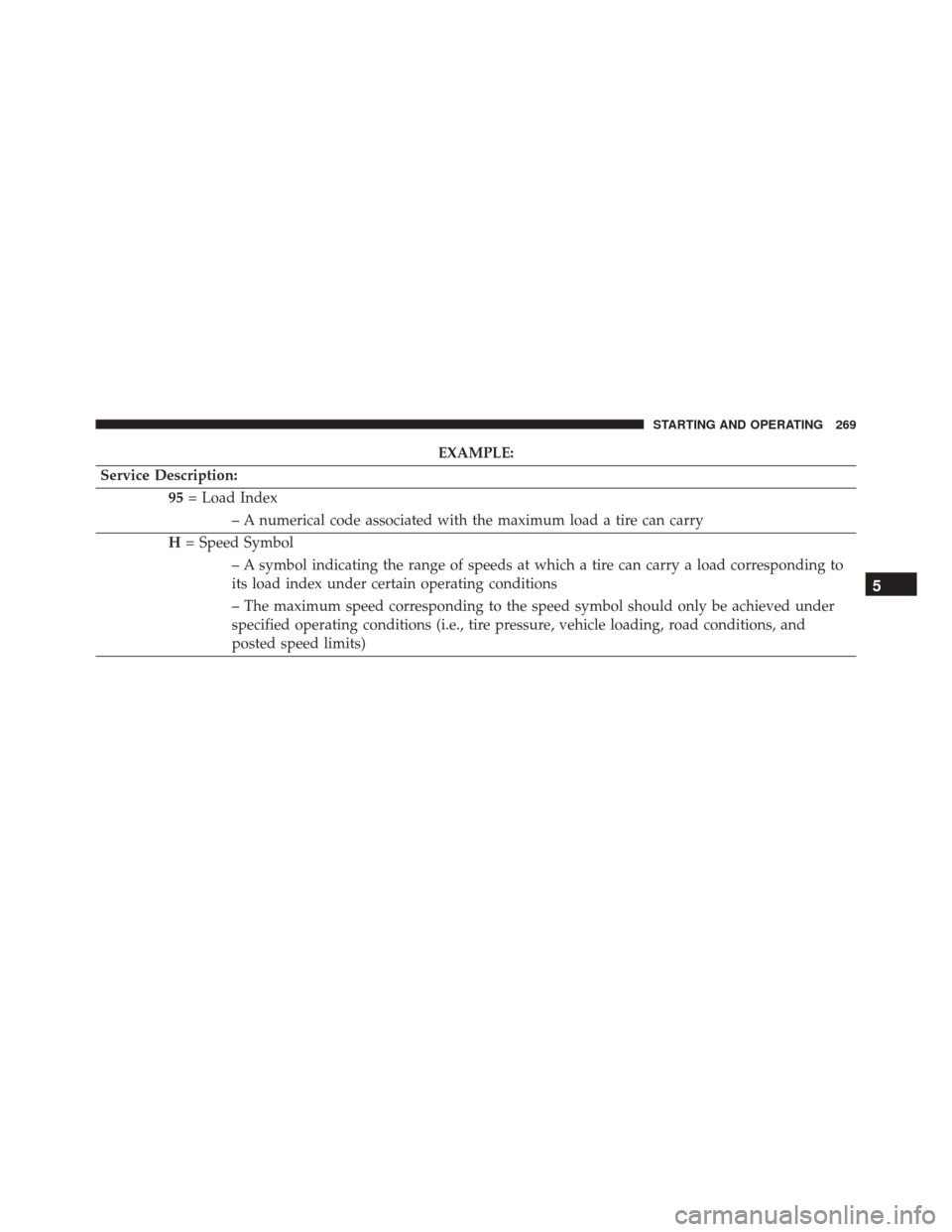
Service Description: 95= Load Index
– A numerical code associated with the maximum load a tire can carry
H = Speed Symbol
– A symbol indicating the range of speeds at which a tire can carry a load corresponding to
its load index under certain operating conditions
– The maximum speed corresponding to the speed symbol should only be achieved under
specified operating conditions (i.e., tire pressure, vehicle loading, road conditions, and
posted speed limits)
5
STARTING AND OPERATING 269
Page 272 of 423
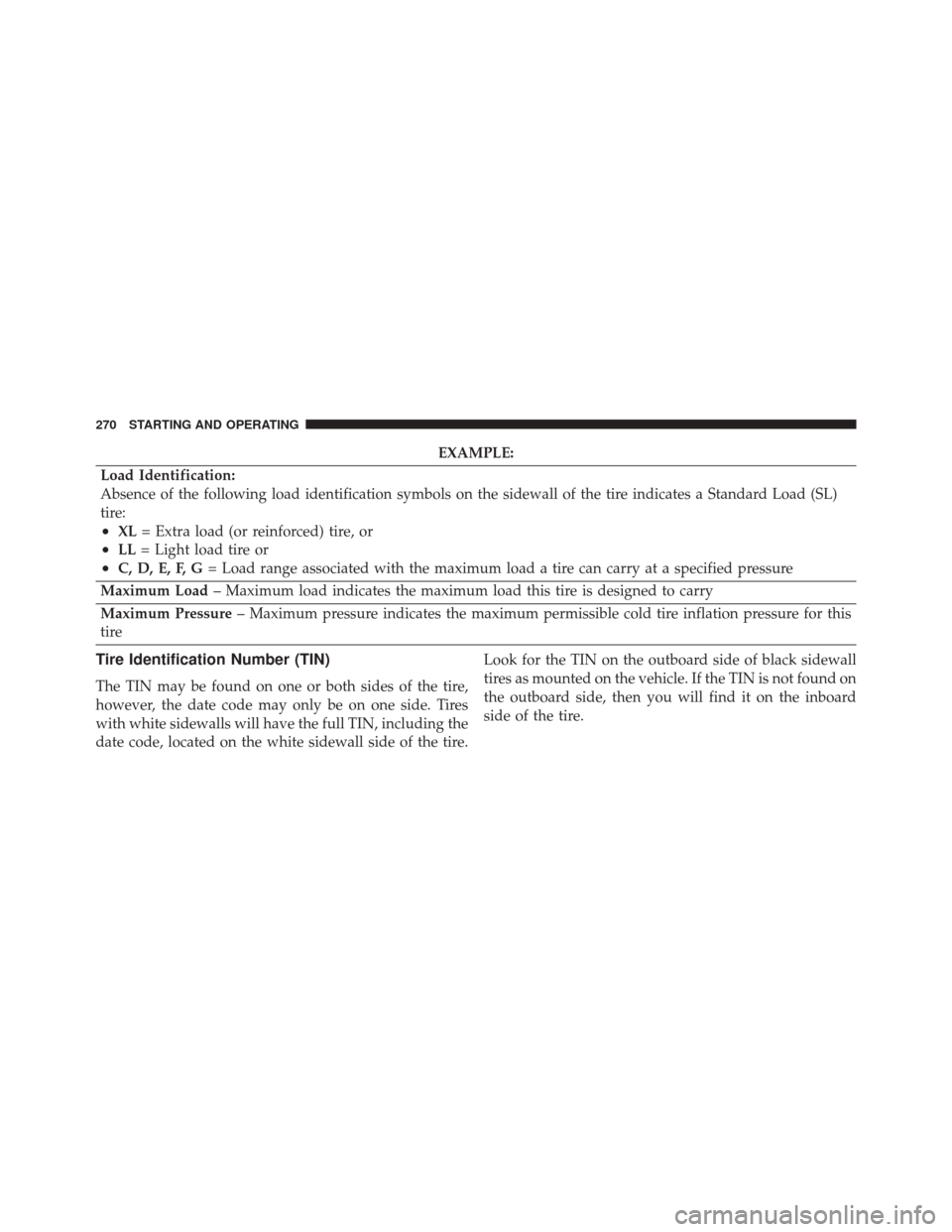
EXAMPLE:
Load Identification:
Absence of the following load identification symbols on the sidewall of the tire indicates a Standard Load (SL)
tire:
•XL = Extra load (or reinforced) tire, or
•LL= Light load tire or
•C, D, E, F, G = Load range associated with the maximum load a tire can carry at a specified pressure
Maximum Load – Maximum load indicates the maximum load this tire is designed to carry
Maximum Pressure – Maximum pressure indicates the maximum permissible cold tire inflation pressure for this
tire
Tire Identification Number (TIN)
The TIN may be found on one or both sides of the tire,
however, the date code may only be on one side. Tires
with white sidewalls will have the full TIN, including the
date code, located on the white sidewall side of the tire. Look for the TIN on the outboard side of black sidewall
tires as mounted on the vehicle. If the TIN is not found on
the outboard side, then you will find it on the inboard
side of the tire.
270 STARTING AND OPERATING