Page 81 of 423
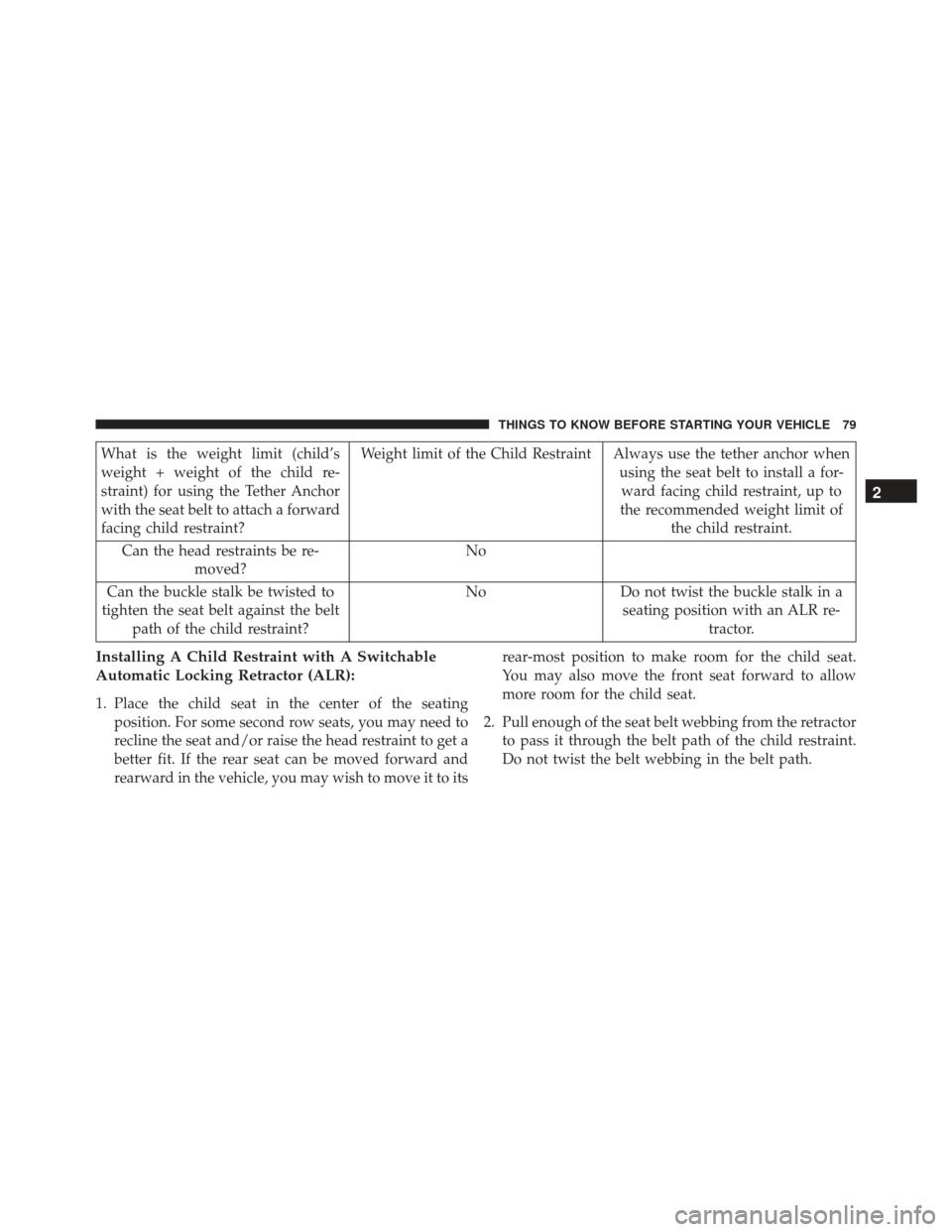
What is the weight limit (child’s
weight + weight of the child re-
straint) for using the Tether Anchor
with the seat belt to attach a forward
facing child restraint?Weight limit of the Child Restraint Always use the tether anchor when
using the seat belt to install a for-ward facing child restraint, up to
the recommended weight limit of the child restraint.
Can the head restraints be re- moved? No
Can the buckle stalk be twisted to
tighten the seat belt against the belt path of the child restraint? No
Do not twist the buckle stalk in a
seating position with an ALR re- tractor.
Installing A Child Restraint with A Switchable
Automatic Locking Retractor (ALR):
1. Place the child seat in the center of the seatingposition. For some second row seats, you may need to
recline the seat and/or raise the head restraint to get a
better fit. If the rear seat can be moved forward and
rearward in the vehicle, you may wish to move it to its rear-most position to make room for the child seat.
You may also move the front seat forward to allow
more room for the child seat.
2. Pull enough of the seat belt webbing from the retractor to pass it through the belt path of the child restraint.
Do not twist the belt webbing in the belt path.
2
THINGS TO KNOW BEFORE STARTING YOUR VEHICLE 79
Page 82 of 423
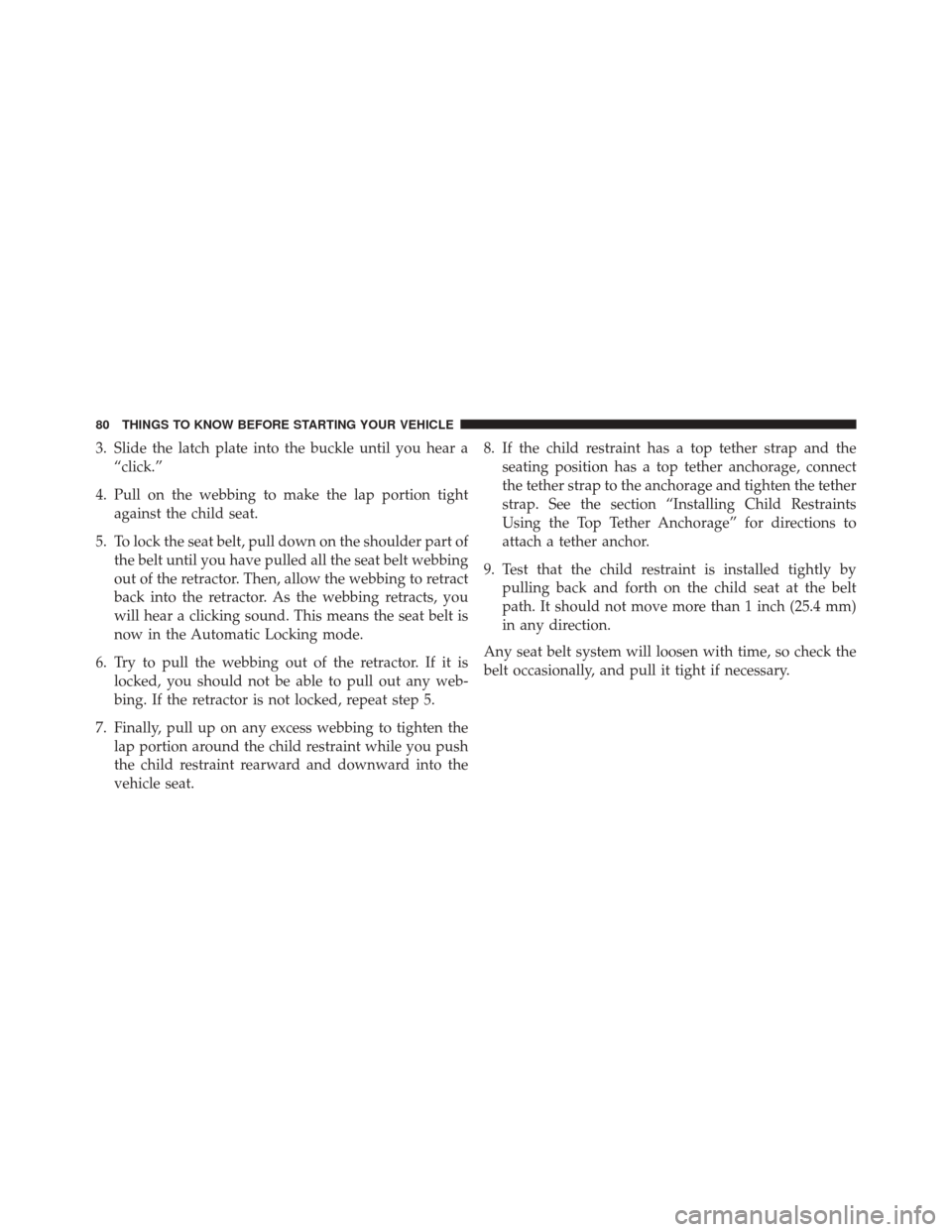
3. Slide the latch plate into the buckle until you hear a“click.”
4. Pull on the webbing to make the lap portion tight against the child seat.
5. To lock the seat belt, pull down on the shoulder part of the belt until you have pulled all the seat belt webbing
out of the retractor. Then, allow the webbing to retract
back into the retractor. As the webbing retracts, you
will hear a clicking sound. This means the seat belt is
now in the Automatic Locking mode.
6. Try to pull the webbing out of the retractor. If it is locked, you should not be able to pull out any web-
bing. If the retractor is not locked, repeat step 5.
7. Finally, pull up on any excess webbing to tighten the lap portion around the child restraint while you push
the child restraint rearward and downward into the
vehicle seat. 8. If the child restraint has a top tether strap and the
seating position has a top tether anchorage, connect
the tether strap to the anchorage and tighten the tether
strap. See the section “Installing Child Restraints
Using the Top Tether Anchorage” for directions to
attach a tether anchor.
9. Test that the child restraint is installed tightly by pulling back and forth on the child seat at the belt
path. It should not move more than 1 inch (25.4 mm)
in any direction.
Any seat belt system will loosen with time, so check the
belt occasionally, and pull it tight if necessary.
80 THINGS TO KNOW BEFORE STARTING YOUR VEHICLE
Page 259 of 423

WARNING!
•Never leave children alone in a vehicle, or with
access to an unlocked vehicle. Allowing children to
be in a vehicle unattended is dangerous for a
number of reasons. A child or others could be
injured seriously or fatally. Do not leave the key
fob in or near the vehicle (or in a location accessible
to children), and do not leave the ignition of a
vehicle equipped with Keyless Enter-N-Go in the
ACC or ON/RUN mode. A child could operate
power windows, other controls, or move the ve-
hicle.
• Ensure the parking brake is fully disengaged be-
fore driving. Failure to do so can lead to brake
failure, and an accident.
BRAKE SYSTEM
Your vehicle is equipped with dual hydraulic
brake systems. If either of the two hydraulic
systems loses normal capability, the remaining
system will still function. However, there will
be some loss of overall braking effectiveness. You may
notice increased pedal travel during application, greater
pedal force required to slow or stop, and potential
activation of the “Brake System Warning Light.”
In the event power assist is lost for any reason (i.e.,
repeated brake applications with the engine off) the
brakes will still function. However, the effort required to
brake the vehicle will be much greater than that required
with the power system operating.
5
STARTING AND OPERATING 257
Page 417 of 423
Replacement Tires........................ .288
Reporting Safety Defects ....................399
Restraint, Head .......................... .102
Restraints, Child ...........................72
Restraints, Occupant ........................33
Rocking Vehicle When Stuck .................327
Rotation, Tires .......................... .290
Safety Checks Inside Vehicle ..................87
Safety Checks Outside Vehicle .................88
Safety Defects, Reporting ....................399
Safety, Exhaust Gas .........................86
Safety Information, Tire .....................266
Safety Tips ...............................85
Schedule, Maintenance ..................385, 386
Seat Belt Automatic Locking Retractor (ALR) ...........44
Energy Management Feature ................44
Lap/Shoulder Belt Operation ................39Lap/Shoulder Belts
.......................36
Lap/Shoulder Belt Untwisting ...............41
Pregnant Women ........................43
Seat Belt Extender .......................42
Seat Belt Pretensioner .....................43
Seat Belt Reminder .......................35
Seat Belt System .........................33
Seat Belt Maintenance ..................... .363
Seat Belt Reminder .........................35
Seat Belts ............................ .34, 87
Child Restraint ..........................72
Extender ..............................42
Front Seat ....................... .34, 36, 39
Inspection .............................87
Operating Instructions ....................39
Pregnant Women ........................43
Pretensioners ...........................43
Rear Seat ..............................36
Reminder ............................ .148
10
INDEX 415