Page 464 of 664

Electronic Roll Mitigation (ERM)
This system anticipates the potential for wheel lift by
monitoring the driver ’s steering wheel input and the
speed of the vehicle. When ERM determines that the rate
of change of the steering wheel angle and vehicle’s speed
are sufficient to potentially cause wheel lift, it then
applies the appropriate brake and may also reduce
engine power to lessen the chance that wheel lift will
occur. ERM can only reduce the chance of wheel lift
occurring during severe or evasive driving maneuvers; it
cannot prevent wheel lift due to other factors, such as
road conditions, leaving the roadway, or striking objects
or other vehicles.
NOTE:ERM is disabled anytime the ESC is in “Full Off”
mode (if equipped). Refer to “Electronic Stability Control
(ESC)” in this section for a complete explanation of the
available ESC modes.
WARNING!
Many factors, such as vehicle loading, road condi-
tions and driving conditions, influence the chance
that wheel lift or rollover may occur. ERM cannot
prevent all wheel lift or roll overs, especially those
that involve leaving the roadway or striking objects
or other vehicles. The capabilities of an ERM-
equipped vehicle must never be exploited in a reck-
less or dangerous manner which could jeopardize the
user’s safety or the safety of others.
Trailer Sway Control (TSC)
TSC uses sensors in the vehicle to recognize an exces-
sively swaying trailer and will take the appropriate
actions to attempt to stop the sway. TSC will become
active automatically once an excessively swaying trailer
is recognized. Note that TSC cannot stop all trailers from
swaying. Always use caution when towing a trailer and
462 STARTING AND OPERATING
Page 552 of 664

If frequent jump-starting is required to start your vehicle,
you should have the battery and charging system in-
spected at your authorized dealer.
CAUTION!
Accessories plugged into the vehicle power outlets
draw power from the vehicle’s battery, even when not
in use (i.e., cellular devices, etc.). Eventually, if
plugged in long enough without engine operation,
the vehicle’s battery will discharge sufficiently to
degrade battery life and/or prevent the engine from
starting.
FREEING A STUCK VEHICLE
If your vehicle becomes stuck in mud, sand, or snow, it
can often be moved using a rocking motion. Turn the
steering wheel right and left to clear the area around the
front wheels. Then shift back and forth between DRIVEand REVERSE while gently pressing the accelerator
pedal. Use the least amount of accelerator pedal pressure
that will maintain the rocking motion, without spinning
the wheels or racing the engine.
CAUTION!
Racing the engine or spinning the wheels may lead to
transmission overheating and failure. Allow the en-
gine to idle with the transmission in NEUTRAL for at
least one minute after every five rocking-motion
cycles. This will minimize overheating and reduce
the risk of transmission failure during prolonged
efforts to free a stuck vehicle.
550 WHAT TO DO IN EMERGENCIES
Page 561 of 664
ENGINE COMPARTMENT — 2.4L
1 — Engine Coolant Reservoir7 — Power Distribution Center (Fuses)
2 — Power Steering Fluid Reservoir 8 — Air Cleaner Filter
3 — Engine Oil Fill 9 — Automatic Transmission Dipstick (4–Speed Only)
4 — Brake Fluid Reservoir 10 — Washer Fluid Reservoir
5 — Remote Jump Start (Positive Battery Post) 11 — Coolant Reservoir Cap
6 — Remote Jump Start (Negative Battery Post) 12 — Engine Oil Dipstick
7
MAINTAINING YOUR VEHICLE 559
Page 562 of 664
ENGINE COMPARTMENT — 3.6L
1 — Engine Coolant Reservoir5 — Air Cleaner Filter
2 — Power Steering Fluid Reservoir 6 — Washer Fluid Reservoir
3 — Brake Fluid Reservoir 7 — Engine Oil Dipstick
4 — Power Distribution Center (Fuses) 8 — Engine Oil Fill
560 MAINTAINING YOUR VEHICLE
Page 601 of 664

WARNING!(Continued)
disassemble or modify the system. Seat belt assem-
blies must be replaced after a collision if they have
been damaged (i.e., bent retractor, torn webbing, etc.).
Cleaning The Cupholders
Clean with a damp cloth or towel using a mild detergent.
FUSES
WARNING!
•When replacing a blown fuse, always use an appro-
priate replacement fuse with the same amp rating as
the original fuse. Never replace a fuse with another
fuse of higher amp rating. Never replace a blown
fuse with metal wires or any other material. Failure
(Continued)
WARNING! (Continued)
to use proper fuses may result in serious personal
injury, fire and/or property damage.
•Before replacing a fuse, make sure that the ignition
is off and that all the other services are switched off
and/or disengaged.
• If the replaced fuse blows again, contact an autho-
rized dealer.
• If a general protection fuse for safety systems (air
bag system, braking system), power unit systems
(engine system, gearbox system) or steering system
blows, contact an authorized dealer.
Interior Fuses
The interior fuse panel is located on the passenger side
under the instrument panel.
7
MAINTAINING YOUR VEHICLE 599
Page 620 of 664
Chassis
ComponentFluid, Lubricant, or Genuine Part
Automatic Transmission Use only ATF+4 Automatic Transmission Fluid.
Failure to use ATF+4 fluid may affect the function or
performance of your transmission.
We recommend MOPAR ATF+4 fluid.
Power Transfer Unit (PTU) We recommend you use MOPAR Gear Lubricant 75W-
90.
Rear Drive Assembly (RDA) We recommend you use MOPAR Gear Lubricant 75W-
90.
Brake Master Cylinder We recommend you use MOPAR DOT 3, SAE J1703. If
DOT 3 brake fluid is not available, then DOT 4 is ac-
ceptable.
Power Steering Reservoir We recommend you use MOPAR Power Steering Fluid
+ 4, or MOPAR ATF+4 Automatic Transmission Fluid.
618 MAINTAINING YOUR VEHICLE
Page 623 of 664
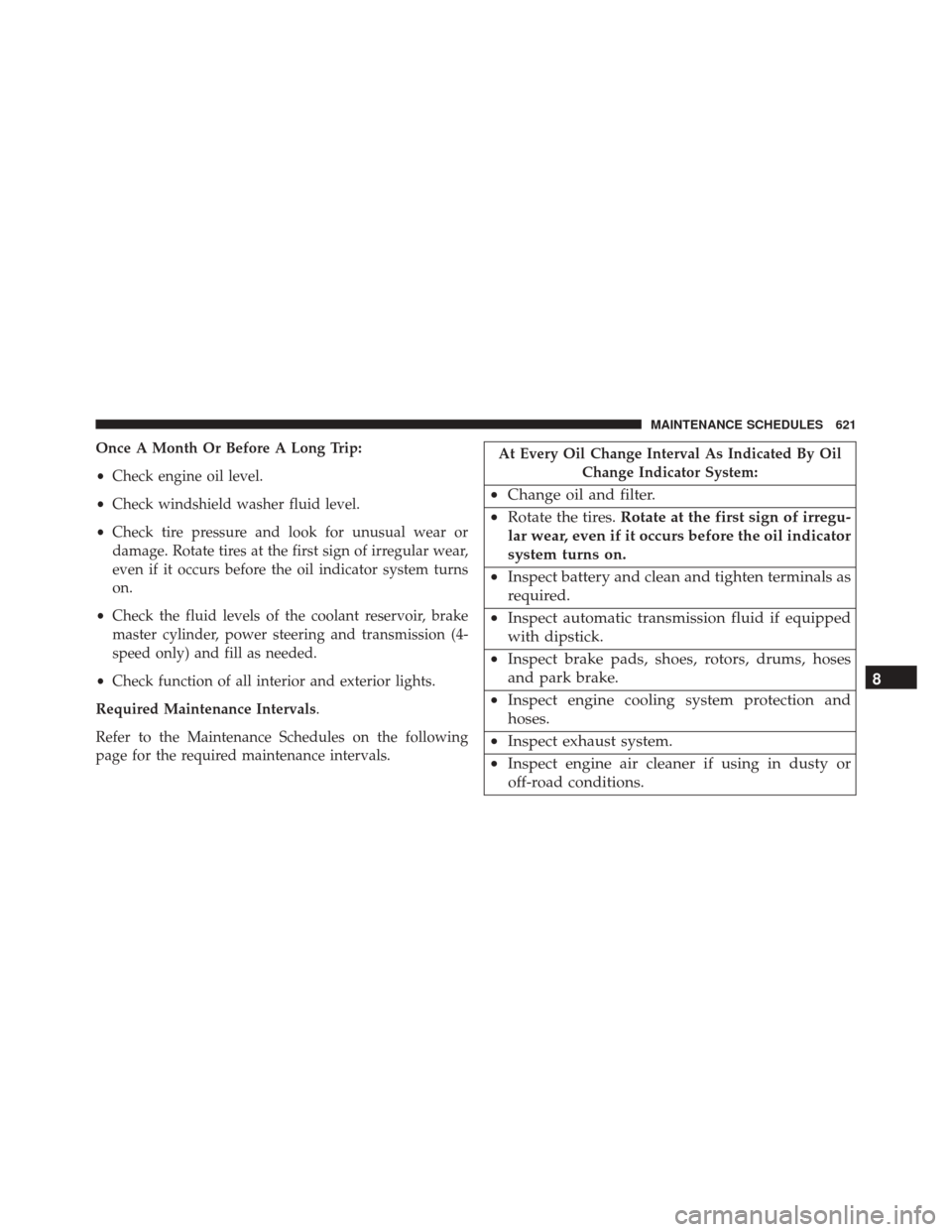
Once A Month Or Before A Long Trip:
•Check engine oil level.
• Check windshield washer fluid level.
• Check tire pressure and look for unusual wear or
damage. Rotate tires at the first sign of irregular wear,
even if it occurs before the oil indicator system turns
on.
• Check the fluid levels of the coolant reservoir, brake
master cylinder, power steering and transmission (4-
speed only) and fill as needed.
• Check function of all interior and exterior lights.
Required Maintenance Intervals.
Refer to the Maintenance Schedules on the following
page for the required maintenance intervals.At Every Oil Change Interval As Indicated By Oil Change Indicator System:
•Change oil and filter.
• Rotate the tires. Rotate at the first sign of irregu-
lar wear, even if it occurs before the oil indicator
system turns on.
• Inspect battery and clean and tighten terminals as
required.
• Inspect automatic transmission fluid if equipped
with dipstick.
• Inspect brake pads, shoes, rotors, drums, hoses
and park brake.
• Inspect engine cooling system protection and
hoses.
• Inspect exhaust system.
• Inspect engine air cleaner if using in dusty or
off-road conditions. 8
MAINTENANCE SCHEDULES 621
Page 642 of 664

Body Mechanism Lubrication.................573
B-Pillar Location ......................... .470
Brake Assist System ...................... .453
Brake Control System, Electronic ..............450
Brake Fluid ............................ .618
Brake, Parking .......................... .446
Brakes ................................ .449
Brake System ........................ .449, 585
Fluid Check ....................... .586, 618
Master Cylinder ....................... .586
Parking ............................. .446
Warning Light ........................ .304
Brake/Transmission Interlock .................431
Brightness, Interior Lights ...................230
Bulb Replacement ..................... .606, 608
Bulbs, Light ..........................111,606
Camera, Rear ........................... .250
Capacities, Fluid ......................... .614Caps, Filler
Fuel ................................ .505
Oil (Engine) ....................... .559, 567
Power Steering ........................ .445
Radiator (Coolant Pressure) ................583
Carbon Monoxide Warning ...............108, 502
Cargo Area Cover ........................ .286
Cargo Area Features ...................... .282
Cargo Compartment ...................... .282
Light ............................... .282
Luggage Carrier ....................... .290
Cargo Load Floor ........................ .283
Cargo Management System ..................283
Rollaway Tonneau Cover ..................286
Tri-Fold Load Floor ..................... .283
Cargo Tie-Downs ........................ .284
Cargo (Vehicle Loading) .................283, 508
Car
Washes ............................ .593
Certification Label ........................ .508
640 INDEX


