Page 561 of 664
ENGINE COMPARTMENT — 2.4L
1 — Engine Coolant Reservoir7 — Power Distribution Center (Fuses)
2 — Power Steering Fluid Reservoir 8 — Air Cleaner Filter
3 — Engine Oil Fill 9 — Automatic Transmission Dipstick (4–Speed Only)
4 — Brake Fluid Reservoir 10 — Washer Fluid Reservoir
5 — Remote Jump Start (Positive Battery Post) 11 — Coolant Reservoir Cap
6 — Remote Jump Start (Negative Battery Post) 12 — Engine Oil Dipstick
7
MAINTAINING YOUR VEHICLE 559
Page 562 of 664
ENGINE COMPARTMENT — 3.6L
1 — Engine Coolant Reservoir5 — Air Cleaner Filter
2 — Power Steering Fluid Reservoir 6 — Washer Fluid Reservoir
3 — Brake Fluid Reservoir 7 — Engine Oil Dipstick
4 — Power Distribution Center (Fuses) 8 — Engine Oil Fill
560 MAINTAINING YOUR VEHICLE
Page 588 of 664

WARNING!(Continued)
high brake temperatures, excessive lining wear, and
possible brake damage. You would not have your full
braking capacity in an emergency.
Master Cylinder — Brake Fluid Level Check
Check the fluid level in the master cylinder immediately
if the “Brake Warning Light” indicates system failure.
Check the fluid level in the master cylinder when per-
forming underhood services.
Clean the top of the master cylinder area before removing
the cap. If necessary, add fluid to bring the fluid level up
to the requirements described on the brake fluid reser-
voir.
Overfilling of fluid is not recommended because it may
cause leaking in the system. Fluid level can be expected to fall as the brake pads wear.
Brake fluid level should be checked when pads are
replaced. However, low fluid level may be caused by a
leak and a checkup may be needed.
Use only manufacturer’s recommended brake fluid. Re-
fer to “Fluids, Lubricants, And Genuine Parts” in “Main-
taining Your Vehicle” for further information.
WARNING!
•Use only manufacturer’s recommended brake fluid.
Refer to “Fluids, Lubricants, And Genuine Parts” in
“Maintaining Your Vehicle” for further information.
Using the wrong type of brake fluid can severely
damage your brake system and/or impair its perfor-
mance. The proper type of brake fluid for your
vehicle is also identified on the original factory
installed hydraulic master cylinder reservoir.
(Continued)
586 MAINTAINING YOUR VEHICLE
Page 589 of 664

WARNING!(Continued)
•To avoid contamination from foreign matter or
moisture, use only new brake fluid or fluid that has
been in a tightly closed container. Keep the master
cylinder reservoir cap secured at all times. Brake
fluid in a open container absorbs moisture from the
air resulting in a lower boiling point. This may
cause it to boil unexpectedly during hard or pro-
longed braking, resulting in sudden brake failure.
This could result in a collision.
• Overfilling the brake fluid reservoir can result in
spilling brake fluid on hot engine parts, causing
the brake fluid to catch fire. Brake fluid can also
damage painted and vinyl surfaces, care should be
taken to avoid its contact with these surfaces.
(Continued)
WARNING! (Continued)
•Do not allow petroleum based fluid to contaminate
the brake fluid. Brake seal components could be
damaged, causing partial or complete brake failure.
This could result in a collision.
Automatic Transmission
Selection Of Lubricant
It is important to use the proper transmission fluid to
ensure optimum transmission performance and life. Use
only the manufacturer ’s specified transmission fluid.
Refer to “Fluids, Lubricants, And Genuine Parts” in this
section for fluid specifications. It is important to maintain
the transmission fluid at the correct level using the
recommended fluid. No chemical flushes should be used
in any transmission; only the approved lubricant should
be used.
7
MAINTAINING YOUR VEHICLE 587
Page 590 of 664

CAUTION!
Using a transmission fluid other than the manufac-
turer ’s recommended fluid may cause deterioration
in transmission shift quality and/or torque converter
shudder. Refer to “Fluids, Lubricants, And Genuine
Parts” in this section for fluid specifications.
Special Additives
The manufacturer strongly recommends against using
any special additives in the transmission.
Automatic Transmission Fluid (ATF) is an engineered
product and its performance may be impaired by supple-
mental additives. Therefore, do not add any fluid addi-
tives to the transmission. The only exception to this
policy is the use of special dyes for diagnosing fluid
leaks. Avoid using transmission sealers as they may
adversely affect seals.
CAUTION!
Do not use chemical flushes in your transmission as
the chemicals can damage your transmission compo-
nents. Such damage is not covered by the New
Vehicle Limited Warranty.
Fluid Level Check — Four-Speed Automatic
Transmission
Use the following procedure to check the transmission
fluid level properly:
1. Park the vehicle on level ground.
2. Run the engine at normal idle speed for at least 60seconds, and leave the engine running for the rest of
this procedure.
3. Fully apply the parking brake, and press the brake pedal.
588 MAINTAINING YOUR VEHICLE
Page 592 of 664

NOTE:If it is necessary to check the transmission below
the operating temperature, the fluid level should be
between the two COLD (lower) holes on the dipstick
with the fluid at approximately 80°F (27°C). If the fluid
level is correctly established at 80°F (27°C), it should be
between the HOT (upper) reference holes when the
transmission reaches 180°F (82°C). Remember it is best to
check the level at the normal operating temperature.
8. Check for leaks. Release the parking brake.CAUTION!
• Using a transmission fluid other than the manufac-
turer’s recommended fluid may cause deterioration
in transmission shift quality and/or torque con-
verter shudder, and will require more frequent
fluid and filter changes. Refer to “Fluids, Lubri-
cants, And Genuine Parts” in this section for fluid
specifications.
• Dirt and water in the transmission can cause seri-
ous damage. To prevent dirt and water from enter-
ing the transmission after checking or replenishing
fluid, make sure that the dipstick cap is re-seated
properly.
Fluid Level Check — Six-Speed Automatic
Transmission
The fluid level is preset at the factory and does not
require adjustment under normal operating conditions.
590 MAINTAINING YOUR VEHICLE
Page 620 of 664
Chassis
ComponentFluid, Lubricant, or Genuine Part
Automatic Transmission Use only ATF+4 Automatic Transmission Fluid.
Failure to use ATF+4 fluid may affect the function or
performance of your transmission.
We recommend MOPAR ATF+4 fluid.
Power Transfer Unit (PTU) We recommend you use MOPAR Gear Lubricant 75W-
90.
Rear Drive Assembly (RDA) We recommend you use MOPAR Gear Lubricant 75W-
90.
Brake Master Cylinder We recommend you use MOPAR DOT 3, SAE J1703. If
DOT 3 brake fluid is not available, then DOT 4 is ac-
ceptable.
Power Steering Reservoir We recommend you use MOPAR Power Steering Fluid
+ 4, or MOPAR ATF+4 Automatic Transmission Fluid.
618 MAINTAINING YOUR VEHICLE
Page 623 of 664
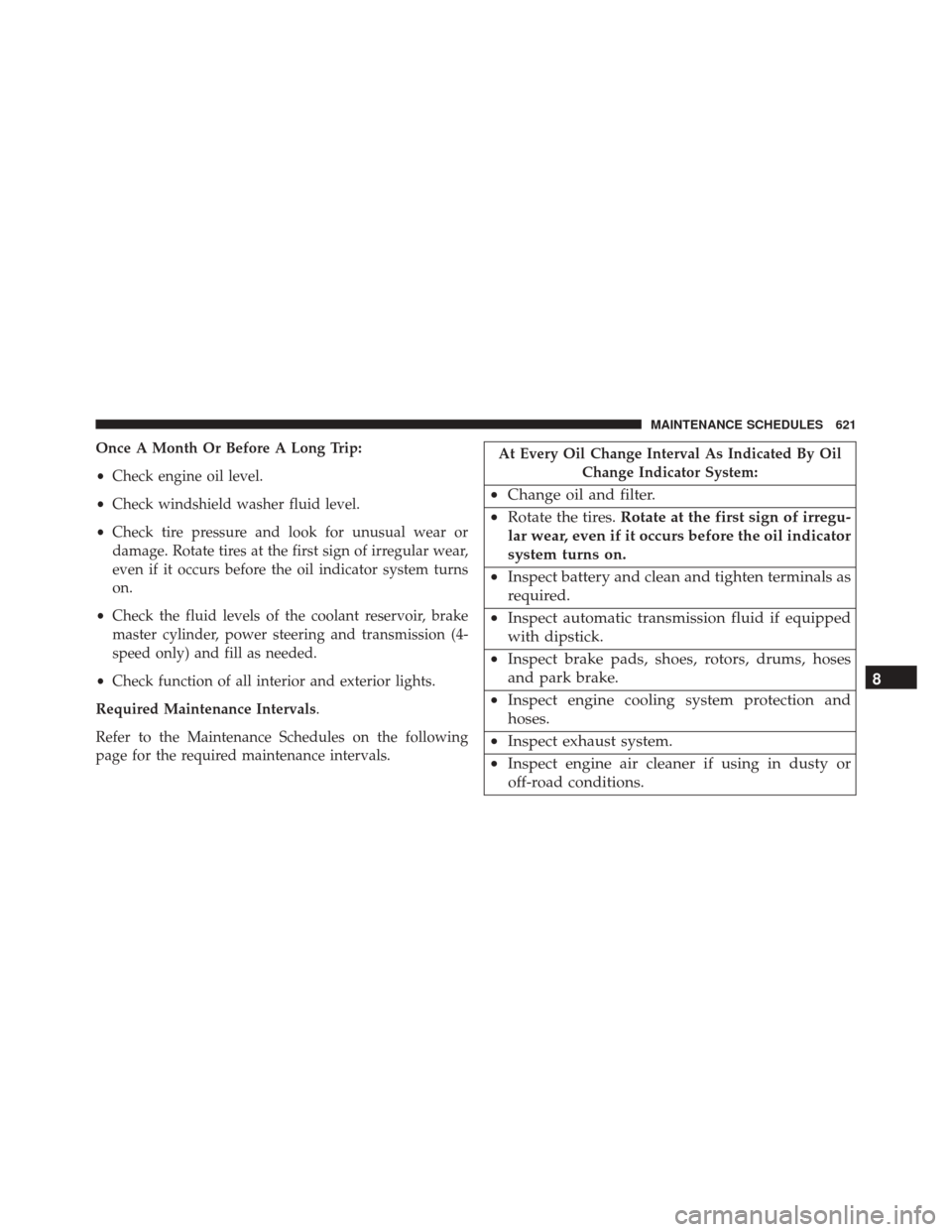
Once A Month Or Before A Long Trip:
•Check engine oil level.
• Check windshield washer fluid level.
• Check tire pressure and look for unusual wear or
damage. Rotate tires at the first sign of irregular wear,
even if it occurs before the oil indicator system turns
on.
• Check the fluid levels of the coolant reservoir, brake
master cylinder, power steering and transmission (4-
speed only) and fill as needed.
• Check function of all interior and exterior lights.
Required Maintenance Intervals.
Refer to the Maintenance Schedules on the following
page for the required maintenance intervals.At Every Oil Change Interval As Indicated By Oil Change Indicator System:
•Change oil and filter.
• Rotate the tires. Rotate at the first sign of irregu-
lar wear, even if it occurs before the oil indicator
system turns on.
• Inspect battery and clean and tighten terminals as
required.
• Inspect automatic transmission fluid if equipped
with dipstick.
• Inspect brake pads, shoes, rotors, drums, hoses
and park brake.
• Inspect engine cooling system protection and
hoses.
• Inspect exhaust system.
• Inspect engine air cleaner if using in dusty or
off-road conditions. 8
MAINTENANCE SCHEDULES 621


