Page 504 of 651
3. Remove the fastener securing the spare tire.4. Remove the spare tire.
5. Remove the fastener securing the jack.
Opening The Access PanelSpare Tire Fastener
502 WHAT TO DO IN EMERGENCIES
Page 517 of 651

NOTE:Push the �ESC Off� switch to place the Electronic
Stability Control (ESC) system in �Partial Off�mode
before rocking the vehicle. Refer to “Electronic Brake
Control” in “Starting And Operating” for further infor-
mation. Once the vehicle has been freed, push the �ESC
Off� switch again to restore �ESC On�mode.
CAUTION!
•When “rocking” a stuck vehicle by shifting be-
tween DRIVE / 1ST GEAR and REVERSE, do not
spin the wheels faster than 15 mph (24 km/h), or
drivetrain damage may result.
• Revving the engine or spinning the wheels too fast
may lead to transmission overheating and failure.
It can also damage the tires. Do not spin the wheels
above 30 mph (48 km/h) while in gear (no trans-
mission shifting occurring).
WARNING!
Fast spinning tires can be dangerous. Forces gener-
ated by excessive wheel speeds may cause damage, or
even failure, of the axle and tires. A tire could
explode and injure someone. Do not spin your vehi-
cle’s wheels faster than 30 mph (48 km/h) or for
longer than 30 seconds continuously without stop-
ping when you are stuck and do not let anyone near
a spinning wheel, no matter what the speed.
MANUAL PARK RELEASE — 8 SPEED
TRANSMISSION
WARNING!
Always secure your vehicle by fully applying the
parking brake, before activating the Manual Park
(Continued)
6
WHAT TO DO IN EMERGENCIES 515
Page 518 of 651
WARNING!(Continued)
Release. Activating the Manual Park Release will
allow your vehicle to roll away if it is not secured by
the parking brake or by proper connection to a tow
vehicle. Activating the Manual Park Release on an
unsecured vehicle could lead to serious injury or
death for those in or around the vehicle.
In order to move the vehicle in cases where the transmis-
sion will not shift out of PARK (such as a dead battery),
a Manual Park Release is available.
Follow these steps to use the Manual Park Release:
1. Firmly apply the parking brake.
2. Remove the console storage bin to access the Manual Park Release lever. 3. Using a small screwdriver or similar tool, fish the
tether strap up through the opening in the console
base.
Console Storage Bin
516 WHAT TO DO IN EMERGENCIES
Page 519 of 651
4. Insert the screwdriver into the slot in the center of thelever, and disengage the lever locking tab by pushing
it to the right.
5. While holding the locking tab in the disengaged position, pull the tether strap to rotate the lever up and
rearward until it locks in place in the vertical position. The vehicle is now out of PARK and can be moved.
Release the parking brake only when the vehicle is
securely connected to a tow vehicle.
To Reset The Manual Park Release:
1. Push the latch (at the base of the lever, on the rear side) rearward (away from the lever) to unlatch the lever.
Locking TabTether Strap
6
WHAT TO DO IN EMERGENCIES 517
Page 520 of 651
2. Rotate the Manual Park Release lever forward anddown, to its original position, until the locking tab
snaps into place to secure the lever.
3. Pull up gently on the tether strap to confirm that the lever is locked in its stowed position. 4. Tuck the tether strap into the base of the console.
Reinstall the console storage bin.
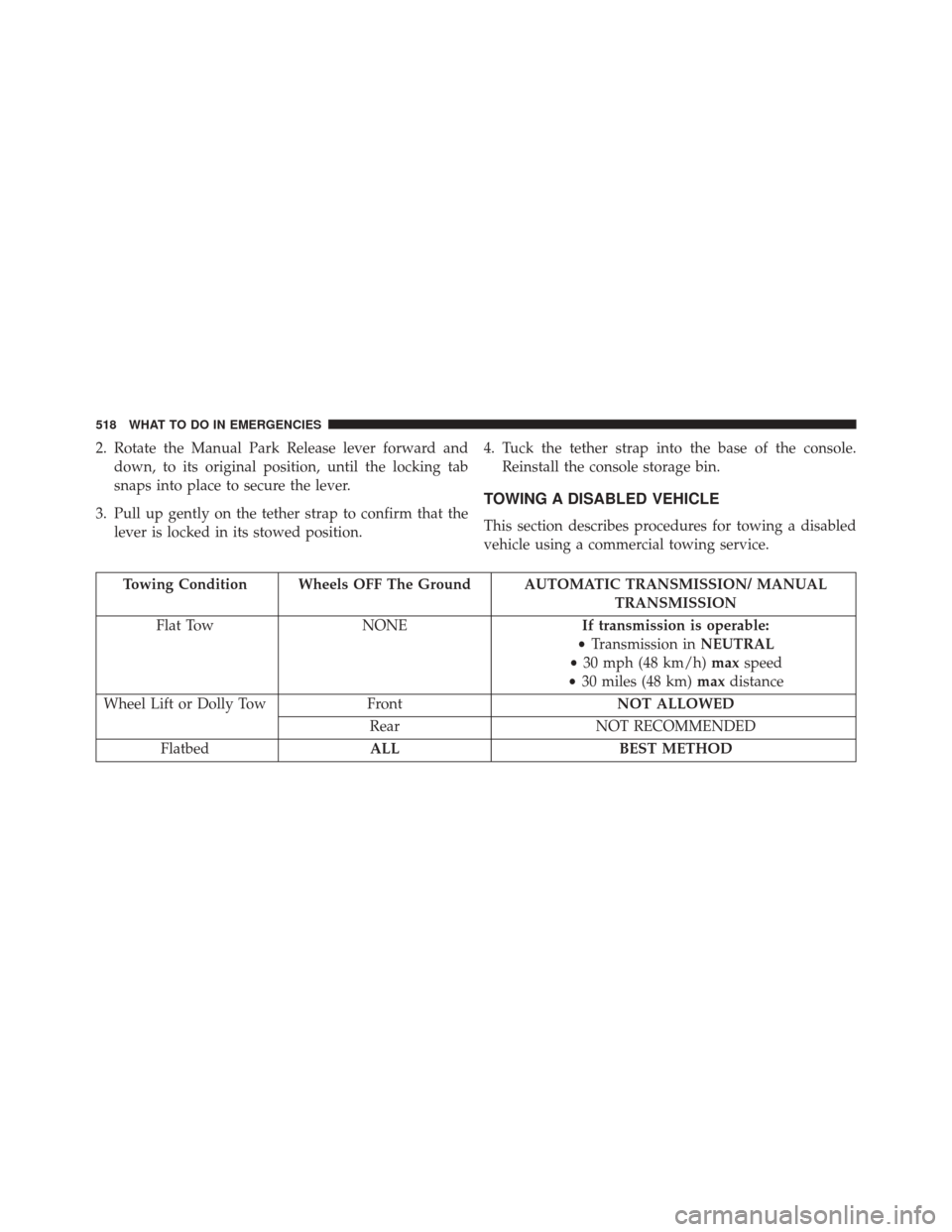
TOWING A DISABLED VEHICLE
This section describes procedures for towing a disabled
vehicle using a commercial towing service.
Towing Condition Wheels OFF The Ground AUTOMATIC TRANSMISSION/ MANUAL TRANSMISSION
Flat Tow NONE If transmission is operable:
• Transmission in NEUTRAL
• 30 mph (48 km/h) maxspeed
• 30 miles (48 km) maxdistance
Wheel Lift or Dolly Tow FrontNOT ALLOWED
Rear NOT RECOMMENDED
Flatbed ALL BEST METHOD
518 WHAT TO DO IN EMERGENCIES
Page 521 of 651

Proper towing or lifting equipment is required to prevent
damage to your vehicle. Use only tow bars and other
equipment designed for this purpose, following equip-
ment manufacturer ’s instructions. Use of safety chains is
mandatory. Attach a tow bar or other towing device to
main structural members of the vehicle, not to bumpers
or associated brackets. State and local laws regarding
vehicles under tow must be observed.
If you must use the accessories (wipers, defrosters, etc.)
while being towed, the ignition must be in the ON/RUN
position, not the ACC position.
CAUTION!
•Do not use sling type equipment when towing.
Vehicle damage may occur.
• When securing the vehicle to a flatbed truck, do not
attach to front or rear suspension components.
(Continued)
CAUTION! (Continued)
Damage to your vehicle may occur from improper
towing.
• The manufacturer does not recommend towing this
vehicle using a tow dolly. Vehicle damage may
occur.
Automatic Transmission
The manufacturer recommends towing your vehicle with
all four wheels OFF the ground using a flatbed.
If flatbed equipment is not available, and the transmis-
sion is operable, the vehicle may be flat towed (with all
four wheels on the ground) under the following condi-
tions:
• The transmission must be in NEUTRAL. Refer to
�Manual Park Release� in this section for instructions
on shifting the transmission to NEUTRAL when the
engine is off.6
WHAT TO DO IN EMERGENCIES 519
Page 523 of 651
MAINTAINING YOUR VEHICLE
CONTENTS
�ENGINE COMPARTMENT — 3.6L ..........524
� ENGINE COMPARTMENT — 5.7L ..........525
� ENGINE COMPARTMENT — 6.4L
(392 HEMI) .......................... .526
� ONBOARD DIAGNOSTIC SYSTEM — OBD II . .527
▫ Onboard Diagnostic System (OBD II)
Cybersecurity ....................... .527
▫ Loose Fuel Filler Cap ..................528
� EMISSIONS INSPECTION AND
MAINTENANCE PROGRAMS .............529
� REPLACEMENT PARTS ..................530 �
DEALER SERVICE ..................... .530
� MAINTENANCE PROCEDURES ...........531
▫ Engine Oil ......................... .532
▫ Engine Oil Filter ..................... .538
▫ Engine Air Cleaner Filter ................539
▫ Maintenance-Free Battery ...............539
▫ Air Conditioner Maintenance .............541
▫ Body Lubrication .....................545
▫ Windshield Wiper Blades ...............545
▫ Adding Washer Fluid ..................546
7
Page 529 of 651
ONBOARD DIAGNOSTIC SYSTEM — OBD II
Your vehicle is equipped with a sophisticated onboard
diagnostic system called OBD II. This system monitors
the performance of the emissions, engine, and automatic
transmission control systems. When these systems are
operating properly, your vehicle will provide excellent
performance and fuel economy, as well as engine emis-
sions well within current government regulations.
If any of these systems require service, the OBD II system
will turn on the “Malfunction Indicator Light” (MIL). It
will also store diagnostic codes and other information to
assist your service technician in making repairs. Al-
though your vehicle will usually be drivable and not
need towing, see your authorized dealer for service as
soon as possible.
CAUTION!
•Prolonged driving with the MIL on could cause
further damage to the emission control system. It
could also affect fuel economy and driveability.
The vehicle must be serviced before any emissions
tests can be performed.
• If the MIL is flashing while the engine is running,
severe catalytic converter damage and power loss
will soon occur. Immediate service is required.
Onboard Diagnostic System (OBD II)
Cybersecurity
Your vehicle is required to have an Onboard Diagnostic
system (OBD II) and a connection port to allow access to
information related to the performance of your emissions
controls. Authorized service technicians may need to
7
MAINTAINING YOUR VEHICLE 527