Page 485 of 651
•To prevent excess heat generation, avoid continuous
driving at high RPM. Reduce vehicle speed as neces-
sary to avoid extended driving at high RPM. Return to
a higher gear or vehicle speed when grade and road
conditions allow.
Cooling System
To reduce potential for engine and transmission over-
heating, take the following actions: City Driving
When stopped for short periods, shift the transmission
into NEUTRAL and increase engine idle speed.
Highway Driving
Reduce speed.
Air Conditioning
Turn off temporarily.
RECREATIONAL TOWING (BEHIND MOTORHOME, ETC.)
Towing This Vehicle Behind Another Vehicle
Towing Condition
Wheels OFF The Ground All Models
Flat Tow NoneNOT ALLOWED
Dolly Tow FrontNOT ALLOWED
Rear NOT RECOMMENDED
On Trailer AllOK
5
STARTING AND OPERATING 483
Page 486 of 651
Recreational towing (with rear wheels on the ground) is
NOT ALLOWED. The only acceptable method for tow-
ing this vehicle (behind another vehicle) is on a vehicle
trailer with all four wheelsOFFthe ground.
Use of a towing dolly (with rear wheels on the ground) is
NOT ALLOWED, as severe transmission damage will
occur. Use of a towing dolly (with front wheels on the
ground) is not recommended, as vehicle damage may
occur.CAUTION!
Towing this vehicle in violation of the above require-
ments can cause severe transmission damage. Dam-
age from improper towing is not covered under the
New Vehicle Limited Warranty.
484 STARTING AND OPERATING
Page 488 of 651
�MANUAL PARK RELEASE — 8 SPEED
TRANSMISSION ...................... .515
� TOWING A DISABLED VEHICLE ...........518▫
Automatic Transmission ................519
▫ Manual Transmission ..................520
486 WHAT TO DO IN EMERGENCIES
Page 520 of 651
2. Rotate the Manual Park Release lever forward anddown, to its original position, until the locking tab
snaps into place to secure the lever.
3. Pull up gently on the tether strap to confirm that the lever is locked in its stowed position. 4. Tuck the tether strap into the base of the console.
Reinstall the console storage bin.
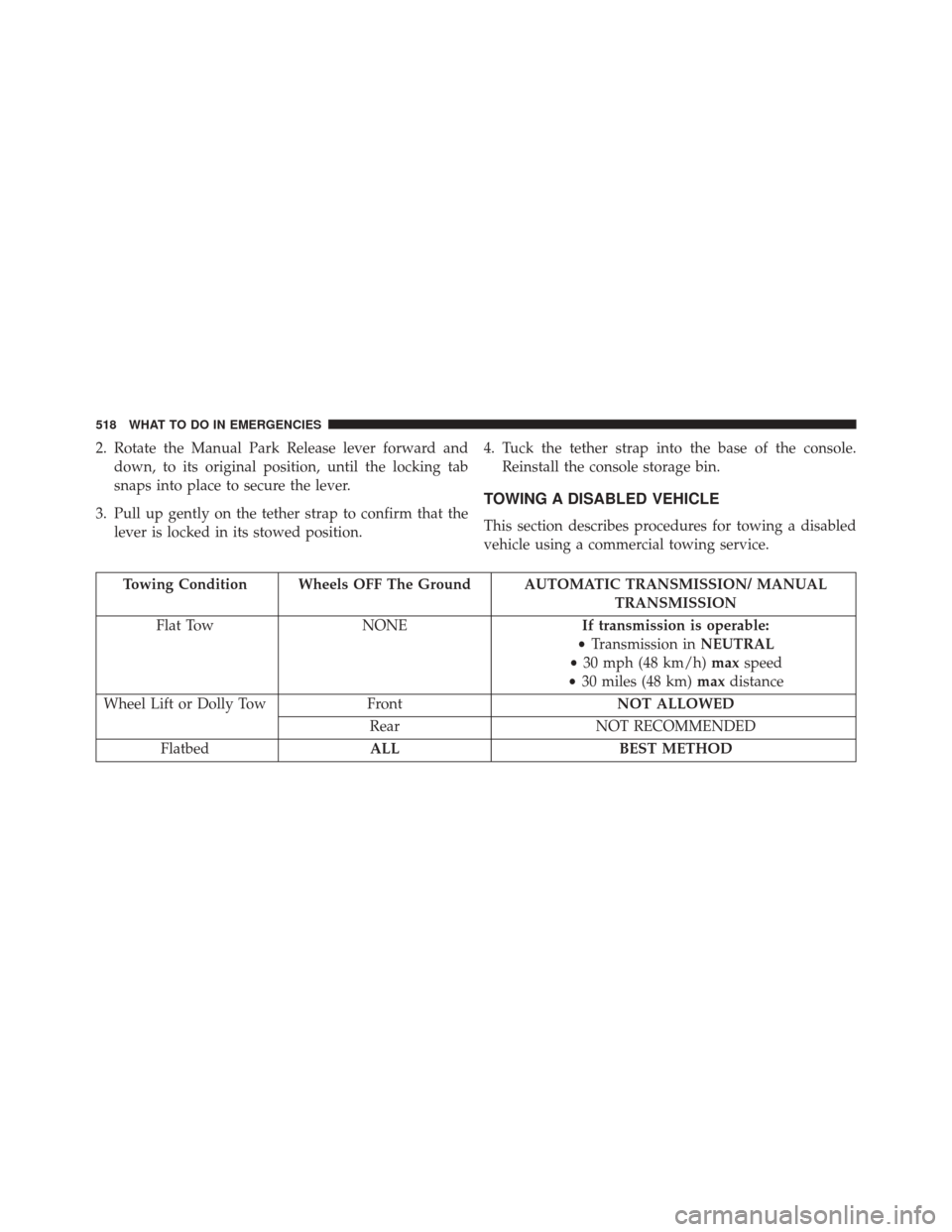
TOWING A DISABLED VEHICLE
This section describes procedures for towing a disabled
vehicle using a commercial towing service.
Towing Condition Wheels OFF The Ground AUTOMATIC TRANSMISSION/ MANUAL TRANSMISSION
Flat Tow NONE If transmission is operable:
• Transmission in NEUTRAL
• 30 mph (48 km/h) maxspeed
• 30 miles (48 km) maxdistance
Wheel Lift or Dolly Tow FrontNOT ALLOWED
Rear NOT RECOMMENDED
Flatbed ALL BEST METHOD
518 WHAT TO DO IN EMERGENCIES
Page 521 of 651

Proper towing or lifting equipment is required to prevent
damage to your vehicle. Use only tow bars and other
equipment designed for this purpose, following equip-
ment manufacturer ’s instructions. Use of safety chains is
mandatory. Attach a tow bar or other towing device to
main structural members of the vehicle, not to bumpers
or associated brackets. State and local laws regarding
vehicles under tow must be observed.
If you must use the accessories (wipers, defrosters, etc.)
while being towed, the ignition must be in the ON/RUN
position, not the ACC position.
CAUTION!
•Do not use sling type equipment when towing.
Vehicle damage may occur.
• When securing the vehicle to a flatbed truck, do not
attach to front or rear suspension components.
(Continued)
CAUTION! (Continued)
Damage to your vehicle may occur from improper
towing.
• The manufacturer does not recommend towing this
vehicle using a tow dolly. Vehicle damage may
occur.
Automatic Transmission
The manufacturer recommends towing your vehicle with
all four wheels OFF the ground using a flatbed.
If flatbed equipment is not available, and the transmis-
sion is operable, the vehicle may be flat towed (with all
four wheels on the ground) under the following condi-
tions:
• The transmission must be in NEUTRAL. Refer to
�Manual Park Release� in this section for instructions
on shifting the transmission to NEUTRAL when the
engine is off.6
WHAT TO DO IN EMERGENCIES 519
Page 522 of 651

•The towing distance must not exceed 30 miles (48 km).
• The towing speed must not exceed 30 mph (48 km/h).
If the transmission is not operable, or the vehicle must
be towed faster than 30 mph (48 km/h) or farther than 30
miles (48 km), then the only acceptable method of
towing is with a flatbed truck.
CAUTION!
Towing this vehicle in violation of the above require-
ments can cause severe transmission damage. Dam-
age from improper towing is not covered under the
New Vehicle Limited Warranty.
If the key fob is unavailable, or the vehicle’s battery is
discharged, refer to “Manual Park Release” in this section
for instructions on shifting the automatic transmission
out of PARK for towing.
Manual Transmission
The manufacturer recommends towing your vehicle with
all four wheels OFF the ground using a flatbed.
If flatbed equipment is not available, and the transmission
is operable, the vehicle may be flat towed (with all four
wheels on the ground) under the following conditions:
• The transmission must be in NEUTRAL.
• The towing distance must not exceed 30 miles (48 km).
• The towing speed must not exceed 30 mph (48 km/h).
If the transmission is not operable, then the only accept-
able method of towing is with a flatbed truck.
CAUTION!
Towing this vehicle in violation of the above require-
ments can cause severe engine and/or transmission
damage. Damage from improper towing is not cov-
ered under the New Vehicle Limited Warranty.
520 WHAT TO DO IN EMERGENCIES
Page 529 of 651
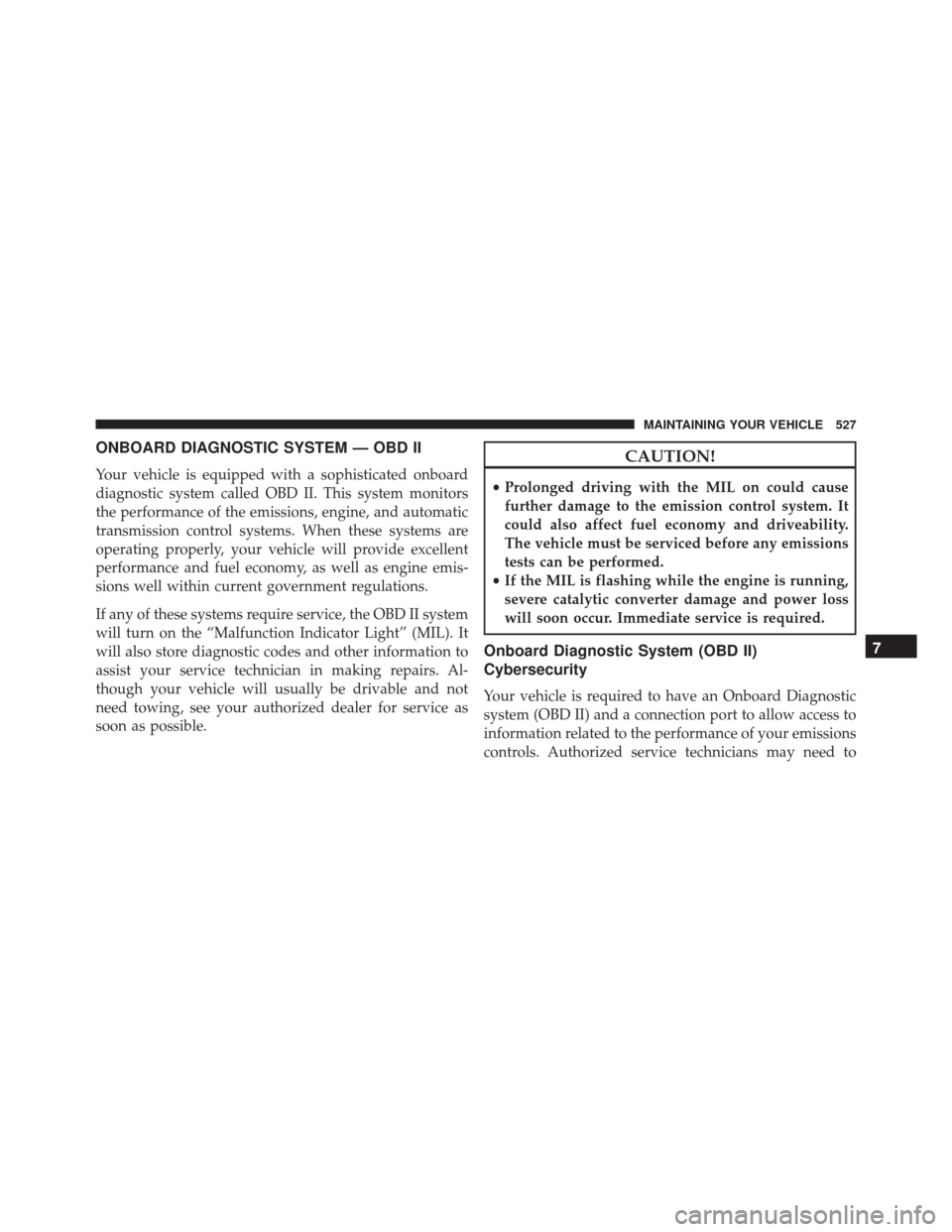
ONBOARD DIAGNOSTIC SYSTEM — OBD II
Your vehicle is equipped with a sophisticated onboard
diagnostic system called OBD II. This system monitors
the performance of the emissions, engine, and automatic
transmission control systems. When these systems are
operating properly, your vehicle will provide excellent
performance and fuel economy, as well as engine emis-
sions well within current government regulations.
If any of these systems require service, the OBD II system
will turn on the “Malfunction Indicator Light” (MIL). It
will also store diagnostic codes and other information to
assist your service technician in making repairs. Al-
though your vehicle will usually be drivable and not
need towing, see your authorized dealer for service as
soon as possible.
CAUTION!
•Prolonged driving with the MIL on could cause
further damage to the emission control system. It
could also affect fuel economy and driveability.
The vehicle must be serviced before any emissions
tests can be performed.
• If the MIL is flashing while the engine is running,
severe catalytic converter damage and power loss
will soon occur. Immediate service is required.
Onboard Diagnostic System (OBD II)
Cybersecurity
Your vehicle is required to have an Onboard Diagnostic
system (OBD II) and a connection port to allow access to
information related to the performance of your emissions
controls. Authorized service technicians may need to
7
MAINTAINING YOUR VEHICLE 527
Page 550 of 651

CAUTION!(Continued)
In the event of engine malfunction, particularly
involving engine misfire or other apparent loss of
performance, have your vehicle serviced promptly.
Continued operation of your vehicle with a severe
malfunction could cause the converter to overheat,
resulting in possible damage to the converter and
vehicle.
Under normal operating conditions, the catalytic con-
verter will not require maintenance. However, it is im-
portant to keep the engine properly tuned to assure
proper catalyst operation and prevent possible catalyst
damage.
NOTE: Intentional tampering with emissions control
systems can result in civil penalties being assessed
against you. In unusual situations involving grossly malfunctioning
engine operation, a scorching odor may suggest severe
and abnormal catalyst overheating. If this occurs, stop
the vehicle, turn off the engine and allow it to cool.
Service, including a tune-up to manufacturer’s specifica-
tions, should be obtained immediately.
To minimize the possibility of catalytic converter dam-
age:
•
Do not shut off the engine or interrupt the ignition,
when the transmission is in gear and the vehicle is in
motion.
• Do not try to start the engine by pushing or towing the
vehicle.
• Do not idle the engine with any spark plug wires
disconnected or removed, such as when diagnostic
testing, or for prolonged periods during very rough
idle or malfunctioning operating conditions.
548 MAINTAINING YOUR VEHICLE