2016 DACIA SANDERO STEPWAY speed
[x] Cancel search: speedPage 67 of 174

ENG_NU_817-10_B90_Dacia_2
On versions with")
JauneNoirNoir texte
2.7
ENG_UD22287_11
Conseils : antipollution, économies de carburant, conduite (B90 - U9\
0 - L90 Ph2 - F90 Ph2 - R90 Ph2 - H79 - Dacia)
ENG_NU_817-10_B90_Dacia_2
On versions with an automatic gear-
box, it is preferable to keep the gear
lever in position D.
–
D
o not try to maintain the same
speed up a hill, accelerate no more
than you would on the level. Keep
your foot in the same position on the
accelerator pedal.
–
Double
declutching and accelerating
before switching off are unnecessary
in modern vehicles.
–
P
oor weather conditions, flooded
roads. Do not drive through water if it
is higher than the lower edge of the
wheel rim.Exhaust gas monitoring
system
The exhaust gas monitoring system de-
tects operating faults in the vehicle’s
antipollution system. These faults may
cause mechanical damage or the re-
lease of harmful substances.
ÄThis warning light on the in-
strument panel will indicate if
there are any faults in the system:
This comes on when the ignition is
switched on and goes out after three
seconds.
–
I
f it comes on continuously, consult
an approved dealer as soon as pos-
sible.
–
If
it flashes, reduce the engine speed
until the light stops flashing. Contact
an approved dealer as soon as pos-
sible.
Driving– Drive carefully for the first few miles until the engine reaches its normal
operating temperature, rather than
let it warm up while the vehicle is sta-
tionary.
ADVICE: antipollution, fuel economy and driving (2/3)
Driving problems
On the driver ’s side, only
use mats specially adapted
for the vehicle and attached
to prefitted devices. Check regularly
to make sure they are secure. Do
not overlay several mats.
Risk of pedals jamming .
– Speed is expensive.
–
Sporty
driving uses a lot of fuel: drive
with a light right foot.
–
Study
the road ahead so that you are
able to brake as little as possible, it
can be sufficient just to lift off the ac-
celerator.
–
A
void sudden acceleration.
–
Do
not overrev the engine in the in-
termediate gears. Always use the
highest gear possible without labour-
ing the engine.
Page 74 of 174

automatic gearbox (use) ....................... (up to the end of the DU)
changing gear ....................................... (up to the end of the DU)
driving ................................................... (up to the end of the DU)
automatic gearbox selector lever.......... (up to the end of the DU)
2.14
ENG_UD22554_10
Boîte automatique (B90 - L90 Ph2 - F90 Ph2 - R90 Ph2 - Dacia)
ENG_NU_817-10_B90_Dacia_2
Jaune NoirNoir texte
Automatic gearbox
Selector lever 1
P: park
R: reverse
N: neutral
D: automatic mode
3:
d
isplays gear engaged in manual
mode.
Operation
With the gear lever in position P or N,
switch on the ignition.
With your foot on the brake pedal, move
the lever out of position P.
Only engage D or R when the vehi-
cle is stopped, with your foot on the
brake and the accelerator pedal re-
leased.
You must apply the brake before
pressing the unlocking button
2 t
o
move out of position P.
AUTOMATIC TRANSMISSION (1/3)
2
1
Driving in automatic mode
Move lever 1 to position D.
In the majority of traffic conditions, you
will not have to touch the gear selector
lever again: the gear will be changed
automatically at the right time and at
the most suitable engine speed be-
cause the automatic system takes into
account the vehicle load and road con-
tour and adjusts itself to the particular
driving style you have chosen.
Economical driving
When driving, leave the lever in posi-
tion D, keeping the accelerator pedal
lightly depressed to ensure automatic
gear changes at comparatively low
engine speeds.
Accelerating and overtaking
Depress the accelerator pedal firmly
and fully (so that it goes beyond the
kickdown point).
This will enable you to change down
to the optimum gear within the
engine range.
3
For safety reasons, do not
switch off the ignition before
the vehicle has come to a
complete standstill.
Page 82 of 174

heating system ..................................... (up to the end of the DU)
ventilation ............................................. (up to the end of the DU)
3.6
ENG_UD25103_1
air conditionné manuel (B90 - L90 Ph2 - Dacia)
ENG_NU_817-10_B90_Dacia_3
Jaune NoirNoir texte
Manual air conditioning
MANuAL AIR CONDITIONING (1/3)
Distribution of air in the
passenger compartment
Turn control A.
WClose the dashboard vents
for more effective demisting.
All the air is then directed to the wind-
screen and front side window demister
outlets.
iThe air flow is distributed be-
tween all the air vents, the
front side window demisting vents, the
windscreen demisting vents and the
footwells.
FThe air flow is directed mainly
towards the footwells.
Controls
A Adjusting the distribution of air in the
passenger compartment.
B
A
ir conditioning button (depending
on vehicle).
C
Adjusting the ventilation speed.
D
A
ir recirculation and isolation of the
passenger compartment.
E
H
eated rear screen and demister
and heated door mirror button (de-
pending on vehicle).
F
Adjusting the air temperature. Information and advice for use:
Please
see the information on “Air con-
ditioning: information and advice on
use”.
FABCDE
Page 83 of 174

demistingrear screen ....................................................... (current page)
rear screen demisting ......................................................... (current page)
Jaune NoirNoir texte
3.7
ENG_UD25103_1
air conditionné manuel (B90 - L90 Ph2 - Dacia)
ENG_NU_817-10_B90_Dacia_3
MANuAL AIR CONDITIONING (2/3)
GThe air flow is directed towards
the dashboard vents and the
footwells.
JAll the air flow is directed to the
dashboard vents.
This selection is not appropriate if all
the air vents are closed.
Rear screen de-icing/
demisting
W i t h t h e e n g i n e r u n n i n g , p r e s s
button E , the operating warning light for
the button will come on.
This function permits rapid demisting/
de-icing of the rear screen and de-icing
of the door mirrors (on equipped vehi-
cles).
To exit this function, press button
E
again.
Demisting automatically stops by de-
fault.
yAdjusting the
ventilation speed
Turn control C from 0 to 4.
T he passenger compartment is ven-
tilated by blown air. The blower deter-
mines how much air enters but vehicle
speed has a slight effect on this.
The further the control is positioned to
the right, the greater the amount of air
blown into the passenger compartment.
EC
Page 109 of 174
tyre pressures ....................................... (up to the end of the DU)
tyres ...................................................... (up to the end of the DU)
tyre pressure......................................... (up to the end of the DU)
4.11
ENG_UD19741_9
Pressions de gonflage des pneumatiques à froid (B90 - U90 - L90 Ph2 \
- F90 Ph2 - R90 Ph2 - Dacia)
ENG_NU_817-10_B90_Dacia_4
Tyre pressures
TyRE PRESSURE
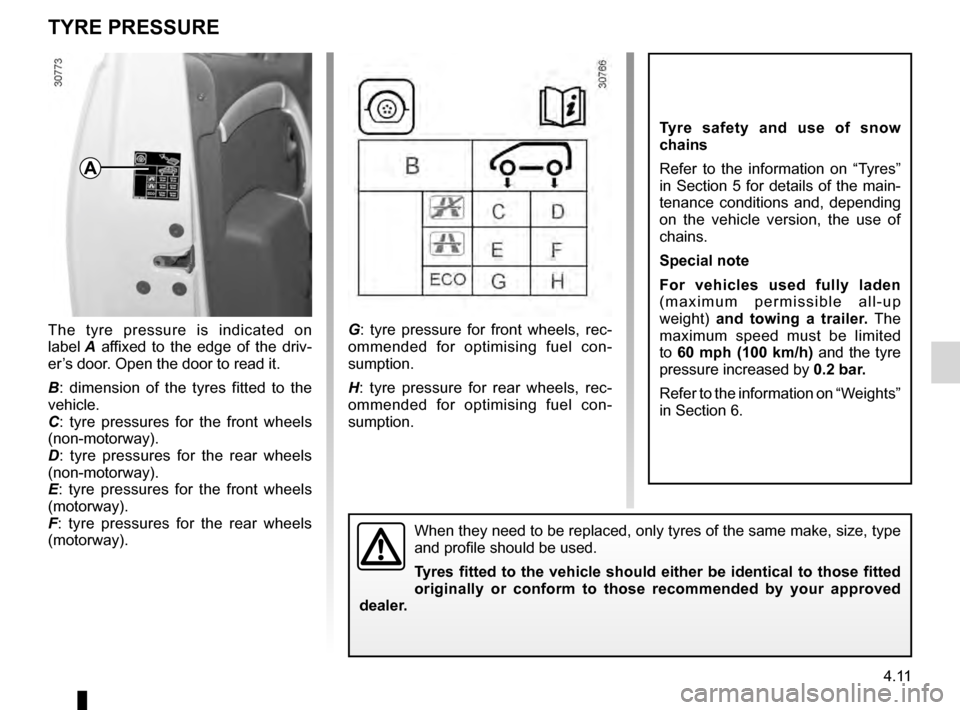
The tyre pressure is indicated on
label A
affixed to the edge of the driv-
er’s door. Open the door to read it.
B : dimension of the tyres fitted to the
vehicle.
C : tyre pressures for the front wheels
(non-motorway).
D : tyre pressures for the rear wheels
(non-motorway).
E : tyre pressures for the front wheels
(motorway).
F : tyre pressures for the rear wheels
(motorway). G
: tyre pressure for front wheels, rec-
ommended for optimising fuel con-
sumption.
H : tyre pressure for rear wheels, rec-
ommended for optimising fuel con-
sumption.
Tyre safety and use of snow
chains
Refer to the information on “Tyres”
in Section 5 for details of the main-
tenance conditions and, depending
on the vehicle version, the use of
chains.
Special note
For vehicles used fully laden
( m a x i m u m p e r m i s s i b l e a l l - u p
weight) and towing a trailer. The
maximum speed must be limited
to 60 mph (100 km/h) and the tyre
pressure increased by 0.2 bar.
Refer to the information on “Weights”
in Section 6.
When they need to be replaced, only tyres of the same make, size, type
and profile should be used.
Tyres fitted to the vehicle should either be identical to those fitted
originally or conform to those recommended by your approved
dealer.
A
Page 117 of 174

practical advice ..................................... (up to the end of the DU)
puncture................................................ (up to the end of the DU)
emergency spare wheel ....................... (up to the end of the DU)
lifting the vehicle changing a wheel ............................ (up to the end of the DU)
5.3
ENG_UD25179_5
Crevaison (B90 - Dacia)
ENG_NU_817-10_B90_Dacia_5
Puncture
PUNCTURE
Emergency spare wheel
This is stored in cage 3 under the floor
at the rear of the vehicle.
T
o access it:
–
Open the tailgate.
–
U
ndo nut
1
with the wheelbrace
found in the luggage compartment;
refer to the information on “Tools” in
this section;
–
Detach the cage using handle
2
.
–
R
emove the emergency spare
wheel
4
.
1
324
In the event of a puncture,
depending on the vehicle,
you will have:An emergency spare wheel or tyre in-
flation kit (refer to the information on the
following pages).
If the emergency spare wheel has been stored for several years, have it checked by your Dealer to ensure that it is
safe to use.
Vehicles fitted with an emergency spare wheel which is different to the f\
our other wheels:
–
Never fit more than one emergency spare wheel to the same v
ehicle.
–
Repla
ce the emergency spare wheel as soon as possible with a wheel identical to the original one.
–
When
this is fitted to the vehicle, which must only be a temporary measure, the driving speed must not exceed the speed
indicated on the label on the wheel.
–
Fitting
an emergency spare wheel may alter the way the vehicle usually runs. Avoid sudden acceleration or deceleration and
reduce your speed when cornering.
–
If
you need to use snow chains, fit the emergency spare wheel to the rear axle and check the tyre pressure.
Page 120 of 174

ENG_NU_817-10_B90_Dacia_5
TYRE INFLATION KIT (3/3)
Once the tyre is inflated correctly:
–
stop usin")
5.6
ENG_UD22290_8
Kit de gonflage des pneumatiques (B90 - L90 Ph2 - F90 Ph2 - R90 Ph2 - D\
acia)
ENG_NU_817-10_B90_Dacia_5
TYRE INFLATION KIT (3/3)
Once the tyre is inflated correctly:
–
stop using the kit;
–
close
the integrated cap on the bottle
again;
–
disconnect adapter
8;–
a
ff i x d r i v i n g r e c o m m e n d a t i o n
label
1
0
to the dashboard where it
can easily be seen by the driver;
–
store the kit;
–
after
the first inflation procedure the
tyre will still be leaking; it is vital to
drive in order to plug the hole;
–
s
tart immediately and drive at be-
tween 12 and 36
m
ph (20 and
60
k
m/h) to distribute the product
evenly throughout the tyre, stopping
after a distance of 2 miles (3 kilome-
tres) to check the pressure; –
i
f the pressure is above 1.3 bar but
lower than the recommended pres-
sure, readjust it (refer to the label
affixed to the edge of the driver ’s
door), otherwise contact an ap-
proved dealer: repair is not possible.
Note : after using the inflation kit, you
should visit an approved dealer to re-
place the inflation hose and the bottle
of repair product.
Precautions when using the
kit
The kit should not be operated for more
than 15 consecutive minutes.
Important: a missing or
loose valve cap may com-
promise the tyre seal and
cause a loss of pressure.
Always use valve caps which are
identical to the originals and fully
tightened.
Following repair with the kit,
do not travel further than
120 miles (200 km). In addi-
tion, reduce your speed and
under no circumstances exceed 48
mph (80 km/h). The sticker, which
you must affix in a prominent posi-
tion on the dashboard, reminds you
of this.
Depending on the country or local
legislation, a tyre repaired with the
tyre pressure kit will need to be re-
placed.
Nothing should be placed
around the driver ’s feet
as such objects may slide
under the pedals during
sudden braking manoeuvres and
obstruct their use.
8
10
Page 126 of 174

tyre pressure.......................................................... (current page)
5.12
ENG_UD19769_10
Pneumatiques (B90 - U90 - L90 Ph2 - F90 Ph2 - R90 Ph2 - Dacia)ENG_NU_817-10_B90_Dacia_5
Jaune NoirNoir texte
Changing wheels around
This practice is not recommended.
Emergency spare wheel
Refer to the information on the
“ E m e r g e n c y s p a r e w h e e l ” a n d
“Changing a wheel” in Section 5.
Fitting new tyres
TYRES (2/3)
Tyre pressures
Adhere to the tyre pressures (including
the emergency spare wheel). The tyre
pressures should be checked at least
once a month and additionally before
any long journey (refer to the label af-
fixed to the edge of the driver’s door).
Incorrect tyre pressures
lead to abnormal tyre wear
and unusually hot running.
These are factors which
may seriously affect safety and lead
to:
–
poor roadholding;
–
r
isk of blowouts or throwing a
tread.
The tyre pressure depends on the
load and speed of use; adjust the
pressures according to the condi-
tions of use (refer to the information
on “Tyre pressures” in Section 4).
Pressures should be checked when the
tyres are cold; ignore higher pressures
which may be reached in hot weather
or following a fast journey.
If tyre pressures cannot be checked
when the tyres are cold, assume an in-
crease of 0.2 to 0.3 bar.
Never deflate a hot tyre.
Special note
Depending on the vehicle, there may
be an adapter which needs to be posi-
tioned on the valve before air is added.
For safety reasons, this op-
eration must be carried out
by a specialist.
Fitting different tyres may
change your vehicle as follows:
–
it
may mean that your vehicle no
longer conforms to current regu-
lations;
–
It
may change the way it handles
when cornering;
–
I
t may cause the steering to be
heavy;
–
i
t may affect the use of snow
chains.
Important: a missing or
loose valve cap may com-
promise the tyre seal and
cause a loss of pressure.
Always use valve caps which are
identical to the originals.