2016 Citroen JUMPY Citroen jumpy
[x] Cancel search: Citroen jumpyPage 325 of 595

323
Jumpy _en_Chap08_En-cas-de-panne_ed01-2016
For optimum service life of the battery, it is
essential to maintain an adequate state of
charge.
In some circumstances it may be necessary to
charge the battery:
-
i
f you use your vehicle essentially for short
journeys,
-
i
f the vehicle is to be taken off the road for
several weeks.
Contact a CITROËN dealer or a qualified
workshop.
Charging the battery using
a battery charger
F Switch off the ignition.
F S witch off all electrical consumers (audio
system, lighting, wipers, ...).
If you envisage charging your vehicle's
battery yourself, use only a charger
compatible with lead-acid batteries of a
nominal voltage of 12 V. Follow the instructions for use provided
by the manufacturer of the charger.
Never reverse polarities.
Never try to charge a frozen battery.
If the battery has been frozen, have
it checked by a CITROËN dealer or a
qualified workshop, who will check that
the internal components have not been
damaged and the casing is not cracked,
which could cause a leak of toxic and
corrosive acid.
If this label is present, it is essential
to use only a 12 V charger, to avoid
causing irreversible damage to the
electrical components related to the
Stop & Start system. It is not necessary to disconnect the
battery.
F
S
witch off the charger B before connecting
the cables to the battery, so as to avoid any
dangerous sparks.
F
E
nsure that the charger cables are in good
condition.
F
R
aise the plastic cover, if your vehicle has
one, on the (+) terminal. F
C
onnect the charger B cables as follows:
-
t
he positive (+) red cable to the (+)
terminal of the battery A ,
-
t
he negative (-) black cable to the earth
point C on the vehicle.
F
A
t the end of the charging operation, switch
off the charger B before disconnecting the
cables from the battery A .
8
In the event of a breakdown
Page 326 of 595
324
Jumpy _en_Chap08_En-cas-de-panne_ed01-2016
Do not force the lever as locking will
not be possible if the clamp is not
positioned correctly; start the procedure
again.
Disconnecting the battery
In order to maintain an adequate state
of charge for starting the engine, it is
recommended that the battery be disconnected
if the vehicle is taken out of service for a long
period.
Wait 2 minutes after switching off the ignition
before disconnecting the battery.
F
c
lose the windows and the doors before
disconnecting the battery,
F
s
witch off all electrical consumers
(audio system, wipers, lighting, ...),
F
s
witch off the ignition and wait for
four
m
inutes.
Having exposed the battery, it is only
necessary to disconnect the (+) terminal.
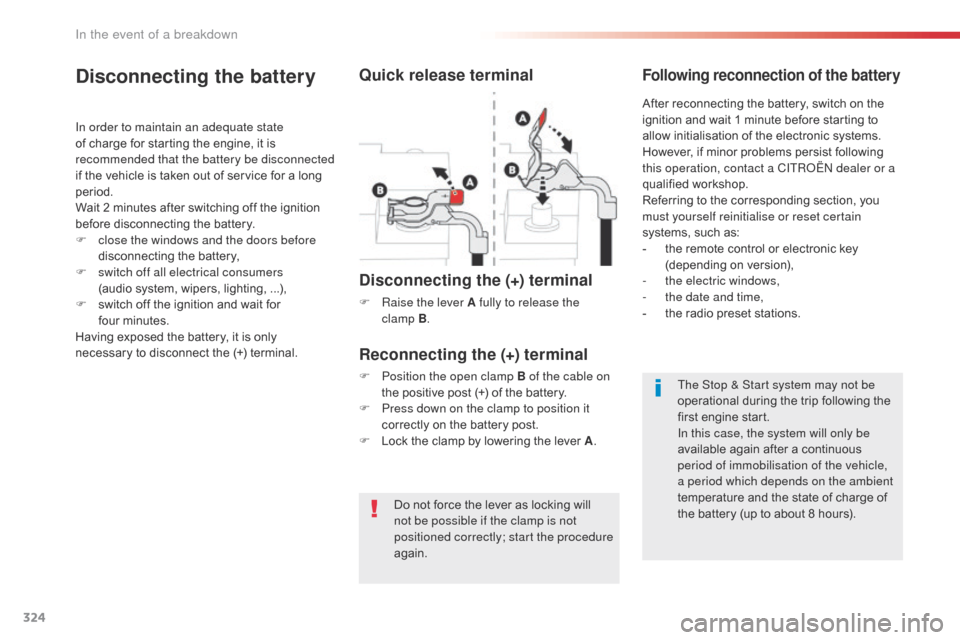
Quick release terminal
Disconnecting the (+) terminal
F Raise the lever A fully to release the clamp B.
Following reconnection of the battery
Reconnecting the (+) terminal
F Position the open clamp B of the cable on
the positive post (+) of the battery.
F
P
ress down on the clamp to position it
correctly on the battery post.
F
L
ock the clamp by lowering the lever A .After reconnecting the battery, switch on the
ignition and wait 1 minute before starting to
allow initialisation of the electronic systems.
However, if minor problems persist following
this operation, contact a CITROËN dealer or a
qualified workshop.
Referring to the corresponding section, you
must yourself reinitialise or reset certain
systems, such as:
-
t
he remote control or electronic key
(depending on version),
-
t
he electric windows,
-
t
he date and time,
-
t
he radio preset stations.
The Stop & Start system may not be
operational during the trip following the
first engine start.
In this case, the system will only be
available again after a continuous
period of immobilisation of the vehicle,
a period which depends on the ambient
temperature and the state of charge of
the battery (up to about 8 hours).
In the event of a breakdown
Page 334 of 595

332
Jumpy _en_Chap09_caracteristiques-techniques_ed01-2016
Engines
Engine characteristics
The engine characteristics (capacity,
maximum power, maximum power speed, fuel,
CO
2 emissions...) for your vehicle are given in
t
he registration document, as well as in sales
brochures.
These characteristics correspond to the
values type-approved on a test bed, under
conditions defined in European legislation
(Directive
1
999/99/EC).
For more information, contact a CITROËN
dealer or a qualified workshop.
Weights
The kerb weight is equal to the unladen
weight + driver (75 kg).
The GTW and towed load values indicated
apply up to a maximum altitude of
1
000 metres; the towed load mentioned
must be reduced by 10 % for every additional
1
000 metres.
The weight of the braked trailer can be
increased, within the GTW limit, on condition
that the GV W of the towing vehicle is reduced
by the same amount.
The recommended nose weight is the vertical
load on the towbar ball (removable with or
without tools). High ambient temperatures may result
in a reduction in the per formance of
the vehicle to protect the engine; when
the ambient temperature is higher than
37
°C, limit the towed weight.
If the ambient temperature is high, it
is recommended that the engine be
allowed to idle for 1 to 2 minutes after
the vehicle comes to a stop, to facilitate
its cooling. Towing with a lightly loaded vehicle can
adversely affect roadholding.
Braking distances are increased when
towing a trailer.
Never exceed 60 mph (100 km/h) when
towing (comply with the legislation in
force in your country).
GV W:
g
ross vehicle weight, the maximum
authorised vehicle weight.
GT W:
g
ross train weight, the maximum
authorised weight of vehicle plus trailer.
Weights and towed
loads
The maximum weights and towed loads for your
vehicle are given are given in the registration
document, as well as in sales brochures.
These values are also present on the
manufacturer's plate or label.
For more information, contact a CITROËN
dealer or a qualified workshop.
Technical data
Page 340 of 595
338
Jumpy_en_Chap10a_BTA_ed01-2016
Emergency or assistance call
If an impact is detected by the airbag
control unit, and independently of
the deployment of any airbags, an
emergency call is made automatically.
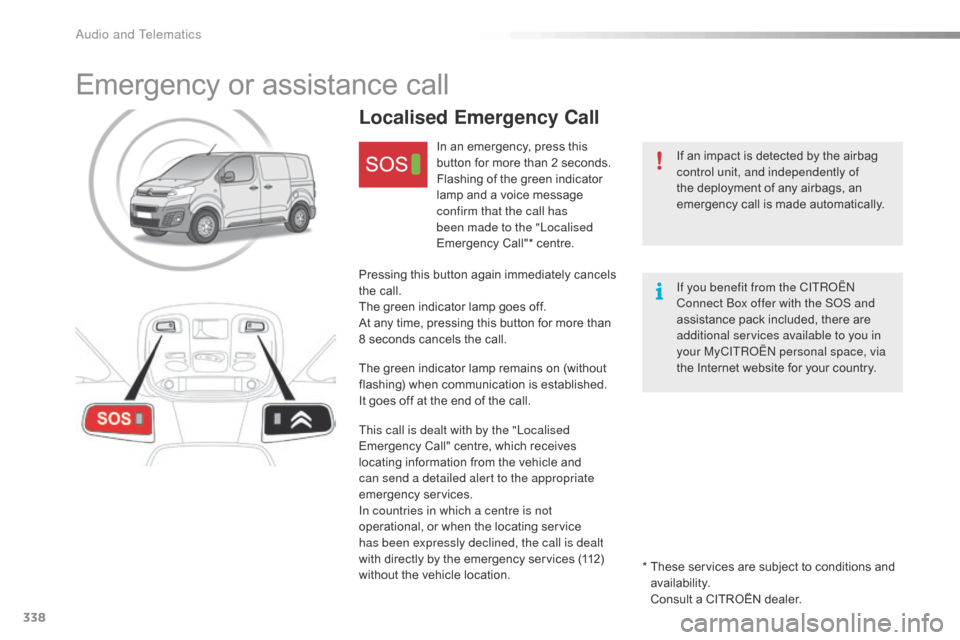
Localised Emergency Call
In an emergency, press this
button for more than 2 seconds.
Flashing of the green indicator
lamp and a voice message
confirm that the call has
been made to the "Localised
Emergency Call"* centre.
Pressing this button again immediately cancels
the call.
The green indicator lamp goes off.
At any time, pressing this button for more than
8 seconds cancels the call.
The green indicator lamp remains on (without
flashing) when communication is established.
It goes off at the end of the call.
This call is dealt with by the "Localised
Emergency Call" centre, which receives
locating information from the vehicle and
can send a detailed alert to the appropriate
emergency services.
In countries in which a centre is not
operational, or when the locating service
has been expressly declined, the call is dealt
with directly by the emergency services (112)
without the vehicle location. *
T
hese services are subject to conditions and
availability.
C
onsult a CITROËN dealer.If you benefit from the C
ITROËN
C
onnect Box offer with the SOS and
assistance pack included, there are
additional services available to you in
your MyCITROËN personal space, via
the Internet website for your country.
Audio and Telematics
Page 341 of 595
339
Jumpy_en_Chap10a_BTA_ed01-2016
Localised Assistance Call
If you purchased your vehicle outside
the CITROËN dealer network, we
invite you to have a dealer check the
configuration of these services and, if
desired, modified to suit your wishes.
In a multi-lingual country, configuration
is possible in the official national
language of your choice.
For technical reasons, particularly
to improve the quality of Telematic
services to customers, the
manufacturer reserves the right to
carry out updates to the vehicle's on-
board telematic system.
The fault with the system does not
prevent the vehicle being driven. Press this button for more than
2 seconds to request assistance
if the vehicle breaks down.
A voice message confirms that
the call has been started*.
Pressing this button again immediately cancels
the request.
The cancellation is confirmed by a voice
message.
Geo-location
You can deactivate geo-location by
simultaneously pressing the "Localised
Emergency Call" and "Localised Assistance
Call" buttons, followed by a press on "Localised
Assistance Call" to confirm.
To reactivate geo-location, simultaneously
press the "Localised Emergency Call" and
"Localised Assistance Call" buttons again,
followed by a press on "Localised Assistance
Call" to confirm.
The orange indicator lamp is on fixed: the back-
up battery should be replaced.
In both cases, the emergency and assistance
calls service may not work.
Contact a qualified repairer as soon as
possible.
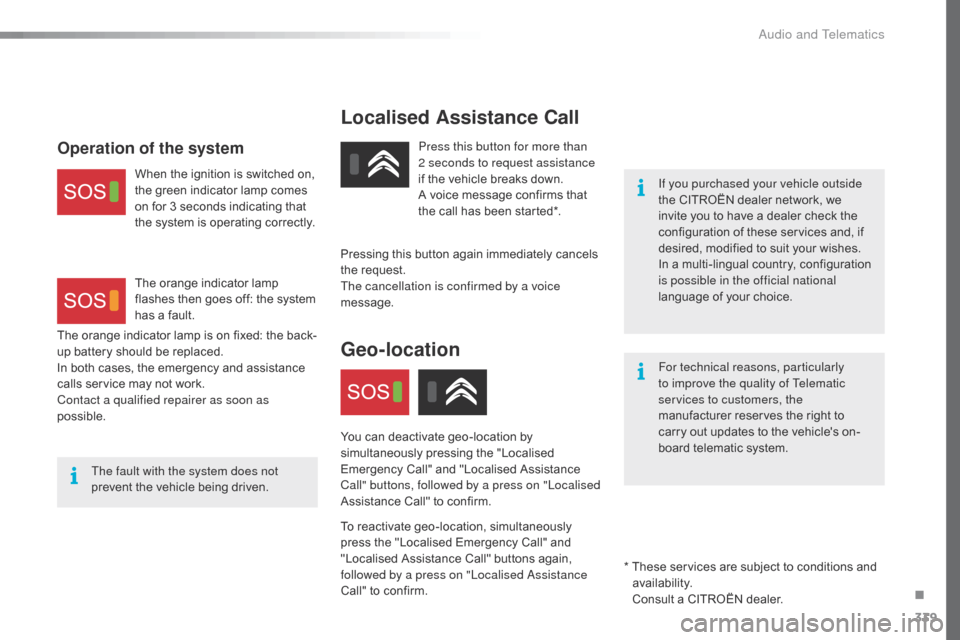
Operation of the system
When the ignition is switched on,
the green indicator lamp comes
on for 3 seconds indicating that
the system is operating correctly.
The orange indicator lamp
flashes then goes off: the system
has a fault.
*
T
hese services are subject to conditions and
availability.
Consult a CITROËN dealer.
.
Audio and Telematics
Page 343 of 595
341
Jumpy_en_Chap10b_NAC-1_ed01-2016
CITROËN Connect Nav
GPS satellite navigation - Connectivity - Multimedia audio - Bluetooth® telephone
Contents
First steps
3 42
Steering mounted controls
3
44
Menus
3
45
Voice commands
3
46
Navigation
3
52
Connected navigation
3
68
Connectivity
3
78
Radio Media
3
88
Telephone
400
Settings
4
12
Frequently asked questions
4
22
The system is protected in such a way that it will only operate in
your vehicle.
The link below gives access to OSS (Open Source Software)
codes for the system.
http://www.psa-peugeot-citroen.com/oss As a safety measure and because it requires sustained attention
by the driver, the pairing of a Bluetooth mobile telephone with
the Bluetooth hands-free system of your audio system must be
done with the vehicle stationary
and the ignition on.
The display of the energy economy mode message signals that
a change to standby is imminent. For more information on the
Energy economy mode refer to the corresponding section.
.
Audio and Telematics
Page 431 of 595

429
Jumpy_en_Chap10c_RCC-1_ed01-2016
CITROËN Connect Radio
Connectivity - Multimedia audio - Bluetooth® telephone
Contents
First steps
4 30
Steering mounted controls
4
32
Menus
4
33
Connectivity
4
34
Radio Media
4
44
Telephone
4
56
Settings
4
68
Frequently asked questions
4
78
The system is protected in such a way that it will only operate in
your vehicle.
The link below gives access to OSS (Open Source Software)
codes for the system.
http://www.psa-peugeot-citroen.com/oss As a safety measure and because it requires sustained attention
by the driver, the pairing of a Bluetooth mobile telephone with
the Bluetooth hands-free system of your audio system must be
done with the vehicle stationary
and the ignition on.
The display of the energy economy mode message signals that
a change to standby is imminent. For more information on the
Energy economy mode refer to the corresponding section.
.
Audio and Telematics
Page 509 of 595
507
Jumpy_en_Chap11_index-alpha_ed01-2016
Checks .......................................... 277, 281, 282
Checks, routine ..................................... 2 81, 282
Child lock
...............................
................19 4, 195
Child lock, electric
...............................
..........19 4
Child lock on rear windows
...........................19
5
Children
...............................
.. 182, 187, 188, 190
Children (safety)
...............................
.............19 4
Child seats
.....1
69, 174-176, 180 -182, 184, 193
Child seats, conventional
.............. 18
0 -182, 18 4
Child seats, ISOFIX
...................... 1
87, 188, 190
C
ITROËN
C
onnect Box
...............................33
8
CITROËN Connect Nav
................................ 3
41
CITROËN Connect Radio
............................. 42
9
C
ITROËN
L
ocalised
Emergency Call
.......................................... 33
8
Closing the boot
...............................
...............94
Closing the doors
... 5
9, 64, 74, 75, 77, 82, 91, 93
Collision risk alert
................... 2
3, 243 -245, 247
Compressor, tyre inflation
............................ 29
0
Connection, Bluetooth
................. 3
80, 406 - 408,
436, 462- 464, 498
Connection, MirrorLink
........ 3
82, 384, 438, 440
Connection, Wi-Fi network
................... 3
81, 437
Connectivity
...............................
...........378, 434
Control, emergency boot release
...................94
C
ontrol, emergency door
..........................
53, 68
Control, heated seats
............................ 10
3, 105
Control stalk, lighting
..............................3
0, 146
Control stalk, wipers
.............................15
6, 157
Courtesy lamp
...............................
................312
Courtesy lamp, front
..............1
41, 142, 312, 315
Courtesy lamp, rear
...............1
41, 142, 312, 315
Courtesy lamps
......................1
41, 142, 312, 315
Cover, load space
......................................... 12
3
Crew cab, fixed
...............................
..............117
Cruise control
................2
24, 227, 232, 233, 237
Cruise control, adaptive
........................ 2
27, 236
Cruise control by speed limit recognition
.......................................... 2
27 Fatigue detection
..............................
.... 250, 251
Filling the fuel tank
................................2
65, 267
Filter, air
...............
.........................................281
Filter, oil
......................................................... 2
81
Filter, particle
........................................2
80, 281
Filter, passenger compartment
..................... 2
81
Finisher
..............................
...........................302
Fitting a wheel
...............................
................299
Fitting roof bars
.............................................2
73
Fittings, interior
..................................... 12
0, 123
Fittings, rear
...............................
...................123
Fitting the mat
...............................................11
9
D
F
E
DAB (Digital Audio Broadcasting) - Digital radio ............... .... 396, 397, 452, 453, 490, 491
Date (setting)
...............................
....46, 420, 476
Daytime running lamps
......... 1
46, 149, 304-306
Deactivating the passenger
airbag
.................................................. 17
1, 17 7
Deactivation of DSC (ESC)
...........................16
3
Deadlocking
...............................
......... 51, 58, 65
Defrosting
...............................
............... 132, 144
Demisting
...............................
.......................132
Demisting, rear
...................................... 13
3, 13 4
Demisting, rear screen
......................... 13
3, 13 4
Diagnostic system, engine
..............................21
D
ial
........
.................................................... 15, 16
Dials and gauges
............................................ 14
D
imensions
..............................
.............328-330
Dipstick
................
....................................34, 278
Direction indicators
...................... 1
48, 304, 307,
308, 310, 313, 315
Display, head-up
........................................... 2
22
Display screen, instrument panel
................................................1
4-16, 208
Door pockets
................................................. 12
0
Doors
..............................................................
.74
Doors, rear
...............................
.......................91
Doors, side-hinged
........6
4, 65, 91-93, 310, 311
Driver's door open warning
.............................75
D
river’s fatigue warning
........................ 2
50, 251
Driving abroad ............................................... 148
Driving economically ....................................... 12
Driving time warning
............................. 2
50, 251
DSC
............................................................... 16
1
Dynamic stability control (DSC)
.................................... 2
5, 161, 163, 164EBA .............................................................
..161
EBFD ...............................
..............................161
Eco-driving (advice)
........................................ 12
E
conomy mode
...............................
..............270
Electric windows
............................................. 98
E
lectronic brake force distribution
(EBFD)
...............................
.........................161
Emergency call
.....................................1
60, 338
Emergency warning lamps
...................1
60, 287
Emissions control system, SCR
.....................2
7
Energy economy mode
.................................2
70
Engine compartment
.................................... 2
77
Engine,
Diesel
............ 2
1, 267, 277, 327, 333, 335, 336
Environment
...............................
.12, 54, 70, 139
ESC/ASR
...............................
........................161
ESC (electronic stability control)
....................25
ES
C system
.....................................................25
.
Alphabetical index