Page 128 of 500
DS5_en_Chap04_conduite_ed02-2015
Head-up display
System which projects information onto a
transparent blade in the driver's field of vision so
that they do not have to take their eyes off the road.
This system operates when the engine is running
and the settings are stored when the ignition is
switched off.
1. Head-up display On / Off.
2. Di splay height adjustment.
3.
Bri
ghtness adjustment. Once the system has been activated, the
information projected in the head-up display is:
A.
Th
e speed of your vehicle.
B.
Cr
uise control/speed limiter information.
c. Na
vigation information (depending on
ve r s i o n).
displays during operation
For more information on the navigation
system, refer to the "Audio and
telematics" section.
Page 129 of 500

127
DS5_en_Chap04_conduite_ed02-2015
F With the engine running, press button 1. The
activated/deactivated status when the engine was
switched off is retained when the engine is switched
on again.
The blade retracts automatically 3 seconds after switching
off the engine except in STOP mode of Stop & Start.
Activation / dea ctivation
F With the engine running, adjust the
b
rightness of the information using
button
3 :
- to
wards the rear to increase the
brightness,
-
to
wards the front to decrease the
brightness.
Brightness adjustment
We recommend that adjustments are
only made using these buttons when
the vehicle is stationary.
When stationary or while driving, no
objects should be placed around the
transparent blade (or on its cover) to
avoid blocking deployment of the blade
and preventing its correct operation.
In certain extreme weather conditions
(rain and/or snow, bright sunshine, ...)
the head-up display may not be legible
or may suffer temporary inter ference.
Some sunglasses may hamper reading
of the information.
To clean the transparent blade, use a
clean, soft cloth (such as a spectacles
cloth or microfibre cloth). Do not use
a dry or abrasive cloth or detergent or
solvent products as these could scratch
the blade or damage the anti-reflection
coating.
Height adjustment
F With the engine running, adjust the display
t o the required height using button 2 :
-
to
wards the rear to move the display up,
-
to
wards the front to move the display
down.
driving
Page 152 of 500
DS5_en_Chap05_visibilite_ed02-2015
Manual adjustment of
halogen headlampsAutomatic adjustment of
xenon headlamps
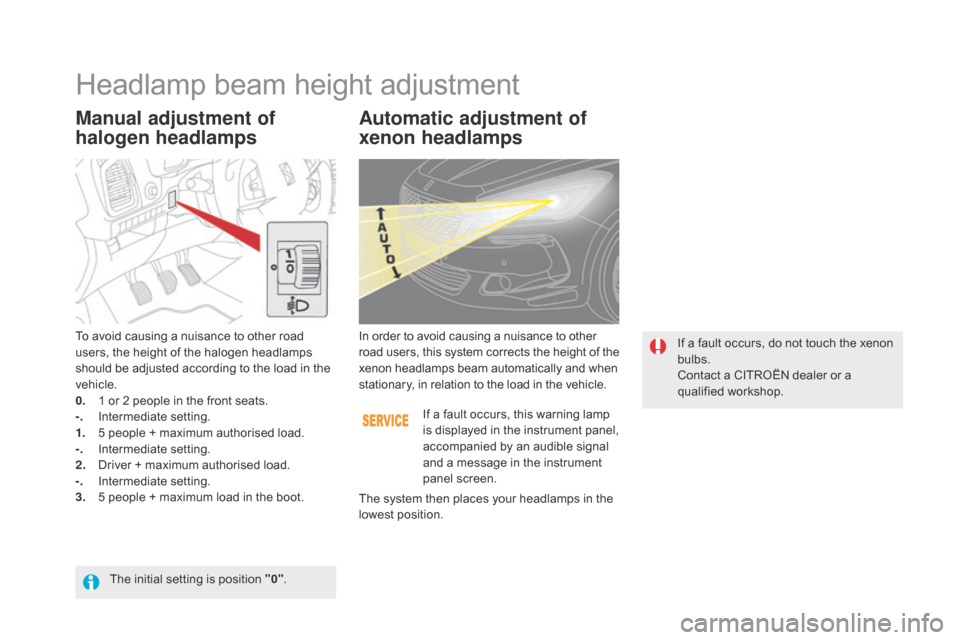
To avoid causing a nuisance to other road
users, the height of the halogen headlamps
should be adjusted according to the load in the
vehicle.
0.
1 or 2 p
eople in the front seats.
-.
In
termediate setting.
1.
5 pe
ople + maximum authorised load.
-.
In
termediate setting.
2.
Dr
iver + maximum authorised load.
-.
In
termediate setting.
3.
5 pe
ople + maximum load in the boot. If a fault occurs, this warning lamp
is displayed in the instrument panel,
accompanied by an audible signal
and a message in the instrument
panel screen.
In order to avoid causing a nuisance to other
road users, this system corrects the height of the
xenon headlamps beam automatically and when
stationary, in relation to the load in the vehicle.
If a fault occurs, do not touch the xenon
bulbs.
Contact a CITROËN dealer or a
qualified workshop.
The system then places your headlamps in the
lowest position.
Headlamp beam height adjustment
The initial setting is position "0" .
Page 171 of 500

169
DS5_en_Chap06_securite-enfants_ed02-2015
Installing child seats attached using
the seat belt
In accordance with European regulations, this table indicates the options for installing child seats secured using a seat belt and universally approved (a)
a ccording to the weight of the child and the seating position in the vehicle:
Weight of the child and indicative age
Seat Under 13 kg
(groups 0 (b) and 0+)
Up to approx 1 year From 9 to 18 kg
(group 1)
1 to 3 years approx From 15 to 25 kg
(group 2)
3 to 6 years approx From 22 to 36 kg
(group 3)
6 to 10 years approx
Front passenger seat (c) with
height adjustment U (R)
U (R)U (R)U (R)
Outer rear seats (d) UUUU
Centre rear seat XXXX
(a) Universal child seat: child seat that can be installed in all vehicles using a seat belt.
(b)
Gr
oup 0, from birth to 10 kg. Shells seats and baby carriers cannot be installed in the front
passenger seat.
Wh
en installed in the 2
nd row, they prevent use of the other seats.
(c) Refer to the legislation in force in your country before installing your child on this seat.
(d)
To i
nstall a child seat at the rear, rear ward facing or for ward facing, move the front seat
for wards, then straighten the backrest to allow sufficient space for the child seat and the child's
legs.
U:
se
at suitable for the installation of a child seat secured using a seat belt and universally
approved, rear ward facing and/or for ward facing.
U (R):
sa
me as U , with the passenger seat adjusted to the highest position and as far back as possible.
X: seat position not suitable for installation of a child seat for the weight class indicated. Remove and stow the head restraint
before installing a child seat with a
backrest on a passenger seat. Refit the
head restraint once the child seat has
been removed.
child safety
Page 173 of 500
171
DS5_en_Chap06_securite-enfants_ed02-2015
ISOFIX child seats recommended by CITROËN
CITROËN offers a range of ISOFIX child seats listed and type approved for your vehicle.Refer also to the child seat manufacturer's fitting instructions for information on installing and removing the seat. Baby P2
c M
ini and its ISOFIX base
(size categories:
c, d, E )
Gr
oup 0+: from bir th to 13 kg
Installed rear ward facing using an ISOFIX base which is attached to the anchorage rings A .
The base has a support leg, adjustable for height, which sits on the vehicle's floor. This seat can also be secured with a seat belt. In this case only the seat shell is used.
child safety
Page 174 of 500
DS5_en_Chap06_securite-enfants_ed02-2015
"RÖMER duo P lus ISOFIX"
(size category B1 )
Group 1: from 9 to 18 kg
Installed only in the for ward facing position.
Attached to the rings A , as well as the ring B, referred to as the TOP TETHER,
using an upper strap.
Three seat body angles: sitting, reclining, lying.
This child seat can also be used on seats which are not fitted with ISOFIX mountings. In this case, it must be attached to the vehicle seat using the three point seat belt.
Baby P2
c M
idi and its ISOFIX base
(size categories:
d, c, A, B
, B1)
Group 1: from 9 to 18 kg
Installed rear ward facing using an ISOFIX base which is attached to the rings A .
The base includes a support leg, adjustable for height, which rests on the vehicle's floor. This child seat can also be used for ward facing.
This child seat can not be secured with a seat belt.
We recommend that it be used rear ward facing up to 3 years.
Page 189 of 500
187
DS5_en_Chap07_securite_ed02-2015
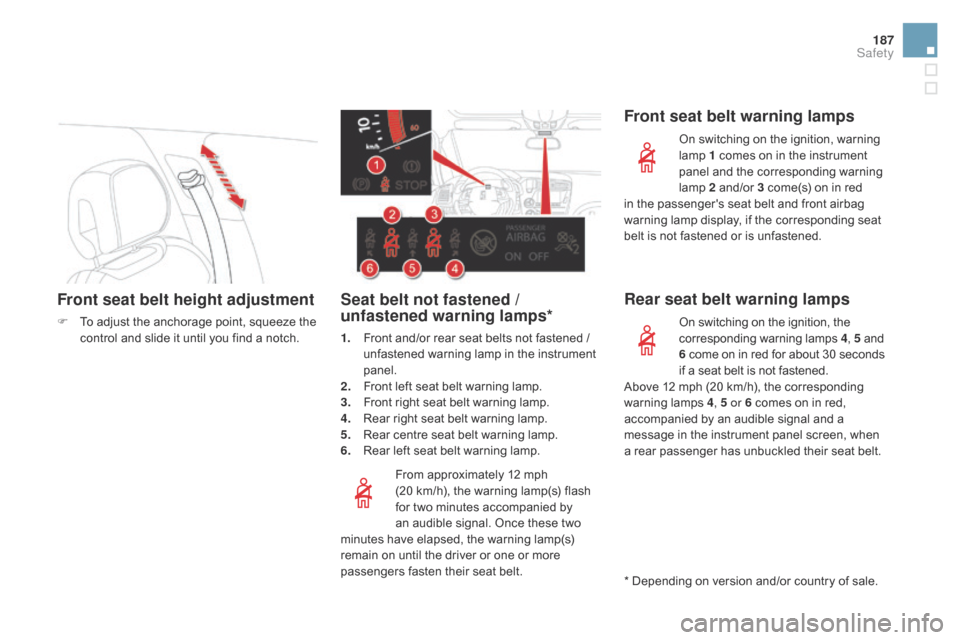
Front seat belt height adjustment
F To adjust the anchorage point, squeeze the
control and slide it until you find a notch.
From approximately 12 mph
(20
k
m/h), the warning lamp(s) flash
for two minutes accompanied by
an audible signal. Once these two
minutes have elapsed, the warning lamp(s)
remain on until the driver or one or more
passengers fasten their seat belt.
Seat belt not fastened /
unfastened warning lamps*
1. Front and/or rear seat belts not fastened /
u nfastened warning lamp in the instrument
panel.
2.
Fr
ont left seat belt warning lamp.
3.
Fr
ont right seat belt warning lamp.
4.
Re
ar right seat belt warning lamp.
5.
Re
ar centre seat belt warning lamp.
6.
Re
ar left seat belt warning lamp.
Front seat belt warning lamps
On switching on the ignition, warning
lamp 1 comes on in the instrument
panel and the corresponding warning
lamp 2 and/or 3 come(s) on in red
in the passenger's seat belt and front airbag
warning lamp display, if the corresponding seat
belt is not fastened or is unfastened.
Rear seat belt warning lamps
On switching on the ignition, the
corresponding warning lamps 4, 5 and
6 come on in red for about 30
s
econds
if a seat belt is not fastened.
Above 12 mph (20 km/h), the corresponding
warning lamps 4, 5 or 6 comes on in red,
accompanied by an audible signal and a
message in the instrument panel screen, when
a rear passenger has unbuckled their seat belt.
* Depending on version and/or country of sale.
Safety
Page 234 of 500
DS5_en_Chap08_info-pratiques_ed02-2015
Fitting roof bars
Maximum authorised load evenly
distributed on the roof bars, for a
loading height not exceeding 40 cm
(with the exception of bicycle carriers):
70 kg.
If the height exceeds 40 cm, adapt the
speed of the vehicle to the profile of the
road to avoid damaging the roof bars
and the fixings on the roof.
When fitting transverse roof bars, take care to
position them correctly:
Use accessories recommended by
CITROËN
o
bserving the manufacturer's
recommendations and fitting
instructions so as to avoid the risk
of damaging the body (deformation,
scratches, ...).
F
Re
move the cap using an allen
TM key.
F Pu
t the bars into position then fit and
tighten the securing screws. Be sure to refer to national legislation in
order to comply with the regulations for
transporting objects which are longer
than the vehicle.


